

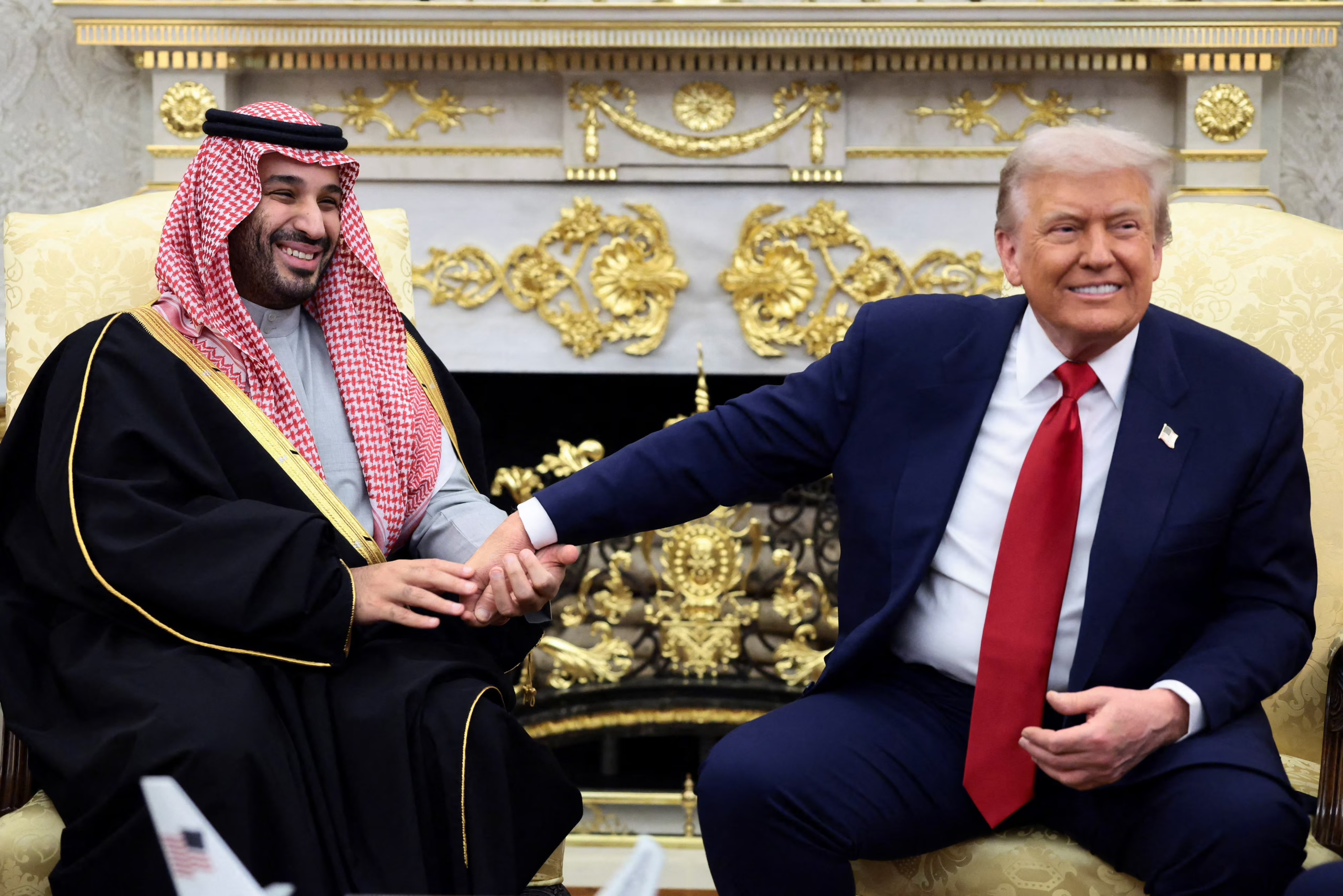
The designation of Saudi Arabia as a “Major Non-NATO Ally” (MNNA) has revived the trajectory of strategic partnership with the United States after years of relative coolness. This move goes beyond protocol it reaffirms Riyadh’s position within the U.S. security architecture at a moment when the Middle East is being reengineered amid the wars in Gaza, Lebanon, Iran, and Yemen, and escalating tensions in the Red Sea.
This classification, legally recognized under U.S. law, allows Washington to extend advanced privileges in arms sales, military training, intelligence cooperation, and defense industry development to friendly countries without including them in NATO’s collective defense system or promising direct military intervention.
It serves as a middle ground between full military alliance and security partnership, providing the U.S. a tool to maintain influence without bearing the burdens of binding military commitments.
The decision comes after Saudi Arabia’s growing sense that the traditional framework of the alliance with Washington no longer offers sufficient deterrence particularly following the 2019 Aramco attacks, suspension of arms deals, and political pressure under the Biden administration.
In response, Riyadh diversified its alliances and strengthened ties with China, bypassing traditional constraints often imposed by Washington.
In turn, the United States is seeking to contain China’s inroads into the Gulf and reposition itself in the region by offering advanced security incentives that can reinforce old alliances and build new ones.
This development is not the birth of a new alliance but a renewal of a historic alignment one that restores Saudi Arabia to a prominent place in the U.S. security network, enabling it to solidify its central role amid shifting regional power dynamics.
The Legal Foundations of MNNA Status
The designation of “Major Non-NATO Ally” was not born out of mere technical considerations. It emerged as a political instrument during the post–Cold War era, allowing the U.S. to reshape its global alliances without triggering NATO’s binding defense commitments.
At its core, MNNA is neither an “alternative membership” nor a “pathway to NATO,” but rather a U.S. legal framework enabling advanced defense cooperation without providing binding security guarantees.
The concept first appeared in the 1987 U.S. law on defense relations with friendly nations. It is conferred by the White House and the Department of Defense in coordination with Congress. Its use expanded in the 1990s as Washington sought to manage conflicts in the Middle East and Asia through a flexible network of alliances that fell short of formal military pacts but offered significant privileges in training, arms access, and defense technology.
Over time, the classification evolved from a legal instrument into a geopolitical tool for tethering friendly nations to the U.S. security order without invoking NATO’s Article 5 obligations.
This separation of “military alliance” from “defense cooperation” has made MNNA particularly suitable in volatile regions, where Washington prefers strategic flexibility over automatic commitments in case of armed conflict.
Crucially, the U.S. retains the right to determine the level of privileges granted under MNNA and to revoke the status if strategic interests shift underscoring its political nature, unlike NATO membership which is governed by binding collective defense rules, voting systems, and shared budgets.
What Does MNNA Status Actually Provide?
While MNNA status does not guarantee direct U.S. military protection, it unlocks a high level of security cooperation unavailable to non-allied states. It grants recipients critical advantages in weapons acquisition, military technology, and strategic positioning making the designation more of a power-balancing mechanism than a symbolic diplomatic label.
Top among its benefits is priority access to advanced American weapons systems, including sensitive technologies, communications networks, and military spare parts. It also allows countries to engage in joint research and development programs with the U.S. Department of Defense and major defense contractors opportunities typically reserved for NATO members or top-tier allies.
Beyond the technical perks, MNNA status facilitates weapons financing through credit programs and guarantees from the U.S. Defense Export Financing Agency, enabling high-cost purchases without immediate payment.
Operationally, it allows the U.S. to pre-position munitions on allied soil, improves intelligence-sharing capabilities, and increases participation in joint military exercises at a level not accessible to non-MNNA states fostering deeper military integration and interoperability in times of crisis.
The designation also carries political weight, signaling American recognition of a country’s regional stature. It broadens diplomatic maneuverability and strengthens negotiating positions with other global powers.
However, these privileges remain contingent on U.S. interests. Cooperation under MNNA is neither mandatory nor consistent it can be revised as administrations change or strategic calculations shift.
Thus, MNNA offers real gains in arms access, technology, and geopolitical standing but without reciprocal obligations on Washington’s part to defend the state if attacked. The relationship rests on a fluid balance of interests, not a binding military pact.
In that sense, MNNA resembles a “functional alliance” granting Washington influence and giving allies substantial privileges without reaching the level of full-fledged defense partnerships governed by formal mutual obligations.
Why Does the U.S. Grant MNNA Status?
Washington does not confer MNNA status as a diplomatic courtesy or a precursor to NATO membership. It is a political tool designed to manage a vast network of military and economic influence without the burdens of NATO’s collective defense commitments.
This classification allows the U.S. to integrate friendly states into its security framework at a high level, while maintaining the flexibility to redefine or limit the relationship whenever American interests dictate without accusations of abandoning binding commitments.
Contrary to political rhetoric, MNNA is rarely about equal partnerships. It is often intended to enhance regional partners’ capacity to serve U.S. strategic goals by containing adversaries or filling security gaps the U.S. prefers to avoid directly.
In this light, MNNA is part of influence management rather than a full alliance. It provides states with weapons, intelligence, and training but not written defense guarantees or automatic protection in case of conflict.
The global spread of MNNA status mirrors Washington’s strategic map. It has been granted to countries like Qatar, Bahrain, Kuwait, Jordan, Egypt, Morocco, Tunisia, and Israel in the Middle East; Pakistan, the Philippines, Thailand, South Korea, New Zealand, and Australia in Asia; and Argentina, Colombia, and Brazil in Latin America.
Most recently, Saudi Arabia joined the list underscoring Washington’s intent to deepen its presence in the Middle East and especially the Gulf.
This global distribution reflects more than just wide-ranging interests; it reveals that the U.S. turns to MNNA when it seeks flexible, scalable alliances not bound by institutional treaties.
The underlying logic is “privilege in exchange for alignment,” rather than “security in exchange for mutual commitment” making MNNA a tool of strategic leverage, not merely a framework for military cooperation.
Geopolitics and the China Factor
Saudi Arabia’s inclusion on the MNNA list is not simply a technical step tied to arms deals or security coordination. It marks a pivotal moment in rebuilding the strategic relationship between Riyadh and Washington after years of drift and growing Saudi dissatisfaction with the traditional alliance model.
That frustration took shape after the 2019 Houthi attack on Aramco facilities, when the Trump administration refrained from military retaliation despite heavy rhetoric about “protecting allies.”
It became clear that Riyadh would no longer settle for being a “traditional ally” passively aligning with U.S. strategic visions without tangible commitments especially amid rising regional tensions and changing conflict dynamics.
The Biden years deepened this trust gap, with arms deals paused and relations reassessed in light of the Jamal Khashoggi case and human rights concerns prompting Riyadh to diversify partnerships.
China stepped in to fill the strategic vacuum with large-scale investments, high-tech cooperation, and infrastructure and energy agreements free from Washington’s typical political conditions.
This allowed Saudi Arabia to act more independently under the banner of “Saudi First,” seeking to shape regional power balances rather than merely react to them.
Granting MNNA status to Saudi Arabia thus serves three primary U.S. goals:
-
Fortifying its Gulf presence and preventing China from converting economic engagement into strategic dominance through the Belt and Road Initiative;
-
Rebuilding a flexible alliance structure that allows the U.S. to remain the dominant power in the Middle East without the cost of direct military deployment aligning with the isolationist trends from the Trump era;
-
Creating a defense and political infrastructure that leverages allies’ demand for advanced weapons systems especially stealth and critical defense technologies to drive U.S. defense industry expansion.
From Riyadh’s perspective, MNNA offers a pathway to strengthen its military and strategic capabilities at a time when the Middle East is being redrawn amid the ongoing conflicts in Gaza, Lebanon, Yemen, and Iran and a shifting balance of power among emerging regional players.
Saudi Arabia aims to position itself as an architect of regional dynamics, not just a participant making advanced military cooperation, including nuclear defense technology and enhanced combat capabilities, essential. This is especially true in today’s hybrid warfare environment, where state actors are increasingly entangled with non-state forces.
In this context, the MNNA designation is not a temporary or transactional move it reinforces a long-standing strategic alignment that has shaped U.S.–Saudi relations for decades, despite recent turbulence.
With this step, the relationship reverts to its foundational structure: a strategic partnership built on deep security interests in the Gulf, even as Riyadh seeks greater autonomy within that alignment.
Thus, MNNA status marks not the creation of a new path, but the restoration of an established one allowing Saudi Arabia to cement its central role in shaping U.S. influence in the region and to expand its competitive edge amid evolving power equations.