

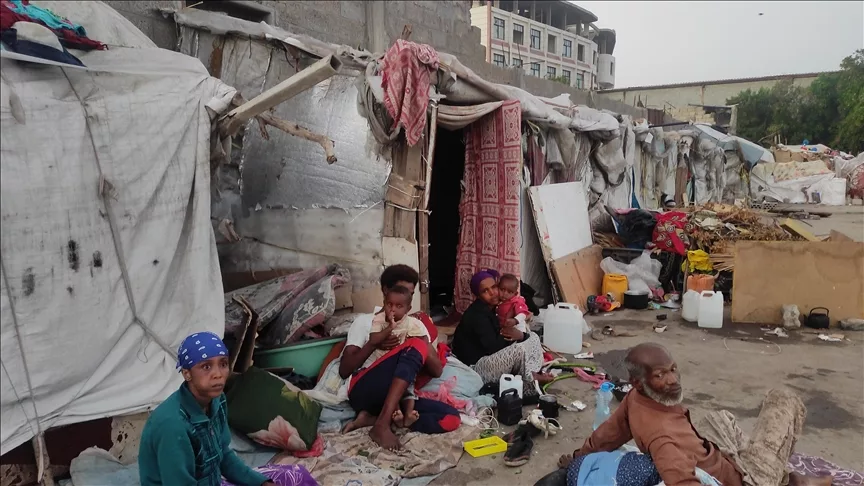
At a time when Yemen is enduring one of the most harrowing humanitarian tragedies in modern history a catastrophe that has claimed the lives of tens of thousands of women and children, pushed more than 17 million people to the brink of slow death from hunger and food insecurity, and displaced millions since 2015 this war-torn nation now finds itself in a paradoxical situation: from a country whose people are bleeding out to one that is increasingly becoming a magnet for waves of irregular migration from the Horn of Africa.
According to estimates, over 26,000 African migrants entered Yemen illegally during just the months of September and October 2025. October alone witnessed the arrival of nearly 18,000 individuals a staggering 99% increase compared to September according to data from the United Nations’ International Organization for Migration (IOM).
This stark contradiction between Yemen’s catastrophic living conditions and the rising number of incoming migrants akin to seeking refuge from fire only to leap into the flames cannot be understood through raw statistics alone.
The issue transcends conventional economic and security dimensions, revealing a deeper, more complex crisis.
These human flows, occurring amid state fragility and institutional erosion, raise serious concerns about a dangerous imbalance threatening Yemen’s stability and future especially amid growing suspicions that hidden forces and agendas may be working to prevent the country from recovering.
Thus, the picture becomes more opaque: a nation in ruins turning into both a transit corridor and possibly a battleground for conflicts and interests that exceed its own suffering, adding unbearable burdens to its already overwhelming pain.
Djibouti: The Starting Point
Ethiopians make up the overwhelming majority of African migrants heading to Yemen approximately 97% of total arrivals. Behind these statistics lie countless human stories shaped by desperation and coercion. Men account for 66% of the migrants, women for 17%, and children among the most vulnerable make up 16% of these perilous journeys.
For many, the journey begins in Djibouti, now a major departure point for roughly 75% of migrants crossing the Gulf of Aden to reach Yemen’s shores. Somali migrants often take a different route toward the beaches of Radhum district.
Regardless of the path taken, all face a common fate: exploitation and extortion by smuggling networks that see in these desperate travelers nothing more than a source of profit, extracting large sums in exchange for passage from one inferno to another.
The year 2019 marked a peak in this exodus, with Yemen receiving more than 120,000 African migrants, according to UN figures. The organization labeled Yemen the largest corridor for mixed migration from East Africa. Despite international alarms, the situation on the ground has only grown more complicated.
From 2015 to 2020 alone, nearly 300,000 African migrants mostly Ethiopians entered Yemen, according to Major General Abdul Karim Al-Marouni, head of the Immigration, Passport, and Nationality Authority.
These migrants arrive via sea or through various entry points, driven by dreams of reaching northern borders and ultimately Gulf countries dreams that may be uncertain but are more appealing than the hopelessness left behind.
Why Yemen?
This jarring contrast between Yemen’s collapse under poverty, hunger, and war and the continuous influx of tens of thousands of African migrants raises urgent humanitarian questions: Why choose Yemen, a country mired in suffering, as a waypoint for such perilous journeys?
There’s no single answer. Rather, it’s the result of intersecting conditions: conflict-ridden countries of origin and Yemen’s institutional vacuum. Nations in the Horn of Africa are plagued by insecurity, economic collapse, and chronic instability conditions that drive people to flee in search of safety or livelihood, even if it means traversing deadly routes.
In Yemen, years of war have debilitated the state’s ability to secure its borders. Border patrol capacities have diminished, leaving coastlines and crossings wide open to irregular migration.
Smuggling networks thrive in this vacuum, preying on the despair of the poor and selling them fragile dreams of reaching the Gulf via Yemen, while ignoring the dangers that begin at sea and extend deep into Yemeni territory.
Geography, too, plays a decisive role. Yemen’s proximity to the Gulf and its coastline facing the sea make it a natural migration corridor especially through the coasts of Abyan and Shabwah for anyone hoping to reach the other shore of life, no matter the cost.
Yemen on the Brink
Yemen, which has not had a moment’s respite for years, now faces a new wave of strain. The hardship is no longer limited to the war that has ravaged its land and people for nine years its open borders are now the stage for increasing flows of irregular migration, rendering this fragile nation a free-for-all zone for transients and escapees.
This unfolding reality brings with it a complex web of repercussions from security and economics to public health, the environment, and politics. It’s as if the already battered state is now receiving another blow that deepens its wounds.
The security threat is perhaps the most alarming. With weak oversight, lax control, and the proliferation of armed groups, criminal organizations grow bolder. Some forcibly recruit migrants into combat or compel them to serve various militias, transforming this vulnerable population into fodder for conflicts not their own.
In this way, Yemen becomes an open arena for militias and mercenaries, where arms trafficking intertwines with human desperation.
Meanwhile, the migrants themselves remain caught in a vicious cycle of exploitation and blackmail at the hands of traffickers fueling a human trafficking economy with severe societal and security ramifications. The country’s already fragile demographic structure grows more strained.
The fallout doesn’t end with security. It extends to essential services: these migration waves place immense pressure on healthcare and social systems already struggling to serve Yemenis. As resources and job opportunities become more scarce, tensions rise between local communities and migrants who seek only survival.
Then there’s the looming health risk: the arrival of large numbers of people living in poor conditions creates a breeding ground for disease outbreaks especially in camps and reception areas lacking adequate health infrastructure.
The UAE Under Fire
Some analysts go beyond surface-level assessments of the migrant crisis in Yemen, arguing that these movements are not mere chaotic human flows but tools deliberately manipulated by regional and international agendas to serve strategic interests at Yemen’s expense.
This school of thought contends that certain regional powers are leveraging the influx to further burden Yemen with demographic and security challenges, deepening instability and prolonging its inability to recover thus keeping it locked in a cycle of weakness.
In this context, the interests of those powers align with prolonging division and chaos in Yemen, allowing them to entrench their influence and extract maximum economic and strategic gains.
Foremost among the accused is the United Arab Emirates. Numerous reports suggest Abu Dhabi supports armed groups in southern Yemen, especially the Southern Transitional Council, and carries out operations aimed at securing strategic stakes along southern ports and coastlines often benefitting from, or turning a blind eye to, migrant smuggling networks operating in areas under its control.
A report by the French magazine Marianne highlighted the UAE’s alleged role in recruiting mercenaries from African migrants to serve its objectives in Yemen. After 2015, as Houthi influence backed by Iran grew, Saudi Arabia backed its ally the UAE in efforts to combat the Houthis.
Yet, the UAE had broader, more covert ambitions: securing control over Yemen’s southern regions and its strategic ports along the Arabian Sea, such as Mukalla, Balhaf, Socotra, Aden, Mocha, and Mayun Island.
To realize these goals, the UAE trained and funded various militias, including the secessionist Southern Transitional Council, the Giants Brigades, Salafi groups, the Storm Forces, and Abu Al-Abbas militias some of which are designated as terrorist organizations by the United States.
Major General Abdul Karim Al-Marouni confirmed that the war facilitated the entry of illegal migrants through border areas controlled by the coalition, particularly those overseen by the UAE and its proxies.
In January 2020, Yemen’s Interior Ministry revealed the UAE’s involvement in recruiting thousands of Ethiopian migrants, accusing Abu Dhabi of financing smuggling and human trafficking rings from the Horn of Africa into southern and central Yemeni provinces especially the city of Rada’a in Al-Bayda Governorate.
The ministry stated that the number of migrants in Rada’a had surpassed 60,000, compared to just 35,000 native residents raising serious concerns about what it described as an “Emirati-backed African resettlement” scheme, one that threatens Yemen’s social and economic fabric.
The report noted that some migrants carried significant sums reportedly provided by UAE backers—to purchase property. One such case involved the acquisition of a large building overlooking the city’s central market for 180 million Yemeni riyals ($720,000).
This migration influx has also contributed to local displacement, disease outbreaks, rising crime, moral decay, drug trafficking, and increasing lawlessness, gradually turning the city into a hotspot of insecurity and social unrest.
In light of all this, it is increasingly evident that irregular migration from the Horn of Africa into Yemen is no longer just a transient flow of people it has become a central factor exacerbating the country’s fragility and threatening its already-fractured social and security fabric.
Amid ongoing war and economic collapse, Yemen now faces added pressures on its borders, cities, and essential services factors that heighten the risk of internal conflict and societal breakdown.
At the heart of this tangled reality, some regional powers chief among them the UAE appear to be leveraging the migration file as a tool to achieve strategic gains at Yemen’s expense.
Through their support for local militias, control of migration routes, and tacit approval of smuggling networks, these actors are perpetuating instability and fragility in a country already teetering on the edge.