





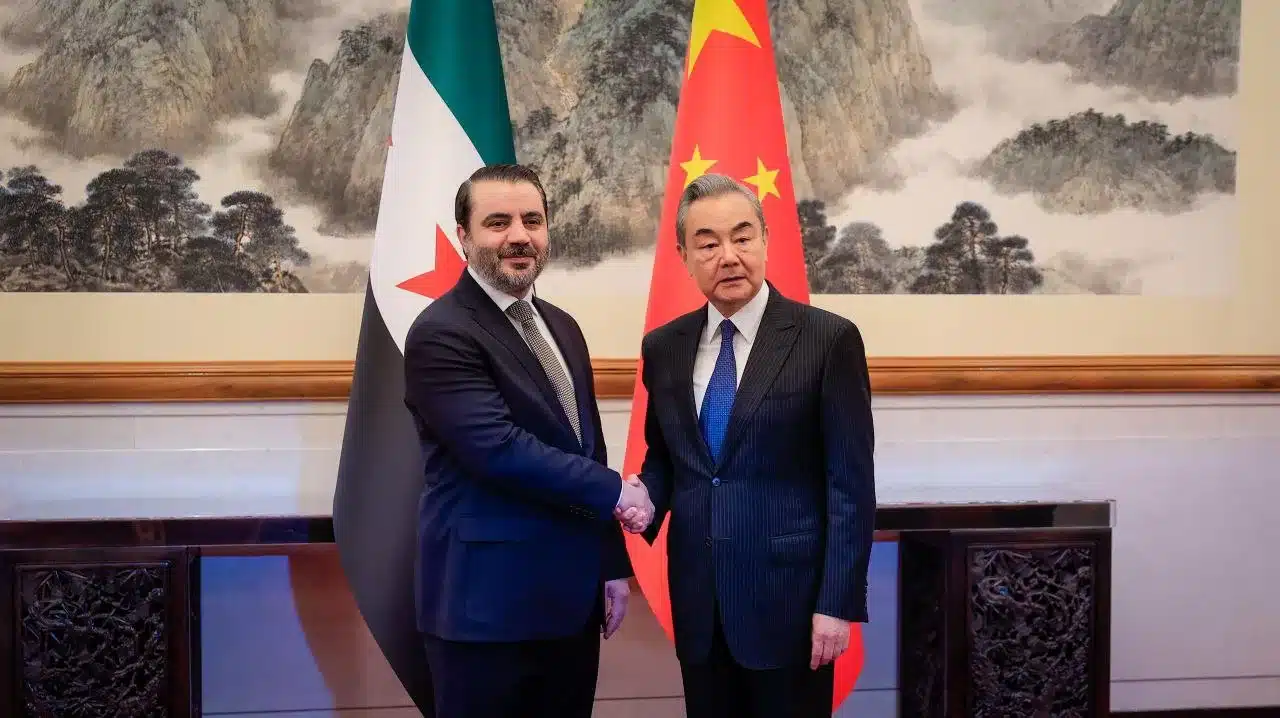
The meeting between Syrian Foreign Minister Asʿad al‑Shaibānī and his Chinese counterpart Wang Yi provided a clearer framework for the shared files between the two countries including those that form China’s concern while Beijing remains an important international actor for Syria in the post‑Assad era, especially as Damascus desires to pursue a “zero‑problems” policy and build calm, balanced relations.
The visit on Monday, 17 November, was the first official visit by a Syrian foreign minister to China since the fall of Bashar al‑Assad’s regime. The final statement carried many shared files and consensuses, with the aim of returning relations to their “correct path”, after China had been an ally of the Assad regime and supported it politically and diplomatically.
This report spotlights the most prominent files during the ministers’ meeting in Beijing, the nature of the bilateral relationship, and its impact on Syrian policy and whether Syria can balance between China and the United States, in light of Washington’s lack of desire to see Beijing’s role rising in the eastern Mediterranean.
Cautious rapprochement
China appears cautious and apprehensive in its dealings with the new Syrian administration, from the earliest hours of the Assad regime’s fall. That regime had strong relations with Beijing and enjoyed broad diplomatic cover China used its veto nine times after 2011 in the UN Security Council against draft resolutions on Syria, aiming to prevent its condemnation in human‑rights and chemical‑weapons files, and to block resolutions regarding cross‑border humanitarian aid, in positions similar to Russia’s.
China’s approach to Damascus came in careful, hesitant steps, weighed down by its legacy of alignment with Assad, and its clear‑cut concern over the potential risks posed by Uyghur fighters affiliated with the Turkistan Islamic Party inside Syria with repeated Chinese warnings about their continued activity, and its insistence on Damascus’ commitment to its counter‑terrorism obligations.
This cautious approach manifested itself when China abstained from voting on a draft resolution at the Security Council on 6 November, to remove President Ahmed al‑Sharʿa and Interior Minister Anas Khattāb from terrorism‑linked sanctions lists.
China justified its position, saying that the resolution did not meet the principles and considerations it deems necessary to achieve stability in Syria and combat terrorism and manage the foreign‑fighter file.
In contrast, Syria’s new administration maintains that it seeks to build balanced, calm relations with all states, as part of its “zero‑problems” policy and attempt to enhance its regional presence and re‑open to the international arena. President Sharʿa stressed that Syria aims to establish stable relations with everyone.
In October, Minister al‑Shaibānī said of the relationship with China that Syria has repaired it, noting that the country needs China at this stage for reconstruction; he pointed out that the Beijing visit comes in response to an official invitation from the Chinese government.
In recent months, the two sides held preparatory meetings the first in February between the then‑acting Minister of Domestic Trade and Consumer Protection, Maher Khalīl al‑Hasan, and a Chinese commercial delegation to explore ways to enhance bilateral trade; and another meeting that same month between President Sharʿa and Minister al‑Shaibānī with Chinese Ambassador to Damascus Shi Hongwei.
Also in October, the port of Tartus received a Chinese‑bound commercial ship carrying more than 16,000 tons of iron and assorted equipment for the “Shanghai” company the first direct import from China via that port. In September, the same port handled a Chinese vessel laden with 50,000 tons of rice.
Files and commitments
In a joint statement following the foreign‑ministers’ meeting, the two sides said talks took place in a “constructive atmosphere,” and included wide‑ranging exchanges on bilateral relations and matters of mutual interest, while discussing a package of files reflecting a shared desire to broaden cooperation and affirm the importance of “historic friendly relations.” The main axes included:
-
Discussion of cooperation in economy, development, Syria’s reconstruction and capacity‑building, improving living conditions, along with other areas of mutual interest.
-
Agreement on combating terrorism and enhancing security coordination, with emphasis on the Chinese‑Arab Cooperation Forum and continuing work within its framework.
-
Syria’s renewed commitment to the One‑China principle: affirming Taiwan as an integral part of China, supporting China’s sovereignty and territorial integrity, rejecting any external interference in China’s internal affairs.
-
Syria’s pledge to take into account China’s security concerns and ensure that its territory will not be used in ways that harm China or its interests.
-
China’s reaffirmation of respect for Syria’s sovereignty, independence and territorial integrity, regard for the Syrian government as the sole legitimate representative of the Syrian people, support for the political process led by Damascus, praise for its efforts in combating drugs, strengthening rule of law and protecting Syrians’ rights, and an acknowledgment that the Golan is occupied Syrian territory.
Simultaneously with the meeting, AFP quoted two Syrian (government and diplomatic) sources as saying Syria intends to hand over 400 Uyghur fighters to China. The Syrian Foreign Ministry quickly denied this, with a source stating there is no truth to what the agency reported.
Researcher Aaron Lund of the Century International think‑tank sees Chinese authorities deeply concerned that Syria could become a base for Uyghur separatists, given the presence of the Turkistan Islamic Party in Syria and its close ties to Hayʾat Tahrir al‑Sham (which led the offensive that brought down the Assad regime).
He suggests Damascus has proposed to keep Chinese authorities informed and under oversight regarding Uyghur activities in Syria to ensure no action is taken against China.
Lund tells NoonPost that Minister al‑Shaibānī’s Beijing visit reflects ongoing dialogue between the sides over this issue, and demonstrates their keenness to move forward and build strong ties noting Syria has given all the expected statements to reassure China about counter‑terrorism and opposing Taiwan’s independence, while China for its part reaffirmed support for Syria’s territorial integrity.
Political analyst Darwīsh Khalīfa comments to NoonPost that the striking point in the joint statement is the admission by al‑Shaibānī of China’s sovereignty over Taiwan coming less than two weeks after the Chinese delegate refrained from voting on the resolution to lift sanctions on Sharʿa and Khattāb.
He says this development reflects Syria’s motives, which alternate between necessity and strategic calculations: Damascus wants, in exchange for this recognition, economic support for reconstruction and diversification of its partners, while Beijing is showing willingness to support economic development, capacity‑building, and living‑standard improvements, while focusing on cooperation in the fields of counter‑terrorism and drugs.
Conversely, Syria commits not to permit use of its territory against Chinese interests — particularly in relation to the Turkistan Islamic Party, which Beijing considers a direct threat to Xinjiang’s security. China’s position in the statement closely mirrors its stance toward Israel it affirmed support for Syria on the Golan issue as occupied Syrian territory.
The statement also opens the door to boosting cooperation under the Chinese‑Arab forum, giving Damascus additional cards in the region. On the language level, Khalīfa notes that the statement is positive and comprehensive, and it is natural that the first document between the sides bears a diplomatic tone that avoids controversial issues.
But this does not eliminate the challenges tied to Syria’s relationship with the West evident in its entry into the U.S.‑led international coalition against terrorism, and the foreign‑fighter file, where Beijing says the numbers entering via its airports exceed by tenfold the figures Syrian authorities acknowledge.
Balancing diplomacy and Washington’s stance
Syria has entered a new political phase after the fall of the Assad regime, one based on clearing the heavy legacy and settling disputes with several states, without closing its communication channels with the Assad allies and supporters in particular Russia and China.
It has adopted an external policy based on dialogue, cooperation, and respect for sovereignty, with a realistic approach to power balances.
Damascus has seen diplomatic activation and renewal of relations with states previously severed including the United States.
Amid this fast‑paced diplomatic movement in Damascus, and its attempt to redraw its foreign policy map, the question remains how Syria will balance its relations with competing international powers especially the rivalry between China and the United States and how the restoration of Syria‑China ties will reflect on Damascus’ relationship with Washington, or place it in a zone of confusion.
Aaron Lund argues that engagement with China is part of the new Syrian leadership’s policy of opening up to all states and avoiding conflict especially with great powers and UN Security Council permanent members and that China appears ready to reciprocate.
He points out that China offered no promise of major investments in Syria, nor did it spend much money supporting the Assad government before 2024; and Sino‑Syrian economic agreements under Assad did not make a marked difference in Syria’s economy including the strategic‑cooperation deal signed during Assad’s 2023 Beijing visit.
Lund says he does not expect the United States to obstruct improved Syria‑China relations unless a major crisis arises in U.S.–China relations, noting that Washington is concerned about growing Chinese economic presence in the eastern Mediterranean and Middle East but it is unlikely Beijing will become a major actor in Syria anytime soon.
In general, he expects Washington’s interest to be in a stable, successful Syria now that it has decided to support the Sharʿa government to override any fears about China’s role in Syria.
He adds that the United States may revise its stance in the future if China emerges as a very significant economic actor in Syria, or if Syrian‑Chinese military ties grow substantially; then U.S. opposition would certainly appear though he deems this unlikely at present.
Darwīsh Khalīfa says Syria does not appear to be in a position to crystallize stable external orientations in the near or medium term; its internal problems are at least as heavy as its external complications tied to sanctions, Israeli interventions and the heavy legacy of the previous regime these combined place the country before a series of accumulated knots needing gradual untangling.
On the domestic front, the new Syrian administration has faced several challenges and ongoing repercussions: most notably clashes and violations in the Syrian coast and al‑Suwayda, with calls in the province for independence and the right to self‑determination; meanwhile, the issue of integrating the Syrian Democratic Forces (SDF) into the Syrian army is proceeding slowly, with obstacles and challenges hindering progress.