

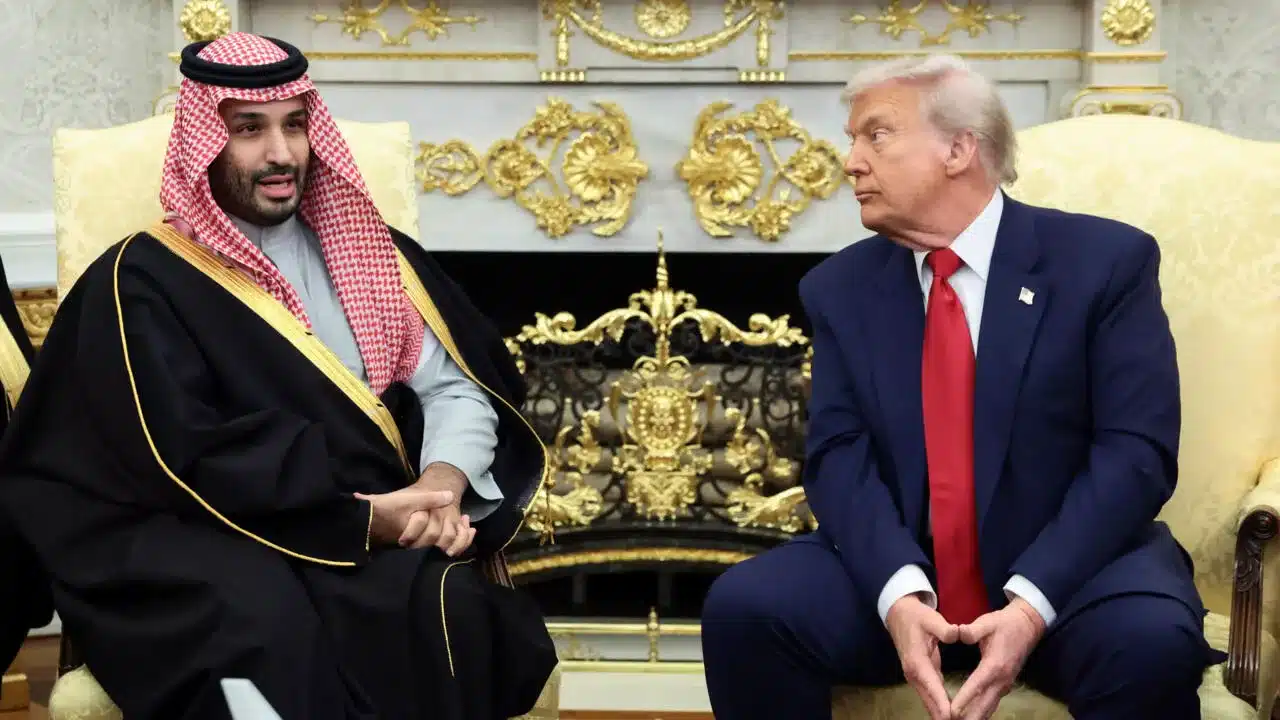
In a striking show of support, former President Donald Trump staunchly defended Saudi Crown Prince Mohammed bin Salman against accusations linked to the killing of journalist Jamal Khashoggi inside the Saudi consulate in Istanbul in October 2018.
When asked by ABC’s Mary Bruce about the case during a White House press conference on November 18, Trump insisted that the crown prince “had no knowledge whatsoever” of the operation and that the Kingdom had made significant progress in its investigation.
However, Trump’s handling of such a sensitive topic human rights and international relations drew widespread criticism. He appeared visibly tense and angry, calling the question “terrible and inappropriate,” even threatening to revoke ABC’s media license.
His defense of the crown prince clashed directly with a 2021 U.S. intelligence assessment, which concluded that Mohammed bin Salman had approved the operation that led to Khashoggi’s death.
Still, the timing and nature of the question during the crown prince’s first visit to the United States since the incident carried clear political implications. It signaled that, despite cordial rhetoric, Washington wanted to remind Riyadh that the Khashoggi file remained open and could be revisited at any time making it a tool of leverage in a landscape of complex geopolitical balances.
From the moment the crime was committed, successive U.S. administrations adopted a purely pragmatic approach: swiftly moving past the moral shock and diplomatic uproar in favor of transforming the case into a multifaceted bargaining chip.
Over time, Khashoggi’s murder became a source of leverage used to extract political and economic concessions, whether in matters of oil, arms deals, normalization efforts, technology, or investments an indication of how the U.S. has used human rights as a means of influence rather than as a fixed value.
Trump and the Initial Moral Shock
During his first term, President Trump adopted a cautious approach, carefully straddling the line in responding to the assassination of Jamal Khashoggi a moral shock that placed the United States in a difficult position.
While the CIA confirmed the crown prince’s involvement in authorizing the killing, Trump insisted on shielding the Saudi leadership, portraying Riyadh as a cornerstone of American strategy.
This earned him accusations of complicity and of disregarding the very values Washington claims to uphold.
Nonetheless, both official and unofficial American institutions began exerting political, economic, and diplomatic pressure on Riyadh from the moment Khashoggi disappeared. This ranged from threats and halted cooperation to the imposition of sanctions all aimed at pushing Saudi Arabia to reveal the full details of the crime.
As the White House adopted a lax stance, Congress emerged as a far more assertive force. Twenty-two senators invoked the “Magnitsky Act” to demand a full investigation and accountability for those involved. Meanwhile, major U.S. media outlets and business executives withdrew en masse from Saudi Arabia’s “Future Investment Initiative” conference.
Criticism of the crown prince grew increasingly direct in Congress, with lawmakers openly questioning the Saudi official narrative, calling for a freeze on civilian nuclear cooperation, and advocating a reevaluation of bilateral ties.
This pressure led to the departure of Saudi Ambassador Khalid bin Salman from Washington and prompted the U.S. Treasury Department to sanction 17 Saudi officials found to be complicit.
At the same time, Western capitals voiced mounting concern over a series of alarming Saudi policies—from mass arrests of elite political and economic figures to the brief detention and forced resignation of Lebanon’s prime minister, as well as growing repression of dissent at home and serious abuses in regional and international conflicts.
Despite the internal and external pressure, the Trump administration continued maneuvering to preserve its strategic partnership with Riyadh particularly regarding arms sales and the war in Yemen. Trump repeatedly warned of potential economic losses and the risk of Saudi Arabia pivoting toward Moscow or Beijing if arms deals were suspended.
This strategy helped reduce the crown prince’s international isolation and gradually restored his global standing. Yet, it ultimately backfired on Trump, as details of his secret communications with the Saudi leadership during the crisis emerged and were weaponized by his Democratic opponents in the 2020 election, contributing to his political decline and eventual defeat.
Khashoggi as a “Diplomatic Crisis”
President Joe Biden’s administration adopted a markedly different course from Trump’s in dealing with the Khashoggi case, taking a far tougher stance on human rights and political accountability. During his campaign, Biden labeled Saudi Arabia a “pariah state.”
On the second anniversary of Khashoggi’s murder, then-candidate Biden emphasized that the killing would not go unpunished. He pledged to reassess U.S.-Saudi relations, end American support for the war in Yemen, and prioritize democratic values and human rights in Washington’s foreign policy even with its closest security partners.
Biden positioned himself as a champion of activists, dissidents, and journalists facing political oppression and violence worldwide.
After assuming office in January 2021, Biden began fulfilling those promises through a “reset” in U.S.-Saudi relations. The White House announced that presidential communication would be limited to King Salman, in stark contrast to Trump’s direct engagement with the crown prince a clear diplomatic signal of disengagement.
This shift caused a notable chill in bilateral ties, affecting political coordination and security cooperation. In February 2021, the Biden administration declassified the intelligence report implicating Mohammed bin Salman in Khashoggi’s murder and imposed visa bans on 76 Saudi officials connected to the crime.
However, it stopped short of sanctioning the crown prince directly, taking into account broader strategic considerations.
The administration also moved to end U.S. support for the war in Yemen and incorporated human rights into its political dealings with Riyadh. Yet despite these measures, Washington maintained open channels with Saudi Arabia, striving to balance criticism of its human rights record with the preservation of shared interests in energy and regional security.
A Bargaining Chip Reemerges
The Russian invasion of Ukraine in February 2022 upended global energy dynamics. Europe faced an unprecedented crisis due to supply shortages and soaring demand during a harsh winter, while oil prices surged to record highs amid OPEC’s insistence on maintaining production quotas.
Faced with this pressure, President Biden found himself compelled to turn to Riyadh the dominant player in the global oil market despite his previous vow to isolate it.
Geopolitical necessity drove the U.S. to reopen dialogue with Saudi Arabia, culminating in Biden’s visit to Jeddah in July 2022 and a meeting with the very crown prince he had once shunned.
During that visit, Biden raised the issue of Khashoggi’s murder but not as the moral outrage he had emphasized during his campaign. Instead, it was framed as a bargaining chip in a political push to persuade Saudi Arabia to boost oil production and stabilize prices.
Thus, the Khashoggi case was reengineered from a symbol of accountability into a tool of interest-driven diplomacy, in a moment when energy dictated global power dynamics and forced Washington to reorder its priorities with traditional allies.
After the visit, Biden stated only that he had discussed the Khashoggi case with the crown prince, without citing any concrete outcomes or reiterating his past criticisms even though he remained fully informed of intelligence assessments that placed blame squarely on bin Salman.
The Golden Goose
During his presidency, Donald Trump governed by his trademark business mindset leveraged the Khashoggi case and the broader human rights file as indirect tools to pressure Saudi Arabia and extract maximum economic gain.
Riyadh, in turn, responded pragmatically, willing to pay the financial and even political cost to minimize criticism, under a simple formula: money in exchange for political protection.
In this context, Trump secured hundreds of billions of dollars in deals and investments that boosted the U.S. Treasury and benefited his own companies, as well as those of his son-in-law Jared Kushner. His May visit to Saudi Arabia epitomized this transactional approach.
During that trip, the two sides signed a wide array of memorandums and agreements across defense, energy, and investment sectors including what the White House called the largest arms deal in history, valued at $142 billion. Saudi Arabia also pledged investments exceeding $600 billion.
Crown Prince Mohammed bin Salman reinforced this path by announcing early in the year his intention to raise Saudi investments in the U.S., after which Trump revealed that he had requested the crown prince increase that amount to $1 trillion confident that Riyadh would comply.
In the current visit, the two sides agreed on a fresh package of deals in nuclear energy, critical minerals, and artificial intelligence, with a Saudi commitment to increase investments to the $1 trillion level Trump had sought six months earlier.
Professor Charles Dunne, former U.S. diplomat and international relations expert, described the U.S.-Saudi relationship under Trump as entirely transactional, built on deal-making.
He noted that Trump staunchly defended Saudi Arabia even using his veto to block congressional efforts to halt arms sales while simultaneously criticizing Riyadh in 2017 for not spending “fairly” enough.
Dunne added that Saudi Arabia is now more compelled than ever to work harder to maintain its position with Trump, despite the difficulty of determining “where he stands” at any given moment.
Lavish receptions, political courtship, and intensified economic agreements remain Riyadh’s core strategies to sustain the relationship without revisiting sensitive files that could strain it, foremost among them the Khashoggi case.
From Moral Outrage to Political Currency
In the end, the U.S. response to the murder of Jamal Khashoggi reveals a striking transformation: from an initial wave of moral outrage that provoked global condemnation, to a diplomatic crisis that strained ties with Riyadh, then to a pragmatic phase in which the crime was weaponized to serve urgent political and economic interests and finally, to its conversion into a strategic card to be played when advantageous.
What was once a symbol of justice and human rights has become one of the most telling examples of U.S. political realism, where principles are recalibrated to suit energy needs, strategic alliances, and commercial interests. It is a vivid illustration of how interests not values govern Washington’s relations with Riyadh, and with much of the world.