
As Syria nears the first anniversary of Bashar al-Assad’s regime collapse, several institutions and services have expanded beyond their original base in Idlib where they operated under the rule of Hay’at Tahrir al-Sham (HTS).
These entities have extended their reach into multiple provinces, assuming increasingly prominent roles in administrative, service, and media sectors amid the country’s shifting political and institutional dynamics.
This expansion has sparked divergent assessments. Some see it as a natural evolution, contributing to job creation and the transfer of organizational and technical expertise to new areas especially those previously plagued by corrupt governance. Others view it as a consolidation of influence, raising questions about the nature of these institutions and their roles in the new administrative and economic landscape.
Among the most prominent examples are the “Sham Cash” app, the “E-CLEAN” sanitation foundation, the media platform “Syrian Creatives,” and the construction company “Al-Raqi.” Some are openly affiliated with HTS, while others have faced accusations of links albeit without confirmation.
Over the past years, many of these institutions have made efforts to maintain a clear distance from any direct association with HTS, particularly as the group itself avoided overt ties to civilian entities to prevent the risks of being labeled a terrorist organization or disrupting their work.
This report traces the expansion of these institutions, examines the context of their spread across Syrian provinces, and explores with experts the underlying drivers and potential consequences for state institutions and public sectors.
The Idlib Governance Model
Prior to the “Repelling the Aggression” campaign, which culminated in the fall of Bashar al-Assad’s regime on December 8, 2024, Idlib was governed through four civilian and military bodies: the Salvation Government, the General Shura Council, the General Security Service, and HTS. In addition, various non-governmental humanitarian organizations operated in the area.
These entities shared responsibilities across service, economic, security, and military domains, yet HTS remained the most influential actor in decision-making and managing key portfolios.
The three other bodies were either formed under HTS’s direction or oversight to fulfill multiple administrative and service functions. Parallel to this administrative framework, other civilian and service institutions emerged to manage different sectors.
Following Assad’s flight to Russia, Ahmad al-Shar’a (HTS’s leader) assumed leadership of the country during a transitional phase set to last five years. A three-month caretaker government was first established, followed by a 23-minister cabinet largely based on the Salvation Government’s core structure. HTS officially announced its dissolution in January 2025.
President al-Shar’a has publicly discussed the Idlib governance experience on several occasions, noting that it relied on the direct formation of the Salvation Government and the development of local institutions drawing on diverse expertise not necessarily tied to any single group or faction.
He claimed that despite lacking the fundamentals of a functioning state, this governance model achieved better administrative performance than the previous regime’s areas. He acknowledged, however, that the Idlib model could not be universally applied across Syria, though it served as a stopgap mechanism until national institutions were formed.
Sham Cash: Risks on Three Fronts
The “Sham Cash” app emerged as a digital service that expanded from Idlib to other Syrian regions after Assad’s fall. It was launched in July 2024 as an e-payment platform and digital wallet that allowed users to send and receive money transfers in Idlib.
Initially developed to facilitate payroll disbursements for the Salvation Government, it later opened to the public and expanded its services to include money transfers, installment and bill payments, monthly sanitation fees, and electricity credit top-ups.
The app is backed by Sham Bank, which was created by HTS in June 2018 through the conversion of “Al-Waseet,” a money transfer company, into a formal bank. Sham Bank has become the main supplier of Turkish currency in Idlib especially small denominations and plays a central role in setting financial and remittance practices in the region.
Sham Cash has stirred debate over its reliability, particularly due to its absence from official Android and iOS app stores and repeated warnings about potential fraudulent or suspicious activities. Its use surged after the fall of the Assad regime and further sparked controversy when the Ministry of Finance adopted it to pay public sector salaries and the Grain Corporation used it to purchase wheat from farmers.
According to economist Mulham al-Jazmati from the Karam Shaar Consulting Firm, Sham Cash poses risks on three documented levels: security/technology, economy, and governance. He argues that the app needs to be reassessed and that safer alternatives should be developed.
1. Security and Tech Concerns
Operating outside official app stores means Sham Cash bypasses platform security standards. It lacks a clear privacy policy and its terms of service exempt it from liability in cases of fraud or data loss. More concerning is that the app’s central server can decrypt and access all user data at any time, potentially enabling surveillance and tracking without legal oversight or regulation.
2. Economic Impact
Sham Cash entirely circumvents the formal banking system, weakening trust in traditional banks and exacerbating liquidity issues. Rather than rehabilitating the banking sector and restoring its role in the economy, the app sidelines it, channeling financial flows through unregulated paths. Al-Jazmati notes that while using Sham Cash to simplify salary transfers may be justified temporarily, relying on it long-term could damage Syria’s financial infrastructure and undermine recovery efforts.
3. Governance and Oversight
The most serious risk, according to al-Jazmati, lies in the app’s lack of transparency. The developer’s identity remains unknown, and it is not supervised by any recognized financial authority, including the Central Bank.
This legal gray area could easily allow the app to become a tool for mass surveillance and political coercion tracking transactions, user locations, and spending habits, freezing or limiting accounts selectively, and potentially rewarding allies while punishing dissenters. Such powers represent a real threat to civil liberties during a fragile political transition.
Strategic Outlook and Safer Options
Noon Post contacted the Ministry of Finance to inquire about its assessment of Sham Cash’s security and whether alternative or additional digital payment platforms were under consideration for public employees. No response was received by the time of publication.
Al-Jazmati emphasized that moving away from Sham Cash doesn’t mean returning to old inefficiencies. Instead, it requires adopting a strategic vision for building a secure, regulated digital financial sector.
One promising initiative, he noted, is the Memorandum of Understanding signed on September 23, 2025, between Syria’s Central Bank and Mastercard. The agreement aims to establish national payment infrastructure, issue domestic and international cards, and link Syrian banks to global payment networks.
This would offer a trusted and secure alternative aligned with international standards.
The government, with international support, could also develop centralized e-payment platforms under Central Bank supervision and legal frameworks that safeguard user data and ensure fair competition among service providers.
International partners could further assist by providing reporting tools, capacity building, and pilot programs in collaboration with mobile operators and fintech companies, offering transparent alternatives to opaque digital wallets.
The Mastercard agreement reflects a shared vision of inclusive and resilient financial systems that expand access to essential services and promote equity through technology, according to the official announcement.
E-CLEAN: A Sanitation Pioneer
E-CLEAN defines itself as a public service institution committed to “a cleaner Syria.” It began operations in August 2022 under the slogan “Towards a Sustainable Environment,” starting with street cleaning and waste collection in five Idlib cities and creating about 100 jobs.
Its activities in Idlib were part of an agreement with the Ministry of Local Administration under the Salvation Government.
In October 2022, after HTS briefly seized control of Afrin in Aleppo’s countryside following clashes with factions from the Syrian National Army, E-CLEAN deployed sanitation teams there. Due to its nascent status and limited operations in Idlib at the time, its Afrin intervention was viewed as a service front for the Salvation Government and HTS.
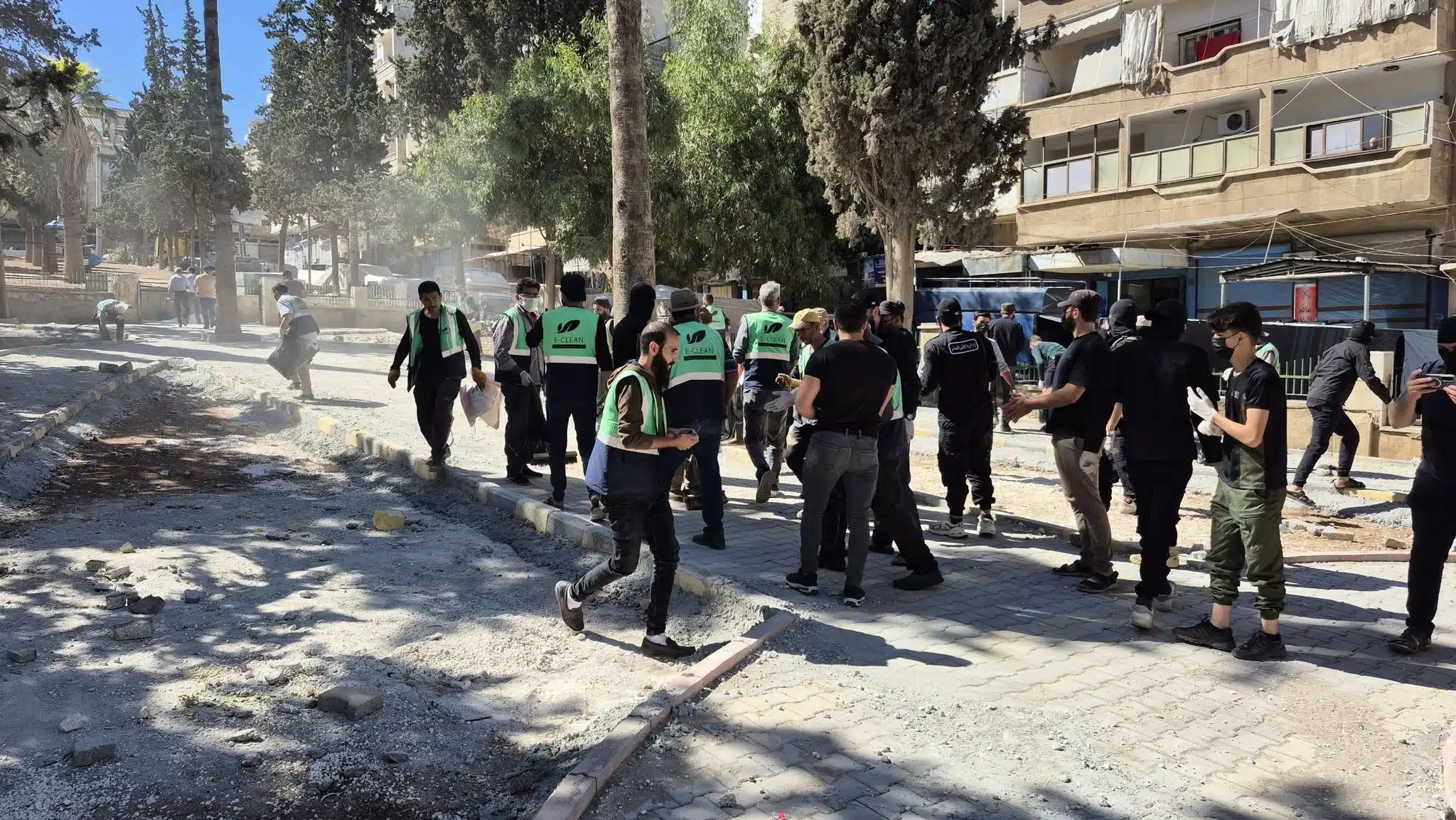
Later, E-CLEAN took over public park management from the Salvation Government and expanded its services across Syria post-Assad. Its activities now include street cleaning, road clearing, trash bin repair, and pest control in cities from Aleppo to Hama, Homs, Damascus, the coast, Daraa, Quneitra, and Deir Ezzor either directly or through joint clean-up campaigns. The organization also announced hiring rounds in cities including Damascus and Deir Ezzor.
Ahmad Yasin, director of E-CLEAN’s Idlib branch, says the institution’s core operations remain in Idlib and parts of Damascus. It specializes in garbage removal through teams consisting of administrators, drivers, sweepers, and support staff, with the necessary machinery.
He clarified that interventions in other provinces are temporary emergency responses to local requests, while the primary service zones remain unchanged.
Al-Raqi Construction
Since its 2020 founding, Al-Raqi Construction has led housing projects for displaced populations and handled infrastructure works in HTS-controlled areas. Between 2021 and 2022, it launched production ventures including a steel rebar plant near the Bab al-Hawa border crossing and facilities for stone, asphalt, and concrete in the same area.
Its CEO, Abdulrahman Salama (Abu Ibrahim), though not officially listed, is a key HTS economic figure and a close confidant of President al-Shar’a. He has appeared alongside him at the presidential palace and other events and was later appointed as deputy supervisor for the areas of Afrin, Azaz, al-Bab, Jarablus, and Manbij.
Following Assad’s fall, Al-Raqi’s activities expanded further. The company undertook projects including road repairs leading to Aleppo, specifically in Atarib, Darat Izza, Azaz, and the airport road, and renovated entrances to key towns. It also led reconstruction in parts of western Suwayda following bouts of unrest.
In August, Al-Raqi and Arkan Construction launched $12 million infrastructure projects after signing contracts with the Idlib governorate. These include fully resurfacing Idlib city, refurbishing Sarmada’s main road, and paving key streets in Dana.
Media and Messaging
“Syrian Creatives” launched in March 2021 as a media initiative by Creative Inception, a company based in Idlib. The platform focused on northern Syrian issues, with occasional attention to Syrians in Turkey.
Over time, it faced accusations of affiliation with HTS. While the platform denied these links, critics pointed to biased reporting especially in incidents involving HTS fighters or civil protests, such as the shooting of a woman in northern Idlib and the platform’s silence on demonstrations over detainee conditions.
During the “Repelling the Aggression” campaign, Sham Cash launched a donation feature to support military operations, and Syrian Creatives broadcasted special coverage of the fundraising drive.
Following Assad’s ouster, the platform’s output dropped significantly and did not grow as rapidly as Sham Cash, E-CLEAN, or Al-Raqi. However, some staff moved into government media positions like Musa al-Bakr, who became head of public relations at the General Authority for Radio and Television, and Ala’a Barsilo, who now heads the entire agency.
A journalist from Idlib, speaking anonymously, said the platform’s alignment with HTS narratives was evident and stemmed from a perceived need to support HTS’s vision. He noted this approach contradicted professional media ethics but reflected a deliberate editorial choice.
He added that while these staff transitions don’t necessarily exclude others, they may help shift stagnant practices within state media. Still, he cautioned that broader reforms are needed and called for greater equity and opportunity in the sector.
Loyalty and Flexibility
The spread of Idlib-born institutions into other provinces raises complex questions. Is this a knowledge-sharing process aimed at inclusion and curbing corruption, or a power consolidation strategy aimed at monopolizing control over public services?
Ayman al-Dasouqi, a political economy expert at the Omran Center for Studies, says the Salvation Government area had developed a unique mix of formal and informal structures that achieved real results. These structures, though damaged, have persisted post-Assad.
He notes that security concerns about state institutions perceived as compromised by Assad-era networks combined with bureaucratic dysfunction have led to a continued reliance on former Salvation Government actors. These figures offered both loyalty and flexibility, prompting structural and personnel shifts.
Al-Dasouqi argues that in the absence of a new social contract and national governance framework, unofficial actors will continue to operate in gray zones, blending into state institutions. This lack of clarity undermines public trust and complicates the potential reintegration of other governance models particularly in northeast Syria into a unified national system.
He warns that unless transparency improves and a new national vision emerges, these blurred lines will foster negative friction and deepen institutional uncertainty.