

Discussion about the F‑35 fighter jet has surged in recent weeks, as signs grow that Saudi Arabia may reach an agreement with the U.S. to purchase the world’s most advanced stealth aircraft a development that has repositioned Israeli anxiety at the forefront of the security, media and political agenda.
This development comes at a sensitive regional moment in which Middle Eastern states’ appetite for advanced aerial deterrents has increased, coinciding with an unprecedented Israeli surge in using force beyond traditional boundaries including precision strikes deep into the region, exceeding former security thresholds, and reinforcing the logic of imposing dominance by firepower.
This rapid shift complicates calculations for a number of Washington’s partners in the Middle East, who see acquiring qualitative air‑capabilities as a basic condition for preserving influence balance and deterring multiple threats in a strategic environment that has been sharply polarized politically and militarily for two years.
With Israel in an election year, Washington re‑embracing deal‑culture in foreign policy as an economic priority, and a clear Arab insistence on entitlement to advanced fighters, the issue becomes a central axis in regional real‑engineering discussions arrangements of influence that, as usual, place American interest first before other security or political considerations.
Multiple deals on the table
When Saudi Crown Prince Mohammed bin Salman arrived in Washington, one of the Middle East’s most sensitive military files resurfaced: Riyadh’s ability to obtain advanced U.S. fifth‑generation F‑35 fighters. If completed, this step would reopen the question of Israel’s aerial superiority in the region a “red line” that Tel Aviv has uncompromisingly defended in the U.S. for decades.
Renewed talk of the Saudi deal comes amid proposed arms packages estimated to exceed $142 billion, encompassing a comprehensive armament bundle rather than simply stealth fighters reflecting Riyadh’s shift from boosting defensive capabilities to building an advanced integrated deterrent umbrella.
According to U.S. media estimates, Saudi Arabia requested about 48 F‑35 aircraft a number that cannot be considered cosmetic but potentially a strategic new air‑force project that could change regional superiority equations if it goes through to completion.
This development did not emerge in a vacuum; rather, it came amid a silent race in the Middle East to acquire this preferential military technology. Several Arab and regional states including the UAE, Morocco, Qatar, Egypt and Bahrain have over recent years either submitted requests, reached understandings, or shown interest.
Some preliminary deals were signed during the first Trump administration, particularly under the umbrella of the Abraham Accords yet many deals remain pending and have not reached actual delivery because of political, technical and legislative complications, among them mounting Israeli pressure.
Even U.S. NATO‑allies such as Turkey a direct industrial partner in the F‑35 program, contributing more than 900 production parts for the aircraft found themselves fully excluded in 2019 after Washington suspended their participation in the wake of Turkey’s purchase of the Russian S‑400 system.
Reports confirm that Israel played an influential role in pushing Ankara’s exclusion, citing the risk of a further regional power gaining the same technology.
At the same time, the Moroccan scenario has emerged unexpectedly: specialized platforms recently discussed the possibility of Rabat acquiring around 32 F‑35s signalling that North Africa has also entered the high‑sensitivity aerial competition zone, not just the Gulf.
Why the F‑35 in particular?
The regional debate is not simply about any advanced fighter but about the aircraft that serves as the cornerstone of modern U.S. air power and the most sensitive element of Western military superiority.
The F‑35 “Lightning II” is not just a high‑end strike aircraft with long operational range; it is a sovereign system combining stealth, information warfare, deep situational awareness and precision multi‑role strikes which explains its transformation into a strategic symbol of aerial dominance in the current century. (f35.com)
Because the aircraft was designed as a flying command centre, not simply a fighter, three main variants were produced:
-
F‑35A for air forces — longest range and largest payload.
-
F‑35B for the Marines — short take‑off/vertical landing.
-
F‑35C for navies — larger wings for carrier operations. (Bundeswehr)
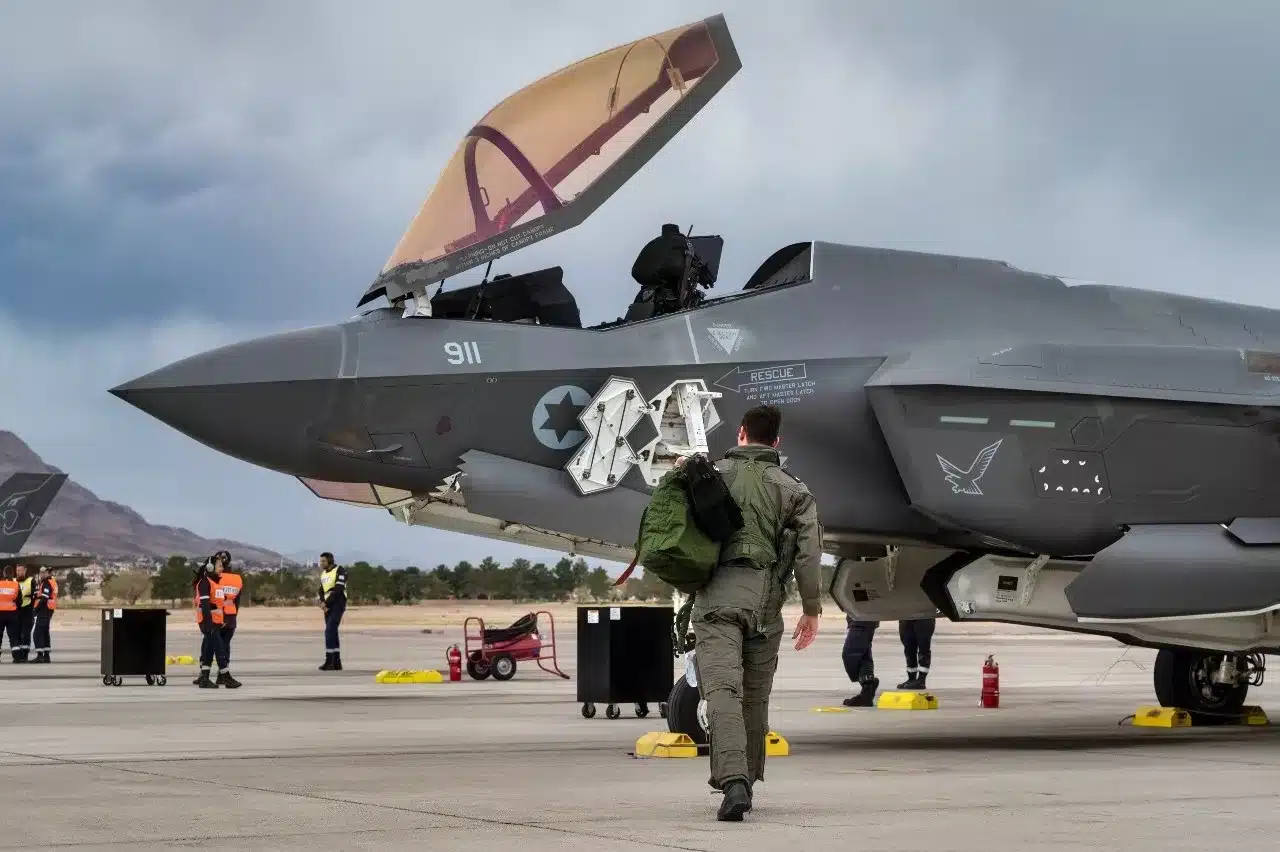
In Israel’s case, a specially modified version named F‑35I “Adir” was produced with locally built cyber‑ and electronic‑warfare systems, full integration of Israeli communications, radars and munitions (including Python‑5, SPICE) and an exclusive combat helmet display system. This made Tel Aviv the first globally to test the fighter in actual combat outside its borders in 2018.
The F‑35’s power rests on a combination of stealth, penetration, jamming, and unprecedented information‑gathering capability in the fighter realm. Its stealth is not only due to radar‑absorbent paint but to precise airframe engineering that diffuses returns and minimizes both radar and thermal signatures.
The aircraft was designed with internal weapons bays (preserving stealth when loaded, unlike 4th‑gen fighters that carry blades/pods externally). Its advanced sensor‑fusion system includes the AESA AN/APG‑81 radar, DAS 360‑degree infrared camera suite, EOTS electro‑optical targeting system and HMDS helmet display delivering the pilot direct tactical information in real time.
Beyond the tech, the system’s real dominance comes from its data‑fusion and real‑time linkages: the aircraft links airborne, ground and naval platforms to provide a unified operational picture, turning the F‑35 into a flying command centre able to manage the electronic battlespace and make precise decisions based on instantaneous data offering strategic advantage not just in air‑superiority battles but in “battlefield awareness”.
Israeli concerns: Superiority first
Within Israel’s security and political discussions there is what amounts to a geopolitical early‑warning: the speed of talks between Washington and Riyadh over a potential F‑35 sale to Saudi Arabia triggers genuine alarm within the security establishment that Prime Minister Benjamin Netanyahu might make a strategic concession later seen as “a dangerous shift in national security” if he approves the deal without securing guarantees keeping Israel’s qualitative air‑superiority exclusive. Israeli media reported these fears, for example in the newspaper Yedioth Ahronoth.
Tel Aviv closely monitors every regional move to acquire the advanced F‑35 stealth fighter, understanding that this aircraft does more than shift power it reshapes it.
From Israel’s perspective, any Arab or Muslim state acquiring it encroaches on domains that have been Israel’s sole domain for decades specifically the ability to conduct long‑range, technologically shielded offensive operations in a complex defensive environment.
Israeli officials have spoken openly against selling the jet to Saudi Arabia during high‑level visits and contacts in Washington including the former minister Ron Dermer, who insisted the deal represents a strategic challenge that cannot be treated merely as a political or diplomatic exchange.
Israel’s refusal stance draws on a long‑term strategic agreement with the U.S. based on maintaining its Qualitative Military Edge (QME) and receiving capabilities superior to any equipment sold to Middle Eastern states.
To date, Israel remains the only operator in the region of a 5th‑generation fighter, and it has received 50 F‑35A jets in the first deal, followed by 25 additional aircraft in 2023 which it considers the “golden combat block” of its air‑force.
The F‑35I Adir version is deeply customized, granting Israel wider freedom of use than the standard version.
Israeli military sources assert that allowing a regional power such as Saudi Arabia to acquire these capabilities could curb Israeli Air Force freedom of operation in near and far theatres including Lebanon, Yemen and Iran and raise concerns about shifting power balances within regional defence systems over the next decade.
The deal‑logic before the politics
The approach of the Donald Trump administration to the F‑35 sale does not continue from a purely traditional U.S. foreign‑policy lens but from a commercial mindset that views weapons as a massive investment product before being a deterrent or geopolitical tool.
The U.S., under Trump, appeared focused on the profitability and financial sustainability of the expensive and controversial F‑35 programme rather than on regional military superiority or traditional national‑security balances.
The F‑35 Joint Strike Fighter programme is one of the largest military‑procurement programmes in modern history; current estimates suggest its total life‑cycle cost could exceed $2 trillion through 2088. Acquisition costs alone are estimated around $442 billion, with $1.6 trillion earmarked for operations and sustainment.
The massive cost increase from early estimates (which stood at $233 billion in 2001) arises from inflation, continual technical modifications, extended operational service life and linking multiple variants into evolving mission requirements. Israel’s case is illustrative of how high the stakes are in such regional dynamics.
Given these figures, the F‑35 project is more than just an aircraft; it is a sprawling industrial‑military‑economic system that requires long‑term export contracts to ensure financing continuity and production sustainability.
Lockheed Martin has thus engaged extended long‑term purchasing contracts with component suppliers globally to reduce per‑unit cost and achieve supply‑chain economies of scale.
In this context, foreign sales are not merely commercial opportunity but a guarantee of the programme’s survival.
From this viewpoint, Saudi Arabia -with its vast financial and investment capacity- becomes an ideal target for Trump’s deal‑oriented strategic logic. Trump demonstrated unprecedented flexibility in responding to Riyadh’s demands, especially after Saudi pledges of $600 billion in U.S. investment and readiness to sign defence deals exceeding $142 billion described by the White House as the largest defence‑cooperation agreement in U.S. history.
He did not shy from framing the public spectacle of the deal, telling the Saudi crown‑prince: “I’ll ask you to raise the amount to a trillion dollars I believe you’ll do it,” and shifting the political discourse into cheques, profit and investment instead of classic diplomacy.
Although the Trump administration emphasised military‑economic openness with Saudi Arabia, domestic U.S. political considerations remained a mandatory filter for the deal especially in light of the Jamal Khashoggi murder file and the resultant legal and political scrutiny around arms exports to the region.
Concerns extend beyond those mentioned. One of the primary worries is the potential transfer of sensitive technology to U.S. rivals such as China or Russia, via expanding security or industrial cooperation with some regional states particularly Saudi Arabia.
This fear is grounded in U.S.‑intelligence assessments, including a Pentagon report warning of scenarios of direct or indirect tech leakage, whether through industrial collaboration or espionage.
Superiority in exchange for normalization
Given the growing complexity surrounding the sale of F‑35 fighters to regional states, Israel is openly seeking to use the moment to broker a dual‑deal: one that preserves its qualitative military superiority at a level higher than future capabilities, while drawing Saudi Arabia into a normalization path on terms favourable to Israel in exchange for the stealth fighter purchase.
Although Israel publicly opposes any Arab state joining the stealth fifth‑generation club, it internally is willing to advance to an even higher technology level through obtaining enhanced versions of the F‑35 (the so‑called “5th‑gen+”), or early participation in the future sixth‑generation F‑47 project announced in March 2025 (contract awarded to Boeing).
From an Israeli perspective, the F‑47 represents a strategic leap not merely a refresh with features such as speeds beyond Mach 2, operational range over 1,800 km, and stealth‑plus technologies that surpass both F‑35 and F‑22.
In this context, Israel is not just fighting to block the Saudi deal but to exploit it as a political engineering card: estimates within Israeli military and media circles suggest Netanyahu is inclined to accept the sale of F‑35 to Saudi Arabia in exchange for political concessions from Riyadh, most notably decoupling normalization from the Palestinian political track.
According to Israeli military sources quoted in the Hebrew press, Netanyahu prefers a virtually cost‑free normalization rather than maintaining the traditional conditions of qualitative military superiority a move described by some Israeli security officials as “a dangerous strategic concession”.
In that sense, the current discourse on the F‑35 sale transcends the conversation about arms balance and shifts into regional political architecture: Israel pressing for normalization without Palestinian price‑tags, the U.S. banking on sustained economic interests, and Saudi Arabia betting on an aerial leap that re‑defines its strategic posture over the coming decade.