The Kurdish political scene in the Middle East is no longer synonymous solely with the Kurdistan Workers’ Party (PKK); today, Kurdish presence in the region is distributed among diverse political forces and trajectories, ranging from parliamentary parties to local‑governance movements and quasi‑autonomous administrations.
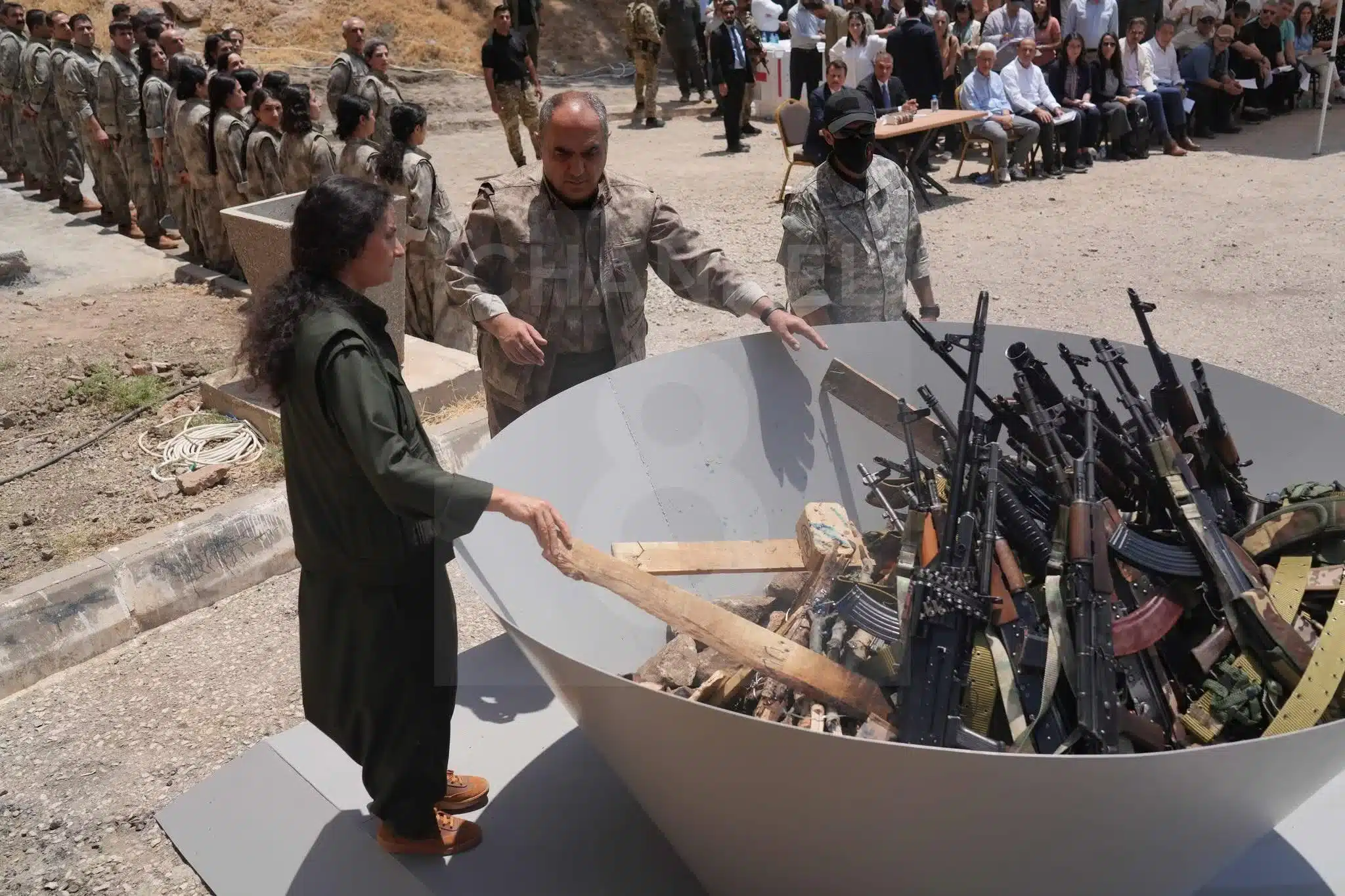
With the PKK’s recent response to its leader Abdullah Öcalan’s call to cease fighting and begin a disarmament track, the party is turning a page on four decades of conflict with the Turkish state, which left tens of thousands dead, opening the door to a new phase driven by politics rather than arms.
While Ankara and its Western allies continue to designate the PKK as a terrorist organization, attention now shifts to the broader Kurdish scene. The Kurdish arena today is divided among various models in Turkey, Syria and Iraq, carrying distinct ideological hues ranging from nationalist left to political Islam and reformist strands forming a complex map that goes beyond the party that for years symbolised the struggle.
The Kurdish‑Turkish Scene
In Turkey, the PKK occupies a central place in the Kurdish political memory as the armed movement with left‑nationalist roots that waged a long insurgency against the Turkish state from 1984. Meanwhile, Ankara and Washington continue to classify the PKK as a terrorist organization.
A large segment of Turkey’s Kurdish population turned to peaceful political expression via the Peoples’ Democratic Party (HDP), which for years served as the foremost parliamentary platform for the Kurdish cause. However, HDP faced mounting judicial pressure, including a full‑scale ban process in 2021.
In response, it gradually re‑formed, contesting the 2023 elections as part of the “Green Left” alliance, then in October 2023 re‑structuring under the name Equality and Democracy Party of the Peoples (DEM Party), declaring its commitment to parliamentary work and peaceful struggle despite continuing accusations by its opponents of being the PKK’s political arm.
On the other side of the scene emerged a different Kurdish current, represented by the Free Cause Party (Huda‑Par), founded in 2012 and aligned with conservative political Islam.
The party draws its base from the predominantly Kurdish southeastern cities, and despite repeated accusations of historic ties to the Kurdish Hezbollah organisation of the 1990s, its leaders insist on peaceful political engagement.
It further consolidated its position by aligning practically with the ruling Justice and Development Party (AKP): in the 2023 elections its candidates entered parliament via the AKP lists, enabling it to present itself as voice of conservative Kurds.
This political diversity between a left‑nationalist party seeking to work within the political system (DEM Party), a conservative Islamist party (Huda‑Par), and the segment of Kurds that prefer assimilation into Turkey’s major parties reflects a deep pluralism within Turkey’s Kurdish society.
It transcends traditional binaries: recent electoral experience proved that Kurds now form a decisive component in national power equations, their votes swinging the balance in presidential and parliamentary contests, thereby granting the Kurdish political movement a new negotiating weight.
Despite ongoing security and judicial pressure, Kurdish political actors in Turkey continue to adhere to the democratic struggle option, relying on parliamentary and mass‑mobilisation tactics to strengthen their presence and expand their political space within the constitutional framework of the Turkish Republic.
The Kurdish‑Syrian Scene
On the Syrian side of the border, the Kurdish movement followed a completely different path. With the retreat of the Syrian state in the north of the country since 2012, the Democratic Union Party (PYD) expanded to become the most influential Kurdish force in northern and eastern Syria.
Since 2013 the party established a de‑facto self‑administration, initially known as “Rojava”, later evolving into the “Autonomous Administration of North and East Syria” (AANES).
It is backed by the armed People’s Protection Units (YPG), which later served as the backbone of the Syrian Democratic Forces (SDF), supported by Washington in the fight against ISIS.
The combination of military and political strength allowed the PYD to govern wide Kurdish‑majority areas almost independently, in both security and services domains.
Yet the entity remained unrecognised: Damascus refuses to grant it legitimacy, and the international community has not legally endorsed it; unlike the traditional Syrian opposition, it has been excluded from Geneva talks and other international negotiating bodies.
In contrast stands the Kurdish National Council (KNC), a political umbrella formed in Erbil in 2011 with direct backing from Masoud Barzani, with the aim of uniting Syrian Kurdish currents amid war changes.
The council initially comprised eleven parties, later expanding and contracting due to withdrawals and splits. Most of its components adopted a moderate nationalist vision close to the line of the Kurdistan Democratic Party (KDP) in Iraq.
Officially, the KNC occupies a position within the Syrian opposition structures it is one of the constituent pillars of the Syrian National Coalition and represents Kurds in the Constitutional Committee and negotiation delegations but inside Syria its influence remained limited, owing to the PYD’s control over the field.
The relationship between the two sides reveals one of the most complex Kurdish‑Kurdish rifts: in recent years tensions escalated to the point of arrests and exile, mutual accusations of links to external powers.
PYD supporters describe the KNC as Ankara‑aligned, whereas the KNC accuses the self‑administration of monopolising power and excluding others. Repeated efforts at reconciliation followed most notably the Erbil (2012) and Duhok (2014) agreements sponsored by Iraqi Kurdistan with US involvement but they failed to last.
Political developments in 2023–2024 revived the rapprochement track after Syrian Kurdish parties reached a competitive agreement on a shared vision of a federal Syria, and the KNC withdrew from the opposition coalition in a move interpreted as a prelude to direct dialogue with the self‑administration and Damascus.
Nonetheless, the road ahead for Syrian Kurds remains strewn with regional obstacles: Ankara views the PYD as the Syrian extension of the PKK and rejects any Kurdish structure along its border.
This conviction led to Turkey launching Operations Euphrates Shield (2016) and Peace Spring (2019), aiming to curb Kurdish expansion and to prevent the anchoring of a stable self‑administration.
The Kurdish‑Iraqi Scene
In Iraq’s Kurdistan Region the political experiment among Kurds offers a distinct model: Kurds enjoy entrenched self‑rule within the federal Iraqi system since the early 1990s, and the duopoly between the Kurdistan Democratic Party (KDP) led by the Barzani family and the Patriotic Union of Kurdistan (PUK) founded by Jalal Talabani, forms the backbone of the region’s politics.
Since the 1991 events and the establishment of autonomy, the two parties have split the power geographically and administratively: the KDP dominates Erbil and Dohuk, while the PUK grips power in Sulaymaniyah and Halabja.
Despite internal fighting in the 1990s, the two sides later built a partnership managed via layered political and security arrangements, allowing both to control institutions from the presidency and government to security organs, the Peshmerga forces, and sectors like oil and media.
While this duopolistic setup has provided relative stability, it has sparked widespread criticism within Kurdish society, where many accuse the two parties of perpetuating patronage and consolidating the two ruling families’ dominance at the expense of transparency and the circulation of power.
Over time, a popular feeling of frustration grew over the Barzanis’ and Talabanis’ monopolisation of politics and economy.
In turn, serious efforts emerged to open the political space to reformist alternatives: the most prominent was the Gorran Movement (Change Movement), founded by Noshirwan Mustafa in 2009 after his split from the PUK, adopting the slogan of fighting corruption and dismantling the monopoly of power.
The movement quickly made its mark, winning about a quarter of parliamentary seats in the 2009‑10 elections, posing the first real challenge to the traditional duopoly.
Gorran called for deep reforms such as unifying the segmented Peshmerga forces and subjecting oil contracts to Baghdad’s oversight.
But after the leader’s death and internal rifts, its presence waned, making room for new forces such as the New Generation Movement (2018), which advanced a more radical opposition discourse, strongly criticising the ruling elite and calling for a thorough restructuring of governance and state institutions.
Alongside the civil currents, a spectrum of conservative Islamist parties remains active in the region, such as the Islamic Union of Kurdistan (affiliated with the Muslim Brotherhood) and the Kurdistan Islamic Group.
Although their representation in parliament has remained modest (jointly about 17 seats by 2016), they articulate the voice of a socially significant segment in areas such as Sulaymaniyah and Halabja, forming part of the Kurdish political pluralism.
Despite the growth of these opposition forces, none has succeeded in dislodging the dominant duopoly. The traditional pair exploited state resources and influence networks to strengthen their electoral hold and entrench patronage systems, keeping the opposition fragmented and unable to wage a unified political struggle.
Ideological and organisational divisions among Gorran, Islamist parties and New Generation further deepened this fragmentation.
Yet, although these dynamics of change may appear slow, they are essential for understanding the Kurdish scene in Iraq, where left‑nationalist currents, conservative religious forces and youthful reform movements coexist.
The region considered the most stable among Kurdish‑inhabited zones faces a true test today between a historic polarisation and a generational drive for a new model of governance that promises transparency and broader political participation.
A Kurdish Mosaic
Observing the Kurdish political experiences across the region reveals that the Kurdish party map is not a unified entity, but rather a political mosaic shaped by local environments and historical contexts.
Ideologically, the spectrum ranges from left‑nationalist, Marxist‑rooted currents (such as the PKK and PUK in earlier phases) to conservative Islamist formations (like Huda‑Par and the Islamic Union of Kurdistan), reform and civil‑society stripes (such as Gorran and New Generation), as well as civil left parties espousing democratic and human‑rights agendas.
In Turkey, decades of armed struggle and confrontation with the state produced a new Kurdish generation closer to a pluralistic democratic discourse while preserving national identity. In Syria, a multi‑ethnic self‑administration experiment emerged amid war, raising wide debate about post‑war models of governance.
In Iraq, Kurdish nationalism merged with a long experience of institution‑building and regional alliances, producing liberal and Islamist strands alongside the traditional leadership.
In the end, a “post‑PKK phase” does not signify the end of the Kurdish question so much as the beginning of a new one, managed across divergent political paths from the Turkish parliament to negotiations between self‑administration and Damascus, and to the government of the Kurdistan Region in Erbil.
The future of the Kurdish cause will depend on the ability of Kurdish forces, in all their orientations, to adapt and cooperate and at the same time to formulate a shared vision that reflects the aspirations of the millions of Kurds exhausted by decades of conflict and looking for a new path that grants them security, dignity and national rights within stable states.