
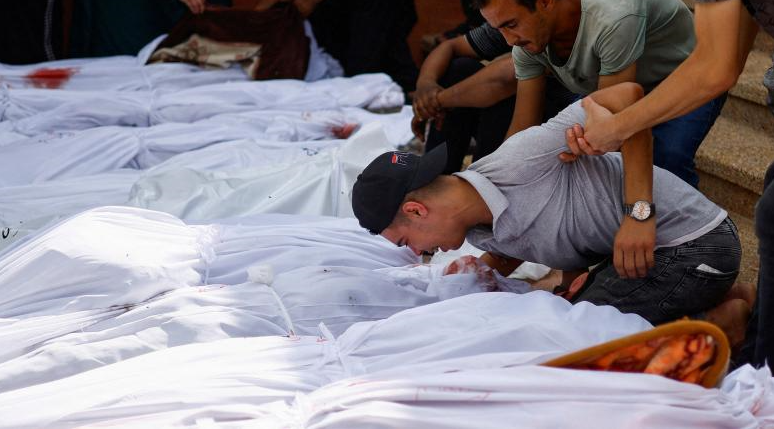
Eyes fixed, searching for the features of erased loved ones, hearts worn down by waiting on the unknown, longing for reassurance even if it means confirming loss. Images so cruel they kill some for their families or revive hope if they are of their son.
Seconds pass between one photo and another; bereaved people ask for the image to be repeated if they suspect a resemblance with their missing one; widows lean closer to the screen if they still have the strength to move after what they have seen.
A cry of weeping here, the silence of grief there, the call of “Allāhu Akbar” from a father once he’s certain the image is his son’s.
Only here does happiness take the shape of a decomposed body brought back by families to bury in a grave they will visit whenever longing overcomes them after the long wait for news of the missing loved one’s fate. But how many families obtained this strange reassurance?
Fewer than a third of the bodies were recognised by their relatives; the remainder were buried by the Ministry of Health in a newly‑created cemetery in Deir al‑Balah, after hope of identification had been lost, and after their bodies had been placed in mobile freezers previously reserved for keeping ice‑cream, in a last attempt to buy time for families.
Since the outbreak of the extermination, the classification “missing” has returned to the forefront, and the number of missing has increased day by day. Martyrs who died on 7 October inside the occupied territories fighters and civilians who rushed in behind them when the scenes from there inflamed their resolve returned in small numbers while others disappeared; their families seek news to confirm whether they were detained or martyred.
The missing count did not stop with those whose trace vanished on that day alone; the reasons behind the unknown fate of large numbers of Gazans over the past two years are many: bodies of martyrs evaporated or turned into fragments; large numbers remain under the rubble amid the continued blockade by the occupier of heavy‑machinery to recover them; in addition there are fighters whose operational areas they never returned from, not to mention detention and forced disappearance so that the number of missing rose to ten thousand according to the latest statistics.
Returning to the missing of 7 October, nothing definite is known of their fate nonetheless, Israeli media leaked a few unverified reports about them, including claims that dozens of members of the “elite” unit in Al‑Qassam Brigades, the military wing of Hamas, who entered the Gaza envelope on the first day of the Flood of al‑Aqsa, were arrested.
The most recent truce deal included, in its first phase, the exchange of bodies; the occupier handed over more than 300 corpses of Palestinians who disappeared on 7 October, in several batches, the first of which arrived in mid‑October thus executing it more slowly than usual, for the number to be delivered is far greater.
The occupier returned the bodies in a shocking manner: decomposed, showing signs of torture and mutilation, with no names attached placing the families of the missing in a new tragedy, characterised by the difficulty of identifying their sons on one hand, and renewed anguish and heightened fear on the other.
The occupier’s refusal to identify the bodies led the Ministry of Health to adopt a mechanism to deal with them in a way that may help families recognise the martyrs publishing a link showing their photos, images too awful for words to describe.
People inspect them at home or in designated halls, attempting to recognise their sons by scraps of clothing and shoes; the lucky ones find a distinctive mark on their martyr such as evidence of surgery.
The search for a missing son is an extremely difficult experience for parents, some describe it as the hardest part of the extermination despite its brutality the fact of not finding their children rekindles their ongoing fear that they may still be alive, held in prisons under continuous torture. Only then do people pray for their loved ones’ martyrdom instead of the horrors of detention.
As for the horror of the pictures, it drives them to imagine what has befallen or still befalls their missing sons: faces on which tanks clearly rolled; bodies stuffed with cotton after organ removal; signs of beating, eyes blindfolded, hands bound, necks encircled by nooses.
In this report, we listen to the stories of searching among the corpses…
“Like the gasp of death”
Two graves she visits whenever she longs for her brother and her husband a wish long waited for by Israa al‑Arir because since the start of the war she has been writhing in the blaze of their disappearance, a fire made fiercer by the beginning of her search for them among the corpses the occupier handed over.
In proportion to her longing for finding them, she discovered that “all the war is on one scale and the search for them on the other,” as she describes it how could it be otherwise when she feels the ordeal resembles “the gasp of death” for its difficulty, differing only in that the gasp repeats every moment, she dies each moment.
Israa told “Noon Post” she was shocked when she learned the occupier had delivered the corpses without names; she awaited the Ministry of Health’s announcement of the recognition mechanism but the bigger shock was the pictures she saw.
She added: “The internet was very slow, so I went to al‑Nasser Hospital to view the display there my psyche narrowed and I felt suffocated; I was so exhausted that I thought I would never stand again.”
She continues: “My brother held my hand and checked on me between picture and picture to reassure himself I was still breathing; my tears dried while my heart wept.”
Israa retains details of her two martyrs: their features, their clothes, everything. She inspects the pictures one by one, pauses at every detail for each martyr; she asks herself: “Could these be my husband’s trousers? Is this shirt my brother’s?” … and when she suspected one photo, its subject wore a silver wedding ring similar to her husband’s ring but not inlaid with black as his.
Forty pictures passed without anyone recognising one of them, when the official supervising the display raised his voice announcing: “Five pictures left, scrutinise well” … and so ended the first day of Israa’s search for Yasser and Diaa. She explains: “On that day no one recognised any body; only one family suspected that one picture might be their son’s.
We all returned crushed, our wounds reopened, and the question haunted us: Are they alive?” She felt bodily and psychologically weary from the horror of the scenes, and what hurt her most were the images of martyrs whose mouths were stuffed with nails and stones.
She remained fixed on the pictures, silent after what she saw silenced her, then returned to the hospital on the next day only for the tragedy to repeat without any result other than more psychological pain and many thoughts about what these martyrs may have suffered of torment before their ascension.
On the third day she resorted to examining the pictures via the web site when she suspected one, she went to the hospital immediately, where she found discrepancies in the shoes and underwear.
After this incident, despair almost took over her, and she thought of giving up the search but she quickly retracted, out of respect for the two martyrs, because she wanted two graves she could visit in moments of longing, and because of her daughter’s right that her father should have a grave and indeed she returned the next day to continue the search, still awaiting with blazing patience the delivery of more bodies in hope of finding them.
She does not have the luxury of stopping the search, for her parents and her husband’s father are unable to perform the task; the pictures exceed their strength to withstand. Her mother viewed a few then quit following, but she continued urging her to scrutinise every image; as for her mother‑in‑law she refused to help verify one of the pictures because she wanted the image of her son in her mind to remain intact.
In spite of everything she saw, her certainty remains that God honours the martyrs, that the souls are with God and cannot be harmed by mutilation of the bodies — yet she wonders: “What was the occupier’s aim in handing back our sons like this? Is what we suffered for over two years not enough?”
Israa continues her painful journey, hope urging her on to meet her husband Yasser (31) and her brother Diaa‑al‑Din (21). She remembers their love for life and zest for it, even though the last conversation between the two martyrs on the war’s eve was about the bride Diaa was seeking; Yasser’s reply: “Since you’re handsome and want a beautiful bride, settle for less your specs don’t exist except in the Houris.”
Nightmares and hallucinations
Israa Muheisen tells “Noon” about her family’s experience in their search for her brother, and what emerged on her mother as a result, after two years of anxiety and sorrow for Mus’ab, who was 23 and about to be engaged at the time of his disappearance.
She says her mother waited for the war to end when she heard of the possibility that the missing‑list and handing over of bodies was part of the agreement; but she never imagined their shape or the way their identities would be hidden.
She adds: “On the first day of showing the missing pictures at al‑Nasser Hospital, my mother was in such a bad psychological state that we persuaded her not to go, and one of my brothers attended but found no trace of Mus’ab.”
That night, the mother spent it flicking through her son’s pictures to recall his features that she had never forgotten, and verifying details of his clothes; the next day she resolved to attend the display, returning empty‑handed and pale‑faced.
Her daughter explains: “That night my mother’s sleep was chased by nightmares, and the pictures she had seen, with many hallucinations as if she saw Mus’ab telling her his body lay in the hospital.”
The next day one of the martyrs had worn a shirt identical to his, but beneath it a jacket he had never had. Although this convinced the family to examine the body (thinking maybe he wore something of a friend), the mother concluded: “This is not my son his body hair is thick.”
Everyone agreed with her except the grandmother to whom Mus’ab was the dearest grandchild; she broke down in tears asking to bring the martyr for her to bid farewell and bury.
Five days passed in the same way: the mother, her children and their relative who shares this obsession, each day returning more disappointed, until pain reached its limit and she refused to go and barred her children from seeing the scenes.
After that a new batch of bodies was handed over by the occupier, making the search this time the father’s mission he found all the bodies nameless and in identical military uniforms, so he returned home dragging the tails of disappointment.
The continued search without result deprived the family of hope of finding him, reopened their wound and revived the spectre of detention they fear that Mus’ab might be a prisoner under torture for two years.
She describes her mother’s condition: “During the display she is composed as my brothers tell us; at home she ignores the matter, doesn’t talk about what she went through or saw, tries to busy herself with anything, and completely ignores the issue yet the physical and psychological fatigue are obvious.”
She tells us of a relative whose son disappeared on the first day of the war; from that day her psychological condition deteriorated until she suffered depression, and while she began to recover in recent months, the search order caused a severe relapse.
She says of her: “Her son’s fate is confirmed: he was martyred but his friends could not bring his body to Gaza, so he remained in the occupied interior.” She adds: “After the ceasefire announcement, this relative sought to end her displacement and return from the central governorate to Gaza, but once she learned of the handing‑over of bodies she decided to stay so that her access to al‑Nasser Hospital would be easier.”
The lady found a body matching her son’s specifications, and the family agreed with her view, yet when she went to the hospital the next day another family said that the martyr was their son, pointing to vitiligo on his leg which the forensic medicine confirmed so that other family buried their son and the bereaved mother was relieved from the fear of burying a body that did not belong to her child.
Better off was the family of the martyr Hamed al‑Qrinawi, who was martyred at the start of the war and buried about two weeks ago.
His sister Hanaa says: “During the war days we wondered whether he was a prisoner, a wounded person or a martyr how much worse than being unable to know the fate of a dear person, it’s one of the cruellest days one can live through; above every horror of war we contemplate the torture he might be enduring if he is detained.”
She adds to “Noon”: “Once the body‑exchange deal was agreed we followed the news minute by minute until the Ministry of Health posted the photo link; from that day I examined them picture by picture.”
She continues: “The first picture I saw was very painful, and it emerged that this was the case for all pictures indescribable horror making the search a very difficult process; a piece of clothing or a shoe and they say: recognise your martyr.”
She goes on: “I decided to endure it to find my brother who we had received news of that he had been martyred on the first day but nothing is certain. What rules out that he might be alive? Nothing.”
None of the photographs carried any indication it could be Hamed in one of them, until the fourth day of the search, when his friends’ family recognised their child, and his sister expected to find him since he was with them. She had agreed with his wife and brother to visit al‑Nasser Hospital in hope of finding him.
At seven o’clock in the morning they were in the designated hall along with many families; while eyes were fixed on the screen she saw in image H19 what indicated it was her brother but she offered no reaction so as not to be asked by the official to review 120 images shown on previous days.
At home she told his wife about the image and she found the same suspicion, so they returned to examine it until they were certain. Hanaa says: “At the beginning of the photo‑display that showed my brother we were told by the official that it was among the thirty worst pictures since the start of the display, but the condition of Hamed’s body was the best of all his features were nearly intact, although the right half of his head was nearly gone, where he sustained the right‑eye injury.”
She adds: “Signs of torture were clear on his face, but much less so than the other bodies where tracks of tanks clearly rolled on their faces, in addition to tooth extraction, organ removal and stuffing of abdomens with cotton and other forms of torture and mutilation.”
Before the burial, another mourning family suspected the same body and although Hamed’s family were confident that it was him, they waited for the other family’s confirmation — “everyone holds on to a straw,” as his sister explains. “Their son looked very much like my brother, but they found different signs that ended their doubts.”
On the paradox of happiness in loss she says: “In recognising him there is psychological relief; in burying him there is a strange feeling when the first search day ended without finding him we felt a large lump, for maybe he was among the bodies we left unrecognised, or perhaps a prisoner, and we who used to pray that he be a martyr so he would escape the torments of detention.”
She adds: “Now it is a mixture of sorrow and joy: sad because I lost my brother forever, and happy because we found a body to bid farewell, bury and we discovered his grave while others still don’t know the fate of their children.
With burial the psychological torture linked to being missing and the fear he is a prisoner being tortured ends; we are happy because he is in a better place.”
Despite this relief, the martyrs’ images remain before Hanaa’s eyes, never disappearing, she confirms: “Our martyrs were in a very harsh condition and exposed to extreme torture before martyrdom: burning, melting substances applied to their bodies, signs of hanging, erased features and many forms of torture and mutilation.
It was obvious that many fingers were cut probably for DNA testing meaning that the enemy could have delivered the bodies with names and in a better way but is a tyrant who knows no one will hold them to account and did this to make the families’ grief deeper.”