
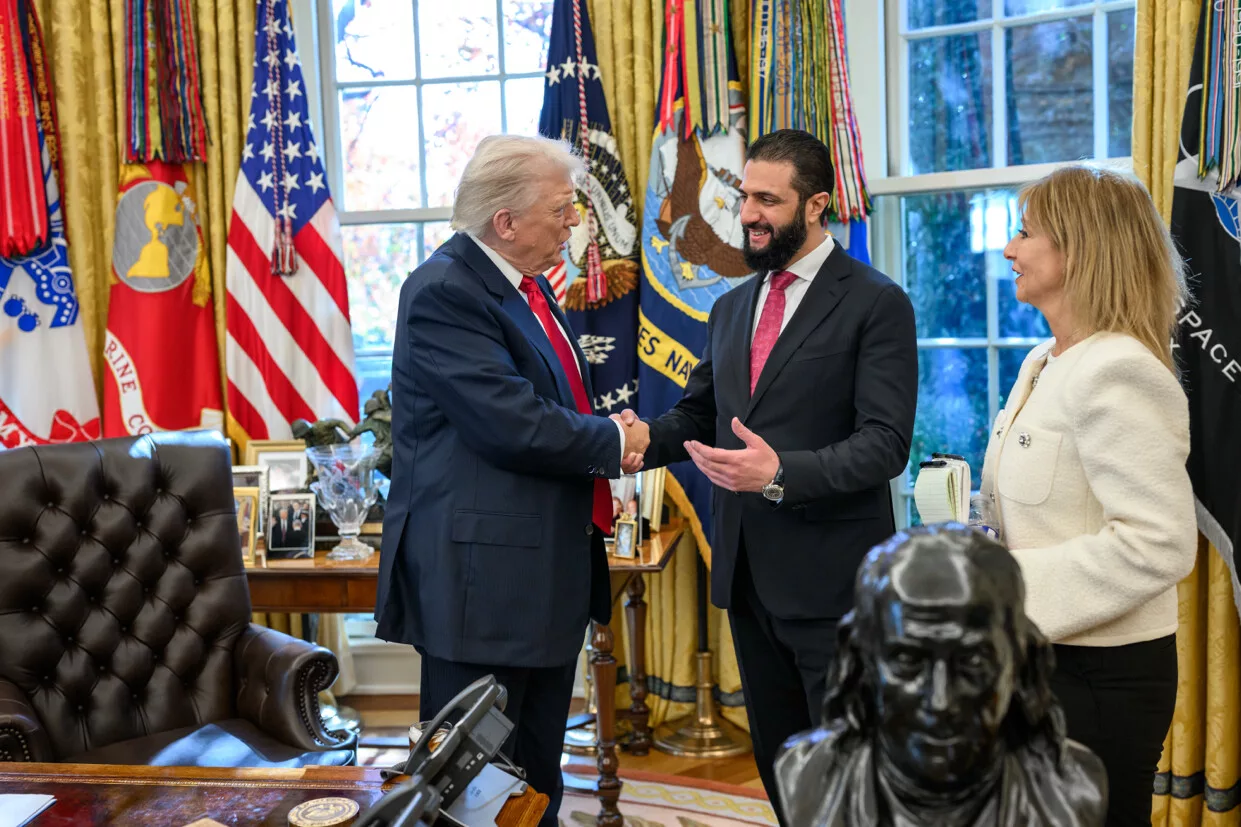
The visit of Syrian President Ahmad al-Sharaa to the White House and his meeting with US President Donald Trump has taken center stage in political and media discussions. Seen as a pivotal and exceptional moment, the visit signals a new chapter in US-Syrian relations one that may not come as a surprise, as it builds on growing contacts between the two sides since the fall of Bashar al-Assad’s regime.
This marks the first time in nearly 80 years that a Syrian president has visited the White House, a visit that has attracted sustained attention in recent days. Its implications extend beyond the recent announcement by US Special Envoy to Syria Thomas Barrack about Syria joining the international coalition to combat the Islamic State (ISIS).
Experts and analysts suggest it reflects broader efforts to rebuild regional power dynamics and integrate Syria into a new political equation shaped by overlapping interests.
This report highlights the significance of the visit, which follows two earlier meetings between al-Sharaa and Trump first in Riyadh on May 14, and then on the sidelines of the UN General Assembly in New York in September. It also explores the main issues on the table and the evolving dynamic between Washington and Damascus after years of estrangement.
Positive Atmosphere Precedes the Meeting
Two days after the United States lifted sanctions on President Ahmad al-Sharaa and Interior Minister Anas Khattab—mirrored by a similar UN Security Council resolution al-Sharaa arrived in Washington on an official visit. Starting on November 8, he met with members of the Syrian-American community, representatives of Syrian organizations, and several key figures, including IMF Managing Director Kristalina Georgieva and House Foreign Affairs Committee Chairman Brian Mast, one of the staunchest opponents of repealing the Caesar Act.
Addressing the diaspora, al-Sharaa emphasized that sanctions were nearing their end, urging continued efforts to lift them completely. He noted that Syria’s return to its rightful place in the world would require more than political visits.
Syria’s UN envoy, Ibrahim Alabi, said that al-Sharaa entered the White House bearing heavy responsibilities, expectations, and optimism predicting a positive outcome.
The White House meeting between al-Sharaa and Trump is a crucial moment to discuss bilateral issues. Over the past months, Washington has laid out several conditions for reopening ties with Damascus following the fall of Assad’s regime on December 8, 2024.
These include destroying any remaining chemical weapons stockpiles, cooperating on counterterrorism, removing foreign fighters from key government positions, ensuring minority rights, assisting in locating missing Americans, and preventing Iran and its proxies from exploiting Syrian territory. Additionally, the US is mediating discussions for a potential security agreement between Syria and Israel.
Within hours of Assad’s flight from Syria, the US expressed full support for a Syrian-led political transition and began signaling a diplomatic thaw. This shift included license exceptions to sweeping sanctions, the lifting of restrictions on al-Sharaa including the rescinding of a bounty previously placed on him as both nations moved to end decades of hostility that began with US sanctions in December 1979, when Syria was designated a state sponsor of terrorism.
The US is now playing an active mediating role between Syria and Israel. Talks nearly reached a framework agreement after months of negotiations in Baku, Paris, and London. However, the process stalled when Israel demanded a “humanitarian corridor” into Sweida province.
Syria’s new administration has shown flexibility in pursuing ISIS cells, even before it became an international expectation rooted in long-standing hostilities between ISIS and rebel factions such as Jabhat al-Nusra, which later evolved into Hay’at Tahrir al-Sham.
The latter, led by al-Sharaa, spearheaded the campaign that toppled Assad in what became known as the “Deterrence of Aggression” offensive. Hay’at Tahrir al-Sham was officially dissolved in January 2025.
One pre-visit issue that drew attention was a Reuters report claiming the US planned to establish a military presence at an airbase in Damascus to support a US-brokered security agreement with Israel.
However, a Syrian Foreign Ministry official denied the claim, saying Washington’s current approach marks a shift toward direct engagement with Syria’s central government and support for the country’s unity, rejecting any calls for partition.
A “Constructive” Meeting Toward a Stable Syria
The White House meeting took place on Monday, November 10, lasting about 90 minutes behind closed doors. It brought together Presidents al-Sharaa and Trump, US Secretary of State Marco Rubio, Vice President J.D. Vance, Syrian Foreign Minister Asaad al-Shibani, and others. The session yielded several major outcomes:
-
The Syrian presidency stated that the talks focused on strengthening bilateral relations and addressing key regional and international issues of shared concern.
-
Trump praised al-Sharaa, saying, “He comes from an extremely difficult background, and he’s a strong man. I admire him.” He stressed that a stable and successful Syria is vital for all regional players.
-
Al-Sharaa emphasized that Syria is now seen as a geopolitical ally rather than a security threat. He discussed lifting sanctions and potential US support in facilitating negotiations with Israel. He noted Syria’s position is distinct from countries that signed the Abraham Accords and revealed that talks with Russia include extradition discussions involving Bashar al-Assad.
-
Foreign Minister al-Shibani called the meeting “constructive,” noting comprehensive discussions about Syria’s future, unity, and reconstruction, along with legal clearance for the full diplomatic operation of Syria’s embassy in Washington.
-
Secretary Rubio confirmed that mandatory Caesar Act sanctions had been suspended in support of Syria’s economic recovery and global reintegration, while expecting tangible Syrian commitments toward sustainable peace.
-
The two presidents reaffirmed their commitment to implement the March 10 agreement to integrate the Syrian Democratic Forces (SDF) into the national army. Trump ordered a follow-up trilateral meeting between Syrian, US, and Turkish foreign ministers.
-
Syrian Information Minister Hamza al-Mustafa described the meeting as cordial and forward-looking, signaling a new chapter in US-Syrian relations. Discussions centered on economic cooperation, American investments, and plans to lift Caesar Act sanctions.
-
Al-Mustafa added that Syria had recently signed a political cooperation agreement with the anti-ISIS coalition, underlining its role in counterterrorism and regional stability. The agreement currently includes no military provisions.
-
Turkish Foreign Minister Hakan Fidan stated that he discussed with US officials Turkey’s vision for Syria’s unity and security. He emphasized that instability in southern and northern Syria threatens territorial integrity.
-
Special Envoy Thomas Barrack said Trump’s Middle East peace plan has turned decades of stagnation into a practical roadmap grounded in security, prosperity, and lasting peace turning a former source of terrorism into a new ally in combating it.
Shared Interests and Mutual Commitments
The White House meeting raises important questions about the evolving US-Syria relationship. Syria has adopted a “zero-problems” foreign policy, while Washington seeks measurable commitments free from imposed models. Barrack has previously noted that the US role is advisory, not prescriptive.
Greek Middle East expert Eva Koulouriotis sees the visit as the outcome of effective diplomacy led by Syria’s foreign ministry and coordinated with the influential Syrian American Council, supported by regional mediators from Qatar, Turkey, and Saudi Arabia.
Speaking to Noon Post, Koulouriotis noted that direct engagement between Washington and Damascus began within weeks of Assad’s ousting, with Barrack leading coordination on internal and regional files ranging from the Sweida issue to the pending Syria-Israel security agreement.
She emphasized that both countries have distinct strategic interests. For Syria, as al-Sharaa stated, economic development is paramount. Reviving a devastated economy requires Washington’s cooperation across multiple fronts. With backing from Arab allies, al-Sharaa’s government concluded that rebuilding Syria depends on redefining ties with Washington and gaining Trump’s trust.
From the American perspective, Washington’s Syria policy revolves around three core issues: counterterrorism, Syrian-Israeli relations, and Syria’s geopolitical alignment with Russia and Iran. These have shaped the foundation of bilateral relations and were central to al-Sharaa’s White House visit.
Complex Issues Test the Relationship
Koulouriotis believes al-Sharaa’s administration is adopting a pragmatic and flexible approach to Washington’s demands across several sensitive files:
-
Syria–Israel Relations: Trump strongly favors talks focused on normalization and joining the Abraham Accords. However, Syria has successfully limited the scope to security concerns only a stance Washington now accepts. Netanyahu, by contrast, seeks to impose unilateral terms, placing Damascus in a difficult position.
-
Counterterrorism: Syria’s inclusion in the anti-ISIS coalition marks a political milestone and may pave the way for military coordination between Syrian and US forces. Strategically, this signals a shift from an Eastern/Iranian axis to a Western/US-oriented alignment.
-
Still, the issue of foreign fighters remains unresolved, with calls from Washington, Moscow, and Beijing for deeper reform beyond Syria’s current security oversight.
-
Northeast Syria and the SDF: While the US backs Syria’s territorial integrity and the March 10 integration deal between al-Sharaa and SDF leader Mazloum Abdi, US forces remain in the East and al-Tanf base. Washington has not exerted sufficient pressure on the SDF to fully implement the agreement. Damascus insists on individually integrating SDF members into its defense ministry, not as a unified bloc.
-
Turkey, viewing the status quo as a direct threat, is pushing for a swift resolution -even militarily- placing Damascus in a tight spot between Ankara and the SDF, which could strain US-Syria ties.
Koulouriotis concludes that Syria is at a historic crossroads. While al-Sharaa’s visit and meeting with Trump have generated positive momentum, the road ahead demands careful strategy and domestic backing. The transitional phase may become a launching point for Syria’s emergence as a strong, sovereign, and unified state.