







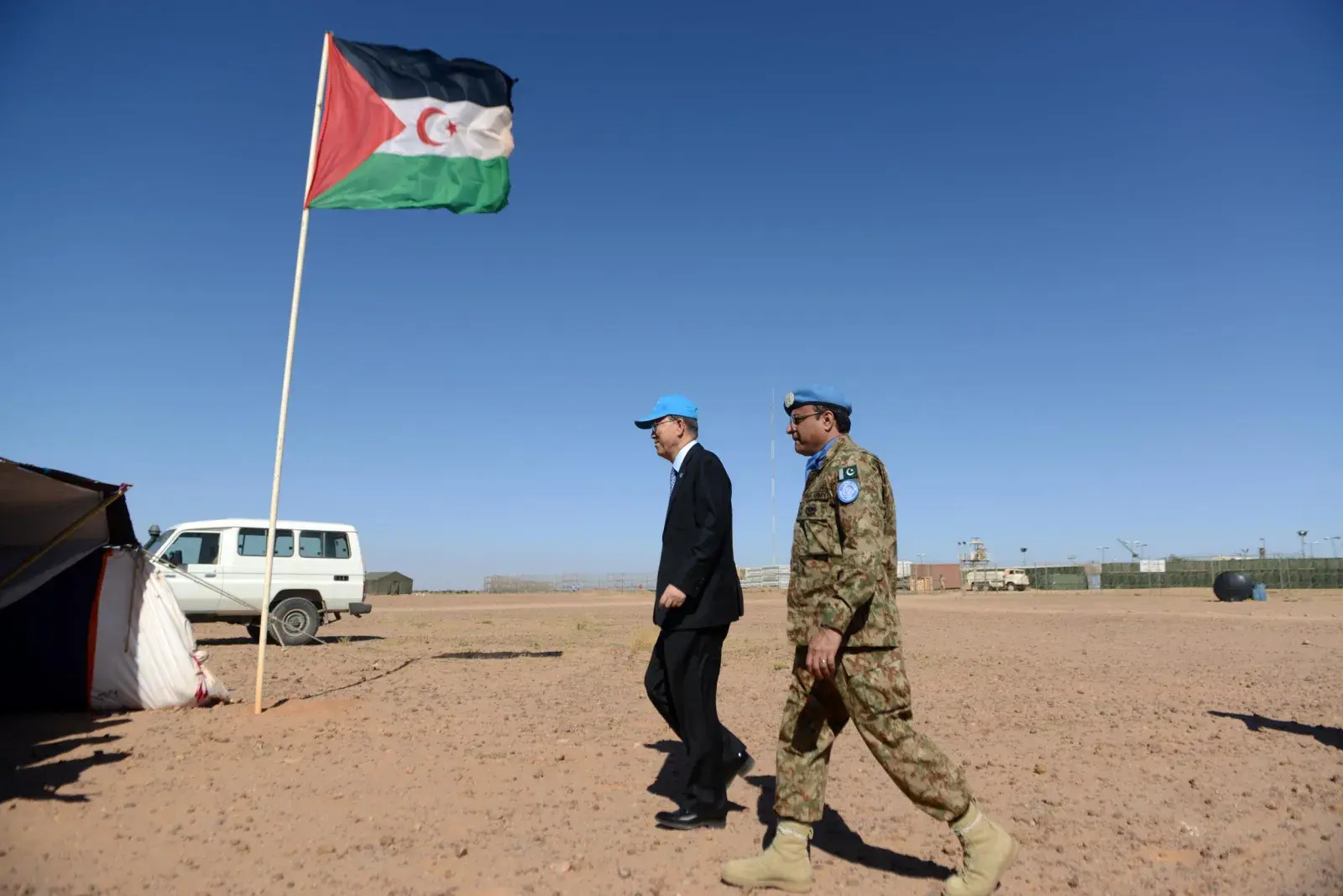
In early November, the United Arab Emirates endorsed UN Security Council Resolution 2797 on the Western Sahara issue an outcome of a U.S.-sponsored proposal originally backed by President Donald Trump.
The resolution, which has recently seen an unprecedented level of international consensus, endorses Morocco’s 2007 autonomy plan as a solution to a conflict that has remained unresolved for nearly five decades.
Morocco’s proposal aims to grant Western Sahara a semi-federal status, while the Polisario Front supported by Algeria continues to demand full independence from Moroccan sovereignty.
The UAE’s backing of this resolution was not unprecedented but rather a reaffirmation of its geopolitical posture. This posture has become increasingly assertive since the rise of Sheikh Mohammed bin Zayed’s foreign policy approach, which blends two fundamental ambitions: projecting imperial influence and constructing new regional alliances grounded in the Abraham Accords.
Within the context of Western Sahara, Abu Dhabi has played a pivotal role in fueling the escalating rivalry between Morocco and Algeria, with the disputed territory emerging as a key intersection of what could be called “Abrahamic Imperialism.”
The UAE’s presence in Western Sahara embodies what Sudanese scholar Hussam Osman Mahjoub refers to as “sub-imperialism,” borrowing the term from Brazilian Marxist activist Ruy Mauro Marini. In this conceptual framework, the UAE is viewed as a peripheral state that exercises imperialist influence in its region while remaining reliant on the United States the primary global imperial power.
Over the past decades, the UAE has invested billions of petrodollars across Africa to secure strategic footholds serving its goals of food security through self-sufficiency, massive infrastructure projects by Abu Dhabi and Dubai ports companies, access to gold mines, and low-cost infrastructure ventures.
These efforts have inevitably entangled the UAE in the Western Sahara issue, a protracted conflict rooted in the founding histories of Morocco and Algeria.
Aligned with its role in the Abraham Accords, the UAE has firmly positioned itself alongside Morocco a key partner in those agreements at the expense of Algeria. Since the opening of its consulate in Laayoune, the largest city in Western Sahara, the UAE has made the disputed territory a cornerstone of its foreign policy.
Laayoune Consulate and Petrodollar Surpluses
Late 2020 marked a significant milestone in the UAE’s involvement in Western Sahara. In a pioneering move among Arab nations, the UAE opened a general consulate in Laayoune. This was widely interpreted as formal legal and political recognition of Morocco’s sovereignty over the contested region.
The move increased pressure on the Polisario Front and its backer, Algeria, and paved the way for other Arab and African countries to follow suit.
This step laid the foundation for a rapidly growing alliance among the Abraham Accords states Morocco, the UAE, and Israel forming a new regional bloc to counter other alignments in the area.
In the Western Sahara context, Moroccan-Emirati cooperation has been centered on reinforcing de facto realities. The UAE has poured billions into infrastructure investments in a region under Moroccan control since 1975, despite the dispute over its final status.
This alliance has taken concrete form in economic collaborations. In 2024, five out of fifteen joint projects between Morocco and the UAE were set in Western Sahara, including the development of Dakhla Airport and port.
By 2025, the two countries signed a record-breaking $14 billion investment agreement targeting energy and water security marking the largest investment deal in Moroccan history.
Through this economic diplomacy reminiscent of its approach in Egypt under Sisi the UAE has linked the Saharan economy to the Moroccan and global economies via its own gateway, thereby cementing its political influence and expanding its strategic reach across North and West Africa.
But perhaps the most direct friction point with Algeria lies in the emerging gas pipeline rivalry.
Open Hostility
“The fabricated statelet has once again returned through one of its bastard channels, spewing a new wave of venom, filth, and vulgarity into the Algerian public.” These undiplomatic words came from Algerian state television in May, responding to comments made by Algerian historian Mohamed El-Amin Belghith on UAE-based Sky News Arabia.
Belghith had described Amazigh identity as a French-Zionist fabrication, an accusation that Algerians viewed as deeply offensive and an assault on their national identity. The Algerian constitution enshrines Islam, Arabism, and Amazigh culture as pillars of national identity.
This incident pushed already tense UAE-Algeria relations into overt hostility tensions that have been escalating since President Abdelmadjid Tebboune took office in 2019.
Why the animosity?
From Algeria’s perspective, the UAE has not only armed Morocco’s Royal Armed Forces especially by supplying Mirage fighter jets and becoming the backbone of Morocco’s air force but also undermined Algerian interests in other critical areas.
Many Algerians view the UAE as a conduit for Israeli influence, working alongside Morocco in a coordinated effort to diplomatically isolate Algeria due to its rejection of the Abraham Accords. In early 2024, Algeria’s High Security Council issued a veiled warning about hostile actions from a “sister Arab state” widely interpreted to mean the UAE.
Algerian media has consistently accused Abu Dhabi of attempts to encircle Algeria and even alleged its involvement in the coup in Niger. But what are the concrete points where the UAE has directly contributed to inflaming Maghrebi tensions?
In 2024, the UAE and Morocco attempted to acquire shares in the Spanish gas company Naturgy. However, Algeria Spain’s largest gas supplier, covering 38.5% of its imports—used its leverage to help block the deal. Undeterred, the UAE’s energy firm TAQA revived the effort in early 2025, triggering fresh concerns in Algiers over the potential re-routing of its gas through Moroccan infrastructure.
Pipeline Politics and Strategic Threats
The most significant looming confrontation between Algeria and the UAE-Morocco alliance revolves around gas pipeline geopolitics. Morocco is eager to challenge the traditional dominance of Algeria and Libya as key transit countries for African gas. With Europe urgently seeking alternatives to Russian gas by 2027, Rabat is positioning itself to become a strategic transit point.
To this end, Morocco is reviving a long-discussed project: the Nigeria-Morocco gas pipeline. Originally proposed in 2016, the project has gained new momentum following Russia’s invasion of Ukraine. Spanning 7,000 kilometers and aiming to deliver 30 billion cubic meters of gas annually to over 400 million people, the pipeline is a potential game-changer.
After years of stalling due to a lack of funding, the UAE stepped in as the primary financial backer in 2025, pledging nearly $25 billion to connect the pipeline to 15 European nations.
This ambitious project threatens Algeria’s longstanding role as Europe’s main gas supplier. Gas has long been a cornerstone of Algeria’s foreign policy, providing leverage in international diplomacy. Algeria sees the new pipeline as a geopolitical maneuver by the UAE, Israel, and Morocco to undercut its influence.
In 2024, Algeria even asked South Africa to lobby Nigeria to favor an alternative pipeline route via the Sahel and Algeria but the effort failed.
In February 2025, President Tebboune declared that Algeria had denied the Polisario Front advanced drone-jamming technologies such as the Russian Repellent-1 system. “They asked for weapons, and we declined for now,” he stated, emphasizing the temporal nature of Algeria’s restraint, which many interpreted as a veiled warning.
From Sudan to Western Sahara, the UAE’s imperial strategies are carving a trail of influence across the region. With its ambitions to dominate maritime trade routes and secure logistical corridors, the UAE has established a near-complete arc of control stretching from the Horn of Africa to West Africa. The Atlantic coast of Western Sahara has thus become a critical link in this chain.
By deepening its partnership with Morocco and intensifying its alignment in the region, the UAE has long moved past traditional notions of Arab solidarity. Its strategic alliance with Rabat aims to redraw the geopolitical map of North Africa a pursuit that, for now, seems only to intensify the bitter flames of a conflict that shows no signs of abating.