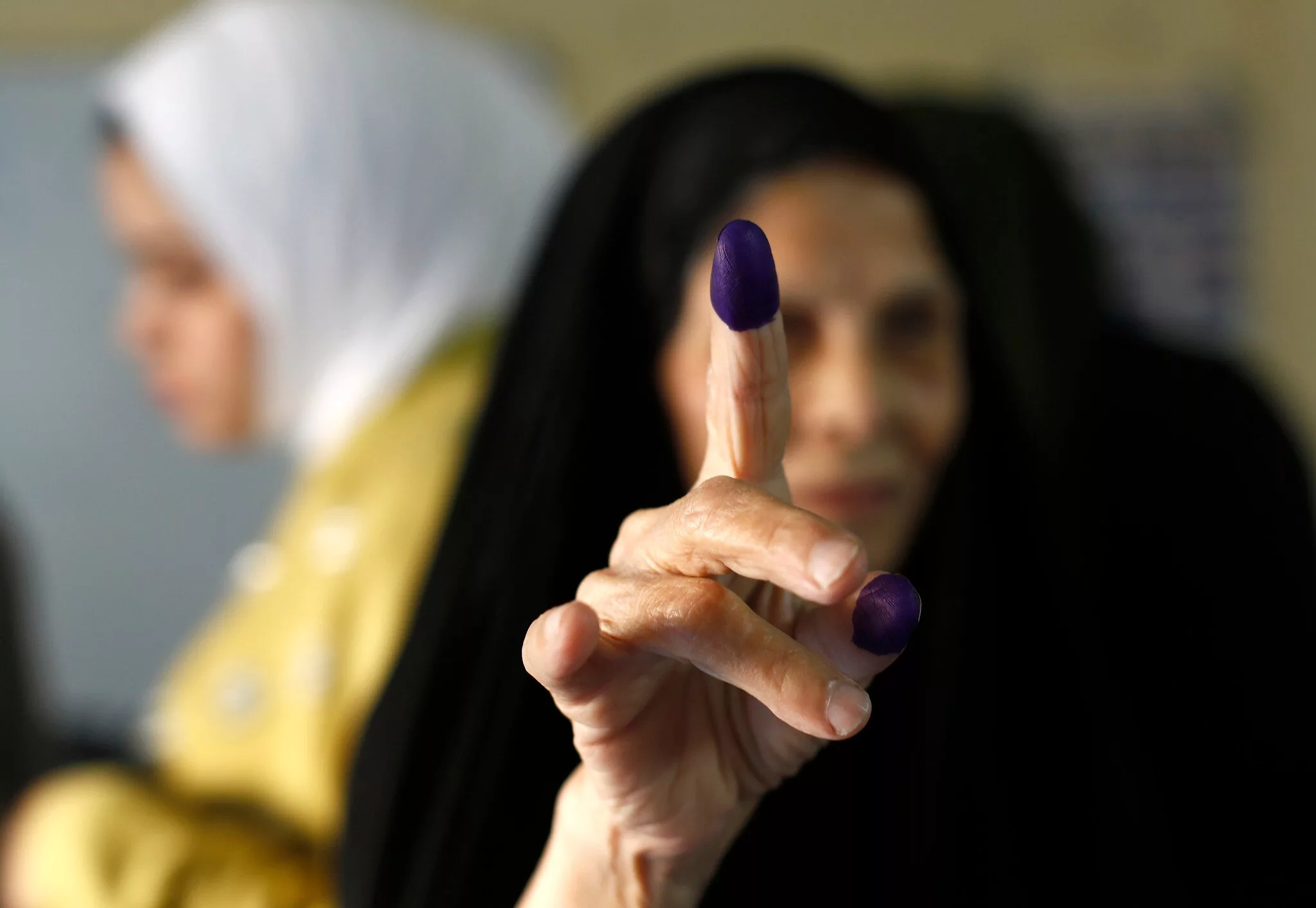
Iraqis are almost unanimous in believing that the scenarios after the 2025 elections will not differ much from those following the five parliamentary elections conducted since the constitution was adopted in 2005. Whether in the repeated dominance of the same political blocs over executive power, or in the lengthy negotiations to form a government that usually stretch for many months, or in the inability of the vote’s winner to actually form a government.
In short, Iraqis believe that elections are not the optimal path to real change and reform in the country, and they believe that their outcomes will not reflect positively on everyday life or end their suffering which explains the large abstention among Iraqis.
But will the post‑2025 election scenarios simply replicate those of the past? Perhaps it is difficult to answer a straightforward “yes” or “no”. What is expected is that the scenarios after the forthcoming elections will not differ radically from those following the five elections since 2005.
Yet there will be small but also potent differences, owing to the geopolitical changes in the region.
Political blocs are already preparing for the post‑election phase next month re‑dividing powers and gains among themselves and the number of parliamentary seats each bloc secures will be the key card they play in their internal power and profit struggle.
It is not necessary that the post‑2025 election scenario will mirror that of 2021, which witnessed fierce confrontation between Shiite blocs particularly between the Sadrist Movement and the Coordination Framework even fighting at the gates of the Green Zone.
The reason is that the Sadrist Movement will not participate in the upcoming elections, and therefore will not enter into a conflict over governance with the Coordination Framework.
As for the parties of the Coordination Framework, it is not expected that there will be a major internal conflict among them as occurred with the Sadrists. That is because these Iran‑aligned parties feel the threat of U.S. intentions to exclude them from governance.
This threat of marginalization will make them unite in “herd‑policy” fashion to preserve their power and gains from the political process.
On that basis, the next political struggle will occur at a different level. With the absence of the Sadrists, the Coordination Framework parties will likely monopolize the Shiite component’s share in parliament, albeit with a slight drop in their seats due to the boycott by the Sadrists and certain other Shiite blocs.
The results of this boycott will emerge in mixed‑sect areas such as the provinces of Baghdad, Diyala, Babil and Salah al‑Din, where the chances of Shiite parties will be less than usual, in favor of Sunni parties.
More dangerous than all this is the fear of the Coordination Framework parties that Shiite voters may resort to “punishment votes” and give their ballots to Sunni or civil blocs opposed to the Framework which will complicate the Framework’s task of forming a government inside the Iraqi parliament.
And if we know that a not‑insignificant number of deputies from the Coordination Framework will come from parties that have armed wings and are listed on the U.S. terrorism list, then the Sunni and Kurdish parties will find themselves in serious embarrassment in forming alliances with the Framework under this geopolitical condition.
This will create a new political situation that cannot yet be predicted and will become a conflict between the Coordination Framework parties and Sunni and Kurdish parties to form the government.
But perhaps after the 2025 elections we will witness unprecedented alliances in the Iraqi political scene for example, a coalition of Kurds and Sunnis with some civil parties and independents, to form the government and break the political norm that the premiership is exclusively a Shiite domain. This scenario would represent one of the greatest fears of Iran and its Iraqi allied parties.
In this context, MP Raed al‑Dahlaki (Sunni, Azm bloc) affirmed that “Sunni parties aspire to obtain 150 parliamentary seats, and if they win a majority then they have the right to demand the premiership this is a popular entitlement, not a gift from anyone.”
What will be the position of the United States? In recent years U.S. influence in Iraq’s political equation has sharply declined, and Washington has left Iraqi affairs mostly to Iran to assume the larger share of influence.
But after the “Al‑Aqsa storm” (referring to the Gaza war) and its consequences in changing the balance of power in the region, this has been reflected in the U.S. view of Iran and its proxies operating in the region.
We have seen that reflected in the striking of Hezbollah in Lebanon to the extent that it was taken out of the military equation, then the change in Syria which happened with either blessing or non‑interference by most active countries in Syria, including the U.S. and Iran emerged in Syria as the largest loser and its axis was severely damaged.
Washington now thinks that wresting Iraq from Iranian hegemony is a matter of the moment, and it must do everything for this goal. It sees the upcoming elections as an ideal opportunity to influence their outcomes to form a government that is pro‑American rather than pro‑Iran, one that works to dismantle and dissolve the Iranian‑aligned armed factions in Iraq.
In line with what has been noted, the expectation is that Washington will strongly back a Shiite figure more aligned with it, who will work to dismantle the armed factions or integrate them into government forces, and gradually distance itself from Iran.
In this regard, the current Prime Minister Mohammed Shia al‑Sudani is seen as the most likely candidate to win U.S. favour, given his alignment with U.S. conditions. On its part, Washington is ready to bet on him to implement its vision in Iraq.
It is necessary to know that al‑Sudani, or any Shiite party, will not be able to form a government alone without the agreement of Sunni and Kurdish parties. It is not surprising that Washington will work to provide political support for him inside the Iraqi parliament from Sunni and Kurdish blocs, along with some small civil parties and Shiite parties aligned with it, so he can form his next government.
Another scenario surfaces if the above expected scenarios fail: Washington might instead lean on the legitimacy of the elections. It is known that large social segments will boycott the upcoming elections, in addition to the boycott of the Sadrist Movement, which will heavily impact the Shiite component in the political equation.
The Sadrists and other boycott‑actors aim to undermine the legitimacy of the electoral process and place their political opponents in a difficult position.
In this case, Washington could resort to this scenario and challenge the elections’ legitimacy if their outcomes are not comfortable for it, and it might cease to present the Iraqi government to the world as a legitimate representative of the Iraqi people.
Especially since the upcoming elections will include a number of armed factions estimated at about 20 groups and lists representing “factions” and political groups that possess “armed wings”, which is a clear violation of the Iraqi constitution, which prohibits armed factions’ participation in the electoral process.
Based on the foregoing, Washington can exploit this point to impose a rerun of the elections if outcomes are not to its liking, and will also force the re‑drafting of an electoral law that will not be like the current law, which serves the parties of power.
According to the latest report by the U.S. newspaper The Hill, it was revealed that Iranian agents infiltrated the Iraqi Electoral Commission and manipulated the process before any votes were cast, pointing out that “the results are written in Tehran”.
The report stated that parliamentary seats are allocated in advance among groups that include militias and political allies connected to what is called the “resistance” axis backed by Iran, as well as Kurdish and Iraqi groups drawn into Tehran’s orbit. And the report pointed out that Iranian influence extends to every corner of Iraq and that Washington must decide by November 11 whether it will resist or surrender. (FDD)
It asked: “What message will Washington send if it abandons Iraq to its biggest regional adversary?” stressing that “America is indebted to Iraq for the opportunity to live free of Iran’s grip.”
The most dangerous and final scenario that the Donald Trump administration could resort to is the acceleration of passing the “Free Iraq from Iran Act”. This legislation, led by U.S. Congressman Joe Wilson and Senator Jimmy Panetta (Democrat), aims to support the Iraqi people’s aspirations to be rid of Iranian influence, working on mechanisms to support democracy, rule of law and human rights in Iraq.
According to the law’s text, the U.S. Secretary of State, in cooperation with the Treasury Secretary and the CEO of the U.S. Global Media Agency, must develop a strategy and submit it to Congress to support the Iraqi people’s efforts to remove the Iran‑backed militias including the Popular Mobilization Forces end Iran’s dominance over Iraq’s political system, and suspend U.S. security assistance to the Iraqi government unless all Iranian‑backed militias are dismantled, cease terrorist support, and are kept from holding any governmental positions.
The executive plan also includes classifying all Iranian militias in Iraq (without exception) as foreign terrorist organisations.
These are some of the steps included in the law, which has been submitted to the Foreign Relations and Judiciary Committees, awaiting the Speaker of the House to schedule it for a vote. From reading the text of the law, it appears as though it declares a war on Iran inside Iraq, stripping it of all its tools of influence in the country.
If the scenario Washington intends to apply in Iraq succeeds, and it secures a government close to its orientations and further from Iran, then the subsequent phase and the more important one will follow: the phase of dismantling and dissolving the factions close to Iran, which is the task aligned with the “Free Iraq from Iran Act” if passed.
It is expected that the United States will throw its full weight behind the new government, with the involvement of the Iraqi Counter‑Terrorism Service and full U.S. air cover to deal with those factions if they refuse to dissolve and disarm.
This task, though difficult for the Iraqi government, will enjoy wide popular support from Iraqis, who have long complained of the armed factions’ intrusion into all spheres of their lives and their seizure of the country’s resources.
Iran’s position on the elections
Iran fears losing its influence in Iraq, because that would mean it would lose its most important instrument of leverage in the Middle East, after losing two of the four capitals it once took pride in controlling.
While the war with Israel weakened its ally Hezbollah in Lebanon and it lost Syria to other rivals in the region, the United States now faces a real opportunity to change the political status quo in Iraq and bolster its influence.
It is worth noting that Iraq is one of the most important countries for Iran, both economically and strategically. It benefits as a conduit to bypass sanctions, and Iran‑aligned Iraqi militias such as Asaib Ahl al‑Haqq and Kata’ib Hezbollah dominate a large share of Iraq’s economy, allowing Tehran to finance its regional operations.
In order not to lose Iraq, Iran has made many and major concessions, wary of provoking Washington or striking its allied factions and destroying its influence there. For example, Iran advised its Iraqi allies to halt attacks for fear of a U.S. reaction.
It also instructed its Iraqi affiliates to release the abducted Elizabeth Tsurkov, pass a previously rejected financial amendment benefiting Kurdish allies of the U.S., and drop an arrest warrant for U.S. President Donald Trump.
Still, despite its relative weakening in Iraq, Iran retains effective tools there. It remains capable of influencing Iraqi elections as it did in most past parliamentary elections in Iraq and it has succeeded in forming governments close to it.
Accordingly, it wants to replicate the same in the upcoming elections, especially since it still has considerable influence over the Electoral Commission and the Federal Court that ratifies election results.
But if the United States this time insists on overseeing Iraq’s upcoming elections in October/November 2025 and ensuring their transparency, it will be able to limit Iran’s influence over the electoral outcomes.