
From his earliest steps in the world of journalism and media, Asaad Taha was never chasing a captivating image to impress the audience. Instead, he was seeking meaning something that could pierce through the darkness. He charted paths to the edges of the world, wearing the badge of a journalist, infused with the spirit of a human storyteller one who sees salvation in the tale and a test in the journey, convinced that places have souls that speak to those who listen, and listen to those who speak.
We came to know him as he ventured into the “gray zones” that others feared places he saw as mirrors of truth, especially when the light had faded from them. He has written, directed, and presented, but his most profound impact lies in his unique narrative style, where precision meets calm, and objectivity merges with contemplation. For him, words are acts of faith in humanity and in its ability to survive even when ruin spreads and hope narrows.
In this special conversation with Noon Post, we delve into the experiences of writer and journalist Asaad Taha, exploring his philosophy of the never-ending journey, the wisdom of walking toward the unknown, and his reflections on culture, freedom, and the role of Syrian intellectuals in transforming wounded memory into a unifying awareness. We ask what it means to be both a witness to the world and a believer in it, all at once.
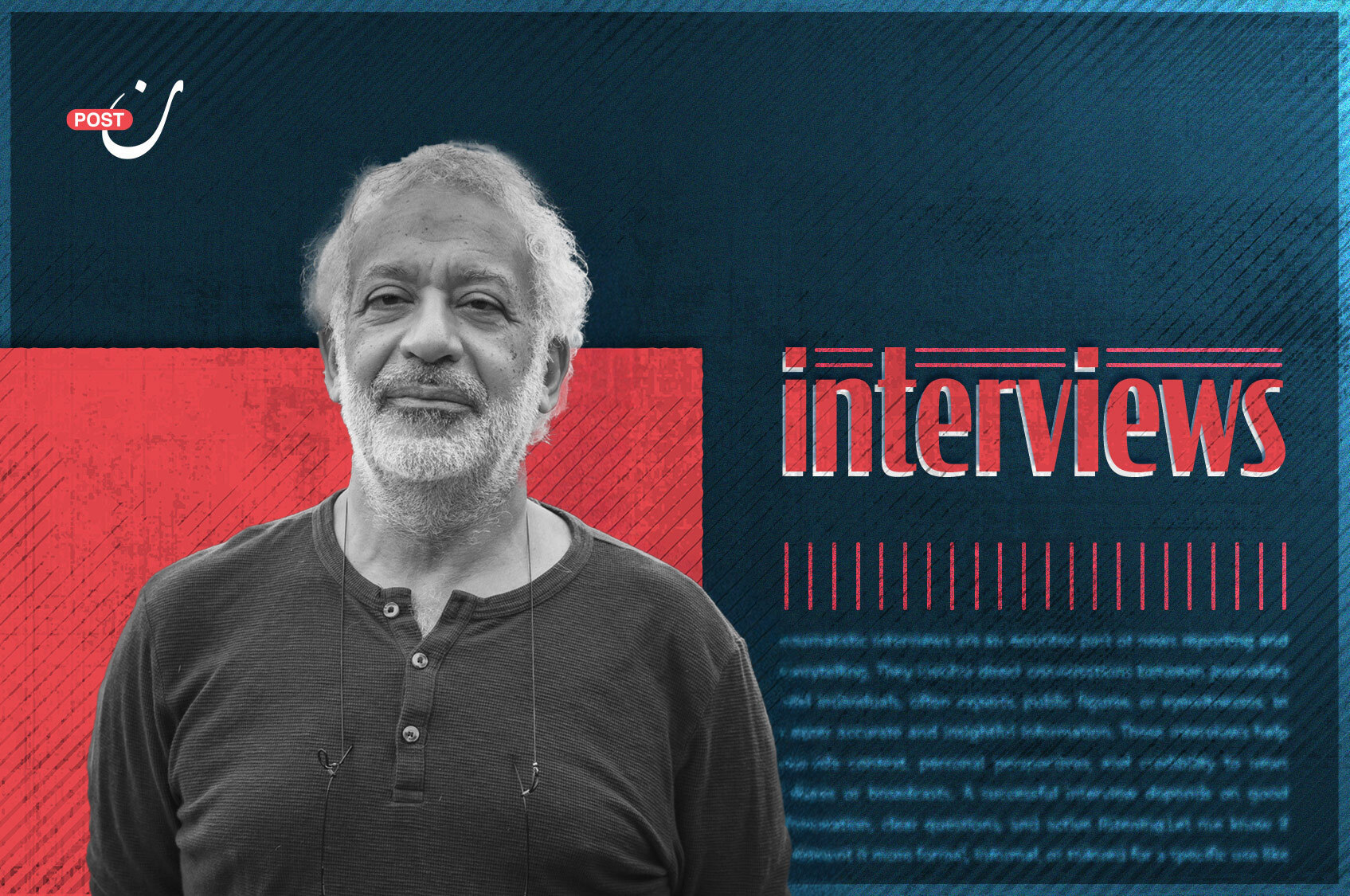
Asaad Taha is an Egyptian journalist, writer, and documentary filmmaker known for his narrative style and investigative, human-centered work in conflict and crisis zones around the world.
He began his career as a field journalist in the 1990s and rose to prominence through his coverage of wars and conflicts in what he terms “gray zones” places like Chechnya, Bosnia, Kosovo, Sudan, Somalia, Yemen, and others that often fall outside the media spotlight.
Yet he is far more than a war correspondent. Taha is a storyteller in pursuit of meaning, treating journalism as both an ethical mission and an inner journey as much as an external one. His most well-known programs include Hot Spot and Once Upon a Time. We sat down with him for this conversation.
You often travel to what you call “gray zones” in history and geography. What draws you to these worlds that others avoid?
What’s the wisdom in doing what everyone else does, in saying what they say, or revealing what they’ve already discovered? Why not do something different shed light on places or issues that have been forgotten or covered in layers of silence, ignorance, or indifference? Why not journey to places that are neither black nor white and lift the veil hiding them from the world?
That’s what I told myself.
I asked myself: Why not travel to the forgotten places, the marginalized issues those that rarely see the light? Then come back to recount what I saw, to give voice to the unheard, and reveal truths that have long been buried.
I go with the spirit of both an explorer and a storyteller. Whether through investigative journalism, literary writing, documentaries, or any form of storytelling I aim to give voice to the silent and sight to the unseen.
And if those places happen to be zones of war, crisis, or conflict if the cost is high the reward is doing something meaningful. Perhaps it won’t change the world, but it’s a step in the right direction. It’s what I can offer: to draw attention to hidden stories in Central Asia, the Philippines, Thailand, the Arctic and beyond.
You wrote that life is not a destination, but a journey and that its value lies in the path, not the arrival. Based on that philosophy, what has remained constant within you despite the changing faces and places over your long travels?
The journey means reflection. It means not passing through places or experiences without pausing to think deeply.
It means reassessing your beliefs and ideas. Each moment of reflection improves the quality of your life, helping you shed ideas proven through experience to be flawed or not suited to you, while strengthening those that remain true.
The most beautiful and dangerous gift from God is the “blessing of choice.” It’s limitless, but also exhausting. At every step, you must choose. It’s hard, but incomparable in its sweetness.
If others choose to act like beasts, then choose to be human.
If their definition of victory lies in material gains, your real triumph is staying true to your principles even if you lose everything else.
I might fail in school then try again. I might lose a job then replace it, even if it’s hard. The same applies to any part of life. But in the afterlife, there’s no redo. You choose in this world and must answer for it in the next.
It’s a simple truth, part of the foundations of our faith, but we forget. Even I, speaking to you now, might be crushed by life at times but by God’s grace, I always find my way back. My faith remains my constant.
In your essay “Did You Smell the Prophet’s Fragrance?” from your book Once Upon a Time, you recount a man far from the Arab world sensing a sacred aroma from you reaching out as if to touch a divine secret. That moment raises a painful question: Have Arabs truly realized that they are entrusted with this message?
We are walking in the wrong direction except for those whom God spares. Others are trying to rise, to dust off their faith and breathe new life into it. We now see young men and women courageously advocating for their religion through a contemporary lens. Sure, there may be flaws, but that’s natural.
Nothing buried rises perfectly. It stumbles, and its appearance may be imperfect.
Even people of other faiths, by the grace of God and perhaps thanks to October 7 are either embracing Islam or at least realizing how grotesquely it has been misrepresented.
Meanwhile, we remain fragmented countless factions, attacking and even excommunicating one another. We’re still lost. Still harsh with each other. Is there hope? I don’t know. So blessed is the one who survives.
Many see you more as a friend than a teacher even among your students, trainees, and audience. How do you maintain such humility in your tone? Is it part of your journalistic philosophy or simply who you are?
You can’t speak to people from a pedestal telling them what they must or must not do. You must be among them, with them. Share what you have with gentleness. Don’t get angry if someone criticizes you or rejects your ideas. Listen perhaps you’ll benefit too.
Also, just because you’ve worked hard and achieved something doesn’t mean you’re right about everything. Humility isn’t merely good manners it’s the truth. You are just like them. Some may even surpass you.
I don’t live my life in two modes one for journalism and another privately. I am the same person in both.
I like to believe I’m a friend to my children, and a friend to young people. Their messages and interactions with me make me feel that deeply. And it brings me great joy.
What role can intellectuals play in mending what’s broken in our region’s societies?
To me, the word “intellectual” feels heavy like those ornate salon couches covered in fabric so they’re never used, saved only for a certain class of guest.
An intellectual isn’t defined by the knowledge they carry, but by the burdens they’re willing to bear to make life better for themselves and others. A foolish intellectual sings the praises of freedom but is never ready to pay its price.
A pitiful intellectual stays detached from the street never mingling with people, never exchanging ideas with them.
Intellectuals must step outside their towers. The times have changed. We need each other. It’s better to draw closer than to stubbornly cling to your own idea without listening to others or accepting difference.
We are living in an era of “understanding crisis.” We won’t survive if we continue to look down on each other.
After years of repression under Bashar al-Assad, where culture was subdued and voices silenced, what responsibility do you believe Syrian intellectuals now bear in transforming wounded memory into a force for unity and reconstruction?
Documentation. We can’t simply turn the page. We must not document out of hatred but out of love. We don’t want the nation to fall again. We want to tell future generations: Look at what happened. Let it not be repeated. Do everything you can to ensure another dictator never emerges.
And by documentation, I don’t just mean records, books, and academic research. I mean novels, stories, films every form of literature and art.
This documentation must meet the highest professional and creative standards. Only then can it withstand the sweeping forces of modern media and captivate audiences, make them pause, reflect, and learn.
In a chaotic media landscape with endless platforms, what do you believe ensures that Arabic writing remains truthful and ethically responsible to its audience?
It must be authentic. It must be truthful. It must reflect real people their joys and sorrows, their beauty and their pain. And it must be light and graceful.
Yes, every generation differs from the one before but this generation is truly unique, with all its strengths and flaws. Reaching them isn’t easy.
You have to understand them first, accept that they’re different from you, and find the right “language” to speak to them.
Make them fall in love with their Arabic language again. Help them cherish it. Help them stop being ashamed of using it.
What’s your advice to the new generation of journalists and writers facing restrictions and setbacks?
You’re living in tough times no doubt. But you have tools previous generations could only dream of. Use them. Don’t speak from the pages of books speak from life. Be a mirror to reality, so people can see their beauty reflected and recognize their flaws to overcome them.