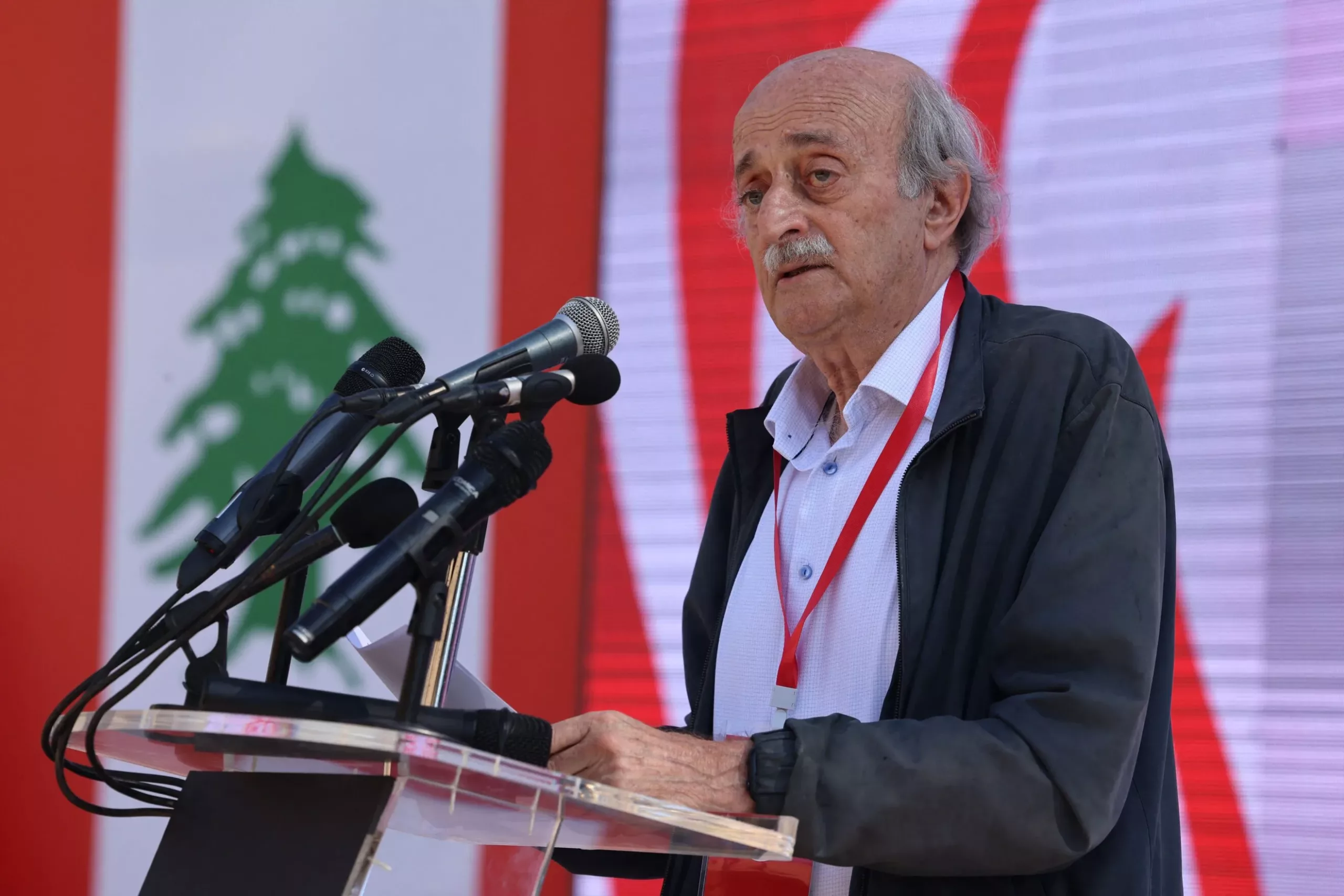
In a Lebanese scene where traditional leaderships are eroding under the pressure of economic collapse and regional transformations, Walid Jumblatt remains an exceptional case, one difficult to categorise. He is the scion of a venerable political lineage reaching back into Mount Lebanon in the nineteenth century, heir to the Druze‑nationalist leadership that his father, Kamal Jumblatt, fashioned at the height of the Cold War.
Yet at the same time, he is a pragmatic politician who has survived every storm that has buffeted Lebanon from the civil war to the present day, moving with remarkable flexibility between axes without losing his position or symbolic significance.
A figure such as Jumblatt is not simply the narrative of a Druze leader’s biography, but a mirror of Lebanon itself a country oscillating between sectarian loyalties and national projects, between bloody memory and shifting interests.
In his person the family, the sect, the party and the state intersect; the continual tension between paternal legacy and the political realism imposed by the collapse of grand ideologies after the civil war is laid bare. With the leadership recently passing to his son Taymur Jumblatt, a deeper question arises:
Does Walid Jumblatt represent the last of Lebanon’s traditional leaders those who combined sectarian symbolism and political cunning, personal charisma and inherited loyalty networks? Or does Jumblatt symbolise the end of an entire era of hereditary leadership, and the beginning of a new phase in which the boundaries between authority, family, and sect erode?
In this article, we attempt to read Walid Jumblatt’s political and intellectual trajectory as a symbolic case of Lebanon’s leadership transformations: from feudalism to modern sectarianism, from ideological discourse to pure pragmatism. We explore how Jumblatt managed to preserve his political existence in a country where everything changes except the fragility of the system itself.
The Inherited Leadership and the Forced Transfer (1949–1977)
The legitimacy of the Jumblatt leadership derives from deep historical roots, symbolised by the palace at Moukhtara in the Chouf, which the family inherited since 1712. In contrast to traditional feudalism, Kamal Jumblatt founded the Progressive Socialist Party (PSP) in 1949 on advanced intellectual principles including socialism, humanism, and a call for secularism and social justice.
Despite the party adopting a cross‑sectarian orientation, most of its supporters remained within the Druze community. Kamal’s political struggle centred on confronting “political Maronism” in Lebanon and supporting the Palestinian cause, making him a key figure in the Lebanese National Movement.
The assassination of Kamal Jumblatt in March 1977 widely thought to have been carried out by the Syrian regime marked a pivotal turning point in Lebanese history and in Walid Jumblatt’s trajectory.
It forced Walid, then a young man not fully prepared, to assume the leadership amid civil war and under a familial history weighed down by violence and assassinations.
This forced transition presented a dual challenge: commitment to his father’s revolutionary ideological legacy, or choosing a path that ensured the family and the sect’s survival.
Walid’s political response to his father’s killing was a radical transformation. While Kamal paid his life for ideological purity amid fierce regional conflicts, Walid realised that leading required adapting ideology to the sectarian reality and war.
He hoisted the Druze standard, reigning the Jumblatt leadership as protector of the mountain, which required a departure from his father’s inter‑sectarian ambitions, instead favouring the traditional role of sectarian guardian. Through this strategy he ensured his prolonged survival, unlike his father and grandfather.
The contrast between father and son is evident: Kamal adhered to a foundational philosophy of socialism, humanism, secularism and revolutionary character. Walid, by contrast, adopted political realism and sharp pragmatism as his survival philosophy, while embracing Druze religious identity. His main axis of conflict also changed: whereas Kamal focused on confronting Maronite political power and right‑wing nationalist causes, Walid’s focus turned to managing regional balances and ensuring self‑protection of his mountain domain.
Even in the mode of succession there was divergence: Walid’s succession followed his father’s assassination (a forced, sudden handover), while Walid himself later executed a controlled, gradual handover to his son Taymur, becoming the first in his family to transfer leadership while still alive.
Pragmatism as a Philosophy of Survival
Walid Jumblatt is often described as “the constant and the shifting” in politics. The constant is the interest in Moukhtara, mountain security, the stability of the Druze community concepts at the core of the Druze inner ethos; the shifting pertains to external alliances.
This school relies on “political realism” and the reading of regional and international developments that force changes of position, considering interests in politics superior to ethics. Through this astonishing flexibility, he permitted himself to play the role of the “swinging egg” in Lebanese politics.
The clearest example of this realism is his dealings with the Syrian regime. Despite the prevalent belief that Damascus was behind his father’s assassination, Walid Jumblatt extended a hand of cooperation to Hafez al‑Assad a mere forty days after the killing.
This extreme turn amounted to sacrificing personal and ideological vengeance to ensure leadership continuity and sectarian protection, turning him into one of Damascus’s key political arms in Lebanon.
Yet this relationship was not fixed. When Jumblatt sensed the Syrian regime’s weakness at the turn of the millennium, he turned against it and joined its opponents during the Cedar Revolution.
In another context, his strained relationship with Hezbollah is also a model of pragmatism. After the Syrian army’s withdrawal, Jumblatt confronted Hezbollah openly, but his defeat in the events of 7 May 2008, which he later admitted were a “miscalculation,” led him to “fold the page of enmity” and join the very alliance he had fought, before once again moving to another camp. This behaviour confirms that for him, there are no permanent enemies or allies in politics only survival and security that compel a turn “for the sake of the phase.”
His pragmatism provides the theoretical frame for such manoeuvres: instead of admitting ideological defeat, Jumblatt declares that his moves are an advanced reading of history and global conditions; hence he famously said he “forgave those who killed my father but did not forget.”
His political realism wasn’t limited to external alignments it also extended to his complex internal role. While he was the Druze leader during the Mountain War in 1983 (which saw civilian displacement), he also engineered the historic “Mountain Reconciliation” with Patriarch Nasrallah Safir in 2001. Such contradictions underscore his capacity to transcend bloodshed in favour of shared mountain stability.
Yet in the post‑Taif era a critical debate emerged around Jumblatt’s role in the corruption system. Within the context of what was called the “national reconciliation,” he assumed the Ministry of Displaced Affairs a tenure some described as a model of “systematic fraud and public funds plundering” where his pragmatism guaranteed mountain security and self‑protection, but also entailed engagement in internal power‑sharing mechanisms built on quota and corruption, as part of the heavy price for political survival.
Walid Jumblatt as Intellectual and Media Phenomenon
Jumblatt stands out as one of Lebanon’s more “cultured” figures. His intellectual depth granted him flexibility in public discourse, as evidenced in his engagement with historical‑social works such as the trilogy “Land of the Black” by Abd al‑Rahman Munif, reflecting the traditional leader’s anxiety at the collapse of intellectual structures amid political breakdown and prompting him to call for a “return to the intellectual and spiritual past” amid waves of change.
This cultural depth provided a philosophical justification for his acute political manoeuvres, contributing to what is described as his “ambiguous personality” a dualism between elite intellectualism and sharp political utility since Jumblatt views history as a reference point for preserving “Druze politicality”, thereby framing his concessions as strategic wisdom rather than ideological defeat.
He also harnessed social media, especially sardonic tweets, as a strategic tool to generate “managed political ambiguity”. His style is marked by irony and “wit,” even “mockery,” in dealing with serious matters particularly those concerning the presidency.
This mockery is not simply a personal trait, but a political tactic: it allows him to test the waters without full commitment and reduce the cost of retreat. When he later corrected a tweet about “empty crates” that provoked the ire of Nabih Berri, he was able to frame the retreat as a “misunderstanding” or “joke”, rather than an exit from a serious position.
Also, his language of ambiguity (such as “the password is encrypted, you guys decrypt it”) aims to confuse both opponents and allies, reinforcing his role as the “swinging egg” reliant on temporary instability.
The Question of the Final Leadership and the Transfer to Taymur
Walid Jumblatt faced a difficult test during the Syrian revolution of 2011 and thereafter, when he chose to side with the Syrian regime in its confrontation with Syrian Druze thereby placing “political calculations” above “sectarian solidarity.” This choice proved disastrous, as it cost him the “trust and backing” of Druze in Syria who represent the strategic and geographic depth of the sect.
As a result of this decline his regional influence shrank to within Lebanon’s borders only, after he had once been considered “the supreme reference for Druze in the region.”
This regional retreat paved the way for the emergence of cross‑border alternatives such as Hikmat Al‑Hijri and Mowafaq Tayr (the spiritual Druze leader in Israel), indicating a serious erosion of absolute leadership. Domestically, “voices of change” began to rise, reaching the Druze sheikhs who once served as his traditional safety network.
In his final political move, Jumblatt carried out what might be described as his ultimate pragmatic act: the organised handover of power to his son Taymur. His resignation was not sudden, but came after a gradual transition that began in 2017 Jumblatt became the first leader in his family’s history to hand over the leadership while still alive.
He placed the “leadership keffiyeh” on Taymur’s shoulders, asked him to carry “your grandfather Kamal Jumblatt’s great legacy,” and in 2018 withdrew from parliamentary work, nominating Taymur for elections. In 2023, he announced his resignation as head of the PSP, calling for a general electoral conference.
The aim of this process was to cosmetically refurbish the traditional leadership with a superficially “democratic” party covering, ensuring a smooth, non‑violent transfer and institutional legitimacy for succession.
Jumblatt did not withdraw completely, declaring that he would remain “an adviser to my son,” emphasising that “the future is his, not mine,” while acknowledging that the era of the charismatic absolute patriarchal leader was over.
Walid Jumblatt, who led for over four decades, embodied the final chapter of the Lebanese traditional leadership model which combined feudal authority, personal charisma and absolute regional influence. He succeeded in surviving by mastering the art of “political realism,” what he called “the constant and the shifting,” with the only constant in his equation being the mountain’s security and the Druze community’s stability.
His organised handover to Taymur coincides with deep‐geopolitical transformations that confirm the end of the Jumblatt‑father era. On one hand, this transition synchronised with the decline of Hezbollah under regional and international pressure, and Israel’s war on Lebanon, which provided the space for the manoeuvring Jumblatt excels at.
On the other hand it represents an attempt to rescript the relation between Lebanese Druze leadership and the sect’s strategic depth in Syria, especially after the previous alignment in the Syrian war cost him the trust of Druze across the border.
Perhaps the clearest indicator of this adaptation is Jumblatt’s recent rapprochement effort with Ahmed al‑Sharaa in Syria a final turn to link Druze leadership in Moukhtara with a “new rising authority” in Syria to compensate for the regionally depleted influence which contracted to within Lebanon’s borders only.
It stands as a fortification of the political entity in the post‑absolute‑leader era, and an acknowledgment that the next leadership will not be a supreme regional reference but a local civilian leadership whose central task is to manage the fragile balances of a country in which traditional heavyweights no longer have, what was once theirs, more than a narrow game of survival.