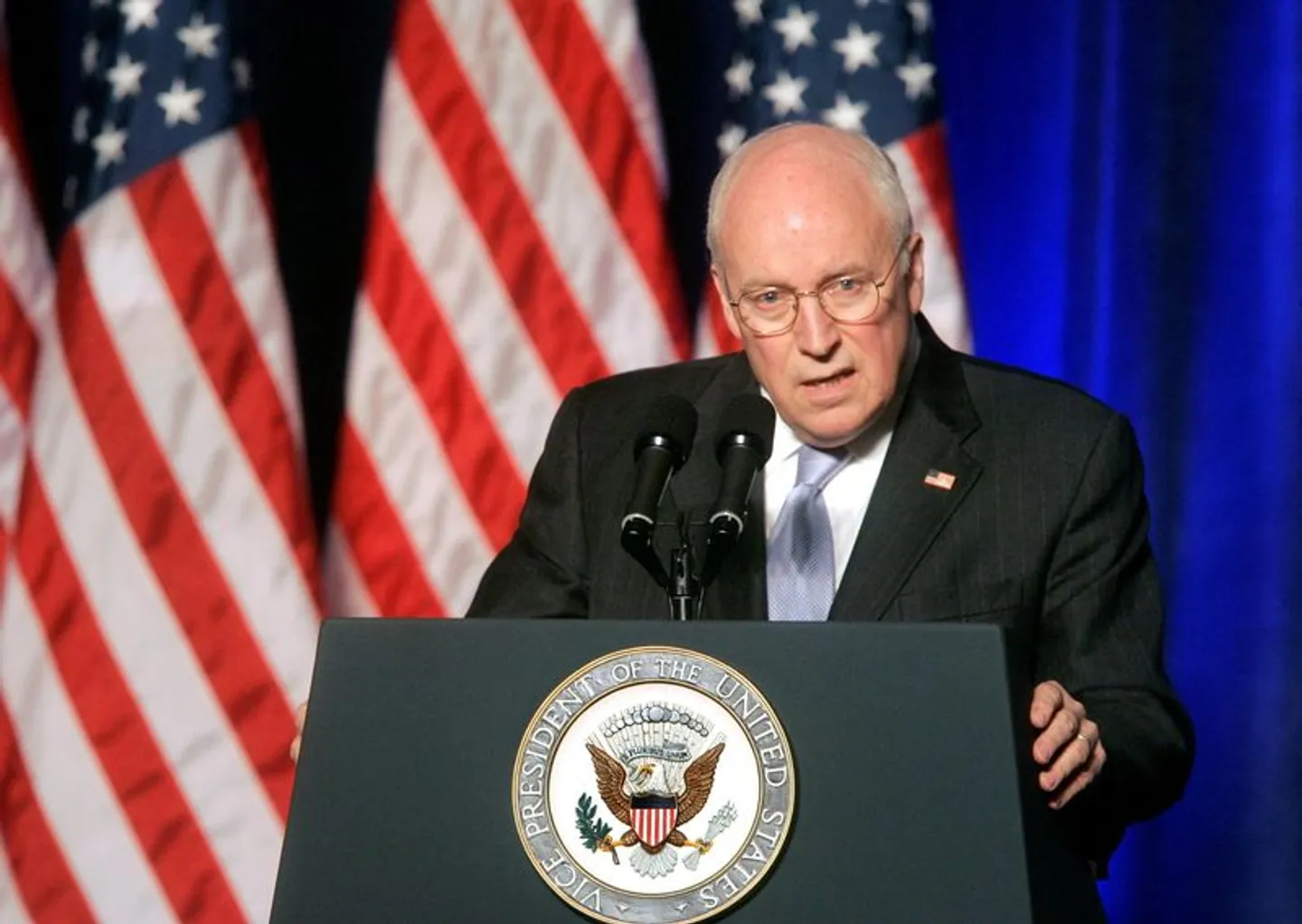
On the evening of Monday, November 4, 2025, the death of one of the most hardline hawks in American politics, Richard “Dick” Cheney, was announced. He passed away at the age of 84 after a long battle with heart and lung disease.
Cheney was not just another political figure who came and went; he was one of the architects of the darkest chapters in the modern history of the Middle East a man whose name has echoed in the memory of Iraqis from the era of George H. W. Bush to George W. Bush, whenever war, sanctions, or occupation are recalled.
I hesitated for a long time before writing about his death. Such figures are not to be mourned, but to be examined. Yet memory loss is an even greater danger than a lack of awareness and so I felt compelled to revisit, with the Iraqi and Arab reader, the file of a man who symbolized the American raven that cawed death over Iraq, from the late 1980s to the early 2000s.
Cheney was not merely an official implementing policy; he was the mind that theorized destruction in the name of security and justified invasion in the name of freedom. From the moment he led the Department of Defense during the 1991 Gulf War, he began outlining a new strategy with one clear goal: to weaken Iraq to the point where it could no longer function as a state.
After the war, he remarked in a televised interview: “We’ve done the job. It’s not wise to lose more American soldiers just to topple Saddam. What matters is keeping him under control.” From that single sentence sprang the first threads of a tragedy that would span twelve years of sanctions, culminating in the 2003 invasion that shattered the state and society alike.
This article attempts to revisit that chapter through the lens of history, not rage—to understand how Cheney crafted the grand lie that led to Iraq’s devastation, and how he evolved from a bureaucrat into a raven cawing destruction within the corridors of the White House.
Engineering Sanctions and Sowing Hostility
At the end of the 1991 Gulf War, Iraq resembled a body battered by airstrikes—its regime intact but its infrastructure decimated. In Washington, a different kind of war had begun: a war of sanctions, which Cheney intended to make both enduring and effective.
As Secretary of Defense under George H. W. Bush, Cheney emerged from that war convinced that Iraq should never be allowed to regain strength. In a National Security Council session, he stated his core belief: “Leaving Saddam in power may seem like temporary stability, but in truth, it’s a dangerous illusion.”
From that doctrine emerged the policy known as “dual containment,” which became a cover for a sweeping sanctions regime that crippled Iraqi society and dragged the country decades backward. The sanctions, imposed in 1991 and maintained until 2003, barred Iraq from importing food, medicine, and essential technologies. According to UNICEF, they caused the deaths of hundreds of thousands of children from hunger and disease.
Though he left the Pentagon in 1993, Cheney remained an influential force from another perch: the corporate world of oil and defense. In 1995, he became CEO of Halliburton, the energy and engineering firm that would later serve as the economic arm of the U.S. war effort in Iraq.
During those years, Cheney opposed any talk of lifting sanctions, arguing that “the goal of the embargo isn’t to punish the Iraqi people, but to ensure Saddam doesn’t threaten the region again.”
In reality, the sanctions punished millions of innocents, becoming a systematic tool to dismantle both the Iraqi state and its social fabric.
By the mid-1990s, Cheney was drawing closer to Washington’s neoconservative circles, which advocated for regime change in Baghdad. In 1997, a think tank named Project for the New American Century was born, and Cheney was a key signatory of its founding statement, which openly called for the use of military force to oust Saddam Hussein.
In a 1998 letter from the project addressed to President Bill Clinton, the authors stated: “The only way to guarantee the safety of the United States is to remove Saddam Hussein from power.”
Thus, Cheney evolved from a former Defense Secretary into a political architect of a war yet to be launched. He knew time was on his side and that the American public hadn’t forgotten the images of Kuwait’s invasion or the specter of weapons of mass destruction. He cleverly harnessed those fears to keep Iraq labeled as a ready-made enemy.
When asked in 1998 about toppling Saddam by force, Cheney replied with a cold prescience: “Whoever brings down Saddam must be ready to stay there for a long time, because what follows his fall won’t be easy.”
It was a prophecy as much as an admission: the coming invasion would not bring liberation, but a protracted chaos. Ironically, Halliburton Cheney’s former company—was among the first to profit from that chaos, receiving multi-billion dollar contracts to “rebuild” the very Iraq Cheney had helped to destroy.
From 1991 to 2001, Washington subjected Iraq to the longest and most exhaustive campaign of attrition in its modern history. Behind every sanctions decision, every congressional speech, and every renewal of the embargo, stood Dick Cheney—calmly orchestrating the collapse.
He succeeded in shifting Iraq’s status from “a rogue state” to “a permanent enemy.” And from that status, Iraq would soon become the first target in America’s new war on terror.
Fabricating the Grand Lie (2001–2003)
The morning of September 11, 2001, changed the world. As planes slammed into the Twin Towers, fear overtook the American psyche. It was at that very moment that Dick Cheney emerged from the shadows to lead one of the most dangerous transformations in U.S. political history: the shift from a war on terror to a war by pretext.
For Cheney, 9/11 was a painful but opportune gift a chance to reshape the global order in line with the vision he had advocated since the 1990s through the Project for the New American Century. From the earliest hours after the attacks, he pushed to expand the circle of blame to include nations with no direct connection chief among them: Iraq.
In his book Plan of Attack, journalist Bob Woodward recounts how Cheney, just hours after the attacks, told a closed-door White House meeting: “We must go after those who gave safe haven and support to terrorists whether they were involved in the attacks or not.”
Thus, Iraq was placed under suspicion before any investigation had begun. Cheney believed that the war in Afghanistan would not be enough to restore U.S. dominance. The real target was Baghdad, the ultimate symbol of resistance to Washington’s will in the Middle East.
From Fear to Media Manufacturing
Between 2001 and 2002, Cheney spearheaded an extensive political and media campaign to build public support for war. In an August 26, 2002 speech to veterans in Nashville, he declared unequivocally: “There is no doubt that Saddam Hussein has weapons of mass destruction. If we don’t act now, he’ll use them against our friends—or against us.”
This statement marked a shift from suspicion to manufactured certainty, from intelligence analysis to political propaganda. U.S. intelligence agencies had no conclusive evidence that Iraq possessed active nuclear or chemical weapons. But Cheney believed that “persuasion is more important than truth,” and that “doubt is enough to justify a strike.”
While Secretary of State Colin Powell expressed reservations, Cheney circulated these claims in the media as undisputed facts.
In late 2002, a mysterious story leaked to the press: an alleged 2001 meeting in Prague between 9/11 hijacker Mohammed Atta and an Iraqi intelligence officer. The claim was later debunked entirely, but Cheney repeatedly cited it in interviews as “strong evidence of a connection between al-Qaeda and Saddam Hussein.”
Thus, the grand lie was constructed linking terrorism with Baghdad, and framing the coming invasion as a necessary response to a dual threat against the free world.
Forging Intelligence and Prepping the Battlefield
Within the Pentagon, Cheney oversaw what would later be known as the “Office of Special Plans” a covert unit tasked with reinterpreting intelligence to support the case for war. This office promoted the now-infamous claim that Iraq had purchased aluminum tubes intended for uranium enrichment, despite experts from the International Atomic Energy Agency stating they were for civilian use.
Later, congressional investigations would reveal that Cheney and his team directly pressured intelligence analysts to amplify data that supported war and suppress anything that contradicted it.
By this time, Cheney was acting as a shadow president gripping the levers of national security, military policy, and intelligence. His influence loomed so large that American newspapers dubbed him “the real president behind the scenes.” In a January 2003 TV interview, he said: “The United States cannot wait for final proof before acting by then, it might be too late.”
That line was the clearest articulation of the Bush administration’s new doctrine of preemptive war authored in large part by Cheney. Thus, the shift from fabricated doubt to war became official policy.
Toward Invasion: A Lie Turned Reality
In March 2003, U.S. planes began bombing Baghdad under the banner of “shock and awe.” Cheney appeared on television, stoic and iron-willed, declaring: “We know with certainty that Saddam has weapons of mass destruction, and we will find them soon.”
But months passed, and nothing was found. The promises gave way to scandal. Iraq descended into chaos. And instead of finding WMDs, the world found the truth: the war had been built on a web of lies.
Hans Blix, head of the UN inspection team, later said: “Information that was far from confirmed was used to justify the war, even though we found no credible evidence.”
Yet Cheney continued defending the war during his final year in office. In 2004, he stated: “We did the right thing even if we didn’t find the weapons. The world is safer without Saddam.”
But reality painted a different picture: over 200,000 deaths, millions displaced, and a country that emerged from sanctions only to collapse into occupation and ruin.
From Lies to Ruin
What Cheney did was no passing decision it was a deliberate engineering of devastation. He laid the groundwork for sanctions, built the case for war on falsehoods, then profited from reconstruction contracts awarded to Halliburton—his former firm.
He embodied three seemingly contradictory but deeply connected roles: the military man who launched the war, the politician who justified it, and the businessman who profited from it.
With every statement, every rationalization, Iraq lost another part of its infrastructure, society, and future becoming an open arena for foreign interventions and sectarian strife. Cheney’s 1998 warning that those who bring down Saddam must be prepared to stay came true. What he didn’t say was that the staying would take place atop the ruins of a nation.
Dick Cheney is gone, but his voice is not. Its echo still lingers in the minds of Iraqis each time they pass a destroyed bridge, a shattered neighborhood, or a fragmented homeland.
The man who once stood in the White House declaring death from behind closed doors may have died but the impact he left on geography, politics, and consciousness will not be erased by his passing.
Cheney represented a rare breed in American political history: a figure who combined the power of decision, the wealth of business, and the influence of narrative.
He designed the sanctions as Defense Secretary, incited the war as Vice President, and reaped profits through war contracts as a defense contractor.
He was not just a man of government, but a man of doctrine—one who believed that force alone shapes order, and that chaos could be a tool to reshape the world in America’s image.
But Iraq was the ultimate cost of that vision.
From 1991 to 2003, the country endured every form of exhaustion: sanctions that starved its children, a war that burned its cities, and an occupation that fractured its identity and dismantled its state.
If the lies Cheney sold once convinced Americans they were fighting for freedom, the truth eventually exposed that they had fought for illusion.
History does not judge leaders by their words alone, but by the legacies they leave. And no matter how apologists may try to sanitize his image, Cheney will remain—within Iraqi and Arab memory a symbol of systematic devastation waged in the name of democracy.
He was the raven before the storm, cawing for Iraq from the White House, until Baghdad fell and night blanketed the entire region.
Perhaps his passing is not a moment for gloating, but for awareness. The issue was never just Cheney the man but the system that produced him, the ideology he embraced, and the media that adorned his lies.
For Iraq’s memory to survive, it must not forget because forgetfulness is the other face of defeat.