
Turkish Trade Minister Ömer Bolat announced Wednesday that the historic Middle East trade route enabling Turkish trucks to cross into Jordan and the Gulf via Iraqi territory will become fully operational next year. His remarks, delivered during a logistics forum in Ankara, went beyond a technical update; they signaled the revival of a strategic commercial artery long obstructed by decades of political instability and security turmoil across the region.
Rooted in ancient trade routes connecting Anatolia, Mesopotamia, and the Arabian Peninsula, this corridor is being resurrected as part of Turkey’s broader vision to reestablish itself as a regional transit hub linking Asia, Europe, and the Arab world.
The project emerges at a moment of significant realignment in global trade and energy corridors from the US-backed India–Middle East–Europe Economic Corridor to China’s Belt and Road land-sea initiatives.
This article examines the new Middle East trade route its path, key stakeholders, economic and strategic dimensions, and its potential to reshape regional relations among Turkey, Iraq, Jordan, and the Gulf states. It is more than just a transportation venture; it is a bid to redefine the regional balance of power in the Middle East.
The Route
Known as the “Middle East Corridor” (Orta Doğu Koridoru), the project is a land-based commercial passage designed to connect Turkey to Jordan and the Gulf Cooperation Council (GCC) countries via Iraq. According to Minister Bolat, the corridor “will be fully operational next year,” signaling the completion of logistical and border infrastructure necessary for its official launch.
Geographically, the route begins in southeastern Turkey, specifically in the Gaziantep region, passing through the Fishkhabour crossing on the Turkey–Iraq border. From there, it stretches across Iraq’s Nineveh province and Mosul, reaching Anbar and the Trebil border crossing with Jordan, before branching toward Saudi Arabia and the Gulf thus forming a direct overland link between the Black Sea, Anatolia, the Red Sea, and the Arabian Gulf.
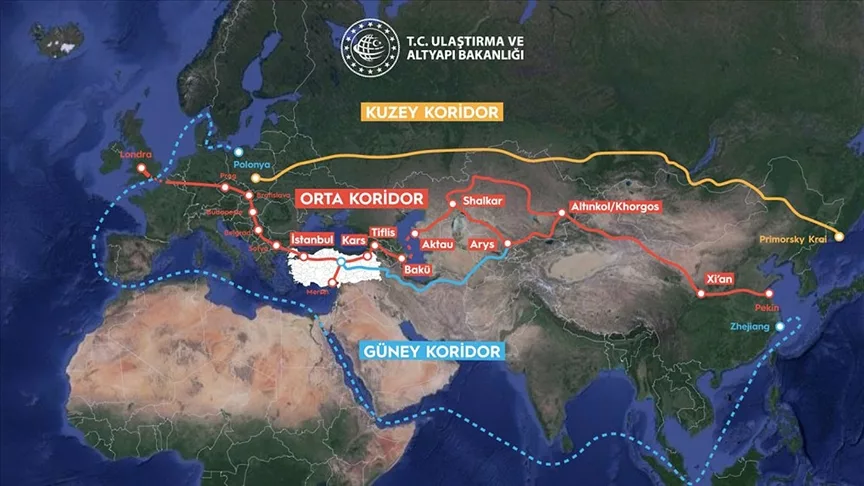
Technically, the corridor relies on the TIR (Transports Internationaux Routiers) system, which was reactivated between Turkey and Iraq in 2023 after years of suspension. The system allows Turkish trucks to travel across Iraqi territory into Jordan and the Gulf without unloading cargo at borders, cutting the journey time from Istanbul to Amman from two weeks to just five days.
Parallel railway infrastructure is also planned as part of the larger “Development Road” project previously launched by Turkey and Iraq. This ambitious initiative involves extending transport and rail lines from Iraq’s southern Al-Faw port to Turkish territory, thereby linking the Gulf to Europe.
The Middle East Corridor complements this by focusing on fast overland freight rather than maritime shipping.
Describing the corridor as “historic” is no coincidence it revives the ancient trade route that connected Anatolia to Mesopotamia and the Arabian Peninsula during the Ottoman era, when goods flowed between Mosul, Aleppo, Damascus, and Medina. Today, these routes are being modernized with digital customs systems, advanced border control points, and joint investment incentives.
Strategically, the corridor offers an overland alternative to maritime routes increasingly threatened by regional tensions, particularly in the Red Sea and Bab al-Mandeb. It also provides Turkey with a direct land link to the Gulf that bypasses Iran.
For Iraq, it marks a reemergence as a pivotal transit country after years of isolation. Jordan, meanwhile, stands to regain its role as a key logistics node bridging the Levant and the Gulf.
Key Stakeholders
The Middle East Corridor involves a range of critical stakeholders, each with distinct motivations but united in viewing the project as a vehicle to reshape their regional influence.
Turkey
Turkey is at the forefront, seeing the corridor not just as a transport route but as a strategic tool to enhance its regional role. According to regional and international analysis, Ankara aims to diversify its economic partnerships and reduce reliance on traditional energy import pathways. The initiative aligns with Turkey’s shifting energy policy toward greater diversification and regional cooperation.
Iraq
Iraq plays a central role as a transit country. The resumption of the TIR system between Iraq and Turkey was instrumental in setting the corridor’s path. Iraq stands to gain economically and geopolitically transforming from a recipient nation to a transit hub and reclaiming its regional importance after years of security and economic decline. Its geographical location makes it an indispensable partner in a project of this scale.
Jordan
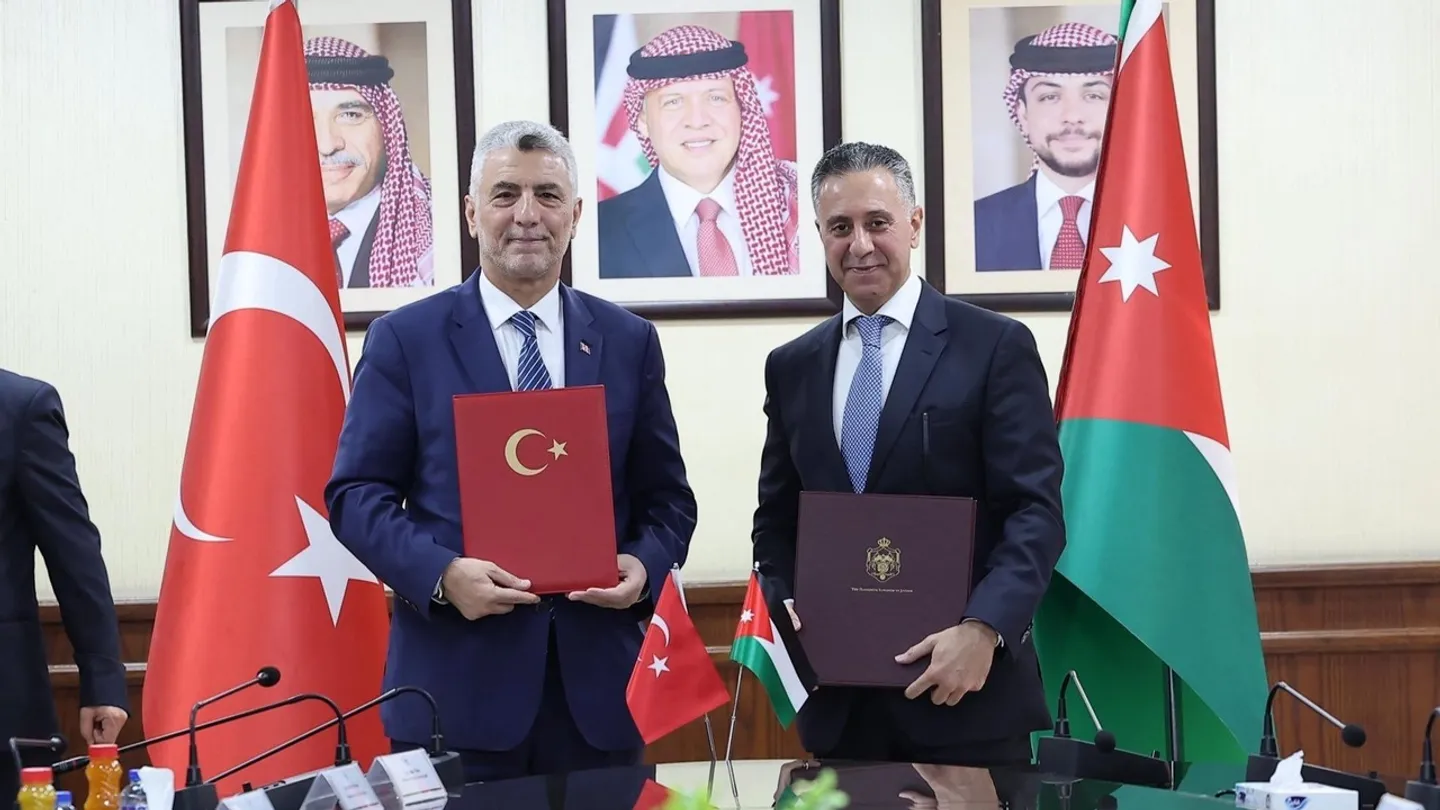
Jordan is positioned as a crucial middle link in the Turkey–Iraq–Gulf chain. Bilateral agreements, including a memorandum signed on October 28, 2025, between Jordan and Turkey, reflect this role. The corridor offers Amman an opportunity to strengthen its role as a logistics gateway between the Levant and the Gulf, benefiting from increased freight movement and regional connectivity.
Gulf States / Saudi Arabia
Although the official narrative focuses on the Turkey–Iraq–Jordan axis, the Gulf dimension particularly Saudi Arabia is essential for expanding the corridor into the Gulf. Saudi Arabia is seen as a potential partner in the project’s later phases, aligning with its broader economic vision and desire to connect to global markets.
However, no final agreements with the Kingdom have been announced, making its role more prospective than active thus far.
International Entities
The International Road Transport Union (IRU) has played a key role in facilitating the TIR system across Iraq, Turkey, and Jordan, indicating a level of international oversight and logistical support. Global research institutions are also examining the corridor within the broader context of Asia–Europe trade links, reinforcing its relevance beyond the Middle East.
Strategic and Economic Significance
The Middle East Corridor is as much a strategic realignment as it is an infrastructure project, reflecting the growing importance of overland routes in global geopolitics.
Economic Significance
First, the corridor offers Turkey a chance to become a key land gateway between Asia and Europe, bypassing congested and vulnerable maritime routes. An IRU study found that freight from Istanbul to Amman now arrives in five days instead of weeks.
Second, the enhanced connectivity between Turkey, Iraq, and Jordan is expected to fuel growth in logistics sectors such as warehousing, trade, and transport finance, enabling more diversified and resilient regional economies.
Third, for the Gulf, the corridor emphasizes the strategic value of overland trade as part of a broader vision to integrate Middle Eastern economies with European markets while reducing maritime dependency.
Strategic Significance
Beyond economics, the corridor serves as a strategic instrument. Amid global power competition, infrastructure is becoming a new frontier of influence. According to Germany’s SWP (German Institute for International and Security Affairs), Turkey is recalibrating its Iraq and Gulf policies through trade and connectivity, not just traditional security means.
The land link strengthens Turkey’s position as an alternative to Iran, gives Iraq and Jordan renewed leverage, and reshapes their ties with Gulf nations. It highlights the multipolar nature of emerging regional alliances.
Implications for Regional and International Relations
The Middle East Corridor marks a turning point in regional diplomacy, where economic interdependence starts to outweigh purely security-based alliances.
Regionally, the project reshapes Turkey’s standing in the Middle East. After years of direct military involvement in Syria and Iraq, Ankara is pivoting to soft power using infrastructure and trade to entrench its influence. The corridor gives Turkey a land route to the Gulf that circumvents Iran, expanding its geopolitical space and bolstering its leverage in negotiations with Washington, Moscow, and Brussels.
At the global level, the corridor fits into the ongoing race between mega-corridor initiatives, from China’s Belt and Road to the US-backed India–Middle East–Europe Corridor. Turkey seeks to establish a third, more balanced position one that avoids full alignment with any single axis while capitalizing on great power rivalries to assert itself as an independent regional hub.
This recalibration may prompt the US to rethink its approach to Turkey. Rather than rely solely on political pressure, Washington may come to view these emerging regional infrastructure projects as opportunities to contain Chinese and Iranian influence through economic cooperation rather than confrontation.
Ultimately, the project reflects Turkey’s ambition to anchor itself as the linchpin between East and West. But despite its technical readiness, the corridor’s success hinges on more than asphalt and checkpoints.
It depends on Iraq’s stability, Jordan’s engagement, and Gulf willingness to embrace a partnership that goes beyond trade and toward political trust. For Ankara, this is not just about moving trucks it’s about moving toward a new vision of its Middle East role.