
The recent developments in Sudan especially the humanitarian catastrophe in El Fasher, capital of North Darfur have reignited questions about foreign agendas influencing the country’s security and stability, pushing it deeper into a spiral of violence and sociopolitical fragmentation.
At the forefront of such analysis is the Israeli agenda. Tel Aviv is seen as one of the most influential, and perhaps most disruptive, actors shaping the Sudanese landscape either directly or indirectly pursuing a long list of strategic interests through its presence in the country.
Observers are well aware of Israel’s strategic and logistical interest in Sudan, a priority that raises questions about its potential role in deepening the current crisis, and which domestic actors it might be backing in the conflict.
It’s worth recalling that Sudan and Israel announced their readiness to normalize relations in 2020, including launching economic and trade cooperation. However, that move sparked widespread criticism from civil and political groups, leading to its formal postponement particularly after Sudan’s descent into renewed bloodshed.
Why Is Sudan Important to Israel?
Sudan occupies a pivotal position on Israel’s strategic map. Tel Aviv views Khartoum as a key gateway to expanding its footprint in Africa and the Red Sea enhancing both its regional influence and logistical reach.
Israel approaches the Sudan file primarily through a security lens. It considers Sudan a critical point for monitoring al-Qaeda activities and Iranian weapons caches, as well as a potential corridor for arms smuggling to Palestinian factions in Gaza and conflict zones in Libya where Turkish influence and foreign investments are also expanding.
In this context, Israel sees expanded influence in Sudan as opening broader horizons across Africa and into the Maghreb. Unlike its ties with Gulf states where economic returns are more immediate Sudan offers Israel a strategic asset, owing to its geography along the Nile and its lengthy Red Sea coastline. This makes it a central point in the geopolitical architecture of both the Middle East and Africa.
Israel’s objectives in Sudan include:
-
Expanding normalization agreements, making Sudan a key link in the “Abraham Accords” especially considering its historical stance of “no peace, no recognition, no negotiation” with Israel.
-
Boosting regional influence and positioning itself as a mediator, including its offer to host ceasefire talks between Sudan’s transitional leaders (Abdel Fattah al-Burhan and Mohamed Hamdan Dagalo, aka Hemedti).
-
Securing intelligence and security interests, preventing chaos from offering safe havens to armed groups, and blocking the flow of weapons to resistance factions threatening Israeli security.
-
Achieving broader geopolitical aims, notably weakening Sudan’s state institutions and using the Nile water file as leverage against Egypt, thereby pressuring Cairo’s political decision-making.
Israel and al-Burhan: Staying in the Safe Zone
Over the past several years, Israel has kept a close, if cautious, relationship with Sudan’s official government and military under General Abdel Fattah al-Burhan. Al-Burhan, seen as the country’s legitimate ruler, signed the preliminary normalization agreements with Tel Aviv.
Following the fall of Omar al-Bashir’s regime, Israeli and Sudanese officials exchanged public visits including a meeting between al-Burhan and Netanyahu in Uganda signaling a relatively “positive” phase in bilateral relations.
But this didn’t last long. Relations began to freeze as disagreements emerged over internal Sudanese dynamics particularly as Sudan renewed ties with Tehran, raising Israeli concerns about growing Iranian influence.
Meanwhile, Israel’s covert intelligence ties with Hemedti’s Rapid Support Forces (RSF) widened the rift between Tel Aviv and al-Burhan. In July 2025, The Jerusalem Post published a report describing al-Burhan as an existential threat to Israel and called for urgent measures to stop the regime he leads.
It argued Sudan had evolved beyond a domestic conflict zone into an “emerging front” in Iran’s campaign against Israeli and Western interests, with al-Burhan playing a direct role.
The report added that al-Burhan’s continued grip on power gives Tehran daily opportunities to encircle and weaken Israel labeling him controversially as “Sudan’s terrorism gatekeeper,” due to his alliance with Iran and the military support his forces receive in the war against the RSF.
It concluded that al-Burhan is neither moderate nor pragmatic but an enabler of the Muslim Brotherhood and Hamas, serving as a strategic tool for Tehran’s expansion in the Middle East and Africa placing Sudan squarely in the heart of Israel’s regional and global rivalries.
Mossad and Hemedti: A Backdoor Partnership
Israel’s relationship with the RSF has deepened significantly since the 2019 fall of Bashir’s regime. This alliance has included political, intelligence, and military coordination, with several revealing developments:
-
On June 26, 2021, Israel’s Walla news site reported a private plane from Tel Aviv landed in Khartoum the same aircraft used by former Mossad chief Yossi Cohen for covert visits to Sudan and other countries. Sources said Mossad officials met RSF-affiliated generals, possibly including Hemedti himself, in what appeared to be his attempt to bypass Sudanese military leadership and build direct ties with Israel.
-
These contacts triggered angry reactions from both al-Burhan and then-Prime Minister Abdalla Hamdok, who accused Mossad of conspiring against Sudan’s legitimate authorities despite the normalization deal.
-
In October 2021, Axios reported secret meetings between Mossad officials and Hemedti, cementing direct intelligence cooperation.
-
On November 30, 2022, Haaretz revealed that the RSF had obtained advanced Israeli surveillance technology, secretly flown into Khartoum via a plane linked to a former Mossad official, and then moved to Darfur. The tools could breach smartphones and communications infrastructure shifting the military balance in Hemedti’s favor.
-
On April 24, 2024, Hemedti’s adviser Youssef Ezzat told Israel’s Kan TV that al-Burhan’s forces resembled “Palestinian terror factions fighting Israel” an appeal aimed at drawing Israeli support for the RSF. He also accused al-Burhan of collusion with Islamist movements and lacking control over the war’s trajectory.
Playing All Sides
While both al-Burhan and Hemedti have expressed commitment to normalization, Israel appears to lean slightly toward the militia leader, who has shown greater eagerness in forging ties. Hemedti moved swiftly to open direct channels with Mossad, sidestepping Sudan’s official institutions a sign of his intent to build an independent Israeli alliance that serves his political and military ambitions.
He even tasked his brother, RSF deputy commander Abdel Rahim Dagalo, with managing ties to Israel. Dagalo paid open visits to Tel Aviv, meeting senior Israeli security officials in a bid to formalize intelligence cooperation, helping the RSF gain leverage in Sudan’s internal power struggle and giving Israel a foothold in one of Africa’s most sensitive arenas.
Yet, Israel seeks to maintain control over all threads in Sudan’s tangled conflict. It appears unwilling to alienate either side. Tel Aviv has thus adopted a dual-track strategy: assigning its Foreign Ministry under Director-General Ronen Levy to handle official contacts with al-Burhan, while Mossad maintains unofficial, on-the-ground links with Hemedti’s camp, including intelligence sharing and clandestine meetings.
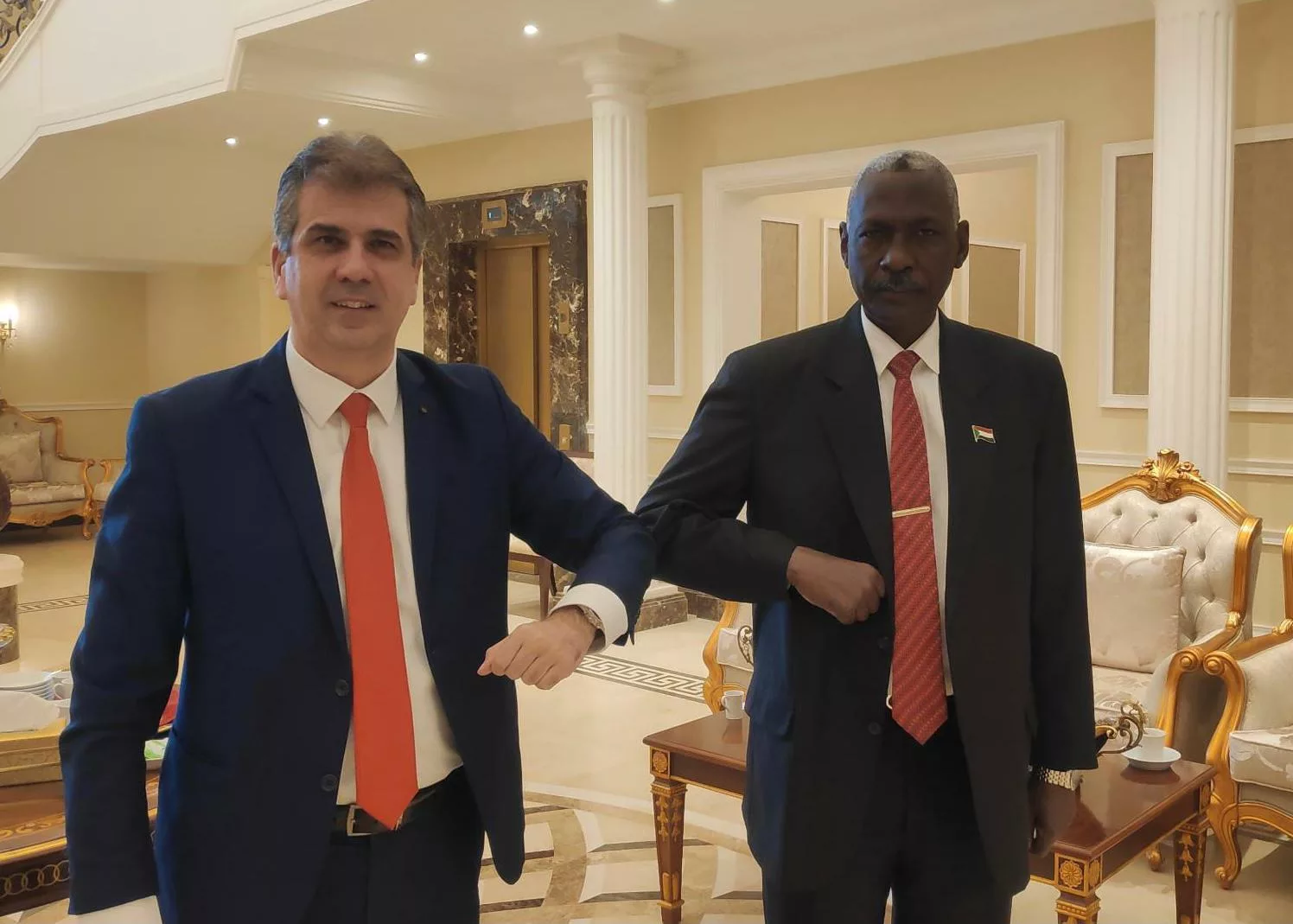
Despite increasing accusations of Israeli support for the RSF in intelligence, equipment, and arms, this hasn’t impacted its overt diplomacy. Israeli Foreign Minister Eli Cohen has continued mediating between the factions, even inviting both leaders to reconciliation talks in Tel Aviv hoping to revive normalization efforts.
Israel fears prolonged war between the generals will derail any final peace deal especially since both have, at different times, expressed willingness to sign, though Hemedti has been more publicly enthusiastic in seeking foreign backing for his position.
Israel’s strategy has also been shaped by its experience in South Sudan, where its deep ties failed to yield long-term gains. Persistent instability and recurring conflicts limited Tel Aviv’s ability to translate those ties into influence across Africa.
Thus, Israel is now handling the Sudan file with greater caution avoiding past mistakes while keeping all communication lines open to ensure a continued strategic presence between the Horn of Africa and the Red Sea.
Balancing Rivals
Amid this complex landscape, Israel has managed to entrench itself in Sudan through a multi-layered strategy of quiet infiltration and indirect influence, rather than overt intervention. It understands that its future leverage in Sudan depends less on who wins the war and more on its ability to balance between rivals and exploit shifting dynamics for its geopolitical and security objectives.
For Israel, Sudan is not merely a delayed normalization file it is a live arena where regional scores are settled and foreign agendas clash. Tel Aviv aims to prevent any vacuum that hostile actors like Iran or the resistance axis might fill, while anchoring its own presence along the Red Sea and into the African continent.
As Khartoum sinks deeper into internal warfare, Israel continues playing all sides engaging al-Burhan under the guise of legitimacy while backing Hemedti as a battlefield asset ensuring it remains the sole beneficiary, regardless of how the war ends.
Ultimately, the identity of Sudan’s next ruler is of little importance to Israel. What matters is preserving its influence over Sudan’s decision-making and cementing its foothold in a country that serves as a strategic bridge between Africa and the Arab world.
In the end, while Sudan bleeds from internal conflict, Israel continues to skillfully pluck every string with cold pragmatism to secure its security and geopolitical gains, even if it means building its influence atop the ruins of a nation torn by war, famine, and competing agendas Israeli, international, and Arab alike.