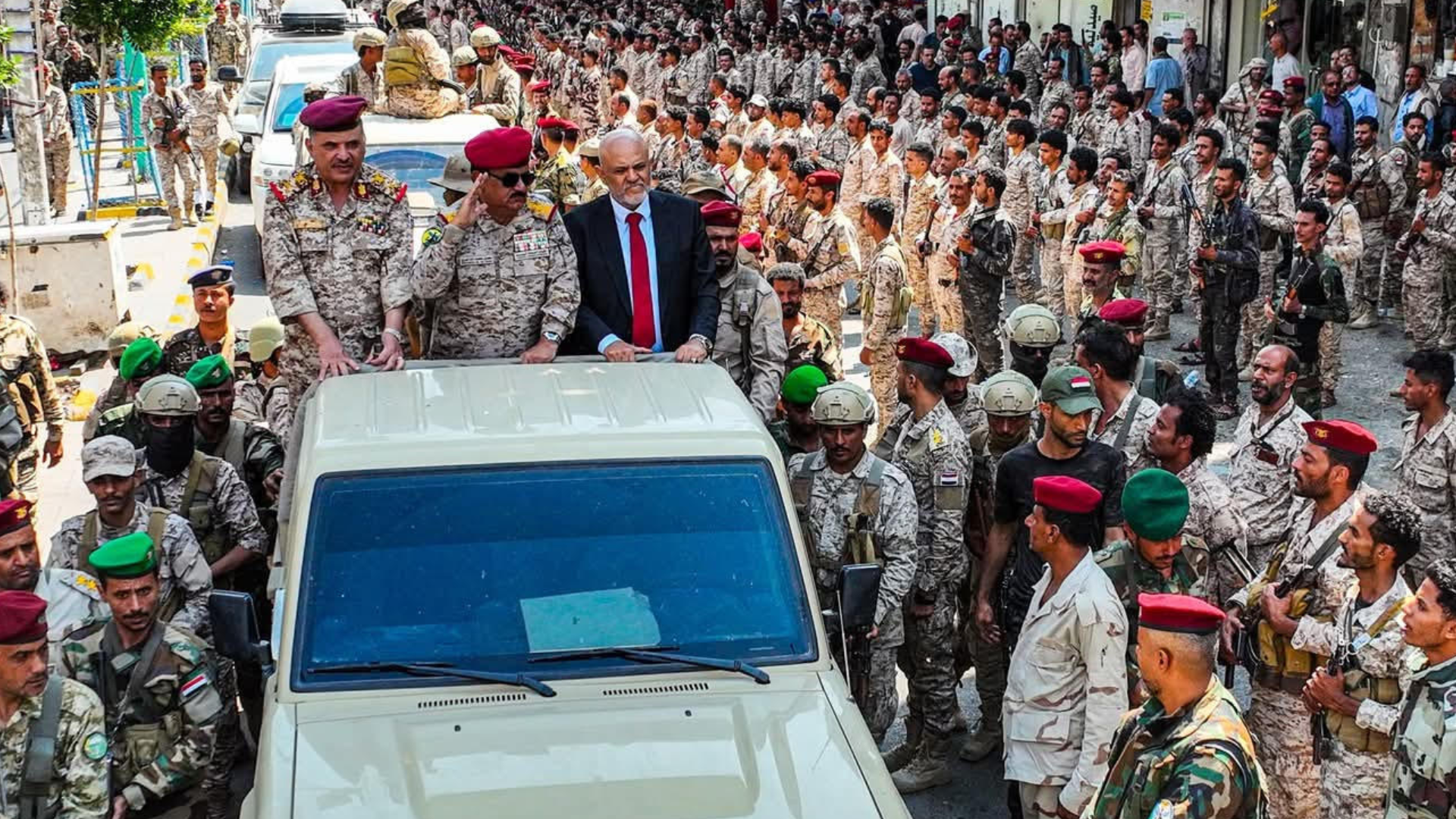
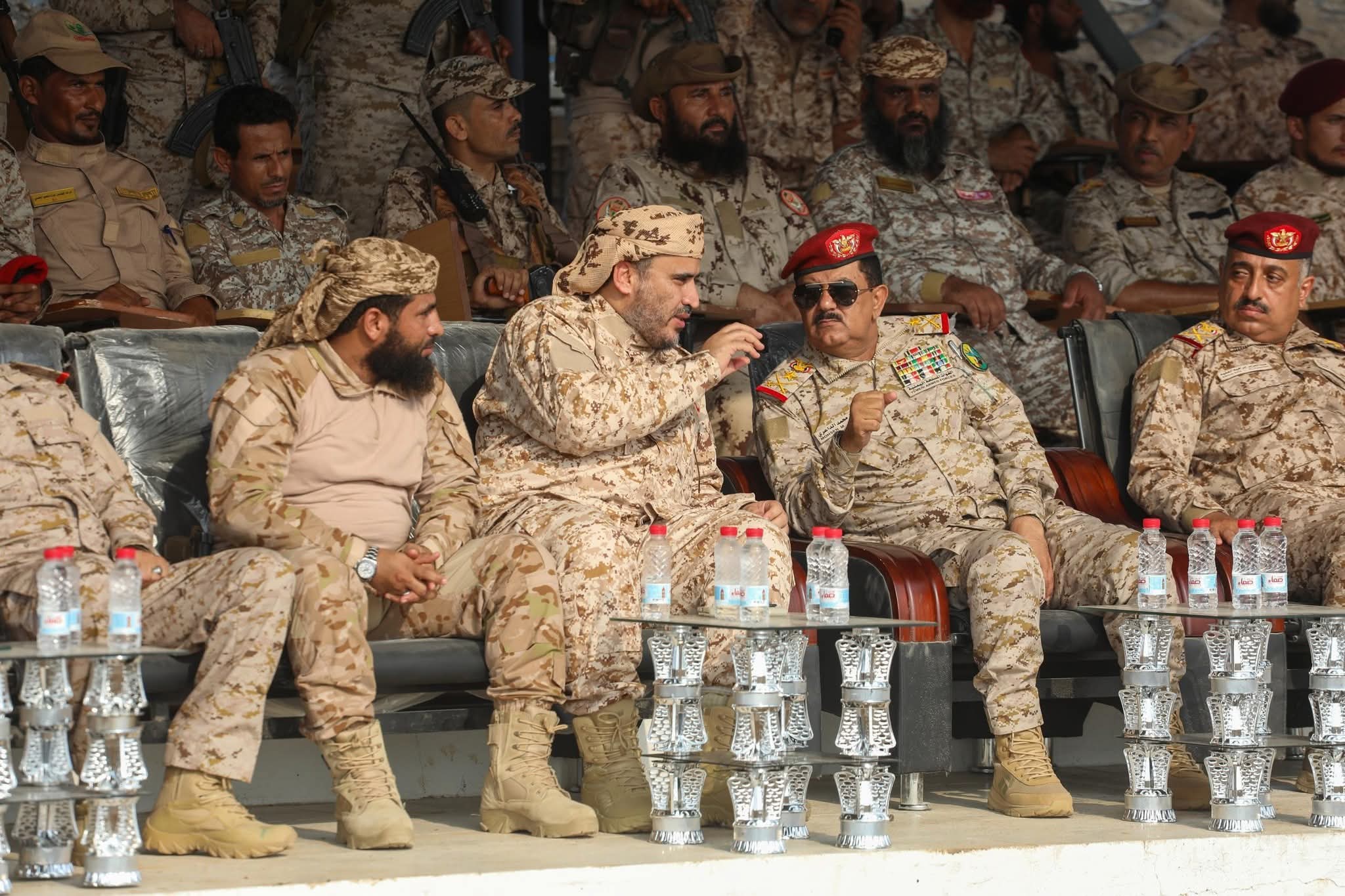
On the morning of October 20, Yemen’s Minister of Defense, Lieutenant General Mohsen Mohammed al-Daeri, concluded a two-month field tour that spanned from the northern fringes of Saada to the southern coasts of Socotra, passing through the plains of Marib, the deserts of al-Wadi’a, and the ports of Mokha.
Ostensibly a morale-boosting mission to signal the state’s alertness amid the chaos of war, the tour in essence exposed the fragility of military control and the web of competing loyalties burdening the Ministry of Defense.
From the Fifth Military Region in Hajjah under the ministry’s command to the Saada fronts, which are operated by Saudi Arabia, the minister reviewed the preparedness of regular forces. He then proceeded to Marib and al-Jawf to inspect units in the Third, Sixth, and Seventh Military Regions still the backbone of the national army in the north.
Moving southward, al-Daeri visited the “Shield of the Nation” forces in al-Wadi’a, led by Salafi commander Brigadier General Basheer al-Mudrabbi officially sanctioned units, yet under direct Saudi supervision.
In the far east, he inspected units in al-Mahra and Socotra before concluding his tour on the western coast, meeting with the National Resistance Forces led by Brigadier General Tareq Saleh and the Giants Brigades under Major General Abdulrahman al-Muharrami. Both are UAE-funded formations, even though their commanders hold senior positions within Yemen’s internationally recognized government.
While the images of the tour appear polished, orderly, and ceremonial, they mask a stark reality: a fatigued national army, and a battlefield shaped by the contrasting influence of Riyadh and Abu Dhabi. While some northern military regions remain under the ministry’s authority, the southern and western coastal fronts are effectively managed by regional powers that control funding and arms yielding a military map where lines of allegiance intersect between the Yemeni state and the coalition.
Domestically, the minister seemed to be sending a message of resilience that the state still exists and its institutions can maintain a minimal on-ground presence. But the gulf between symbolism and reality remains vast.
The most effective combat units are not under unified command, and central decisions rarely reach the frontlines. Yemen’s national army finds itself weakened lacking resources and dwindling support amid forces that hold sway through arms, funding, and operational dominance.
At the heart of it all, the Yemeni citizen remains the primary casualty of this fragmentation. A fractured military means conflicting authorities, diminished security, and collapsing public services. Regardless of how vibrant the tour’s images may seem, they underscore a truth: the state’s symbolism precedes its power, and building a unified army will require a deep political settlement that balances regional interests with national aspirations.
Significance of the Tour
Defense Minister al-Daeri’s inspection of various military formations reveals the complex duality of Yemen’s military reality. On one hand, it signals the official leadership’s ability to enforce some level of coordination among diverse, often rival, units. On the other, it underscores the fragmented institutional affiliations some formations maintain only loose coordination with the ministry, even as they all claim a shared goal: confronting the Houthi militia and defending liberated territories.
Ameen al-Mashouli, political analyst and head of the Justice and Development Party branch in Taiz, views the tour as a potent internal and external message that all military formations still recognize the defense minister as their unified commander, despite operating within separate zones.
“This 360-degree tour isn’t merely a field visit,” he told NoonPost. “It’s a practical affirmation of unified military leadership and cohesion. It also sends a clear message that the national army and affiliated formations operate in harmony, despite their field diversity.”
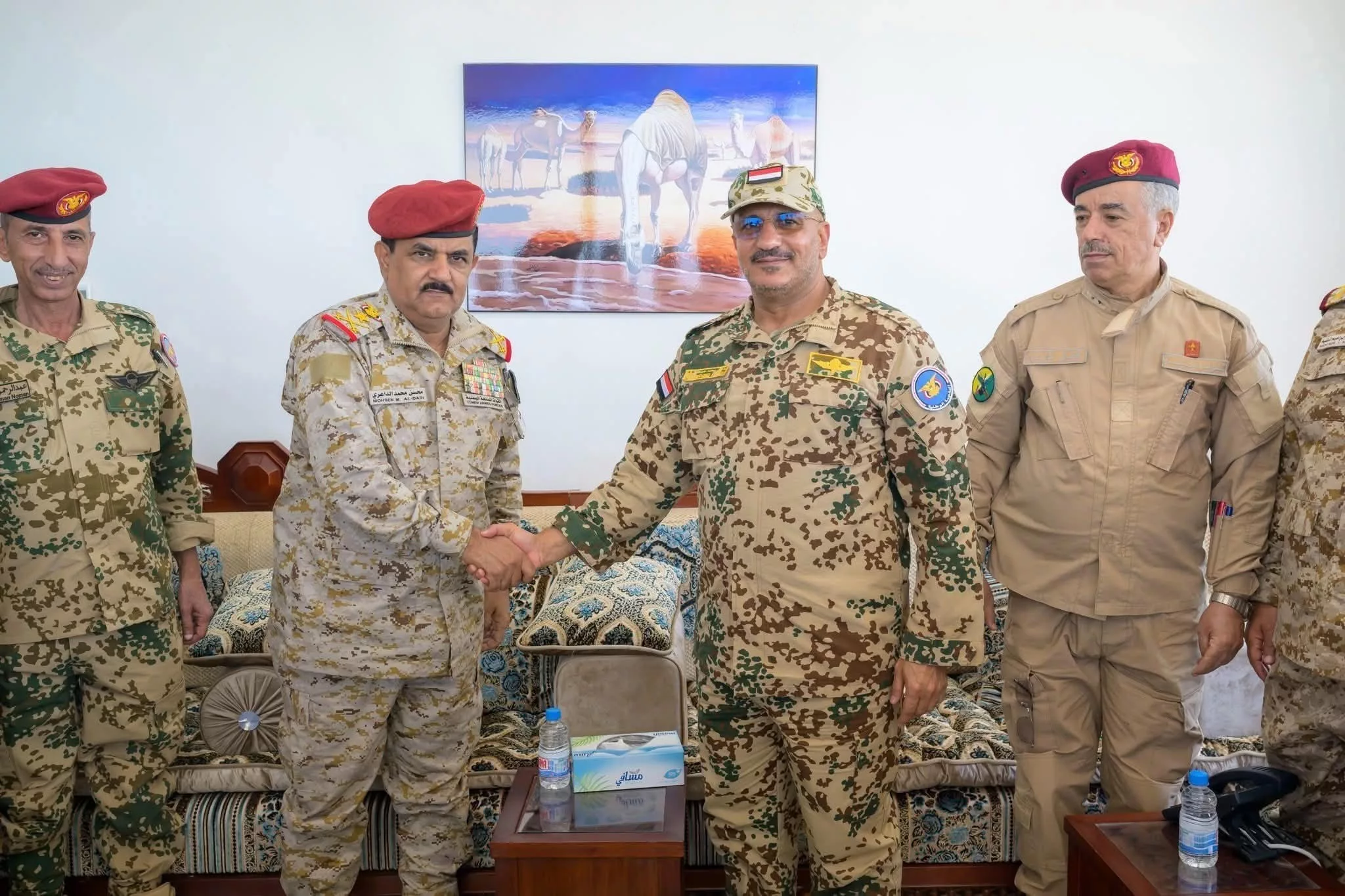
He added, “All the formations appeared in excellent combat readiness well-trained, well-equipped, and disciplined. It’s a clear signal to the terrorist militias that the day of reckoning is coming. The tour surrounded areas of militia presence like a bracelet encircles a wrist.”
Mashouli concluded: “The national army today is well-trained, well-armed, and highly motivated. The proof lies not in words, but in what’s visible on the ground and what the militias will soon face from our determined armed forces.”
For political journalist Abdullah Dooblah, the tour’s scope encompassing not only ministry-aligned units but also politically and militarily diverse groups like the Giants Brigades, Tareq Saleh’s forces, the Southern Transitional Council (STC), and Shield of the Nation reflects a pragmatic political reality, albeit one far from ideal from a state-building perspective.
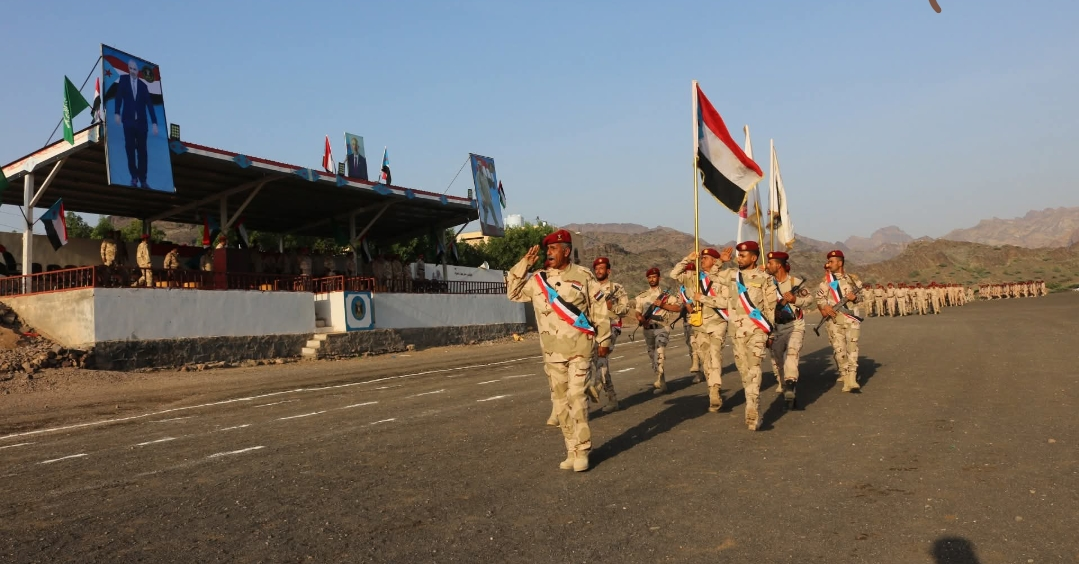
“These formations represent political and military actors with presence inside the government and the Presidential Leadership Council,” Dooblah told Noon Post. “Though not yet integrated into the unified national army, the defense minister finds himself responsible for them as part of the current political order effectively granting them temporary legitimacy to manage the existing power balance.”
“This arrangement, while abnormal from a statehood standpoint, reflects the practical balance of today. Once the state regains full institutional integrity, such arrangements won’t be sustainable. But for now, they require flexible management under the legitimacy umbrella.”
The Failed Integration
In May 2022, Yemen’s Presidential Leadership Council announced the formation of the Supreme Security and Military Committee, headed by Lieutenant General Haitham Qassem Taher, as a foundational step toward rebuilding the military institution after years of division.
The 59-member committee, composed of top officers and commanders, was tasked with restructuring the armed forces and merging disparate units under the Ministries of Defense and Interior.
This initiative was in line with the outcomes of the 2019 Riyadh Agreement between the government and the STC, which promised to end military dualism and unify command structures. But the realities on the ground proved far more complex. In southern and western regions, UAE-backed forces like the Giants Brigades and National Resistance dominate, while Shield of the Nation operates under Saudi oversight making integration impossible without comprehensive regional consensus.
By mid-2022, the committee had begun consultations, gathering data and drafting a “restructuring matrix.” In early 2024, it submitted a “new force structure” to PLC Chairman Dr. Rashad al-Alimi, who approved it and tasked the defense ministry with implementation. The plan included redistributing regional command zones, establishing a unified personnel database, biometric systems, and administrative and financial reforms.
However, execution quickly hit a political wall. The rift between Riyadh and Abu Dhabi over control priorities, commanders’ independent funding streams, and a lack of robust enforcement mechanisms all hampered progress. Additionally, mistrust among local factions and fear of losing influence further derailed the effort.
Today, more than two years later, the committee’s work remains largely theoretical. The military institution continues to be functionally fragmented, with loyalty lines scattered across the map. While the committee’s work was a rare attempt at building a unified army, it also revealed the depth of local and regional fault lines that block any meaningful integration and leave Yemen in a state of chronic security vacuum.
“This is not the committee’s failure it’s the failure of the political forces,” says journalist Abdullah Dooblah. “Loyalties are scattered, agendas are different, and some factions, like the UAE-backed STC, are pursuing a separatist project fundamentally incompatible with national unity.”
“None of the factions will surrender their weapons willingly,” he added. “It’s only natural. Each group is holding on to its forces due to external influence and to preserve leverage. No side will step out of line.”
“In today’s Yemen, political and military plurality is the reality,” he continued. “It’s not ideal, but it’s the phase we’re in. A true national army can only emerge through a political transformation, which won’t happen without the full restoration of state authority.”
Daily Reality: Security Chaos and Unequal Conditions
Ordinary Yemenis are paying the price for the security vacuum. Murad Bakazem, a resident of Abyan governorate, described the daily ordeal of navigating fragmented security zones: “We live in constant chaos. Every area has its own checkpoint controlled by a different force. Each one has its own laws. Sometimes, we’re stopped four times on the same road each time questioned as if we’re strangers in our own country.”
“People are exhausted by this disunity,” he said. “Instead of protecting citizens, checkpoints have become a source of fear. What we need is a single army that defends everyone equally, without favoritism or factionalism.”
Conditions vary drastically among the military formations affiliated with the internationally recognized government. Troops directly supported by coalition countries receive generous financial and logistical support, while others endure salary delays and basic shortages, impacting morale and operational readiness.
A soldier in coalition-backed forces earns 1,000 Saudi riyals per month, plus over 10 riyals in daily allowances. By contrast, a national army soldier receives 60,000 Yemeni riyals about 150 Saudi riyals and these salaries are often suspended for months. Injured soldiers face neglect, and fallen troops may leave behind starving families due to inadequate support systems.
An officer in the Giants Brigades, speaking anonymously, told Noon Post: “Our forces receive consistent coalition support, both financially and logistically. Salaries are paid regularly, and food, fuel, and ammunition are always available. This alleviates stress and helps us stay focused on the battlefield.”
“This support allows us to equip our units properly and maintain frontline stability,” he continued. “Without it, no force could maintain discipline and effectiveness in today’s harsh war conditions.”
In contrast, Ammar al-Samie, deputy media officer of the 22nd “Mika” Brigade in Taiz, described the stark disparity: “There’s a huge gap. Taiz forces suffer severe shortages in food, weapons, and operating expenses. Many soldiers have abandoned their posts, moving to better-supported units for the sake of survival.”
“To cope, brigade commanders have implemented emergency measures, including a temporary local tax to provide partial stipends. Taiz salaries barely reach 10% of what soldiers in other formations receive and even those have been unpaid for five months.”
Yet despite neglect, al-Samie emphasized the army’s resolve: “The national army remains steadfast. It has the will to defeat the Houthi militias and reclaim the rest of the republic.”
Looking Ahead
Political analyst and director of Belqees TV, Ahmed al-Zurqa, sees no realistic path to military integration at present. “No faction is willing to integrate its forces into the national army,” he told Noon Post, “because it involves giving up funding, loyalty lines, and political agendas.”
He argued that post-PLC formation reforms “remained ink on paper,” and while the decision to unify military institutions was made, the will to execute it was missing.
Externally, he cited Saudi and Emirati reluctance to back a unified military institution preferring instead to keep proxy forces in place. “Both countries have used their forces to advance their own interests, not those of Yemen,” he said. “The UAE has deployed its units abroad, while Saudi Arabia has recruited tens of thousands of Yemenis to guard its borders.”
Internally, he blamed political greed and weak national independence: “Each faction pursues its own gains and funding. None can resist regional dictates. Personal ambition overrides the collective vision of a unified army.”
He warned that continued division will perpetuate civilian suffering and empower unaccountable militias: “People are now hostages to de facto authorities. Their lives and property are at the mercy of armed factions.”
Al-Zurqa concluded on a grim note: “If things don’t change, the national army will be starved, besieged, and discredited making way for replacement forces. Without a real political shift, the next three to five years will be the most dangerous yet for the survival of Yemen’s national military institution.”