















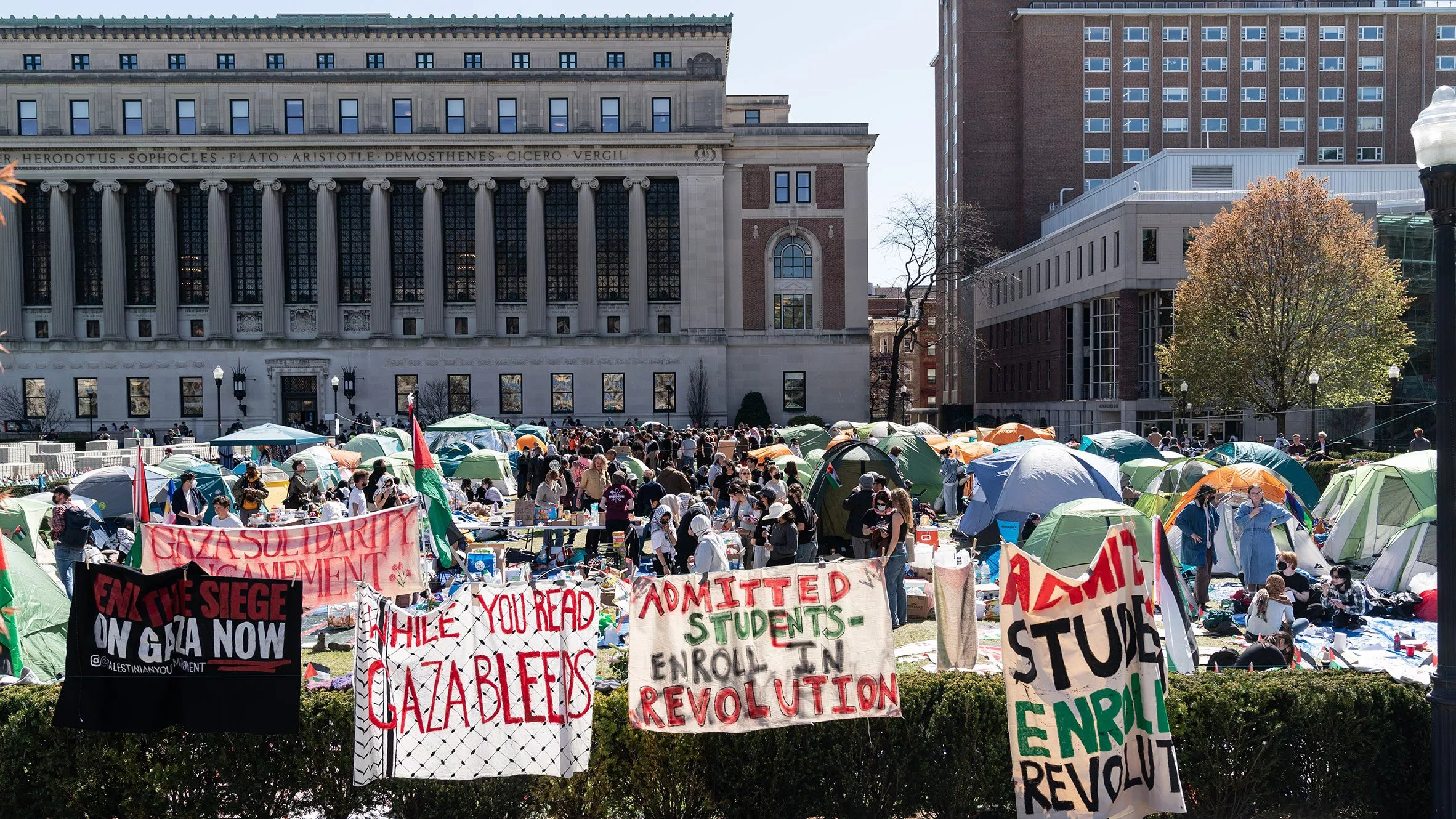
As Western academic solidarity with Palestine continues to grow, Israel finds itself grappling with an unconventional crisis targeting the core of its soft power. The battle is no longer being fought solely on the frontlines, but increasingly in university lecture halls and research labs, where signs of a gradual erosion of Israel’s decades-long scientific prestige are becoming evident.
Israeli authorities view this wave of academic backlash as a strategic threat to the state. In recent months, a series of actions have unfolded across Western academic institutions from canceled conferences and suspended research collaborations to petitions advocating a boycott of Israel.
Among the most striking of these was a call by nearly 1,000 scientists at CERN, the European Organization for Nuclear Research, urging a review of its partnership with Israel in the field of particle physics.
The Crumbling of the Scientific Halo
Despite some European governments’ hesitation to support such boycotts, several universities in the Netherlands, Belgium, Italy, and Spain announced the suspension or termination of joint projects with Israeli institutions following the Gaza war. This trend is largely driven by mounting public and academic pressure on universities and governments, often perceived as complicit with a regime accused of carrying out ethnic cleansing against Palestinians.
This backlash has emerged at a particularly sensitive moment for Israel, which has long built its global stature on scientific excellence. Leading Israeli research centers such as the Weizmann Institute of Science, Tel Aviv University, and the Hebrew University of Jerusalem have traditionally benefited from consistent European funding tied to collaborative projects and innovation hubs.
Since 2021, these institutions have received over €875 million through the Horizon Europe program. However, in July 2025, the European Commission proposed a partial suspension of Israel’s participation.
The Commission’s proposal aimed to partially restrict Israel’s access to Horizon Europe, a flagship EU research and innovation fund worth approximately €95 billion for the current financial period. This move could cost Israel nearly €200 million in future grants and investments, particularly within the European Innovation Council’s tech-focused programs.
To pass, the proposal required a qualified majority of EU member states. While major powers like Germany and Italy requested more time for review, countries including Ireland, Spain, France, Luxembourg, Slovenia, Portugal, Malta, and the Netherlands pushed for broader restrictions.
Austria, Hungary, Bulgaria, and the Czech Republic, however, insisted on keeping scientific collaboration open for strategic reasons. This division resulted in a temporary and partial freeze to avoid political fragmentation within the bloc.
As a result, Israeli participation in Horizon Europe dropped by 41%. In the European Research Council’s latest grants for early-career researchers (2025 cycle), Israeli scholars secured only 10 out of 478 awards a steep decline from 30 out of 494 the previous year. Furthermore, joint publications and citation metrics have declined, according to Scopus.
In Spain, for instance, joint research output dropped from 9.2% to 5.9%. Collaborations with the Netherlands and Canada also fell by roughly one-third. Even Germany which opposed boycott efforts saw its research partnership rate with Israel decline from 16% to 12.7%.
The Brain Drain Threat
European research funding has long been a vital pillar for Israeli science not just financially, but as part of a global scientific ecosystem. Losing access to such networks threatens the sustainability of Israeli research by potentially triggering a brain drain, with top minds migrating to more stable institutions that aren’t mired in ethical or political controversies.
The boycott strategy aims to disrupt the entire lifecycle of scientific research from ideation to application by severing symbolic and financial connections. These ruptures weaken the Israeli research ecosystem’s ties to Europe’s innovation chains. The loss is not merely monetary but also structural, cutting off Israel from knowledge-sharing platforms that accelerate technology transfer and skill development.
Safety concerns have also intensified on Western campuses. A survey of 548 Jewish and Israeli students and faculty across 30 Australian universities found a significant drop in feelings of safety and trust. Only 38% of students and 36% of staff reported feeling physically safe on campus, with around 30% feeling safe online.
Moreover, 60% of students and 54% of staff believed university administrations were not doing enough to address these concerns. Most respondents viewed existing complaint mechanisms as ineffective or risky, contributing to a growing sense of isolation.
What began as sporadic protest responses has now evolved into a coordinated, institutionalized academic boycott movement spanning more than 22 countries, primarily in Western Europe and North America. Estimates suggest that between 45 and 52 leading universities froze or severed ties with Israeli academic institutions between November 2023 and July 2025. At least 110 documented incidents involved canceled conferences, publication rejections, or academic participation bans.
A Limited-Impact Search for Alternatives
Israeli academic leadership was caught off guard by the speed and scale of the boycott. Early 2024 assessments had predicted a temporary and limited campaign. But by mid-2025, it had become a fully-fledged crisis. In response, the Israeli government allocated around 90 million shekels (€25 million) to launch the “Academic Shield” initiative.
Yet the results have been modest, with most new partnerships focused on low-budget technical fields, and a pivot toward institutions in Asia and Latin America to compensate for the European pullback.
The boycott has now spread to Latin America. On October 8, 2025, Brazil’s Federal University of Ceará announced the cancellation of its academic cooperation and student exchange agreement with Ben-Gurion University, following on-campus protests. Activists argued that any collaboration amounted to normalization with a regime responsible for siege and mass killings.
Though the agreement, signed in December 2022, had not resulted in active exchanges or joint programs, it had produced a first round of innovation workshops and a virtual hackathon by July 2023. The second round, scheduled for 2024, was canceled after the war began.
In the United States, no official nationwide academic boycott has been implemented, but several states have enacted legislation barring public universities from participating in economic or academic boycotts. Since May 2025, the National Science Foundation following an earlier move by the National Institutes of Health has required compliance with anti-boycott policies in its grant allocations.
In turn, some American universities have strengthened their partnerships with Israeli institutions to avoid losing federal funding. Harvard, for instance, expanded its academic collaborations with Israeli counterparts while simultaneously pledging to curtail pro-boycott activism on campus.
The Erosion of the Knowledge Economy
With academic isolation deepening and project suspensions mounting, the boycott’s effects now go beyond symbolism, striking at the heart of Israel’s knowledge-based economy. The crisis no longer merely jeopardizes Israel’s scientific image it casts doubt on its future as a regional innovation hub.
The government’s emergency fund underscores a clear recognition of the long-term strategic threat: continued isolation could undermine Israel’s appeal to international researchers and chip away at its standing in vital sectors like medicine, advanced technology, and artificial intelligence all foundations of its modern economy.
Global scientific networks are reshaping the geography of knowledge, and research institutions serve as critical junctions connecting scientists worldwide. Israel’s exclusion from these networks not only reduces funding but also alters research priorities and stymies the training of the next generation of scientists.
As a result, fields once led by Israeli researchers may stagnate, while alternative hubs emerge elsewhere, drawing the benefits of innovation away from Israel.
A knowledge-based economy depends on a constant flow of talent local innovation alone is insufficient without international collaboration. Even if Israeli firms continue to generate cutting-edge solutions domestically, their integration into global value chains may falter.
This could eventually hinder growth and job creation in strategic sectors. Any disruption to this flow especially through brain drain is not a theoretical risk, but a tangible threat to Israel’s ability to compete globally.


