















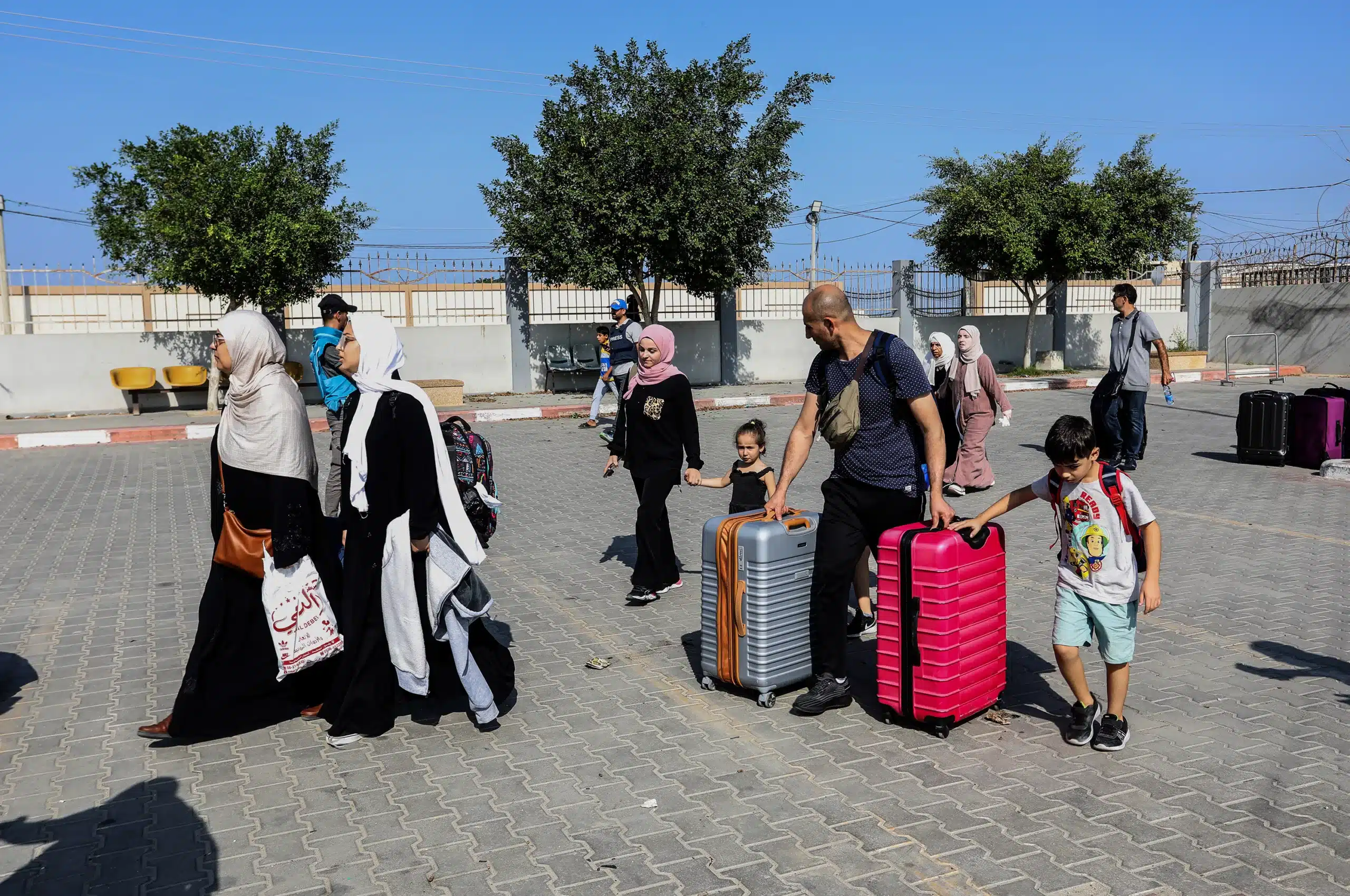
The moment President Donald Trump announced at dawn on Thursday, October 9, 2025 that both Israel and Hamas had agreed to the first phase of a ceasefire, the hearts of Gazans in Egypt leapt into their throats. Their eyes turned instinctively toward the one unchanging compass: home. For them, this was not just a political announcement it was a signal to let their souls begin the journey back.
As the peace summit in Sharm El Sheikh concluded on the evening of Monday, October 13, and with Trump declaring the war officially over, the emotions of Palestinians in Egypt grew more complex. After months of refuge and hospitality on Egyptian soil, their feelings were torn between the overpowering longing for their shattered homeland and the sense of security they had found in their current refuge.
The anticipated return carries a double burden one that almost overshadows the joy: the joy of reunion with the homeland and reclaiming a piece of the lost soul, and the gnawing fear that this joy could be fleeting, that they might soon be uprooted once again from homes barely warmed by their return.
They now wait anxiously for this fragile hope to become a genuine and lasting peace that guarantees their right to remain on their land without the looming specter of another cycle of killing and destruction. For them, returning is not the end of a journey but the beginning of a new challenge: rebuilding life amid the rubble.
From Cairo, but Her Heart Is in Nuseirat: Nour’s Story
Nour Zaqout, who left Gaza for medical treatment in Cairo in July 2024, speaks with a voice cracked by longing for home. For her, Gaza is not merely a location—it is where her soul and memories were born.
“My yearning for Gaza is indescribable, especially for our house in Nuseirat camp,” she tells Noon Post. “It’s where I took my first breath, where I grew up.” The pull toward it is intense and strange, as if the deep-rooted history of the camp is what keeps her “alive” in exile. Her heart clings to “any flicker of hope for an end to the war” that could bring her back to her roots.
Despite the warmth and kindness she has received in Cairo she describes being treated “like a daughter” by Egyptians Nour sees Egypt as a mere “waiting room,” convinced she’ll return home once conditions improve.
What tears her apart most is leaving her mother behind in Nuseirat. “My soul leaves my body a hundred times a day with every strike on the camp,” she says. Though she has tried multiple times to return, her mother insists she stay safe. Here lies her deepest struggle: her body remains in Egypt, but her heart and soul are anchored in Gaza.
Nour ends her account with a resolute declaration. She calls her return a “gamble” a decision many of her friends and neighbors in Egypt oppose, urging her to wait until things are clearer. But she cannot bear the distance any longer.
She swears that the first chance she gets, once the Rafah crossing reopens, she will return to Gaza, no matter the cost even if it means being seen as a “disobedient daughter” in her mother’s eyes. It’s a painful price, she says, but one she’s willing to pay to reclaim her soul and her homeland.
Hossam and the Reality of an Impossible Return
Hossam Dawood, 35, offers a heart-wrenching account of Gaza’s current reality. A year into his displacement in Cairo, he says Gaza’s devastation has gone beyond physical destruction it has torn apart the very fabric of society.
“My house in Gaza was destroyed. There’s no place for me to return to,” he tells Noon Post. “Where would I even live if I went back?” The loss is not just about shelter it’s about shattered community and belonging. “All my neighbors have left.
The few who remain are thinking about leaving. One is even tracing his Argentine roots to apply for citizenship and leave the Strip.” Forced migration has become a survival strategy, with communal ties and a sense of homeland fading fast.
Talking about returning to Gaza, he says, “It’s a painful fantasy right now. The situation is dire. There are simply no conditions for life.” The damage to infrastructure is not partial it’s total.
According to municipal workers in Gaza, it will take three to four months just to clear the rubble and make roads passable again. That timeline alone underscores the scale of destruction and how far Gaza is from basic livability.
In this existential void, remaining in Gaza has become a luxury most cannot afford. “Over 70% of my family is living on the streets, and the few livable homes left are outrageously expensive,” Hossam explains. “There’s no way most Gazans can afford them. How can a community rebuild under these conditions?”
“Even if Egyptian authorities end our stay here, returning to Gaza is not an option. We’ll have to look for another place maybe Malaysia, maybe South Africa,” he says, voice heavy with sorrow.
Hossam’s words are not just a tally of losses. They’re a cry for time to assess whether life in Gaza can ever be viable again.
Al-Madhoun’s Fear of the Unknown
Despite the ceasefire announcement, deep human anxiety continues to grip the displaced. Khaled al-Madhoun embodies this fear, viewing the current calm as a dangerous illusion.
“Nothing is settled,” he says. “Israel’s intentions are unpredictable Netanyahu and his government can’t be trusted.” For him, returning to Gaza in such an ambiguous atmosphere is “a gamble that could cost a person their life.”
His fears are magnified by the material reality awaiting him. “The building I lived in, in Khan Younis, is gone,” he says, describing the scene as “streets unrecognizable from the sheer volume of rubble, turned into a surreal, torn canvas.”
“How can I return with a vulnerable family?” he asks, voice breaking. “I have two sick daughters and a son who’s barely 11. How can I bring them back to that?” This isn’t just about returning to a home it’s returning to a place devoid of even the most basic human needs. “There’s no clean water, no facilities, no schools, no food, no hospitals no humane space to live in.”
Khaled tells Noon Post that his “heart is tied to Gaza,” but sees return now as “suicidal.” His decision is a purely pragmatic one: “I’ll wait until things are clearer. Then I’ll decide whether to return or not.” For now, securing his children’s survival outweighs the desire to go back.
The Return Is Not Just a Journey Home, but a Journey to the Self
In the end, peace cannot be measured by a signed accord or the silence of guns, as Trump and the participants of the Sharm El Sheikh summit might like to believe. True peace lies in the ability of a human being to reclaim their home, their memory, and their dignity. The Palestinian who carried their homeland in their heart into exile does not seek luxury but a simple right: to live without fear, to dream without punishment.
Between a yearning for home even if it has become rubble and a fear of the unknown, no matter how prettily it’s wrapped in empty talk of peace, Gazans now stand at the edge of a fragile hope, searching for the start of a new life on land battered by destruction, yet still pulsing with life.
Perhaps this return is not only to ruined homes, but to a fragmented self that has never known the comfort of security. In the eyes of Nour, Hossam, and Khaled, the entire story is distilled. Through their voices echoes the most beautiful symphony: that of a people still believing that a homeland, no matter how destroyed, can never truly die.


