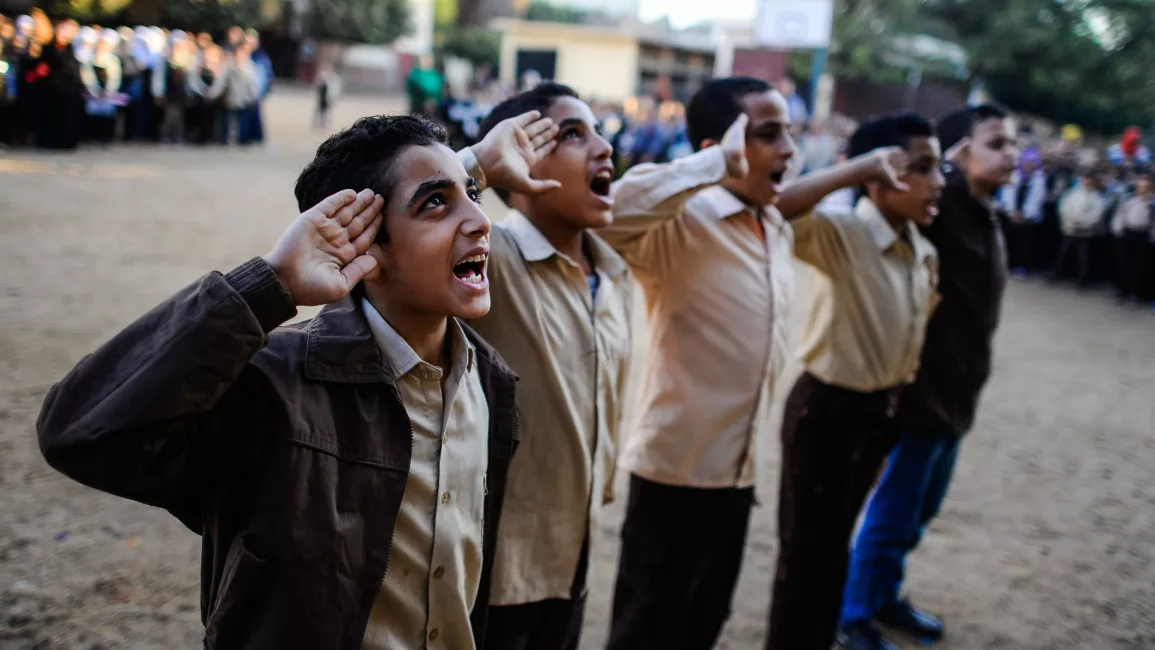
The scenes of Egyptian schoolchildren dressed in military uniforms, chanting nationalistic slogans under the supervision of officers, go far beyond patriotic pageantry or efforts to instill discipline. These images crystallize a philosophical vision that reveals how the state perceives children and citizenship itself.
In this paradigm, the student is not regarded as an independent being capable of critical thinking and imagination, but rather as a “soldier in training” systematically prepared to be absorbed into a machinery of absolute obedience.
This phenomenon what we may call the militarization of education echoes the strategies of totalitarian regimes throughout history, from Stalinist Russia to Maoist China. In such systems, schools are transformed from spaces of intellectual liberation into factories of compliance.
Opposed to this repressive model stands the vision of Brazilian educator Paulo Freire, who argued that the essence of education lies in liberation through dialogue, warning against the “banking model” of education, which treats learners as passive recipients of deposited information.
This article seeks to examine the militarization of education across three axes: first, by exploring its historical and philosophical foundations; second, by assessing its psychological and social impact on early development; and third, by proposing liberatory pedagogical alternatives inspired by Freire’s educational philosophy.
Militarization of Education in the Egyptian Context
Militarizing education is a sovereign strategy that seeks to transform the civic space which should be a domain of dialogue and inquiry into one ruled by the command-and-obey logic of the military. In Egypt, this militarization reflects the paternalistic worldview of the military establishment, which perceives citizens as “children” in need of guidance, discipline, and ideological grooming.
This approach has manifested in attempts to militarize the public sphere, including the conversion of certain technical schools into military-run institutions and the widespread promotion of military songs in schools. In 2019 alone, 27 technical schools were converted into military technical schools as a first step in this process.
Despite President Abdel Fattah el-Sisi’s public remarks highlighting education as a cornerstone of sustainable development and social advancement, his administration has increasingly aligned educational institutions with national security interests and a paternalistic vision of the state. El-Sisi has declared that Egypt’s youth represent hope, and referred to every young man and woman at the Egyptian Military Academy as a “valuable project,” drawing a direct connection between national worth and military incorporation.
Official justifications for this strategy often emphasize the value of military expertise and discipline in enriching the education sector a framing that can evoke pride or passive acceptance among citizens.
Yet at its core, Sisi’s authoritarian project seeks to marginalize the civic mission of education and replace it with an authoritarian logic that brooks no dissent or critical inquiry. This militarization is a tool for constructing an ideological education aligned with the regime’s demand for total obedience, not critical engagement.
Rather than nurturing critical thought, analysis, and creativity to assess intellectual and cognitive development, schools are being reshaped into instruments of social engineering, designed to produce a “polite and disciplined” generation that uncritically accepts the military establishment as a paternal guardian.
In this model, education shifts from a pathway to personal and civic liberation to a mechanism for political and security consolidation embedding discipline and submission into the earliest stages of development. It is the transformation of ideological paternalism into direct behavioral coercion in civilian institutions.
Schools as Factories of Obedience
To understand the deeper philosophical roots of educational militarization, one must look to theorists who have explored how educational institutions function as tools of totalitarian control. French philosopher Louis Althusser described the school as the state’s primary Ideological State Apparatus (ISA), essential for reproducing capitalist relations through ideological conditioning.
Since their modern inception, schools have been central to shaping individuals into what is deemed “good citizens,” yet their hidden function is to generate obedience and suppress critical instincts.
In authoritarian contexts, particularly under militarization, the line between the state’s Repressive State Apparatus (RSA) and Ideological State Apparatus becomes increasingly blurred. Militarization represents the direct intrusion of coercive forces (the army and police) into the heart of ideological production (the school).
This fusion facilitates the process of ideological interpellation transforming individuals into obedient “subjects.” When a child dons military attire and chants slogans, the process of ideological shaping becomes immediate and forceful: the military identity is forcibly superimposed on the child’s civilian self. Material power is fused with epistemic authority, converting a silent mind into a compliant body.
Education Under Totalitarianism
The use of education as an instrument of domination is not unique to Egypt. It is a recurring feature of totalitarian regimes intent on molding a unified collective consciousness in service of the state. In Stalin’s Russia and Mao’s China, schools were key instruments for ideological indoctrination, emphasizing discipline while suppressing critical inquiry.
In these systems, education sought not to liberate minds but to align them with imposed ideologies, replacing intellectual freedom with absolute loyalty.
Although some educational reforms in the Arab world have aimed to remove violent or extremist content such as eliminating jihad-related verses to prevent youth recruitment by armed groups militarization replaces one form of ideological extremism with another. Rather than fostering independent, critically engaged citizens, the system produces directed soldiers whose loyalty is defined solely by submission to authority.
Here, patriotism is redefined as obedience, not civic responsibility or critical commitment to national principles. The overarching goal of the totalitarian school becomes one of social engineering: altering the consciousness of the oppressed to accept their condition, rather than equipping them with tools to change it.
Paulo Freire and the Militarized “Banking Model”
Paulo Freire provides a powerful counterpoint to the militarized approach to education. He argued that education should be rooted in liberation, not indoctrination, and that any teacher-student relationship devoid of dialogue is inherently oppressive. In his seminal work Pedagogy of the Oppressed, Freire described traditional education as a “banking model” where teachers deposit information into passive students, seen as empty vessels.
This model, he asserted, does not produce knowledge, but rather produces obedience. Freire warned that such practices mirror the structure of oppressive societies and are built on teacher dominance and student passivity.
In this model: the teacher knows everything, the student nothing; the teacher thinks, the student is thought about; the teacher disciplines, the student is disciplined.
The “banking model” serves the interests of the oppressors by obstructing critical consciousness (conscientização) and encouraging the oppressed to adapt rather than resist.
Militarizing education represents the most radical and literal form of the banking model. Absolute obedience becomes the link between passive learning and military command. In this militarized-banking environment, students do not merely receive knowledge they receive orders and behaviors.
The value lies not in understanding but in instant, mechanical execution. Militarization strips away the child’s ability to see the world as a place for critical thought, transforming ideological passivity into behavioral submission precisely the scenario Freire most feared.
The Emotional Cost of Militarized Learning
The effects of militarized education are not merely ideological; they penetrate deep into the psychological and social development of children, particularly during formative years. Military environments are based on rigid hierarchies and enforced uniformity conditions that contradict the needs of healthy cognitive and emotional development. In such a context, schools fail to teach children how to think, and instead impose what to think.
The enforced behavioral unity military uniforms, rote chants stifles the child’s budding critical faculties.
Liberatory education requires interactive and exploratory methods such as role-play and problem-solving to cultivate values. Militarization, by contrast, imposes coercive modeling and command-based learning. This crushes the cognitive faculties reliant on diversity, curiosity, and experimentation. A mind raised on uniformity and compliance may later struggle to engage in pluralistic thought or social participation, producing generations primed for acceptance rather than innovation.
Psychologist Urie Bronfenbrenner’s Social Ecological Model helps contextualize these impacts: children’s development is influenced by the “pressures and support from surrounding environments.” In military contexts, children face genuine psychological stress, such as anxiety from displacement or trauma tied to injured or affected parents.
When military rituals and structures are embedded into civilian schooling, the institution becomes an extension of the military apparatus, exposing all children to artificially heightened environmental pressures.
Civilian support systems are dismantled, turning schools from safe havens into anxiety-inducing spaces. Research shows that the absence of emotional and instrumental support undermines children’s resilience and well-being. Militarization prioritizes external discipline at the expense of internal emotional growth.
Ultimately, this environment reshapes identity and citizenship. The child is fashioned not as a “free citizen” but as a “small soldier” a submissive entity who obeys rather than acts, critiques, or questions. When schools suppress the child’s ability to see the world as a space for reflection, obedience becomes the supreme civic virtue.
Toward a Liberatory Education
The intellectual resistance to militarized education lies in returning to educational philosophies that center liberation, particularly the work of Paulo Freire, who championed dialogue and critical awareness.
Liberatory education insists that the teacher-student relationship must be built on dialogue, not dictation. Dialogue is the essence of the human and educational experience. Empowering students to discuss and challenge ideas is the highest form of pedagogical practice.
In this model, the student’s prior knowledge is acknowledged and integrated into a shared process of knowledge creation, making the student an active participant, not a passive recipient.
Educators adopting this approach must be “dialogical” from the outset. There is no justification for coercive or banking-style methods, not even temporarily in the name of patriotism or order. Freire’s alternative problem-posing education reimagines knowledge not as a fixed deposit but as the outcome of a creative and inquisitive human process.
The goal is not to deposit facts but to pose and grapple with human questions. This method depends on “revolutionary futurity” the belief that students can change the world whereas the banking model only seeks to mold students to fit the status quo. This shift demands that the teacher serve as a facilitator, not a guardian of ideology.
The Price of Manufactured Obedience
This analysis reveals that the militarization of education in Egypt is not a superficial measure, but rather a systemic strategy to entrench patriarchal authoritarianism via the educational system. It stunts intellectual and emotional development and trades the potential for active citizenship with the production of programmed executors.
It is the most extreme iteration of the banking model, erasing the civic, intellectual space needed for inquiry and emancipation. The social cost of this manufactured obedience is the loss of a generation’s ability to think critically and transform their reality.
Yet, this also highlights an urgent imperative: to strengthen civic education and champion liberatory pedagogy. This calls for strategic de-coupling of military logic from educational institutions. First, legislative reform is needed to define and protect the civilian function of schools, barring any direct military or security oversight. Education must be governed by dialogue, not force.
Second, curricula must shift from ideological indoctrination whether militarized nationalism or sectarian religiosity to frameworks built on reason, dialogue, and critical thinking, empowering children’s agency.
Teachers must be re-trained to become facilitators, deeply grounded in pedagogy and Freirean methodology, opening paths for questioning instead of policing behavior. Furthermore, democratic citizenship must be taught not through dry theory, but as a practical, early-life experience via simulated parliaments, classroom debates, and interactive role-play. This approach allows children to internalize pluralism and social engagement.
The ultimate goal is to invest in intellectual emancipation, creating school environments that actively promote “difference, inquiry, and experimentation.” Only then can we resist the institutional domestication of education and produce not obedient soldiers, but critical, empowered citizens.