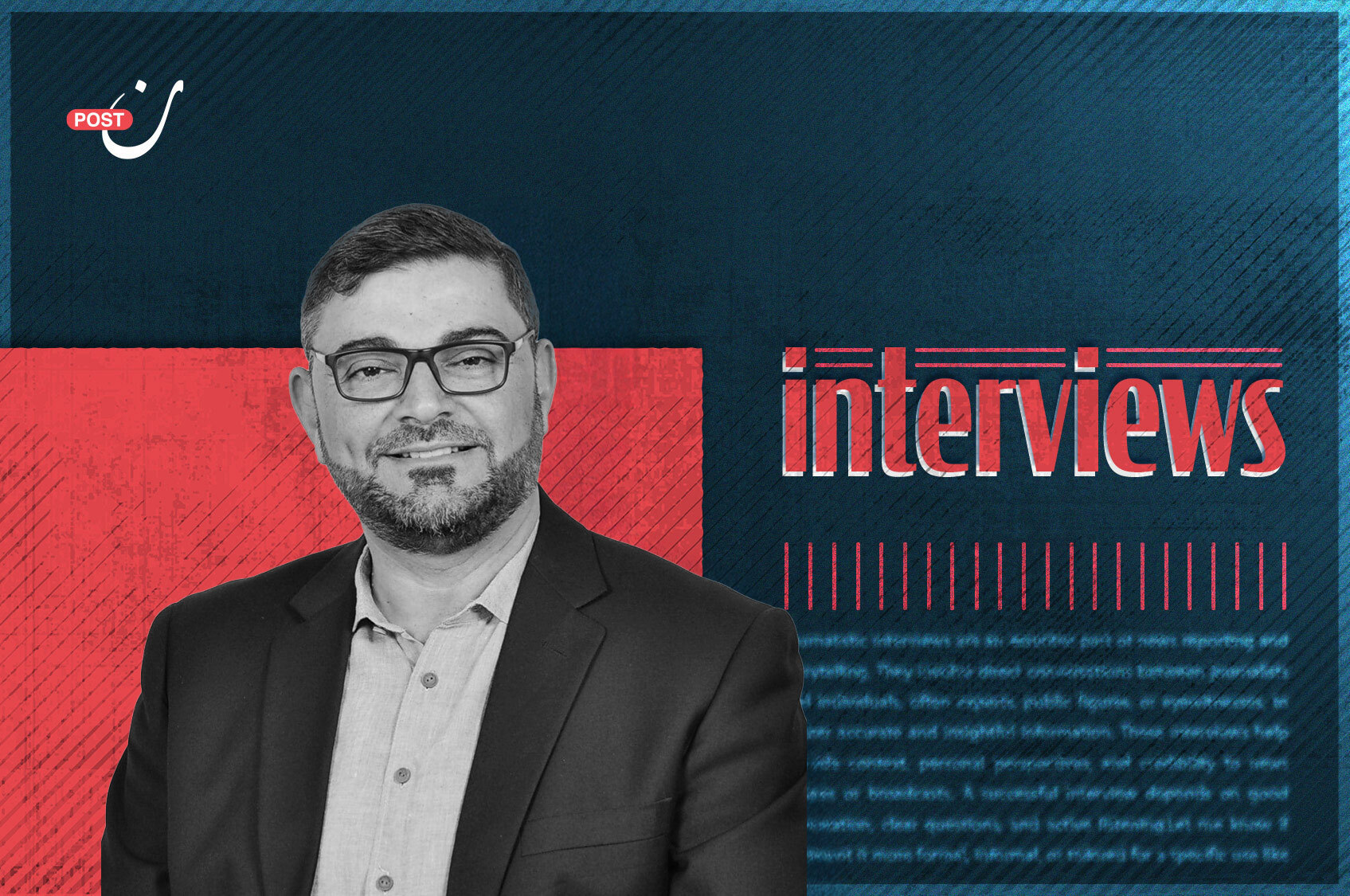
Since the dawn of the new millennium, Ahmed Khairy Al‑Omari has charted a distinctive trajectory in Arabic writing a path unlike any other, where idea and narrative converge, spirit and reality entwine, and faith becomes a living human experience marked by inquiry, restlessness, and transformation.
In his world, stories are not written to entertain the reader, but to awaken them to their questions; religion is not invoked as a rigid system, but seen as a force that returns the person to themselves and grants a deeper meaning to life.
From Baghdad, which shaped his earliest nucleus, to the stations of exile and experiences in diverse societies, Al‑Omari has remained convinced that departure does not nullify belonging, but rather broadens and redefines it. He believes that a true writer does not write to describe the outside world, but to reconstruct the inside and confront the world through it.
Thus his works emerge as successive paths in the human journey toward the self, where religion becomes a renewed awareness—not a closed text—and writing becomes a perpetual exercise in faith and in reclaiming meaning in a world that loses its compass.
In a special interview with Noon Post, Al‑Omari contemplates the meaning of writing in an era flooded with pain and transformation. He revisits the Syrian revolution as a moment of consciousness that cannot be bypassed regarded as a victory for humanity against tyranny, and a space for rediscovering meaning amid the ruins.
This conversation transcends surface discourse to reach the essence of meaning, revealing the path of a writer who believes that a sincere word is not spoken to be forgotten, but to engrave its presence in human consciousness, leaving its trace as long as time endures.
Between novelistic, intellectual, and methodical pedagogical writing, how do you reorder the features of your literary identity? Which is closest to your core?
Frankly, I do not deliberate over my literary or writing identity, nor its features or reordering. Your question reminded me of a similar one whose answer was: a tree does not know anything about agricultural engineering.
I wrote what I wrote, and whatever I have written constitutes my identity to some degree or another. Who supposes that a writer can even define that in the first place? That responsibility belongs to critics, who may be more objective than the writer in that specific part. And even after critics speak, the ultimate critic will come Mr. Time to render the final verdict that nullifies all that preceded.
Mr. Time will determine not only the “features of the identity,” but will decide whether there was anything worthy of preservation in the first place. Will he preserve The Compass or Chemistry of Prayer, or prefer Bilal’s Code or Christmas in Mecca or My Aunt’s House? Or will all of this vanish as though it had never existed at all? Unfortunately, we do not know. Those judgments will issue after we all have departed.
Which is closest to my essence? I first wonder: can not one essence encompass both? But I will not fall into the cliché trap of “They’re all my children.” I will say frankly that intellectual work is closer to my comfort zone, and that doing a novel necessarily lies outside that zone a fact that makes it harder and more exhausting, but also more pleasurable. Yet I believe that literary work by definition lies outside the comfort zone for all writers and novelists, not only for Al‑Omari.
Moving between different places and experiences from Baghdad to other stations how has that reshaped your awareness and vision as a writer, and to what extent has it reflected on your creative output?
The transition from Baghdad to other places coincided with great transformations in Iraq, and then across the region. I don’t think there is anyone who has not had their awareness reshaped, whether they stayed in their original locale or roamed the diaspora of this world.
The world itself changed during that time, so it is quite natural that awareness would undergo reconfiguration, which might contribute to the ripening of that awareness and allow one to see the world more clearly.
Generally, departure makes us more capable of seeing from afar; this may cause us to overlook some details, but it equips us with the capacity to see the larger picture, and makes us able to compare different stations. It also leads us to appreciate certain positives we didn’t perceive amid the detail, and reexamine the certainties that habit had consecrated despite their negativity.
For me: true departure is a myth. We leave our cities, but they never leave us, no matter how much we adapt to different climates or master new languages. As Cavafy said: “No ships can carry you far from yourself; in the same streets you will wander forever.” In short: Baghdad is my genetic origin, the rest are acquired traits—but even that acquisition is partly influenced by genetics.
We see in Alwah and Dusur that writing for you seems a kind of “inner construction,” where proper preparation precedes any large project. How do you view the relationship between ordering the inside before engaging the outside?
In my conception, every piece of writing is first and foremost an inner construction. I cannot understand writing except in that regard, at least creative writing. Still, the relationship between inside and outside is very complex. It is true that writing is internal construction, but that inner construction often stems from a seed arising from the outside.
The inner building begins with an idea born of interaction with the outside. And the matter is not necessarily confrontation with the outside sometimes it is confrontation, sometimes analysis of its causes, sometimes through tunnels that circumnavigate it to transcend it.
The relationship between inside and outside is inevitable from the start; but your phrase “ordering the inside before engaging the outside” caught my attention. I don’t believe that order is possible prior to engagement; it happens during it—if it happens at all.
In the Chemistry of Prayer series, religion is not a rigid text but a compass connecting earth and sky, human and daily life. Do you see literature as more capable of reviving that connection than any direct didactic discourse?
I do not think the Chemistry of Prayer series can be classified as a literary text. The series speaks of the meanings of prayer and its relation to the values of awakening and growth. The language used in the series expresses the message and intellectual content, and messages of thought are not the same as sermons and that does not diminish either.
Can literature replace a didactic sermon? No, it cannot. Some people find comfort in direct sermonic discourse and will not resonate with any literary language or artistic style however original, and that is not a flaw or deficiency but simply nature.
Conversely, others find their strongest interaction in literature or thought. Insisting on a single “appropriate discourse” for all despite individual differences leads to a dead end and deprives everyone of opportunities for diversity.
Many of your texts highlight the human’s struggle with alienation or internal “whale” that engulfs them. Do you view writing itself as an act of deliverance from that whale?
No, not necessarily.
Some writings are devoted to dwelling within the whale’s belly, even if their overt slogans call for escape or its death.
The writing that strives to emerge from the whale’s belly is one that seeks to alter dominant consciousness, and examines the causes of falling into the whale with balance, without placing the entire blame or responsibility on others.
But you are right! The writing I consider devoted to remaining inside the whale may be by an author who believes he’s doing the opposite, and may view what he writes as glorification of the whale’s belly.
Thus, every writing represents an attempt at deliverance from the whale’s belly according to the author’s vision of the world and his paths to salvation. The true placement of each writing among these expressions will only appear after we have all progressed onward.
Some of your characters seek a lifeline in moments of illness or betrayal, but find hope in historical or faith‑rooted symbols. In your view, what makes a return to spiritual memory a source of revitalizing the present?
The direst moments of illness and betrayal are most apt for seeking a lifeline. If not at that moment, then when?
Hope is not always in historical or faith symbols, but faith in its broad meaning can be an essential part of the lifeline.
Historical symbols appeared as lifesaving rings in Bilal’s Code and The Sacrifice of the Family of Yunus, just as faith was present in Christmas in Mecca, and to a lesser degree in My Aunt’s House.
In short: I believe a large portion of our downfall in the present reality is due to ailments and crises accumulated over history. To emerge from this reality, we must exit through the same gate by which we entered. There is a negative heritage built through readings and interpretations of religious texts, and historical crises that were sanctified and exploited.
All this makes history part of the problems of the present, and any attempt to imagine a clean break with this history is doomed to fail. Severance is an illusion. You cannot sever your genes, but understanding their problems helps manage the consequences.
In Istirdad ʿUmr, you often mention that within every person is a “strong seed” that can transform into justice and mercy if invested. How do you see this human transformation possible today in a turbulent world?
Had the world been less troubled and more just, human transformation would have been more difficult. There would not be enough catalysts for transformation.
This turbulent world is what fires the trigger of human transformation, and the path after the trigger is certainly not easy but that is part of any significant transformational process.
There are many distractions and temptations in this troubled world, but there is also much that can be positively invested in that transformation. The information revolution and ease of communication and access have become part of any transformation process in ways that were nearly impossible in previous eras.
I believe in multiple personality types, each capable of being deployed for good or for evil, or in-between there is no single absolute mold we all must fit.
Your novel My Aunt’s House opens a door to prison literature and tragedy a field not directly part of your literary path. What drew you to it and compelled you to write about it?
I did not intend to write a prison literature novel. I came to know things I could not leave unspoken in what I write. I feared the regime would steal the narrative of what happened, especially after for a while it appeared to have prevailed. So I wrote the narrative through the testimonies of those who lived the worst of what happened. That is all for me.
At first I was surprised when people classified it as prison literature. As a reader, I confess I’m not one fond of reading prison literature. I respect it, but it isn’t my preference. I still have reservations about placing My Aunt’s House under prison literature, though I rarely express that—because classification is unimportant once the message has reached, or I hope it has.
On the whole, prison literature as a literary genre inevitably falls under realistic literature, so I do not believe it completely diverges from what I have written previously.