The October 7, 2023 operation and the genocidal war that followed, which devastated Gaza physically and humanely was not a mere passing incident in the long record of conflict. Rather, it was a geopolitical earthquake that redefined Egypt’s notion of national security and placed Cairo into its most dangerous diplomatic and economic quandary in decades.
Over a full two years (October 2023–2025), the Egyptian state has found itself at a crossroads demanding reconciliation among three contradictory priorities: defending its borders and sovereignty via an absolute rejection of forced displacement as a “red line”; asserting its historic role as a central regional mediator and indispensable humanitarian lifeline to Gaza; and finally, preserving the fragile peace treaty with Israel, whose foundations were shaken by border escalations.
The Egyptian stance has oscillated between principled constancy backed by the categorical refusal to resolve the Palestinian question at the price of relocating Gazans into Sinai and the harsh necessities of economic reality.
The war’s impact extended far beyond the security challenges of managing the Rafah crossing and the “Philadelphia” frontier; it imposed an exorbitant economic burden on the regime, especially as Suez Canal revenues were harmed by Red Sea tensions prior to the U.S.–Houthi deal.
In this context, sensitive trade relations most prominently gas deals with Israel came under scrutiny, revealing the tension between immediate economic interests and long-term political and ethical costs.
In this article, we attempt to trace the key phases of Egypt’s precarious balancing act from autumn 2023 to the present, deconstruct the Egyptian strategy in upholding its “red line,” analyze the mediation quandary surrounding management of the Rafah crossing, and assess the fragility of peace in the face of escalating border tensions, particularly around the Israeli presence in the Philadelphia frontier.
We will also analyze the economic burdens stemming from the crisis, including the fallout from Suez Canal losses and commercial and gas‑trade controversies.
In conclusion, the piece seeks to forecast Cairo’s possible trajectories in the near future regarding Gaza in the “day after” the war, and its strategy in managing acute tension with Israel.
National Security as an Existential Priority
Protecting Egypt’s borders and preventing displacement of Gaza’s population into Sinai have been foundational pillars of the Egyptian position, officially described as a “red line” that cannot be crossed under any circumstances. President Abdel Fattah al‑Sisi has reaffirmed this stance numerous times, stressing that the calm and restraint characteristic of Egypt’s policy “do not imply weakness or laxity.”
With the war’s onset, and during a meeting with the German chancellor, Sisi elucidated the strategic dimensions of this refusal.
In an official statement issued by the Egyptian Foreign Ministry in September 2025, it was declared that the continuing siege and blockage of aid exacerbate the catastrophe and threaten civilian lives, stressing that any solutions that disregard Palestinian rights would be seen as violations of international law and “preludes to unacceptable forced displacement.”
The refusal to displace was not motivated primarily by humanitarian concerns, but by a deep understanding of the catastrophic geopolitical consequences for Egyptian national security and regional stability.
Egyptian institutions especially presidential and security apparatuses view forced displacement as a step toward eliminating the Palestinian cause once and for all. Should the Palestinian population be expelled from Gaza into Sinai, “there will be no land left for them to return to” in the future.
Moreover, the security risks inherent in displacement form a central tenet of Egypt’s national security doctrine. If Gazans move into Egyptian territory, it endangers the Egypt–Israel peace treaty and exposes national security to numerous risks.
The underlying assumption is that displacement would create a base from which Palestinian resistance could operate on Egyptian soil against Israel.
This scenario forces Egypt to choose between two bitter options: either a direct clash with Palestinian resistance within its territory, or exposure to Israeli strikes in Sinai under the pretext of pursuing resistance elements transforming Sinai from a buffer zone into a potential conflict arena, which undermines existing security arrangements in the region.
Therefore, from the very beginning, Cairo has been clear and consistent in labeling displacement strategy as a “red line” not only to safeguard its borders but also to compel the international community and Israel to acknowledge Egypt as an indispensable party in any deliberations over Gaza’s future post‑war.
Mediation Challenges, Humanitarian Role, and the Peace Treaties
Despite deep tensions, Egypt alongside Qatar and other regional and international actors has continued to play its historic role as a primary mediator in efforts to contain the war’s fallout and reach a comprehensive ceasefire and prisoner exchange agreement.
The Egyptian role has been crucial in supporting the two‑state process, according to official statements, and it has been affirmed that the Palestinian Authority “will not return to Gaza on Israeli tanks,” but must return within a comprehensive settlement framework.
Egyptian mediation helped secure important clauses in ceasefire agreements related to the Rafah crossing and the Philadelphia frontier, but Israel persistently rejected proposed arrangements. The war extended after two ceasefire agreements: one in November 2023, the second in January of this year.
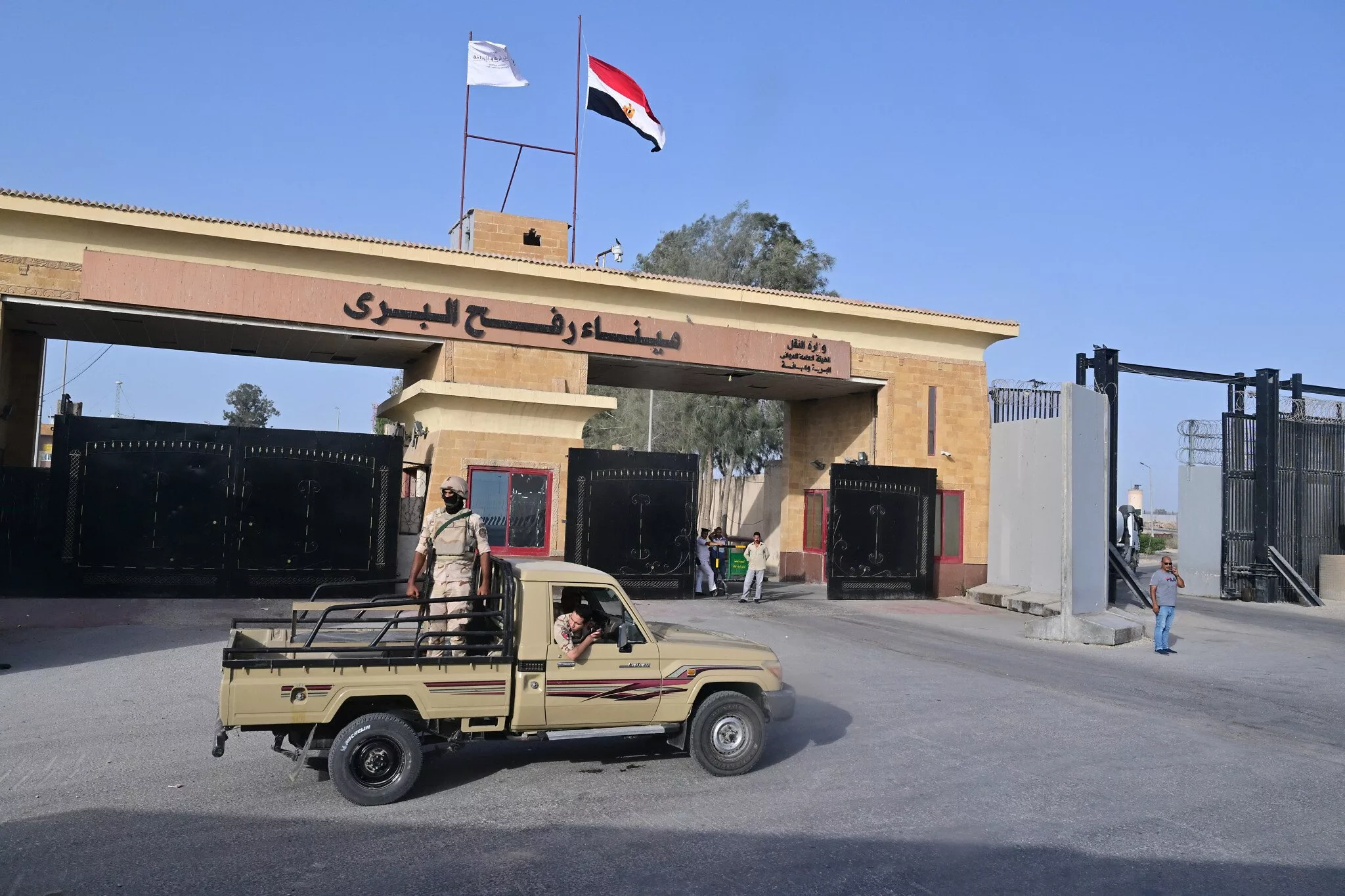
Cairo was under enormous logistical and diplomatic pressure in managing the Rafah terminal, which for a long time (until the Israeli incursion into its Palestinian side in May 2024) remained the sole land corridor for Gaza outside direct Israeli control.
Over the two years, Egypt documented Israel’s systematic obstruction of humanitarian aid entry. In August 2024, an Egyptian official criticized to a U.S. delegation Israel’s intransigence in admitting aid to Gaza, citing an escalation in war operations.
President Sisi went so far as to denounce a “deliberate starvation and genocide” of Gaza’s inhabitants. These criticisms reflected Cairo’s frustration that Israel was using aid as a political and military lever, damaging Egypt’s capacity to fully assume its humanitarian role.
A major crisis arose in managing the Rafah crossing when Israeli forces occupied its Palestinian side in May 2024, demanding permanent Israeli representation in its management a demand Egypt rejected as a breach of agreements. In January 2025, an extended meeting in Cairo between Egyptian intelligence officials (headed by Director of General Intelligence Hassan Rashad) and their Israeli counterparts (heads of Mossad and Shin Bet) produced a temporary accord regarding operation of the crossing on the Palestinian side, stipulating that the Palestinian Authority would administer it under international supervision.
Though provisional and limited to the ceasefire period, this agreement constituted a partial diplomatic victory for Egypt. Cairo’s insistence on Palestinian/international oversight aimed to prevent de facto Israeli control over the movement of people and goods. It also sought to restore Egyptian influence and reaffirm the PA’s legitimacy as an acceptable administrative interlocutor.
This was part of Cairo’s broader strategy: rejecting unilateral Israeli arrangements for the “day after” war that exclude the PA.
The Salah al‑Din (Philadelphia) frontier axis, spanning about 7.5 miles on Gaza‑Sinai borders, has represented the most dangerous flashpoint between both parties. In May 2024, three weeks after the Rafah attack, the Israeli military declared full “operational control” of this strategic corridor, citing claims that Egypt had not done enough to stem arms flow via tunnels across this border claims staunchly denied by Cairo. Israel further alleged the discovery of about 20 tunnels in the area.
The Israeli takeover of the axis confronted security arrangements under the 2005 Crossings Agreement and posed a direct threat to Egyptian sovereignty along its border. Border tensions surged to the point of kinetic engagement: on May 27, 2024, an Egyptian soldier was killed by Israeli sniper fire during exchange of fire on Rafah’s border strip.
An Egyptian security source later asserted the Egyptian forces “did not initiate the firing,” contradicting initial Israeli claims. The Egyptian Armed Forces announced a full investigation, but provided no further details to date.
Although both sides sought to contain the fallout and resume dialogue, the incident constituted the most severe breach in Egyptian–Israeli relations since the peace treaty.
A direct military clash leading to the death of a party’s soldier constitutes a structural erosion of strategic trust and a failure of effective security coordination. When security disputes reach this level of escalation, they imperil the treaty itself, transcending later attempts at resolving “technical logistical” differences.
The Philadelphia axis has remained the principal point of security contention in the negotiations. In the January 2025 talks, there was clear “disagreement” over the axis: while Israel proposed partial withdrawals, Egypt’s position remained unwavering in calling for full withdrawal and restoration of the pre‑war security status. Egypt’s insistence on full withdrawal is a decisive attempt to recover deterrent capacity and preserve its territorial sovereignty.
Accepting even a limited Israeli operational presence, even temporarily, would open the door to Israeli demands for permanent changes to the security terms of the peace treaty something Cairo seeks to avoid to maintain the treaty’s integrity and to block Israel from establishing new security facts at Egypt’s expense.
Despite its anger over the Israeli occupation of Rafah and its closure, Egypt prevented or intimidated any popular or international attempts to reach the crossing, aiming to maintain unilateral pressure on Israel. The security mindset in Cairo preferred to monopolize the right to apply pressure.
Egypt mobilized delegations often government‑affiliated Egyptians to deliver diplomatic messages to Israel and then back off, calibrating each move in response to escalating tensions.
Economic Burdens: The High Price of a Geopolitical Crisis
Egypt’s dilemma was not confined to security and diplomacy; it imposed a heavy economic toll that exposed the fragility of its finances under regional shocks. Red Sea tensions stemming from Houthi attacks on commercial vessels tied to or destined for Israel delivered a severe blow to Egypt’s main foreign‑exchange artery, the Suez Canal.
President Sisi disclosed that Egypt lost about 50–60% of canal revenue over eight months, estimating the loss at more than US $6 billion.
For the full fiscal year 2023/2024, revenues of the Suez Canal Authority fell by 23.4% compared to 2022/2023, dropping from $9.4 billion to $7.2 billion. The number of transiting ships declined from 25,911 to 20,148. International projections aligned: the International Monetary Fund noted that Red Sea disruptions triggered immediate canal revenue declines of up to 70%, underscoring the damage to this vital foreign‑exchange source.
Meanwhile, Egypt was already suffering from a severe foreign‑currency crunch after investors withdrew about $22 billion of “hot money” following the Russia–Ukraine war in early 2022, which caused the Egyptian pound to weaken from around 15 to 50 per U.S. dollar. This sudden shortfall exceeding $6 billion threatened monetary stability and dollar liquidity.
Current portfolio funds (“hot money”) are estimated between $30 and $35 billion critical for exchange‑rate stability. But with a persistent regional war, these funds are vulnerable to rapid withdrawal, risking a repeat of acute currency crises.
This dire economic posture helps explain Cairo’s urgent need to secure foreign currency inflows, even via commercially and politically costly transactions.
Strategy of Separating Diplomacy and Trade
In trade relations particularly energy amid extreme military and political tension over Gaza and the Philadelphia axis border, Egypt’s commercial ties with Israel, especially in gas, emerged as a sharp fault line between economic necessity and diplomatic constraints.
The Egyptian government adopted a strategy of trying to separate the political posture on the war from critical commercial interests.
Egypt’s Petroleum Minister simplified this stance, calling dealings in Israeli gas mere “business,” stressing Egypt’s self‑reliance and that “no one controls our valve.” This attempt at compartmentalization sought to justify continued energy flows, which remain vital for Egypt’s economy.
This strained economic relationship manifested in the announcement of an extension to the Israeli gas import agreement through 2040, valued at $35 billion. The logic is that Egypt imports Israeli gas, re‑liquefies it, and re‑exports it as LNG, leveraging Egypt’s liquefaction infrastructure particularly in the face of reduced domestic production in fields like Zohr.
Yet maintaining such large transactions during a warfare period spawns acute ethical and political contradictions, undermining Cairo’s moral standing in leading Arab responses to the crisis. Regional and popular commentary accused Egypt of “funding Israel’s war on Gaza,” exposing the high political cost of this economic dependency.
Cairo bet that the strategic benefit of securing energy supplies and preserving its regional role as an energy hub would exceed transient political costs. But this gamble weakens its indirect leverage with Tel Aviv in conflict negotiations.
Despite rhetorical claims of self‑reliance, the crisis revealed this strategic independence to be brittle. Egypt at times had to seek alternatives and purchase 60 gas shipments after Israeli supplies were halted.
This underscores that large commercial agreements do not immunize Cairo from security risk they can become a lever of pressure in times of crisis, exposing the gap between official narrative and energy strategy reality.
Projecting Forward: Cairo’s Strategic Trajectories
With two years into the crisis and Egypt’s role entering a more complex phase, forecasting Cairo’s future direction requires precise analysis of Gaza’s “day after” and its strategy for managing tensions with Israel in an exceedingly complex regional and international context.
Cairo’s vision holds to two core postwar principles: rejection of displacement schemes, and rejection of separating Gaza from the West Bank, insisting on a unified Palestinian/authority return to the enclave within a comprehensive settlement, supporting the Palestinian leadership’s refusal to return “on Israeli tanks.”
Yet Egypt’s role has entered a critical new stage with its formal approval of the U.S.–Israeli war‑cessation plan on September 29, 2025. This approval signifies a strategic shift it may reflect that the plan minimally meets Egypt’s red‑line demands regarding the “day after,” or that international and regional consensus forced Cairo onto a new trajectory despite reservations.
Egypt must now operationalize its core principles within this agreement: rejecting plans to detach Gaza from the West Bank, ensuring unified Palestinian authority returns, and preventing a permanent international committee from running Gaza (a notion floated by its chair, Donald Trump).
In the Egyptian security mindset, this approval aims to prevent unilateral Israeli arrangements that consolidate control without political horizon, while reaffirming Cairo’s position as an essential interlocutor for international actors and Gaza.
Egypt’s role is expected to expand in reconstruction oversight and enforcement of the agreement’s terms wherein it remains the indispensable bridge between the international community and Gaza.
Though Cairo has agreed to a broader ceasefire framework, the border security file with Israel remains the biggest challenge to stabilizing this new peace. Egypt’s main demands remain: full Israeli withdrawal from the Philadelphia axis and the reactivation of the pre‑October 7, 2023 border arrangements.
Cairo must exploit its consent to the comprehensive agreement as leverage to demand international guarantees on Israeli withdrawal and full reopening of Rafah under Palestinian/international administration per the January 2025 accord.
Ultimately, Gaza’s war has demonstrated that Egypt’s balancing act between principled steadfastness (rejecting displacement) and practical flexibility (managing economic and security fallouts) was not a choice, but rather an inevitable exercise in “damage control” within a context where Cairo cannot afford to sacrifice its national security, fragile economy, or the eroding peace treaty.
Notably, Egypt never seriously entertained severing ties with Israel or suspending the peace treaty. That reflects the current regime’s alignment, coordination, and flexibility toward Israel.
To date, Cairo has succeeded in achieving its principal strategic objective: forestalling forced displacement by wielding the red line as an effective deterrent. Concurrently, it has maintained the mediation channel open.
Nevertheless, the economic cost has been immense—with Red Sea tensions directly affecting Egypt’s primary foreign exchange source. And the large gas deal with Israel remains a stark strategic paradox: placing vital economic interests in tension with political and moral cost.
The greatest challenge facing Egypt in the post‑October phase is rebuilding its geopolitical influence and reinforcing its role as an indispensable partner in Gaza’s future without sacrificing sustainable economic interests.
Above all, Cairo must manage sharp tension with its Israeli counterpart along the border amid eroding operational trust. The next phase demands a firmer foreign policy in insisting on border restoration to prewar conditions and leveraging its central role to secure major international investment that anchors its financial stability.