

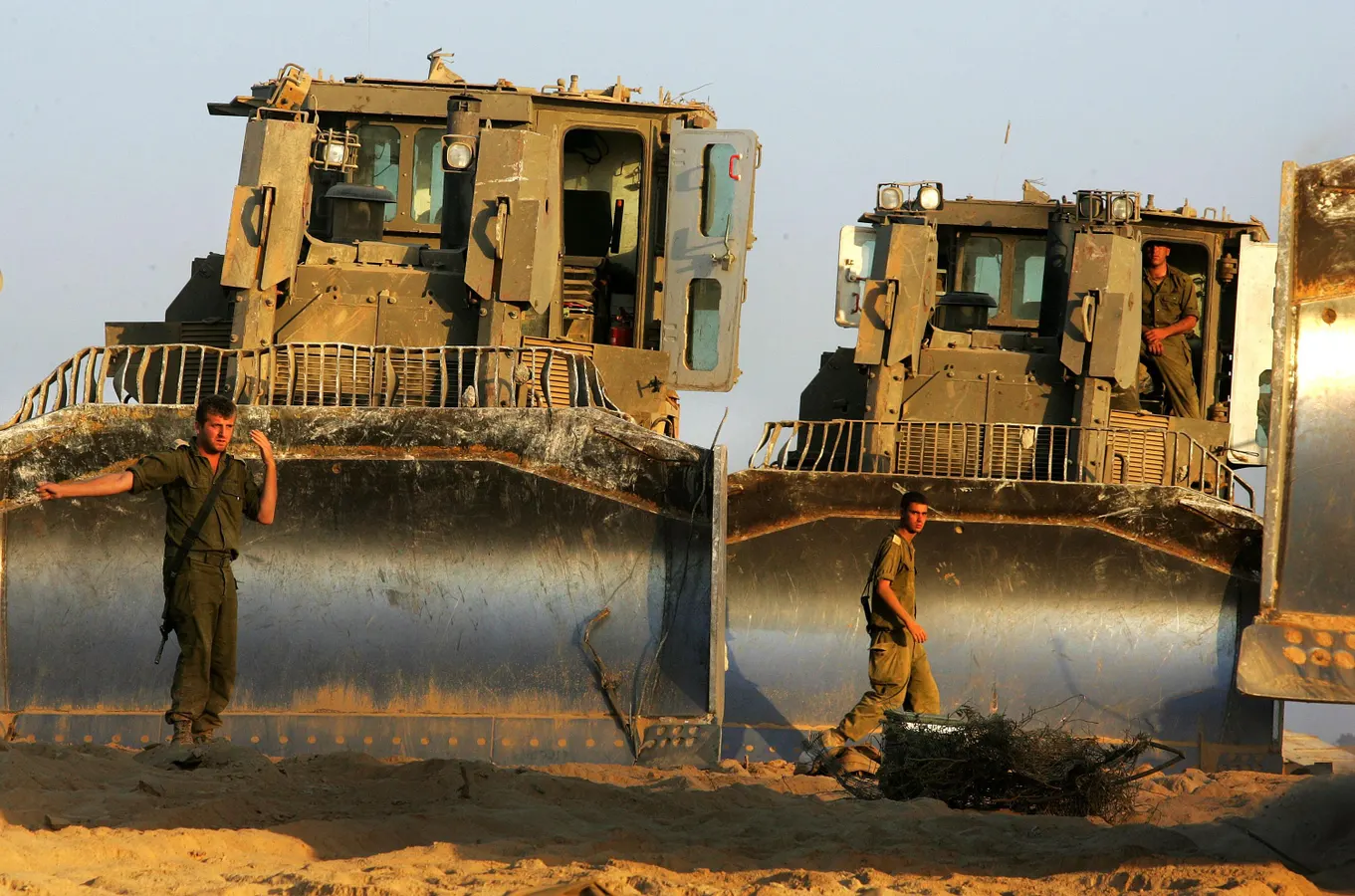
In late February 2025, the U.S. Defense Security Cooperation Agency sent an official notification to Congress regarding a new deal with Israel. The agreement includes massive bulldozers manufactured by Caterpillar known in Hebrew as Dubi or “Teddy Bear.” Some of these machines are to be specially armored or modified for remote, driverless use, similar to the “Panda” version developed by the Israeli military and introduced into service in 2018.
Valued at approximately $300 million, the deal was not presented as “war materiel” but as “engineering equipment,” which eased its passage under U.S. arms export laws. The U.S. State Department even designated it as an “emergency case,” thereby exempting it from the usual congressional review process and clearing the way for Israel to receive the equipment by 2027 without political barriers.
So, what will Israel do with these bulldozers, now granted economic and political cover by Washington? The answer points directly to Gaza, where a devastating war has been ongoing for nearly two years. In this context, the bulldozer has been transformed from a civilian tool into a strategic weapon a lucrative business and a calculated policy to reshape geography and manipulate the memory of the Palestinian people.
From Civilian Tool to Military Weapon
On the surface, a bulldozer is a symbol of development, used to build roads and infrastructure. But in the context of Israeli warfare and occupation, it has evolved from a construction tool into a military and political instrument of the settlement project used to uproot homes, bury tunnels, erase roads, dominate populations, and erase collective memory.
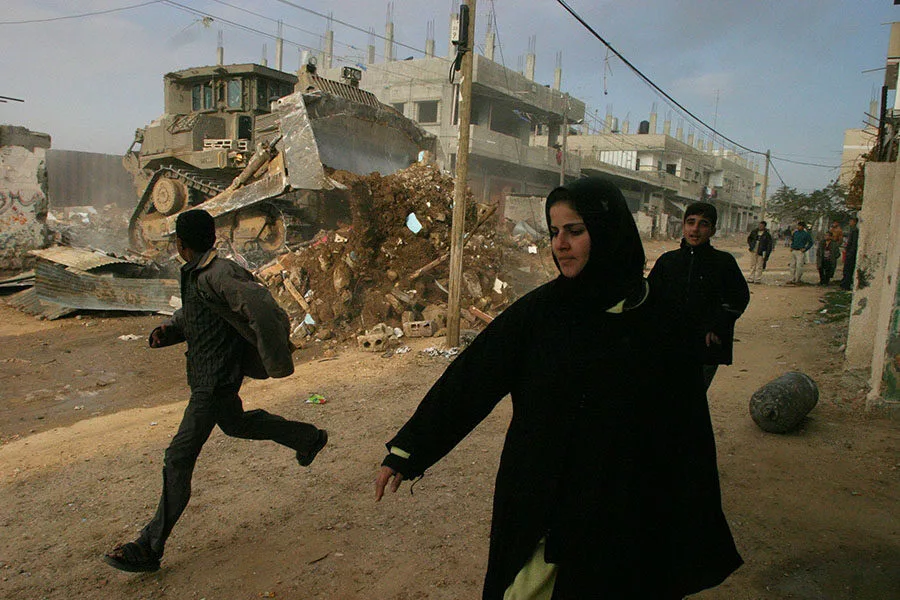
Since the early days of the 1967 occupation, bulldozers and other heavy machinery have served as military tools for imposing new realities on Palestinian land. They drew the outlines of illegal settlements and constructed the walls that separate villages and sever city connections all part of a collective punishment strategy aimed at hindering Palestinian development and reshaping the landscape to serve colonial objectives.
This transformation was not accidental but the result of a strategic policy that merged counterinsurgency needs such as confronting tunnels and booby-trapped homes with a broader project that turned demolition into a hardened military tactic.
Bulldozers became tools for collapsing entire homes onto their residents or emptying entire neighborhoods sometimes as a show of control, other times to legitimize demographic shifts.
Since the Second Intifada and battles like Jenin in 2002, bulldozers have become part of the Israeli army’s “engineering doctrine.” They are armored or remotely operated, deployed ahead of tanks and infantry to clear paths, close tunnels, or bury enemy positions often operated remotely to reduce risk to crews.
Later, bulldozers became more than a preparatory tool. They sent a psychological and political message, especially when used to demolish the homes of leaders or prominent families. In Gaza’s wars (2008–2009, 2014, and beyond), they played a dual role: technically, by revealing tunnels; symbolically, by clearing out neighborhoods and presenting the land as a blank slate ready to be reimagined.
Estimates after the 2014 war indicated that this clearance policy left thousands of homes destroyed and hundreds of thousands displaced. The damage extended beyond physical loss it undermined memory, identity, and a sense of place.
Because these bulldozers are armored and modified, the Israeli army has used them in operations involving civilians. This systematic deployment has sparked widespread ethical and legal controversy, especially in light of testimonies from soldiers and international organizations about demolitions that ignored the basic laws of war and targeted both local and foreign activists attempting to halt the destruction.
This combination of a powerful machine with limited legal accountability makes the bulldozer a political tool with greater weight than its physical force. Over time, it has become part of a military-political ritual demonstrating control, instilling fear, and legitimizing long-term spatial transformation.
Clearance as a Collective Ritual
In urban warfare, such as in Gaza, bulldozers are no longer mere mechanical tools. They are hybrid instruments that merge settlement expansion with battlefield tactics. They open paths for ground forces, dismantle IEDs, and shield advancing troops.
In the latest war, demolitions were no longer denied. Estimates show that nearly 70% of Gaza’s buildings have been destroyed or severely damaged an assessment even acknowledged by Israeli media.
Although the Israeli army claims that houses are used as tunnel entrances, such justifications have failed to convince the international community, particularly in light of repeated misinformation, like the claim that Hamas had headquarters beneath al-Shifa Hospital.
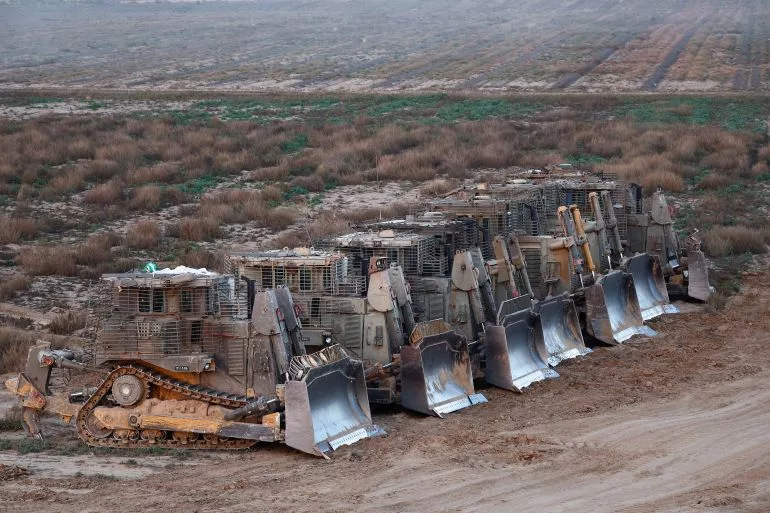
Israel has refused access to any independent investigative commission, but the evidence of bulldozer use is now publicly visible. A new marketplace has emerged where massive profits intersect with violence and destruction. These details are shared openly across social media platforms, where ads recruit bulldozer operators and heavy equipment owners for demolition work in Gaza.
These posts were not targeting soldiers but civilian drivers and contractors, offering attractive pay up to $1,500 per demolished home, with rates increasing depending on the building’s size and number of floors.
The nature of these ads makes their military intent unmistakable. All of this occurs under direct supervision from Israel’s Ministry of Defense. Major construction and infrastructure firms operate under military protection and actively participate in demolition, turning destruction into a self-sustaining industry fueled by the obliteration of Palestinian homes and the displacement of their residents.
Data from recent months shows that the Ministry of Defense signed contracts with heavy equipment owners, covering the cost of transporting machinery into Gaza. As the number of demolished buildings increases, so do the profits of equipment owners.
In July 2025, Haaretz published an investigation revealing that demolition has shifted from a purely military function to a lucrative venture a source of quick wealth for civilian contractors, and even a space for personal revenge, with Palestinian civilians bearing the consequences.
The investigation outlined how these clearance contracts work. Job listings allowed by platforms like Meta revealed a surge in demand for bulldozer operators since May 2025, following the army’s announcement that “every commander wants a bulldozer and a trained operator beside him on the battlefield.”
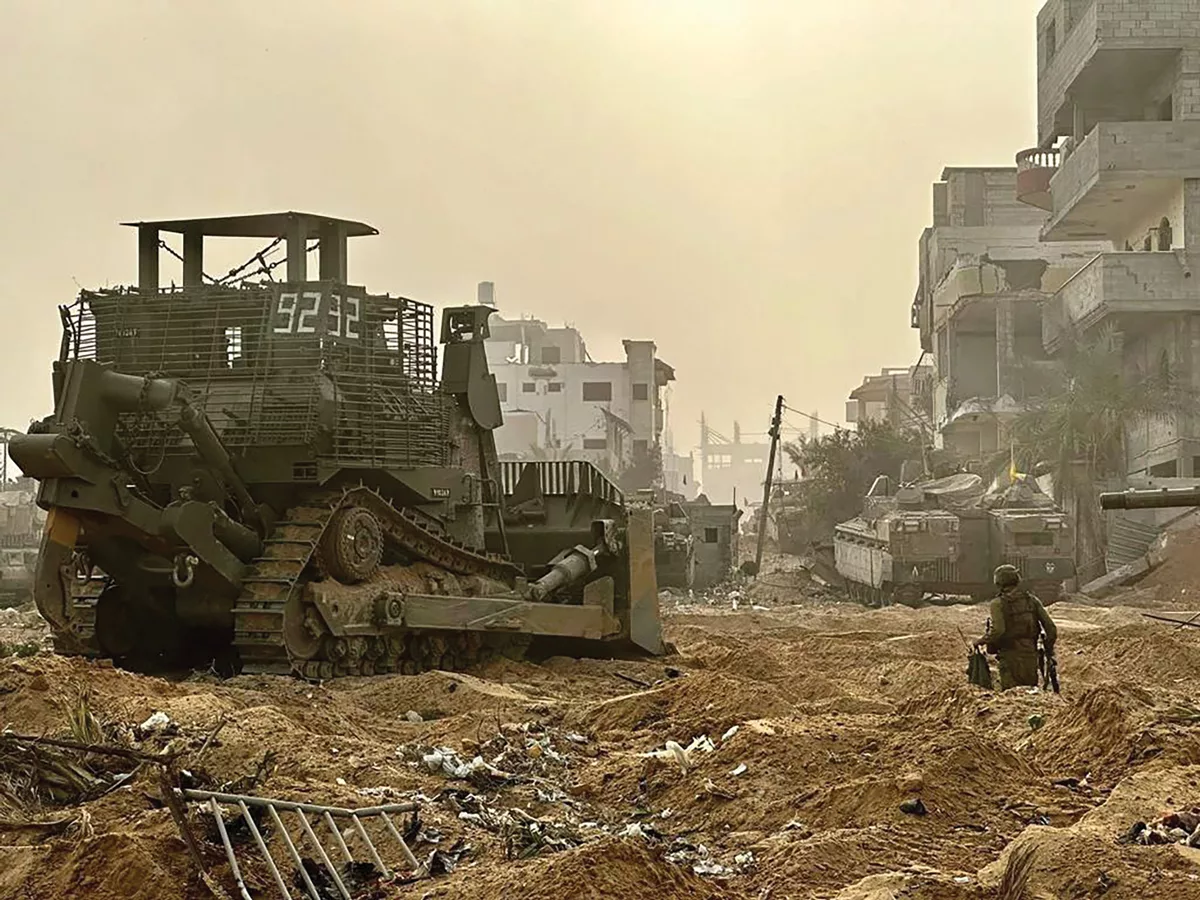
In response, crash courses were launched to train new operators at the frontlines. This shift affected Israel’s domestic construction sector, delaying infrastructure projects as workers and machinery were diverted to Gaza—creating a major gap in the local market.
But the more dangerous trend is that demolition has become a form of collective ritual. Israel hasn’t only mobilized its army but also engaged society at large encouraging civilians to participate in demolitions, expulsions, and even killings, driven by a mix of Zionist fervor, revenge, and fast profit. The bulldozer has become a symbol uniting ideology and capital.
Dozens of ads use ordinary commercial language or even religious appeals to attract more Israelis to demolition work, offering full benefits and up to $900 per day. Demolition is now a lucrative market, where “bulldozer drivers” accumulate wealth atop Palestinian blood and ruins.
The enormous sums offered to contractors and drivers in Gaza far exceed what they’d earn in normal conditions. These payments serve as direct incentives luring civilians into a militarized economy. Operating bulldozers is no longer a task reserved for soldiers; it’s a civilian job marketed as a national contribution.
Demolition as Profitable Business
On the ground, the line between military and civilian, livelihood and warfare, has blurred. Reports indicate that Israeli construction companies are recruiting older reservists as bulldozer operators, deploying them directly to Gaza, with no defined end to their service—while similar-aged infantry and armor reservists are released from duty.
According to Professor Neve Gordon, an expert in international law and human rights at Queen Mary University of London, this amounts to “the privatization of demolition within a systematic erasure project.” This isn’t about removing one or two homes, but about obliterating entire towns and neighborhoods.
Israeli media has recast these operators as national heroes honoring their work in destruction zones. Contractors working for the Ministry of Defense, bulldozing Gaza, aren’t just laborers; they are part of a war machine that hires civilians on special contracts to carry out missions once reserved for soldiers bridging the gap created by shortages in military personnel and equipment.
Perhaps the most disturbing aspect is the testimonies confirming this transformation. In one interview, an Israeli bulldozer operator didn’t speak of politics or strategy but of artistry: “I feel like I’m playing an instrument. You don’t understand what it means to bring down a seven-story building, then a six-story one, then five. In a single week, I was demolishing fifty houses. It’s an art we’ve learned.”
His statement distills the grotesque normalization of destruction turning demolition into a performance, even a craft. Meanwhile, Palestinian families lose everything: their homes, memories, and lives converted into currency in a marketplace that prices devastation in dollars.
Since bulldozers begin where airstrikes end demolishing and preventing return the endgame is clear. Announced Israeli plans indicate an intention to seize 75% of Gaza through bombs and bulldozers, cramming the population into the remaining land, especially the al-Mawasi area, to weaken them, starve them, or force them into exile. Defense Minister Yoav Gallant even proposed turning Rafah into a “detention camp” in preparation for mass expulsion.
Gaza as a Testing Ground
Historically, the term “bulldozer” did not originate as a machine. In the 19th century American South, it was a term used to describe violent racist attacks on Black communities. As Ralph Harrington explains in his essay “The Bulldozer View: Machines, Modernity and the Environment in Post-War Britain,” the bulldozer’s symbolism has always been about force, displacement, and domination.
By the early 20th century, the term came to refer to machines used in agriculture and mining but the connotations of aggressive power and spatial transformation endured.
This symbolism extended to people. Ariel Sharon, a key architect of Israel’s settlement enterprise, was nicknamed “The Bulldozer” a reference to his brute-force political and military tactics. He shaped a systematic policy for controlling Palestinian urban environments using bulldozers to reengineer space, from his armored unit leadership in 1948 to his roles as Minister of Defense and Prime Minister.
Caterpillar’s legacy in this realm is long-standing. By 1954, it had produced its D9 model—a machine that became central to Israeli military campaigns in Gaza and the West Bank. These machines weren’t just used to open safe passages; they were tools for transforming the physical and human terrain.
The newer D9R “Teddy Bear” version, modified and armored, is among Israel’s key combat engineering tools. It was heavily used in the 2023 ground invasion of Gaza, expected to absorb fire and clear narrow streets, though its increased weight 15 additional tons made it less maneuverable and more vulnerable to Hamas rockets.
The Israeli army now owns around 100 of these bulldozers, which were deployed in operations from the 2008–2009 Gaza war to earlier campaigns in Sinai and Lebanon.
But Caterpillar isn’t alone. Behind every bulldozer demolishing homes in Gaza stands a global corporate network. These machines are sold as “civil” or “engineering” equipment but are turned into armored beasts inside Israel fitted with steel plating and advanced defense systems.
Volvo, the Swedish manufacturer, has also been implicated. Its excavators and machines have been seen in Gaza and the West Bank, despite claims that military use is “beyond our control.”
The lack of a domestic heavy-equipment industry has long made Israel dependent on global brands Bobcat, Doosan, Hidromek, Hitachi, Hyundai, and Liebherr among themall of which have appeared in demolition scenes. Human rights organizations have described their roles as complicity in war crimes.
American company Terex is another example. In the early 2000s, its machines were used to demolish homes, build the separation wall, and establish settlement infrastructure making it part of a bloody supply chain operating under armored tracks.
The link between Israel’s military and global corporations reveals that demolition is no longer a national military policy. It has become an international business where the Palestinian homeland serves as both battlefield and experimental ground.
Thus, the civilian contractor demolishing a home in Gaza becomes part of a supply chain that starts in U.S. and European factories, passes through political decisions in Washington and Brussels, and ends in the rubble of a Palestinian neighborhood.
The Ideology of Settlement
Beyond the profits driving Israel’s demolition economy, a deep ideological current persists turning destruction from a profitable task into a symbolic act tied to religious and settler narratives.
Groups like the “Hilltop Youth,” a radical settler movement encouraged by Ariel Sharon, believe in establishing a Jewish state across “Greater Israel” through Palestinian expulsion. They function as tools of assault and forced displacement, founding outposts atop the ruins of Palestinian villages.
Another group, “Oryah Force,” composed of reservists and civilians recruited via private firms, operates not only as bulldozer operators but as ideologues. They present demolition as a sacred act of “liberation” and settlement.
They celebrate the erasure of entire neighborhoods, livestreaming demolitions and using religious language to frame their actions as divine missions “cleansing evil from the land.”
One such figure, reservist Abraham Zerbiv, operates bulldozers while quoting scripture online. In viral videos, he compares demolishing Gaza buildings to “rocking his granddaughter’s swing.” On far-right Channel 14, he boasted of demolishing 50 homes a week, bragging that tens of thousands of Palestinian families now have no homes, no documents, and nothing left to return to.
“Oryah Force” named from a biblical reference declares itself a “victorious engineering team.” Founded in December 2024 after the Biden administration temporarily froze a bulldozer shipment, it rose to prominence in the March 2025 Gaza offensive, executing large-scale demolitions under military cover and with ideological fervor.
In a collective ritual, the group marked the anniversary of a fallen bulldozer operator by demolishing 409 homes in Gaza turning systematic destruction into a form of religious commemoration.
Here, profit and faith converge. Palestinian life is reduced to a sacred settler ritual a campaign to “purify the land” beneath the rubble of erased homes.