
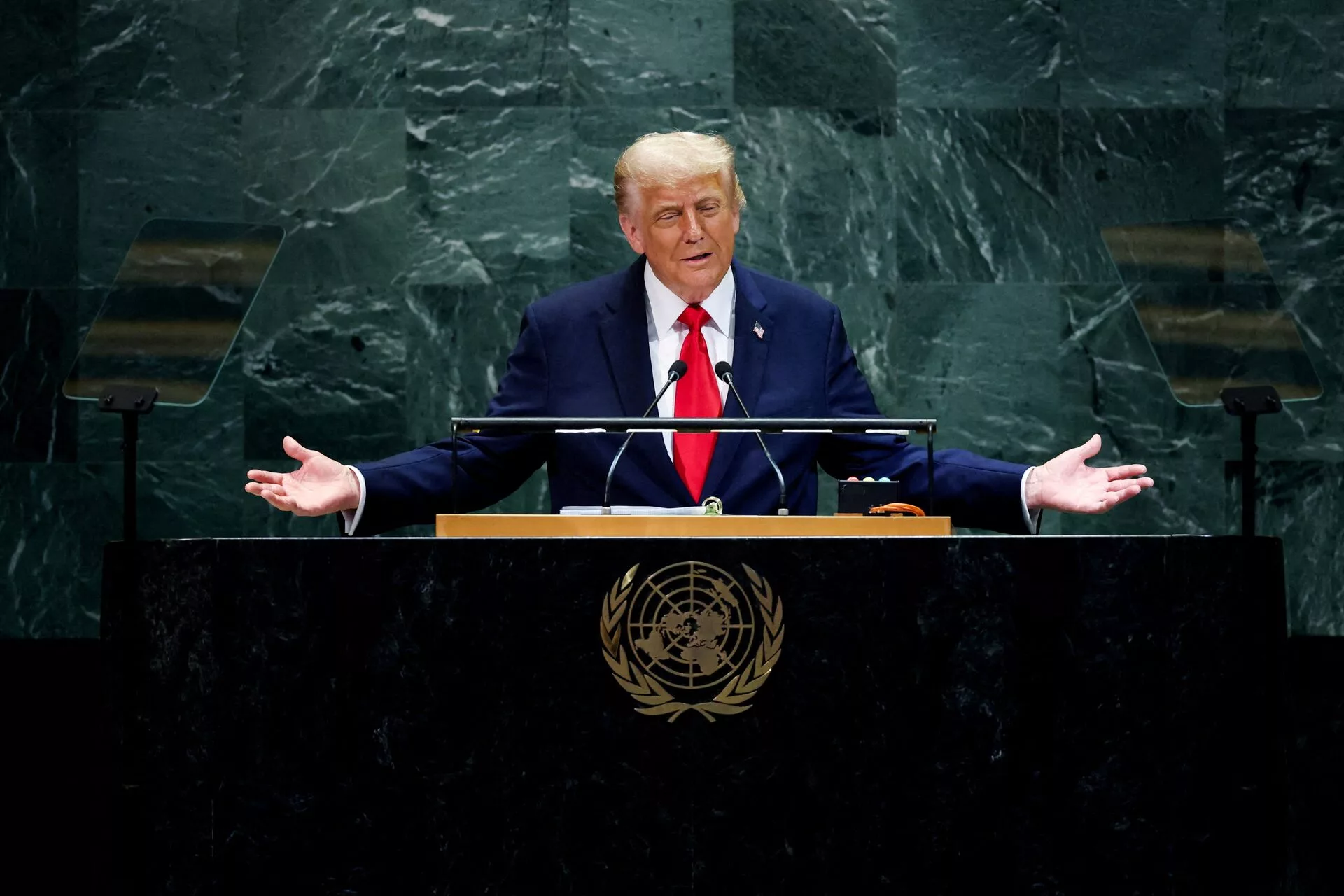
In a theatrical display replete with the usual flair of American presidential propaganda, Donald Trump announced his plan to “end the war” in the Gaza Strip. At its core, the plan centers on the recovery of Israeli captives both living and dead held by the Palestinian resistance.
Trump presented the initiative not merely as a proposal to halt the ongoing conflict but as a broader roadmap toward Middle East peace, asserting that the Israeli government had endorsed it.
The plan, which Trump claimed had been coordinated with and supported by leaders and representatives from eight Arab and Muslim-majority nations during a meeting on the sidelines of the 80th session of the United Nations General Assembly in New York on September 24, received positive signals. These leaders saw in the plan a potential to end the suffering of the Palestinian people and halt the ongoing genocide.
As expected, the announcement was far from surprising. Beyond Washington’s unwavering support for Israel, Israeli Prime Minister Benjamin Netanyahu and his inner circle have consistently shown an ability to shape and steer U.S. political pathways in line with Israel’s strategic vision.
Accordingly, Trump’s proposal was modified to align fully with the objectives of Israel’s war, morphing from a loosely defined diplomatic offer into a tightly calibrated strategic trap one that poses a threat not only to Gaza but to the Palestinian cause as a whole.
The U.S.-Israeli Announcement in Detail
On September 29, the White House unveiled what it called “President Donald Trump’s Comprehensive Plan to End the Conflict in Gaza,” consisting of 20 points, along with a detailed map outlining phased Israeli withdrawal lines. Below are the key components of the plan as officially published:
-
Gaza will be free of extremism and terrorism and will pose no threat to its neighbors.
-
Gaza will be redeveloped for the benefit of its population, who have suffered enough.
-
If both parties agree to the proposal, hostilities will cease immediately, and Israeli forces will withdraw to a pre-agreed line in preparation for the release of hostages. All military operations, including air and artillery strikes, will be suspended, and combat lines frozen until the conditions for a full phased withdrawal are met.
-
Within 72 hours of Israel’s public acceptance of the agreement, all hostages living and deceased will be returned.
-
Upon the release of hostages, Israel will free 250 prisoners serving life sentences and 1,700 detainees from Gaza arrested after October 7, 2023 including all women and children. Additionally, for every released Israeli hostage, Israel will return the remains of 15 deceased Palestinians.
-
Hamas members who pledge to peaceful coexistence and disarmament will be granted amnesty. Safe passage will be provided for those wishing to leave Gaza for third countries.
-
Full-scale humanitarian aid will be dispatched to Gaza immediately upon agreement, at levels at least matching the January 19, 2025 humanitarian accord. This will include infrastructure repairs (water, electricity, sanitation), hospital and bakery rehabilitation, and the equipment needed for debris removal and road clearance.
-
Distribution and aid operations will be managed by the UN and its agencies, the Red Crescent, and other neutral international institutions. Rafah crossing will operate under the same mechanisms as the January 2025 agreement.
-
Gaza will be governed temporarily by a non-political, technocratic Palestinian committee responsible for public services, supported by a new international transitional body called the “Peace Council,” chaired by Donald Trump. Other members, including former UK Prime Minister Tony Blair, will be announced. This council will oversee reconstruction efforts and coordinate the handover of Gaza to the Palestinian Authority once it completes a reform program, as laid out in Trump’s 2020 peace plan and the Saudi-French proposal.
-
An economic development plan for Gaza will be launched, inspired by successful modern cities in the region. International investors will be invited to create frameworks for security and governance that encourage job creation and hope for Gaza’s future.
-
A special economic zone with preferential tariffs and access will be negotiated with participating countries.
-
No one will be forced to leave Gaza. Those who wish to do so may, but residents will be encouraged to stay and rebuild.
-
Hamas and other factions must agree to play no role in Gaza’s governance—directly or indirectly. All military infrastructure, including tunnels and weapons manufacturing facilities, must be dismantled and will not be rebuilt. Independent monitors will supervise the disarmament process, which will include permanent decommissioning of weapons and be supported by an international buyback and reintegration program.
-
Regional partners will guarantee Hamas’ compliance and ensure that Gaza poses no threat to its neighbors.
-
The U.S. will coordinate with Arab and international partners to establish an International Stabilization Force (ISF), which will be deployed immediately to train and support Palestinian police forces in Gaza. The force will consult with Egypt and Jordan and assist in border security alongside Israel and Egypt, with the aim of stopping arms smuggling and ensuring the safe flow of goods into Gaza. A dispute resolution mechanism between the parties will also be established.
-
Israel will not annex or occupy Gaza. Its forces will withdraw based on benchmarks tied to the disarmament process, in coordination with the U.S. and regional guarantors. Areas currently held by the Israeli army will be handed over gradually to the interim authority, though a security buffer will remain until the territory is deemed fully secure.
-
If Hamas delays or rejects the proposal, aid and reconstruction efforts will proceed in “terror-free zones” handed over by the Israeli army to the international force.
-
An interfaith dialogue initiative will be launched to promote tolerance and peaceful coexistence among Palestinians and Israelis.
-
As reconstruction progresses and Palestinian Authority reforms are implemented, conditions may become favorable for a viable pathway to Palestinian self-determination and statehood.
-
The U.S. will launch a political dialogue between Israel and the Palestinians to establish a peaceful and prosperous coexistence framework.
How Netanyahu Rewrote Trump’s Plan
A report by Axios revealed that Israeli Prime Minister Benjamin Netanyahu introduced significant changes to Trump’s original Gaza plan, altering core provisions previously approved by the U.S. and several Arab and Muslim nations.
Netanyahu reportedly met for six hours in Washington with Trump’s son-in-law Jared Kushner, White House envoy Steve Witkoff, and his own advisor Ron Dermer. During this session, he managed to rewrite key clauses especially those concerning Israeli withdrawal from Gaza.
A comparison between the initial draft published by Times of Israel and presented to Arab leaders and the final version released by the White House after Netanyahu’s intervention shows that the Israeli side effectively took over the drafting process.
Key differences include:
Hostage Exchange: The original plan gave a 48-hour deadline for releasing Israeli captives, while the amended version extended it to 72 hours, allowing Israel more time to negotiate or pressure for more favorable terms.
Prisoner Numbers: The first draft allowed room for negotiation with vague language (“several hundred and over 1,000 detainees”), but the revised version strictly stipulates 250 life-term prisoners and 1,700 others, including women and children—limiting Palestinian leverage.
Body-for-Body Clause: A new and controversial element is the 15-to-1 exchange ratio—15 deceased Palestinians for each Israeli body—an unprecedented and highly unequal condition not present in earlier agreements.
Hamas Disarmament: The amended plan ties amnesty not just to peaceful intent but also full disarmament, effectively mandating the political surrender of Hamas.
Military Infrastructure: The revised plan specifies a complete disarmament mechanism with international oversight and weapon buyback programs—ensuring no future rebuilding of resistance capabilities.
Humanitarian Aid: The original commitment to 600 aid trucks per day was removed. Instead, vague language about “full support” was inserted, giving Israel greater control over aid flow.
Oversight and Control: UN and Red Crescent control over aid distribution was loosened in favor of undefined mechanisms, potentially allowing Israeli oversight.
Political Governance: What was initially a jointly devised international body has become the “Peace Council” led by Trump and Tony Blair, reflecting a US–UK-led trusteeship rather than a multilateral arrangement.
ISF Mandate: The Stabilization Force’s role expanded from a training mission to include border control, arms interdiction, and trade regulation—solidifying indirect Israeli security control.
Israeli Withdrawal: Instead of a “phased handover,” the new language makes withdrawal contingent on full disarmament, maintaining a permanent Israeli security perimeter around Gaza.
Annexation Clause: The original explicit statement that “Israel will not annex or occupy Gaza” was completely removed. With conditional language and other tweaks, the revised version leaves the door open for continued Israeli presence under the guise of security needs.
This transformation effectively rewrites a diplomatically palatable plan into a rigid, Israeli-engineered document that achieves occupation goals without the direct costs of war no soldiers lost, no hostages retained, no diplomatic fallout.
The joint communiqué issued by the eight Arab states that met with Trump underscores this divergence. It affirms a commitment to ending the Gaza war through a comprehensive deal ensuring unrestricted humanitarian access, no forced displacement, full Israeli withdrawal, reconstruction, and a path to a two-state solution unifying Gaza and the West Bank into a sovereign Palestinian state.
Yet Trump’s announcement conspicuously omits any reference to annexation or a credible political process toward Palestinian statehood. Meanwhile, Netanyahu continues to assert war goals that render public commitments moot.
Between Trusteeship and the Fragmentation of the Palestinian Cause
A close reading of the plan reveals a blueprint not for peace, but for the restructuring of Gaza and the Palestinian political system in line with U.S.–Israeli priorities. Though framed as a roadmap to regional stability, its provisions threaten the very foundations of the Palestinian national cause.
Trusteeship over Palestinian Sovereignty: The proposed “Peace Council” to govern Gaza—chaired by Trump, featuring Blair, and composed of non-Palestinian elites—would effectively place Gaza under international tutelage. This echoes colonial mandates like those of the early 20th century League of Nations, and for Palestinians, it risks becoming a permanent structure that erases any unified national project.
Disarmament and the End of Resistance: Conditioning amnesty on disarmament is a political death sentence for Hamas. The plan presents the movement with a false binary: surrender militarily and politically, or face continued war and annihilation. Resistance becomes illegitimate, reduced to a threat to be dismantled—not a political actor.
Covert Israeli Security Control: The ISF is portrayed as neutral, but its real function is to enforce disarmament in cooperation with Israeli forces. The “permanent security perimeter” means the Israeli military never truly leaves Gaza.
Conditional Reconstruction: Gaza’s promised economic revival is dependent on American and Israeli approval. Reconstruction becomes leverage—a political tool to extract compliance, not a humanitarian imperative. This creates a dependent economic model akin to foreign-run free zones.
Marginalization of the Palestinian Authority: The PA is cast as a subordinate administrative body, not a sovereign partner. This cements the fragmentation of Palestinian territory and eliminates the prospect of statehood.
Fragmentation Through Aid: One provision allows for reconstruction only in “terror-free zones” designated by Israel. These would be isolated, aid-fed enclaves—proto-ghettos used to reward cooperation and penalize resistance.
A Final Ultimatum: The plan’s underlying message is brutal: accept the terms or face genocide. It reframes the conflict as a choice between total surrender or continued destruction, turning Gaza into the site of an existential blackmail.
A Strategic Trap Disguised as Diplomacy
Behind the polished language of “peace,” Trump’s plan offers a blueprint for restructuring Gaza in Israel’s image: international trusteeship, disarmament of resistance, enduring Israeli security oversight, and conditional reconstruction.
Far from being a diplomatic breakthrough, it reinvents the occupation in a way that minimizes Israel’s burden and maximizes its control. For Hamas and the Palestinian resistance, it poses an existential dilemma—submit or perish.
Yet Gaza and its people have defied such paradigms before. With resilience forged in struggle, they may again surprise the world with their refusal to surrender to externally imposed designs—no matter how sophisticated or diplomatically veiled.