
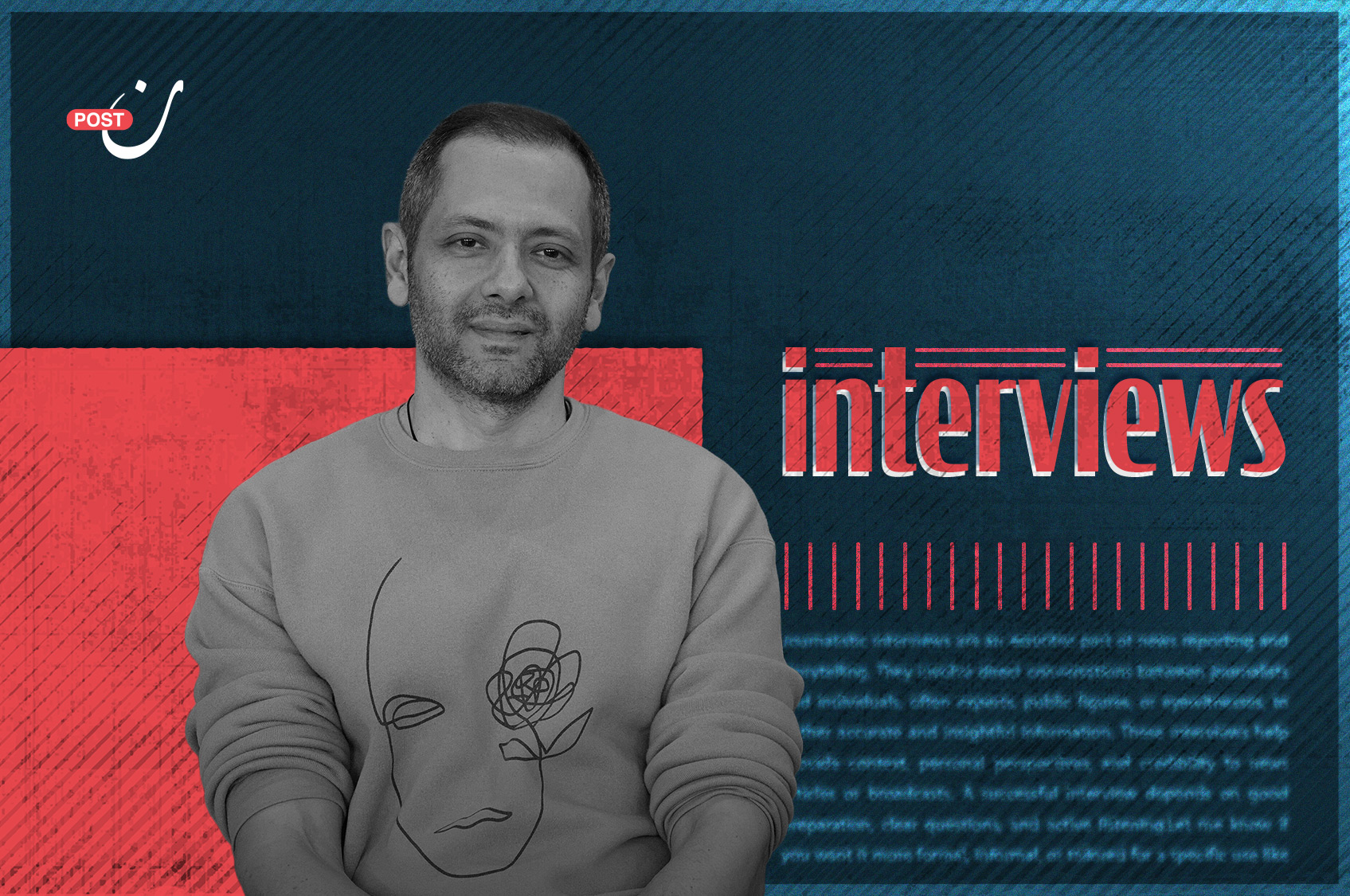
Interview with Omar El Akkad: On Literature, Genocide, and the West’s Moral Collapse Over Gaza
Since the publication of his most recent book “One Day, Everyone Will Say They Were Always Against This” in early 2025 which was longlisted for the 2025 US National Book Award in Nonfiction and translated into several languages, though not yet into Arabic Egyptian-American writer and journalist Omar El Akkad has provoked broad debate across literary and media circles after offering an intellectual and humane testimony about the genocide in Gaza and what it revealed of the West’s moral collapse.
The seed of the book was a tweet El Akkad posted to his X account that received more than 10 million views. The tweet was dated October 25, 2023 three weeks after the Al-Aqsa surge against the Israeli occupier and the start of the genocidal war on Gaza.
He wrote: “There will come a day, when it is safe, when there is no personal cost to calling things what they are, and when it is too late to hold anyone to account, that everyone will say they were always against this.”
El Akkad now lives in Portland, Oregon, on the US West Coast, where he moved twelve years ago the longest he has ever lived in one place, he says. We spoke to him before a new tour for his latest book in Belgium and Italy.
He was profoundly dispirited; the frustration showed in his features, his voice, and his speech and he grew visibly emotional at moments during the interview because of what is happening in Gaza and because of the complete collapse of everything he once believed about the West.
According to the book, El Akkad was born in Egypt in 1982 and left when he was five after his father took a job in Qatar. There, as expatriates often do with their children, they sent him to a British school, then an American one, and then a British one again. As a result, he speaks English not only fluently in speech and writing but with pronunciation and accent indistinguishable from native speakers. The family later moved to Canada.
El Akkad wanted the move to leave an Arab world driven by brute force and shaped by a form of repression for one that promised basic freedoms, rule of law, and a better model than the one he was born into. He later discovered that Western promises were a great lie.
Before this book, he published two novels: American War and What Strange Paradise. Both won literary awards; the second won Canada’s highest literary prize, the Giller Prize, and both were translated into several languages.
Since his first novel, ten years ago, El Akkad has not devoted himself full-time to journalism, though he still freelances occasionally; he focused most of his time on literary writing, but now finds it very difficult to continue.
We conducted the interview in English because it is El Akkad’s more immediate language his upbringing and life have come at the expense of his native tongue and Arab culture, a fact he says he is not proud of, though everything has a price. Most important, he has not lost faith in his causes and principles…
What role can literature and the arts play in exposing the West’s moral double standards and the hypocrisy of its governments?
In the past I had an answer, but now I really don’t know. There is a story I tell in my book about my first novel (American War), in which I wrote about what happened in Sabra and Shatila. No one in North America knows what happened there, so they ask me: Why did you write that section with such violence and brutality? I then have to explain that I am not inventing anything, and that reality is harsh.
When I discussed the novel in a virtual book club organized by some Egyptians, their first question was: Why did you treat the topic in a calm tone and soften its severity? The difference in reception stems from entirely different frames of reference on both sides.
Also, the people who were subjected to that brutality are not distant, alien creatures, any less human than others. For that reason I find it hard to answer what literature can do, because every act of writing is an attempt to say something about what it means to be human. But if your reader lives a completely different life, built on the idea that some people are of lesser worth, then what can your writing really do, for God’s sake?
I think I have lost all faith in Western institutions over the past two years. To be clear, I never had any trust in Egyptian institutions, nor in many Arab governments. But for years I believed Western institutions were built on things like equal justice, international law, fairness. Frankly, after two years of watching a genocide, that conviction has been entirely dispelled.
On an individual level, I have seen people perform acts of genuine courage. I have seen people protest, risk their lives and livelihoods and that happens in the West. But at the institutional level media organizations, political institutions, academic and cultural institutions there has been abject failure. It’s the kind of failure they will apologize for ten or twenty years from now, which is perhaps the most frustrating part.
So I think what I am clinging to right now is the idea that I will not change anyone’s mind with my book, that I will not change the world. What I am doing is the least one can do: calling things by their names, as I witnessed them.
That is the most miserable function of literature, as I say in my book: to witness and speak the truth. But what then, after you have borne witness and spoken the truth? I don’t know.
I am more despondent now than at any other time in my life. I am not sure whether it is a good thing to be a writer at this moment. But it is the only thing I am good at, so I persist.
Have you faced indirect censorship or bias in your literary or journalistic career when addressing sensitive issues like Palestine? How have you experienced freedom of expression in these dark times? Have you paid any costs?
That’s an interesting question. Censorship takes place every day in a million different ways here, some subtle and some overt. It is packaged in formulas like “this will cause discomfort,” or “this may make people feel unsafe” ridiculous language at any time, let alone when you are seeing pictures of children killed every day. As if “discomfort” is the worst thing that can happen, or that you are the cause of that feeling.
I was at a literary festival in Europe when I wanted to read an excerpt from this book for the first time. The festival’s theme was something like freedom of expression and opinion. It was absurd.
I told the organizers about the book, which we had finished editing and which was due to be published in a few months, and their faces changed; they asked me to read a short story or something else.
Anyone who lives in the West knows that the moment Palestine is mentioned, the rules are set aside not only regarding freedom of speech but all the values that this part of the world claims to adopt.
Maybe it happens elsewhere too, but I experienced it harshly in the West. You know that apartheid is bad; it becomes acceptable in this particular case. The same applies to land theft and to freedom of expression.
I know many writers whose careers were irreparably harmed. Or perhaps that’s not true; maybe in twenty years they will be celebrated for what they did. But now I don’t think they will get book contracts, or be invited to literary festivals again.
The reason is they made the mistake of speaking early about what was happening before the environment was “safe” to speak. Everyone knows that.
Are you one of them?
Yes, but I had some advantages and did not face the same hardship. When the events happened in autumn 2023, my career trajectory was clear enough that I avoided some consequences.
I’m not at the reach of someone like Margaret Atwood or Stephen King, but I have won some prizes and sold books, so I have some standing.
When I speak about young writers, I mean those on the cusp of their first book, for example. The second advantage I had possibly the biggest is that I speak their accent without distinction.
For many people I was the polite Arab friend. I have cousins who look like me and have similar names but who do not speak the same way; their experience when they visit the West is entirely different, as if they come from another planet.
The harm I experienced was very small. I lost an agreement to adapt my novel into a film, which would have paid me $10,000–$15,000 a good sum given I don’t have that money.
Was the novel in question American War?
Yes, my first novel. It is a fictional account of a second American civil war, but it is really the story of the world I came from transposed onto the United States, making the novel something of a Trojan horse: it presents itself as very American, but I never saw it that way.
It is about revolt and about a subject Hollywood in the autumn of 2023 did not want to appear to be invested in.
We competed for film rights and a company was chosen. We sent the contract at the end of September 2023. After agreeing all the details, the only step left was signing, but we did not receive a reply. Months later they wrote to say: “We withdraw. We cannot proceed.”
I don’t know whether my tweets on X had anything to do with it, or whether they simply didn’t want to work with an Arab man, or whether it was the book’s subject. I don’t know and I don’t care: it’s better, frankly, to know whom you are working with ahead of time.
It would have been worse to begin the adaptation only to discover I was working with people terrified of my identity or of the book’s subject.
Did you suffer losses besides the film deal?
Yes several events I was due to speak at in the US and Canada were canceled. Interestingly, I don’t receive direct hostility because the subject of my book is explicit. Instead, the harsh criticism tends to be directed at those who support me or publicly associate with me, so anyone who wrote a positive review received real hatred from critics or other writers.
Any bookstore that agreed to host a reading during my tour faced similar hostility. Any library outside Portland, where I live incidentally a progressive city took hits. In Winnipeg, Canada, there were threats of injunctions to prevent me from coming at all, and pressure was put on the hosting bookstore.
We held the event while some people protested outside. All of this is new to me and I had not faced it before, but who cares, really?
But your book was still published in the West by Western publishers. Doesn’t that send a hopeful signal? How do you see that?
I’m not a bestselling author to the extent a publisher would cling to me at all costs, but my books sell they don’t cost the publisher money. Every large publishing house likes to be perceived as a defender of free expression, as if authors can write anything. So censorship of writers becomes a central challenge to a publisher’s image.
It was also to my advantage that editors like John Freeman used their reputations to push this book forward. I remember the tension at our first meeting in February 2024 with the publisher.
There was very real fear about what might happen between then and publication: publishing usually takes at least a year, sometimes two or three, and we did not know what the atmosphere would be by then.
That anxiety before publication contrasted with the relief when the book hit The New York Times bestseller list and when it graced The New York Times Book Review cover.
Why do you think the West has been shamefully silent about the genocide in Gaza while it was so vocal about Ukraine? Is this merely a political stance or the expression of a deeper structure of moral discrimination within Western culture?
Western silence about Gaza has many roots, chief among them racism. The victims in this case are not white — they belong to a race or nationality at the bottom of the hierarchy. There are contexts where the word “Palestinian” is used as a pejorative. In New York, for instance, there is a place called “Cafe Gaza,” and there were calls to close it because of the name.
Another reason is the conflict’s longevity seventy-five years and many, especially among political elites, are surprised by people’s concern now. There is a sense that indifference to the Palestinians’ plight has been acceptable for a long time, to the point that any degree of savagery becomes tolerable.
There was a report released on October 6, 2023, indicating 2023 was the deadliest year in history for Palestinian children. To my knowledge, not a single major media outlet in this part of the world covered it. So it becomes entrenched that these are people you needn’t care about, and you needn’t regard them as human.
A deeper reason is what it would require of an individual to truly oppose it. Because, in truth, the state committing this slaughter is doing so with taxpayer money and with weapons originating in this part of the world, and it practices the same violent colonization on which this state (the United States) was founded.
If I describe a people forced from their land, locked in open prisons, stripped of everything, labeled savages and executed with impunity am I speaking about Palestinians or about the indigenous populations of North America?
The methods and narrative tools are strikingly similar. The condemnation then would not be directed at some distant evil with no relation to you.
Do you think this silence is primarily racial rather than religious?
Religion is, of course, a factor as well. Speaking about race here involves many things, including religion. In this context you can say anything about Muslims or Arabs, especially Palestinians, without fearing consequences.
There are no consequences for silence regarding what is happening to Palestinians; the consequences fall on those who break the silence.
You will lose your job, your friends; people will see you as a troublemaker; you will be blacklisted and face lifelong problems. So it is easier to avoid all that and choose silence as a refuge.
To what extent do you think belated recognition as your title says, “One Day, Everyone Will Say They Were Always Against This” is part of the West’s mechanism to whitewash its history after every war or tragedy? We are now seeing shifts in positions by some Western countries, like France…
Yes, a number of world leaders have suddenly “awoken” after two years and realized genocide is bad. It is miraculous, isn’t it? I don’t know what changed their minds.
That late admission of atrocities, even between France and African countries after years, is not a small thing. I think apology after the fact is not incidental; it is a core component of colonial practice.
Colonialism is endless taking and theft it starts with the obvious: land, resources, the lives of those who resist. But there are more abstract forms of theft stealing narratives, presenting couscous as Israeli food, even stealing grief itself.
I’ll give you an example: every literary event I attend here begins with what we call a “land acknowledgement.” Someone goes on stage to say: “Before we start, I would like to acknowledge we are standing on land that was not ceded by tribe X of the indigenous people.”
I do not doubt the sincerity of the person offering the acknowledgement, and it is a meaningful gesture, but am I surprised if fifty years from now a poetry reading takes place in Tel Aviv with its own land acknowledgement? No it would not surprise me.
What does a land acknowledgement mean? Does it mean they are happy standing on land that is not theirs? It is an admission that the land belongs to the indigenous people and that the event organizers will name the tribe that was dispossessed. This happens in North America, in Canada and the United States.
If you have not heard of it, I suspect the concept will unsettle you. It’s merely an acknowledgement without action: whoever acknowledges the land as stolen expresses regret but does not return it. It is too late for such action.
Some readers misunderstood my title to mean “one day” as in next week. That is incorrect. I would be lucky to see this belated recognition in my lifetime. Apologizing for the slaughter of indigenous people in North America did not take decades but centuries.
I think the Obama administration issued some apology, but regret comes only with a backward glance after the atrocious act has been committed.
In your book you recount the death of Palestinian child Hind Rajab how did that affect you? Do you see it as a revealing moment of the collapse of Western humanitarian discourse?
To be frank, I’m not interested in whether the West collapses or not. I know some personal things: I’m speaking to you from a well-lit house, without the fear of a bomb from the sky wiping out my family. The maddening part is that my tax money goes to pay for bombs that erase entire lineages.
So when I talk about the events’ impact on me, I must stress that my reaction is small relative to the daily suffering I see happening over there.
My life has lost much of its joy. I used to be extremely ambitious prizes, the next book contract, what a critic thought of me, whether my book sold well or reached bestseller lists. None of that nonsense matters to me now.
Two years ago such a transformation would have been catastrophic; I measured my self-worth by many of those things, and now none of them matter. I am in a phase of cutting as many ties with institutions as I can because if an institution failed this test (Gaza), it will never stand for anything at all.
Dominant feelings are sadness and anger. As usual, we who have been subjected to this colonization are expected to get over it, as we supposedly did over the killing of Iraqis, Afghans, and people slaughtered in unlawful wars.
Every morning I wake up, and the first thing I usually see on my computer is a photo of a dead child; then I answer emails and hold Zoom meetings. You can’t live as a human in those conditions.
I’m angrier now than I have ever been in my life, and yet I know I can’t scream at every panel, at every interview, even now in our conversation because I would then be seen as the angry Arab man who might strap a bomb to his chest. Everyone would know the rest of the story.
I no longer know who I am. That sense of not belonging has always been present in some form: I left Egypt at five, I speak their language and understand the culture, but my name and religion mark me as different.
How do you assess Western media performance? Do you see any difference now compared to the start of the genocidal war?
Yes, there is a clear change, but it is slow to the point of anger. I worked for ten years as a journalist in the early years of the war on terror. During that time editors always considered consequences before deciding to publish an article, headline, or photo. They calculated the likelihood of a backlash.
Consequences are, of course, uneven when it comes to Palestinian suffering, and then more generally to Black people. If a journalist is perceived to support these groups, they might lose their job or lose access to certain governmental sources or private-sector contacts; advertisers might pull funding.
The asymmetry remains, but that gap is narrowing because the public outrage at how this genocide is covered is very large among ordinary people who see these double standards.
Some people are killed and their killer is named, while in other cases cowardly, passive language written in the passive voice depicts the other side as if they merely disappear or were struck by stray bullets. Against that double standard, resistance movements arose and I see those movements as the reason media are changing.
Last summer an editor at my old paper asked me to write an opinion piece; I told him they would not publish it because I would describe what’s happening as genocide and say Western governments are complicit. He agreed I was right that it would not be published.
The same editor came back in January and asked again, and I rewrote essentially the same piece but he didn’t object. This is not a moral awakening so much as a pragmatic shift; like in politics or business, there is a calculus of punishment and reward. There is more criticism now and that change is basically pragmatic.
Are you working on any writing projects now?
For months I have not been able to write a single word. I finished that book very quickly it’s all I managed to write in a year. I worked on it diligently every day, and when it was done, I found it very hard to write again.
I signed two contracts to write opinion pieces, but I won’t write them. Perhaps I will be in trouble for that, but something is different and it is difficult for me because I don’t know what else to do. I have no other skills, and for most of my life my values have been derived from writing.
But I don’t know… I can’t anymore. I’m doing my best to cancel professional commitments and hide in the writing room to try to start again. But I haven’t put anything down on paper for a long time.