















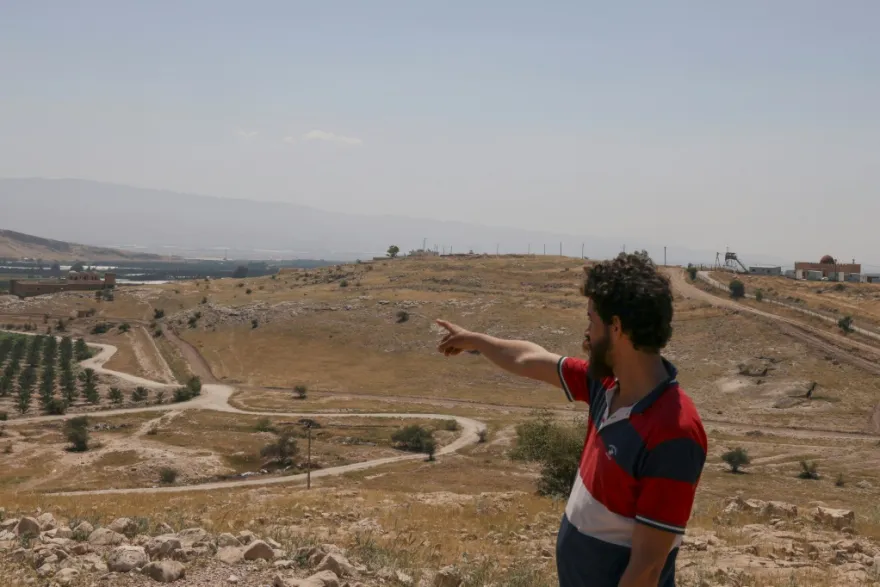
Israeli Prime Minister Benjamin Netanyahu rarely misses an opportunity to reiterate his commitment to annexing the Jordan Valley, which he presents as Israel’s “eastern front.”
No longer seen merely as a border zone with Jordan, the Valley has become a core component of Israel’s strategy to consolidate control and obstruct the establishment of a Palestinian state an ambition that Amman considers a direct threat to its national security and a clear violation of the peace treaty between the two countries.
Netanyahu’s repeated references to the annexation of the Valley highlight that military and sovereign control over the area is a central priority for his government. In his political rhetoric, he consistently emphasizes security and strategic dominance, often citing maps and military justifications to legitimize Israeli sovereignty over the region. But what exactly is the Jordan Valley?
The Jordan Valley: Geography and Strategic Value
Stretching along the Jordanian border and encompassing the northern Dead Sea, the Jordan Valley constitutes nearly 30% of the West Bank and is home to a predominantly Palestinian population.
It is one of the most strategically significant areas, divided administratively between the northern Valley in Tubas Governorate, the central region in Nablus Governorate, and the southern part in Jericho Governorate. Despite this importance, Israel maintains full control over the area.
Thirty-seven Israeli settlements are scattered across the Valley, which the occupation has cut off from the rest of the West Bank with military checkpoints, earth mounds, and trenches.
Severe movement restrictions on Palestinians have denied farmers access to their lands and fueled ongoing displacement aimed at depopulating the area to expand settlements.
The Valley’s strategic value lies in its function as a geographic and demographic buffer between Jordan and the West Bank, severing any potential land connectivity and forming a natural barrier against possible military threats from the east.
Control over the region also offers Israel a defensive advantage to protect its demographic and economic heartland it lies just 30 kilometers from Jerusalem.
But the Valley’s significance extends beyond security. It holds the third-largest water reservoir in the West Bank, and its fertile agricultural land comprises around 38% of the area’s total surface.
This makes it a critical economic asset. Estimates suggest that Israel’s exploitation of the Valley’s resources yields hundreds of millions of dollars annually and plays a vital role in securing water and food supplies.
To cement its presence, Israel has turned more than half of the Valley into closed military zones, hosting over 90 military sites, effectively rendering construction and agriculture nearly impossible. Since 1967, over 50,000 Palestinians have been displaced.
Between 2006 and 2017 alone, nearly 700 homes were demolished, leaving thousands of families homeless. Today, the remaining Palestinians continue to resist these displacement policies, holding on to their land despite mounting pressure.
Israel’s Security and Political Blueprints
The annexation of the Jordan Valley is not a recent ambition. It is part of a broader Israeli strategy outlined in the “Allon Plan,” proposed by Yigal Allon in July 1967, shortly after the Six-Day War.
The plan envisioned returning the West Bank to Jordan, excluding Jerusalem, the Jordan Valley, and the Gush Etzion bloc areas deemed essential for permanent Israeli sovereignty.
Allon argued that defensible borders required leveraging natural terrain as barriers against ground invasions, reinforced politically through settlement building an approach Israel moved quickly to implement.
In the 1970s, settlement activity intensified throughout the Valley’s base and western slopes. The construction of the “Allon Road” demarcated the western boundary of settlement zones and separated them from Palestinian villages. Since then, Israeli thinking has been shaped by the belief that holding the Jordan Valley is an indispensable security necessity.
This view was further reinforced by subsequent plans. In 1994, security expert Yossi Alpher emphasized the need for continued Israeli military presence in the West Bank especially in the Valley with early-warning systems on the mountains and air dominance.
Former Prime Minister Ariel Sharon proposed that a future Palestinian state should be confined to just 42% of the West Bank, with a “united” Jerusalem as Israel’s capital, the Palestinian right of return dismissed, and the Jordan Valley placed under full Israeli sovereignty.
Sharon’s vision outlined two security belts: one along the Green Line and another encompassing the Jordan Valley, connected by a network of strategic roads ensuring complete military control. This transformed the Valley into a forward defensive wall against the Arab east, turning it into a permanent fixture in every Israeli political or military doctrine since the 1960s.
This sentiment is echoed by Professor Efraim Inbar, head of the Jerusalem Institute for Strategy and Security, who argues that controlling the Valley’s border crossings prevents invasions of Israel.
He dismisses the idea that Israel no longer needs the Valley as an eastern frontier, warning instead of potential regional instability from unrest in Jordan or Saudi Arabia to Syria’s return to the “radical axis” and noting the potential withdrawal of the US from the region, which could embolden Islamic forces hostile to Israel and its Western allies.
Evolving Israeli Security Discourse
In recent decades, the discourse around the Jordan Valley has evolved from being a purely military matter to a central political issue, linking national security with the imperative of annexation. This has intensified with the rise of right-wing parties and the growing influence of settlers.
Netanyahu, in particular, has entrenched this narrative in his election campaigns and government platforms, while Israeli think tanks like INSS and JCPA have framed the Valley as either a strategic defensive asset or a bargaining chip.
Despite the 1994 Wadi Araba peace treaty which formally recognized the international border between Israel and Jordan the Valley has remained a politically and militarily contested zone. Amman has repeatedly warned against any Israeli moves to establish a permanent presence there.
Since 2012, Netanyahu has consistently declared that Israel will not withdraw from the Jordan Valley in any future agreement. This marks a shift from a temporary military presence to a fixed strategic stance. On the 50th anniversary of the 1967 war, he reaffirmed the need for Israeli security control over all territory west of the Valley, “regardless of any agreements.”
During his 2019 election campaign, Netanyahu publicly pledged for the first time to impose sovereignty over the Jordan Valley and northern Dead Sea if re-elected.
In 2020, as annexation plans gained traction with the backing of the Trump administration, King Abdullah II of Jordan warned that such moves could trigger a major conflict and jeopardize the Wadi Araba treaty.
Since then, Israel has continued a policy of “creeping annexation.” In July 2024, it approved the largest land seizure in the West Bank in decades 12.7 square kilometers in the Valley. In August 2025, Israeli media revealed Netanyahu’s intention to propose a “partial sovereignty” plan focusing solely on the Valley, deemed less controversial than full annexation.
Amman’s Perception of the Threat
In 2019, Jordanian Foreign Minister Ayman Safadi condemned Netanyahu’s annexation pledge, calling it a blatant breach of international law and a cynical electoral ploy that would kill the peace process and deny the region’s peoples the chance for a just resolution.
He urged the international community to uphold international legitimacy, condemn the annexation agenda, and push for a genuine and effective peace initiative based on a two-state solution.
In response to the threats, Jordan’s military conducted exercises named “Swords of Dignity,” simulating scenarios to repel a potential invasion a direct reference to perceived Israeli aggression.
Amman views any annexation attempt as a threat not only to regional security and the peace agreement, but also to the legal and political status of the Hashemite custodianship over Islamic holy sites in Jerusalem. Jordan has repeatedly warned that such actions could pave the way for more complex regional realignments or even direct confrontation.


