















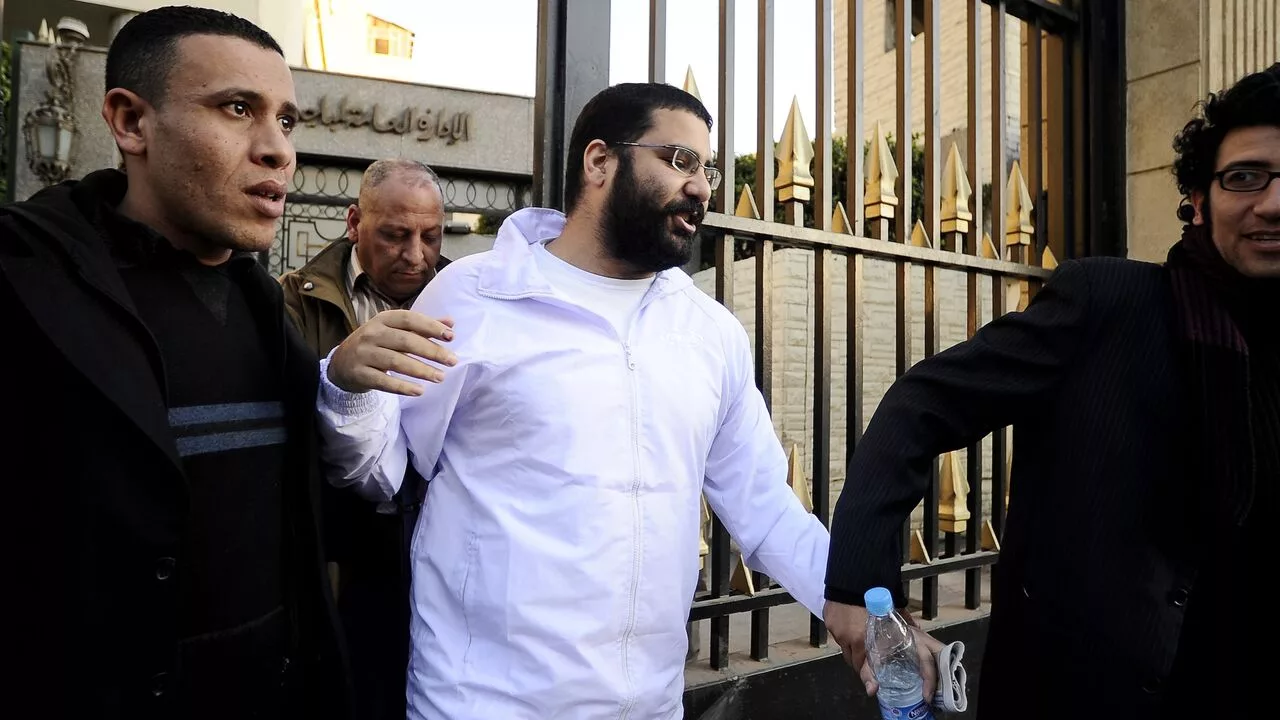
The presidential pardon granted to political activist Alaa Abdel Fattah cannot be understood in isolation from the complex web of political, diplomatic, and security calculations that shape the decisions of the Egyptian regime, nor can it be separated from President Abdel Fattah el-Sisi’s broader and perhaps personal view of political prisoners.
While some interpret the move as a gesture of goodwill or the beginning of a human rights breakthrough amid a convoluted security and regional landscape, others view it as routine: yet another instance of the regime’s piecemeal strategy of selectively releasing political detainees, without any shift in the core tenets of Egypt’s security policies.
In this article, we ask: Why did the authorities choose to pardon Alaa at this moment? And what does this reveal about the deeply entrenched security mindset governing Egypt’s approach to political detainees?
Timing and the Egyptian Regime
The pardon of Alaa Abdel Fattah was neither emotional nor purely humanitarian. Rather, it was the result of sustained pressure both domestic and international particularly from the British government, which repeatedly called for his release.
Alaa’s British citizenship elevated his case to a matter of high-level diplomacy, distinguishing it from the plight of thousands of others who have languished in Egypt’s prisons for years.
This distinction between Alaa’s case and those of similar figures, as well as political prisoners more broadly, is at the heart of the regime’s security logic. Alaa is seen as a symbol of non-Islamist political activism.
By contrast, the regime views Islamist detainees particularly those affiliated with the Muslim Brotherhood as existential threats to be managed with zero tolerance.
This systematic differentiation enables the regime to handle each case individually, without addressing the underlying causes of mass political imprisonment.
Nevertheless, the decision to pardon Alaa should not be seen as a shift in this security mentality. On the contrary, it sends a clear message to Alaa’s advocates chief among them, his family that the regime yields to no pressure, be it human rights campaigns, international lobbying, or even the personal sacrifice of his mother, Laila Soueif, who embarked on a near-fatal hunger strike before relenting at the urging of her daughters and loved ones.
By the time the pardon was granted, media and human rights attention around Alaa’s case had significantly waned. Perhaps the regime found this a convenient moment to act on longstanding appeals some of which came from members of Egypt’s state-affiliated National Council for Human Rights.
The result: a well-orchestrated narrative in which the Egyptian president graciously “ordered a review” of Alaa’s case, followed days later by the announcement of his pardon.
This logic espoused by Egypt’s security apparatus and spearheaded by President Sisi affirms one reality: no matter the pressure, be it humanitarian, legal, or diplomatic, no one is released except by presidential decree. The president alone holds the constitutional authority to pardon.
Security Pathways for Detainees
In the eyes of Egypt’s security state, the detainee file is not monolithic. Instead, it comprises parallel tracks, each governed by its own security logic.
The “non-Islamist track” includes journalists, political activists, lawyers, and others not affiliated—intellectually or organizationally with Islamist movements. These individuals are not perceived as existential threats.
Their cases are handled individually, and their releases are often timed for human rights optics or simply because their continued detention no longer serves a purpose. Still, this does not exempt them from ongoing surveillance, threats, or rearrest.
By contrast, Islamists especially Brotherhood leaders and individuals classified as “jihadist” or affiliated with armed groups like ISIS’s Sinai Province are met with uncompromising repression. They are routinely recycled into new cases after court rulings or even after serving their sentences.
Lower-ranking Brotherhood members and sympathizers may be released, only to be detained again often with no public outcry, save for occasional news of deaths in custody due to medical neglect, torture, or psychological deterioration.
The security agencies assign them little value and view their unmonitored presence in society as a potential risk, particularly in terms of rebuilding organizational networks.
Recently detained pro-Palestine activists form a new category. Some have since been released, but authorities are careful not to free them en masse, fearing this could spark unsanctioned solidarity movements.
The regime insists on monopolizing all public mobilization around Palestine be it protests, gatherings at the Rafah crossing, or aid collection. These arrests reflect the regime’s desire to suppress independent civic action across all issues, domestic and foreign alike.
The Fragmented Opposition: Division as a Tool of Control
More than 12 years after Egypt’s prisons were opened to tens of thousands of political detainees—and despite persistent repression there remains no unified opposition. The longstanding rift between secular and Islamist factions has deepened rather than healed. No credible political front has emerged to collectively pressure the regime for genuine reforms, including the release of detainees.
This failure is rooted in mutual distrust and the deep divide stemming from the aftermath of the 2011 revolution and the events of 2013. The regime has skillfully exploited these fault lines, framing the Muslim Brotherhood as the singular enemy and pressuring other opposition groups to distance themselves to avoid being labeled or targeted.
As a result, solidarity with Islamist detainees especially Brotherhood affiliates has become a political liability, even among rights advocates who liaise with the authorities. Thus, their plight remains siloed, treated as a Brotherhood issue rather than a national crisis.
The most recent chapter in Egypt’s opposition saga only added to this record of dysfunction. The 2023 presidential race was another missed opportunity for unity. Candidate Ahmed Tantawy faced the regime alone, without institutional backing or mass mobilization.
Rather than rallying around him, elements of the opposition engaged in internal disputes and character attacks. When Tantawy was ultimately forced out, another candidate, Farid Zahran, stepped in, offering the regime a veneer of democratic legitimacy for a predetermined outcome.
Once the elections passed, the stage was quietly cleared. Tantawy was jailed on flimsy charges of “forgery.” Egypt’s legal bureaucracy successfully stripped him of his symbolic weight, depriving him of the mantle of a “democracy martyr.” A year into his imprisonment, his courageous stand has elicited only minimal solidarity.
His case did not spark meaningful alignment within the opposition; it remained an isolated cry in a desert of political abandonment. The Egyptian opposition has not only failed to unify it has become adept at missing historical moments.
Meanwhile, the regime has successfully imposed its will, particularly on the so-called “civil movement,” which agreed to a national dialogue that reduced the detainee file to a matter of political bargaining: releasing a handful of prisoners in exchange for whitewashing the regime’s image.
Ironically, since October 7, 2023 when regional and international priorities shifted—the regime no longer feels compelled to even pretend to engage in dialogue.
Egypt’s detainee file remains a mirror reflecting the country’s political deadlock. Alaa Abdel Fattah’s pardon is a deeply personal victory for his family, not a systemic shift in state policy. It has no connection, contrary to some claims, to Israel’s escalating threats to displace Palestinians from Gaza or to Cairo’s growing tensions with Tel Aviv following the invasion of Gaza City.
Instead, this pardon reaffirms the regime’s preference for “selective pardons” and piecemeal concessions—always on its own terms. Meanwhile, it maintains an iron grip on domestic affairs, particularly against the Islamist current, whose members continue to suffer and die in prison. In the absence of a unified opposition, the regime continues to treat political prisoners not as a national or humanitarian issue, but as a bargaining chip to be used at its discretion.


