Talks between Syria and Israel are accelerating toward a “security agreement” whose contours remain unclear, amid continuous Israeli violations inside Syrian territory under varied pretenses, and amid dreams and proposals for larger projects exceeding purely security concerns about ten months after the fall of the previous Syrian regime.
In the most recent official confirmation of nearness to such an agreement, Syria’s Transitional President, Ahmed al‑Sharʿ, said on 17 September that the ongoing negotiations with Israel toward a security pact may yield results in the coming days. He described the security agreement as “essential,” requiring respect for Syrian airspace and the country’s territorial integrity, and stressed it should be subject to United Nations oversight.
Since Bashar al‑Assad’s regime fell on 8 December 2024, Syrian official statements have repeatedly affirmed adherence to the 1974 Disengagement Agreement with Israel, or heading toward a similar deal. On the Israeli side, proposals have varied: demands for Syrian concessions including ceding the occupied Golan Heights, expanding the buffer zone, demilitarizing southern Syria, as well as promoting expansionist projects such as “Dawud Corridor” and “Greater Israel.”
The talk of a looming “security agreement,” mediated by Washington, coincides with Syrian Foreign Minister Asʿad al‑Shaybani’s presence in the U.S. and his meeting with Israeli Strategic Affairs Minister Ron Dermer, while President al‑Sharʿ prepares to attend the 80th session of the United Nations General Assembly in New York—the first Syrian president to do so since 1967.
In this report, we focus on the trajectory of negotiations between Syria and Israel, the nature of the impending security pact, and America’s role in a negotiation process driven by Israel, Syria’s historic foe, exploiting Damascus’s weakness and its attempts to restore stability amid fragile economic and security conditions.
Negotiations Under Pressure
Since 8 December 2024, Israel has escalated targeting inside Syria, hitting military capabilities and weapons depots, penetrating southern Syria, and clearing land, sometimes preventing farmers from accessing their fields. Israeli forces have established military bases and declared the new Syrian administration “untrustworthy.”
Using various pretexts, Israel has intensified air raids on Syrian territory, striking sensitive sites including the General Staff Headquarters and areas around the presidential palace in Damascus, particularly after Syrian army forces entered Suwayda province in July. Covert operations have also been exposed, including an air landing in the al‑Kiswa area of rural Damascus.
One of the operations described as the deepest into Syria in over five decades took place shortly after the fall of Assad’s regime—Israeli forces advanced some 38 kilometers into Syrian depth, seized arms depots and military bases, and captured approximately 3.5 tons of weapons and ammunition.
Meanwhile, Syria’s new administration has repeatedly reaffirmed its commitment to the 1974 Disengagement Agreement, denying that it poses an external threat and emphasizing that the country is war‑weary.
After each attack, Damascus issues statements condemning the Israeli violations as breaches of international law and the UN Charter, calling on the international community to take a clear stance to ensure Syrian sovereignty is respected and to end repeated escalation.
Given these hostile conditions and continuing Israeli attacks, indirect talks between Syria and Israel have started, through international mediators, with the aim of stopping the assaults and reducing escalation. The UAE has been among the key mediators, establishing a communication channel between the two sides; these talks later evolved into direct meetings, unprecedented in the history of relations between Damascus and Israel.
On 19 August, Syria officially announced a meeting between Foreign Minister Asʿad al‑Shaybani and an official Israeli delegation led by Ron Dermer in Paris, mediated by the U.S. This was the second such meeting in fewer than a month in that very city.
Negotiating a Security Agreement
Syria and Israel have been locked in historic enmity since Israel’s establishment in 1948, tied by the Disengagement Agreement of 1974, under UN auspices. That 1974 agreement provides for a buffer zone between Syria and the occupied Golan Heights, monitored by the UN Disengagement Observer Force (UNDOF), which conducts regular patrols and reports to the Security Council. With the fall of Assad’s regime, Israel declared the agreement no longer operative.
On 12 September, al‑Sharʿ said Syria is in discussions with Israel over a security agreement which would restore the situation to what it was before 8 December 2024—either returning fully to the 1974 agreement, or concluding a similar security pact.
Al‑Sharʿ claimed that certain Israeli policies suggest that Israel is “grieved over the fall of the former regime,” adding that Israel had wanted Syria to remain a continuous battlefield and a site of score settling. He alleged Israel had long harbored an old plan to divide Syria.
He said Israel was surprised by the fall of the previous regime, describing it perhaps as an intelligence failure, although in public statements over the years Israel had made clear its desire to reach Damascus and prepare for battle.
Al‑Sharʿ said Israel often responds to its own intelligence and security failures with false or exaggerated security concerns, warning that overemphasis on such fears sometimes leads to war.
However, al‑Sharʿ’s talk of a security agreement contrasts with an earlier Syrian Foreign Ministry denial that any such agreement was imminent. The discussion about the issue surged after the Paris meetings. Several newspapers and websites (including Israel’s i24) cited Israeli officials confirming there is a basis for security cooperation.
“Normalization Is Not on the Table”
Any negotiation between Syria and Israel includes proposals of normalization under Abraham Accords‑style agreements, especially after President al‑Sharʿ’s meeting with U.S. President Donald Trump in Riyadh, where Trump urged al‑Sharʿ to join, and claimed Syria “will join eventually.” Trump suggested that move would be linked to stabilization inside Syria.
Regarding normalization, Israel has insisted on keeping control of the Golan Heights, occupied since 1967, as a condition for normalization with Syria. Israeli Foreign Minister Gideon Saar said that his country intends to maintain presence in Syrian territory and retain the Golan Heights recognition as an essential condition in any future agreement.
Al‑Sharʿ, however, emphasized on 17 September that while the ongoing negotiations with Israel toward a security agreement may produce results “in the coming days,” and although such an agreement represents a “necessity” (requiring respect for Syrian airspace and territorial unity, subject to UN oversight), a peace treaty or normalization under Abraham Accords‑style arrangements is not currently on the table.
On the status of the occupied Golan Heights, al‑Sharʿ said it is too soon to discuss that issue, calling it a “major deal.” He revealed that Syria and Israel came within “four to five days” of agreeing on a security framework last July, but military and security tensions in Suwayda province derailed those discussions.
He described strikes near the presidential palace as “not a message, but a declaration of war,” affirming that Syria is still refraining from military retaliation in order to preserve the prospect of negotiations.
Israeli Proposal
Accounts and proposals of what Israel wants from Syria have varied. According to Axios on 16 September, citing two knowledgeable sources, Israel submitted several weeks earlier a detailed proposal for a new security agreement with Syria, including a map of demilitarized areas extending from Damascus to the border with Israel.
The Israeli proposal is modeled on the 1979 Camp David peace agreement with Egypt. It divides the area southwest of Damascus into three zones, with Syrians allowed different levels of forces/weapons per zone, and includes:
-
Expanding the buffer zone on the Syrian side by two kilometers.
-
Prohibiting military forces and heavy weapons in the strip adjacent to the buffer zone, on the Syrian side nearest the border.
-
Permitting Syria to retain police and internal security forces.
-
Classifying the entire area from southwest Damascus to the Israeli border as a no‑fly zone for Syrian aircraft.
In exchange, Israel would gradually withdraw from territories it has occupied in Syria in recent months—except for a strategic advanced position atop Mount Hermon (Jabal al‑Sheikh). Syria has not yet responded to this proposal; Damascus has been preparing a counter‑proposal in recent weeks, according to the report.
In this context, Agence France‑Presse reported on 16 September that a Syrian military official said Syrian forces have begun withdrawing heavy weapons from southern Syria over roughly the past two months, following clashes in Suwayda; a diplomatic source in Damascus said the withdrawal extends to about ten kilometers south of the capital.
London Meeting: What Form Might the Agreement Take?
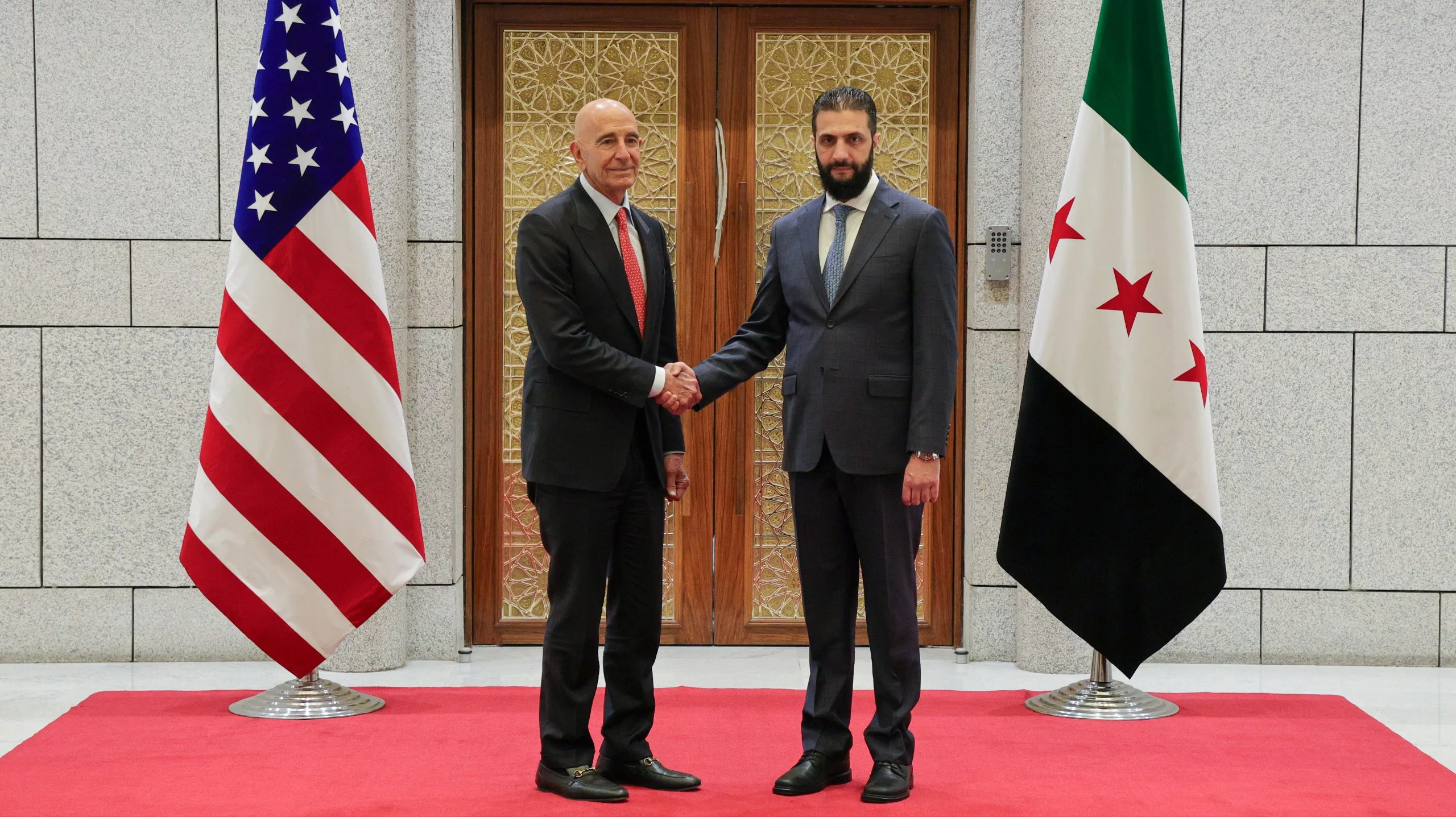
On 17 September, a meeting was held in London between Syrian Foreign Minister Asʿad al‑Shaybani and Israeli Minister Ron Dermer, with U.S. envoy Thomas Barrack present. They met for about five hours to discuss Israel’s proposal for a new security agreement, and to formulate the Syrian response. Axios reported this.
During the meeting, the proposal to halt Israeli military escalation, based on the 1974 agreement, was discussed, along with the Syrian condition that Israel withdraw from areas it has occupied since 8 December 2024.
The next day, AFP quoted a source at the Syrian foreign ministry saying that talks with Israel are making progress, and that consecutive agreements—primarily security and military ones—might be signed before the end of the current year. The source said both parties seek a deal that stops military actions inside Syria, paving the way for further agreements “beneficial to Syrians.”
So far, no final form of the security agreement has been announced. All details in circulation remain preliminary: mutual demands both sides insist upon, and there’s been talk of another Syrian‑Israeli meeting on 19 September in Baku.
Political analyst and executive director of the Jusoor Center for Studies, Wael Alwan, sees thorny issues that cannot be easily resolved—especially under Benjamin Netanyahu’s government, which displays arrogant practices toward regional states, even those that are stable and have already initiated peace like Qatar.
From that angle, it is not expected that Netanyahu’s government will show serious flexibility—on one hand under American and regional pressures, on the other hand using regional chaos for its own agenda, Alwan argues.
Alwan tells Noon Post that what Washington seeks to achieve between Syria and Israel centers on security understandings and ceasefire agreements, ruling out a full return to the 1974 Disengagement Agreement in its original form, given Netanyahu’s rejection of that, and Syria’s weakened bargaining position.
Although international and regional support helps Damascus to limit excessive Israeli force on Syrian soil, that pressure seems insufficient to rein in Israeli actions, which affect regional stability as a whole especially given Syria remains a fragile state in recovery, per Alwan.
Alwan predicts the Syrian government will accept a deal imposed by reality, in exchange for ending repeated violations and curbing Israel’s exploitation of chaos. He emphasizes that achieving security understandings would serve Syria’s interests, particularly in its efforts to assert internal control and make the transitional period succeed toward civic peace.
Syrian researcher Abd al‑Rahman al‑Haj believes that since “Operation Al‑Aqsa Storm,” Israel has claimed to be reshaping its national security strategy by expanding what it calls its “vital space,” citing threats around it; in truth, it is exploiting Syria’s political transition, exhausted from years of war and a revolution that cost hundreds of thousands of lives. Prime Minister Netanyahu has called the moment “an exceptional opportunity,” issuing a series of strikes and incursions against strategic Syrian military sites.
Al‑Haj tells Noon Post that Israel acts from a position of Syrian state weakness, seeking to leverage the moment to impose its terms—terms that appear in proposals which would undercut Syrian sovereignty and allow Israeli aerial dominance.
Al‑Haj notes that Israel is trying to trade its withdrawal from recently occupied areas for Syrian concessions over the Golan Heights—regardless of the deal—but that this proposal has met clear Syrian insistence on separating the 1974 Disengagement Agreement from the Golan issue, insisting on proceeding step by step, and maintaining Syrian territorial unity. He adds that Israeli attempts to tie the future of the Golan to any security agreement have so far failed.
He believes President al‑Sharʿ seeks an agreement that stops Israeli violations of Syrian territory, while Israelis aim for a deal that allows them to capitalize on facts they have established on the ground, converting them into political gains.
Al‑Haj adds that al‑Sharʿ is a negotiator at heart, likely to achieve a formula that preserves Syrian lands and closes Israeli pretexts related to defending its northern borders.
What Role Does Washington Play?
Washington plays an active role in pushing for an agreement between Syria and Israel, especially through U.S. Special Envoy to Syria, Thomas Barrack, who is involved in these efforts alongside other moves such as easing military tensions in Suwayda. These moves helped broker a ceasefire agreement between both sides on 19 July.
Barrack was one of the first to announce that talks had begun; he said in a press conference in Beirut on 7 July that Syria’s new government had opened a dialogue with Israel.
In Syrian memory, the United States is associated with negative moments in the Israeli issue—especially during Donald Trump’s first presidency, when on 25 March 2019 he issued a recognition of Israel’s sovereignty over the occupied Golan Heights.
Recently, Reuters reported that Syria is being pressured by the United States to accelerate negotiations with Israel toward a security agreement; Washington aims to produce enough progress by the United Nations General Assembly meetings at the end of September to enable Donald Trump to announce a breakthrough. Any agreement, even modest, would count as an achievement.
Al‑Sharʿ has denied that the U.S. is exerting pressure on Syria, saying rather that it plays the role of mediator.
Earlier, a U.S. State Department official told Noon Post that the United States continues to encourage a lasting agreement between Israel and Syria, without clarifying the nature of the desired agreement; adding that Donald Trump has articulated a clear vision of a prosperous Middle East, with Syria stable and at peace with itself and its neighbors. Peace among neighbors, including Israel and Syria, is a foundational element of that vision.
Researcher Abd al‑Rahman al‑Haj believes the United States seeks to speed up agreement to allow Trump to appear as a peacemaker given his failures in Ukraine and Palestine; thus Washington is pressuring both Syria and Israel to reach a ceasefire or “security agreement,” which has visible political dimensions.
Al‑Haj says Trump is a man of surprises; his decision recognizing Israel’s sovereignty over the Golan could be reversed if necessary, since the matter is tied to reaching a comprehensive peace, not a temporary security deal which could collapse at any moment.
Political analyst Wael Alwan sees the U.S. pushing toward a security agreement between Syria and Israel, having accepted—under pressure from Riyadh—that a full peace deal or Syria’s joining the Abraham Accords is highly unlikely under current conditions.
He warns there is concern that Israel may not abide by any agreement it signs, especially if doing so conflicts with its security or political calculations, as Israel has in past instances failed to honor such commitments when inconvenient.
He also notes that Netanyahu’s government often acts outside what might be considered Israel’s long‑term strategic interest or Washington’s preferences; it moves according to more extreme or short‑term calculations that may ultimately be injurious not just to Syria but also to Israel itself.
On these grounds, Alwan asserts that any realized security understandings would first of all serve Syria, and also benefit the United States and its allies—especially Gulf states and Turkey. However, Netanyahu’s government, which often appears to operate independently or even at odds with this framework, may find compliance difficult, and could breach agreements when convenient to showcase its military strength.