NoonPost NoonPost

NoonPost

  • Home
  • Politics
  • Economy
  • Society
  • Culture
  • Files
  • Long Reads
  • Podcast
AR
Notification Show More
نون بوست
“There Are Nights I Can’t Close My Eyes”: How Gazans Are Living in Homes on the Brink of Collapse
نون بوست
From al-Jolani to Ahmad al-Shara: The Evolution of Syria’s New Leader
نون بوست
When Political Islam Receded in Egypt: Who Filled the Void?
نون بوست
An Extension of Genocide: Gaza’s Detainees Speak Out
نون بوست
A Tightrope Between Survival and Sovereignty: The Syrian Government Faces Normalization Pressures
نون بوست
American Aircraft Carriers: Has the Era of “100,000 Tons of Diplomacy” Ended?
نون بوست
U.S. Regime‑Change Policies: Why They Are Destined to Fail
نون بوست
Transformations of Israeli Judaism: Between the Victim Complex and the Colonizer’s Doctrine
نون بوست
The Gulf’s Balancing Act: Iran, Israel, and Hidden Links
نون بوست
Iraq–Turkey Oil Export Treaty: Why Did Ankara Cancel It After 52 Years?
نون بوست
Syria’s Northeast on Edge: QSD Between Ankara and Damascus
نون بوست
Has Europe Changed Its Stance on Israel… or Just Its Language?
NoonPost NoonPost
AR
Notification Show More
نون بوست
“There Are Nights I Can’t Close My Eyes”: How Gazans Are Living in Homes on the Brink of Collapse
نون بوست
From al-Jolani to Ahmad al-Shara: The Evolution of Syria’s New Leader
نون بوست
When Political Islam Receded in Egypt: Who Filled the Void?
نون بوست
An Extension of Genocide: Gaza’s Detainees Speak Out
نون بوست
A Tightrope Between Survival and Sovereignty: The Syrian Government Faces Normalization Pressures
نون بوست
American Aircraft Carriers: Has the Era of “100,000 Tons of Diplomacy” Ended?
نون بوست
U.S. Regime‑Change Policies: Why They Are Destined to Fail
نون بوست
Transformations of Israeli Judaism: Between the Victim Complex and the Colonizer’s Doctrine
نون بوست
The Gulf’s Balancing Act: Iran, Israel, and Hidden Links
نون بوست
Iraq–Turkey Oil Export Treaty: Why Did Ankara Cancel It After 52 Years?
نون بوست
Syria’s Northeast on Edge: QSD Between Ankara and Damascus
نون بوست
Has Europe Changed Its Stance on Israel… or Just Its Language?
Follow US

“They Fight Us with a Sip of Water”: Ein Samia and the Spring Drained by Settlement Expansion

سندس بعيرات
Sondos Published 26 March ,2026
Share
نون بوست
نون بوست
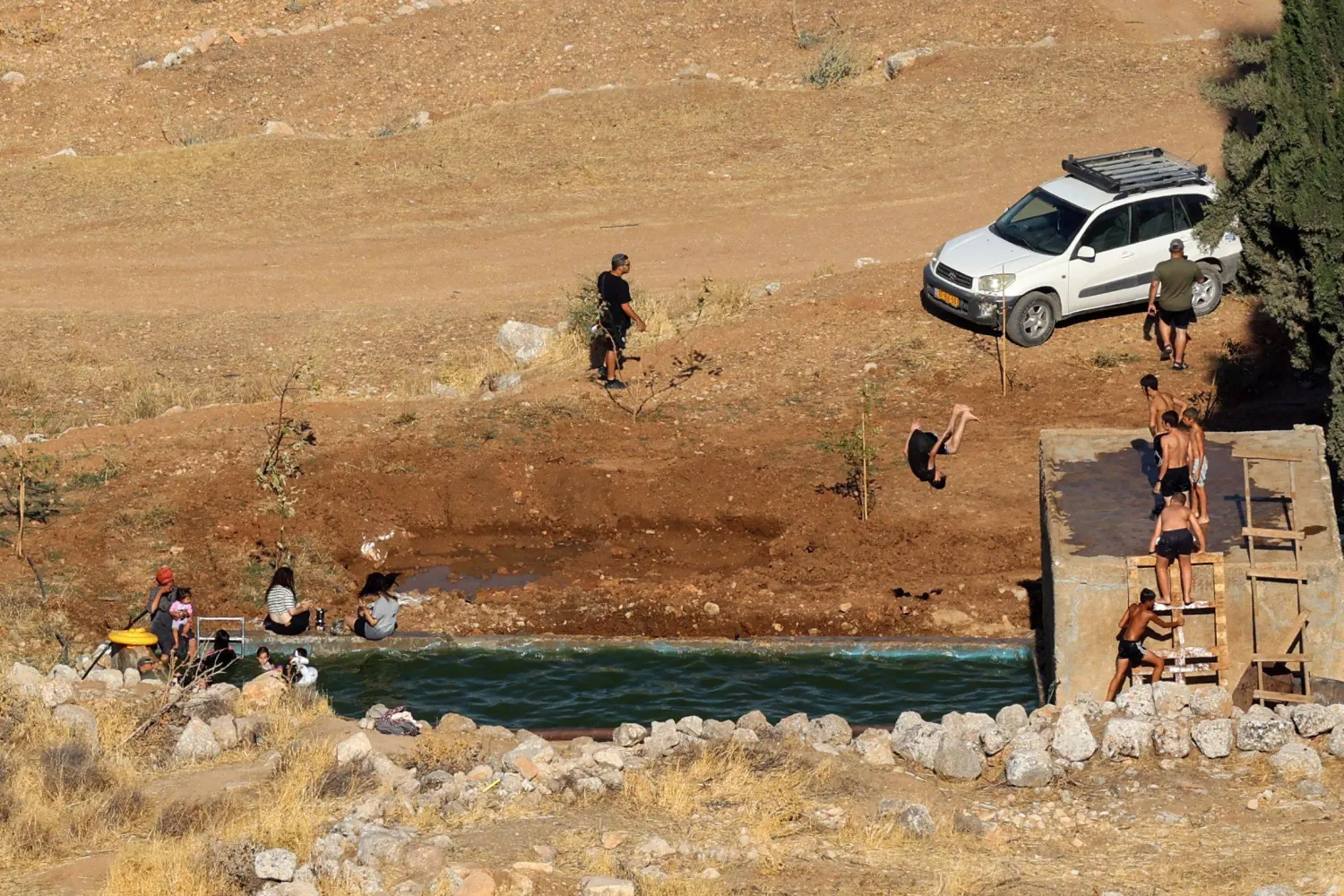
Settlers Swim in Ein Samia Wells in the West Bank. July 15, 2025 (AFP)

(This is the second report following the story of Ein Samia, the land that resisted settler ambitions through various means—until the pace of seizure accelerated after October 2023.)

A new crime has been added to the series of violations committed against Ein Samia. This time, the victim is its vital spring, and the perpetrators are Israeli settlers. The lifeline for nearly 100,000 Palestinians has become a target of settler rampage.

Thirty-three villages are now deprived of water, their residents left thirsty so that an abandoned pool can be filled and turned into a leisure spot for settlers and their children. And this is just the beginning.

In an interview with Noon Post, Fares al-Maliki, Director of Media and Public Relations at the Jerusalem Governorate Water Authority, described the settlers’ attacks in the Ein Samia area, east of the village of Kafr Malik, as part of a systematic policy and a multifaceted crime against both land and water.

He explained: “Recently, the main water lines have been deliberately targeted, including the primary pump at Well No. 6 in the area. These recurring attacks over the past two and a half months have led to the suspension of water pumping and the denial of water access to thousands of Palestinians.”

Ramifications and Scope of the Crisis

According to al-Maliki, the Ein Samia area contains five key wells that serve as the main—and often only—water source for 19 Palestinian communities. These include Deir Dibwan, Al-Taybeh, Rammoun, Deir Jarir, Al-Mazraa al-Sharqiya, Silwad, Ein Yabrud, Yabrud, Kafr Malik, Khirbet Abu Falah, Al-Mughayir, Turmus Ayya, Sinjil, Abwein, Jiljiliya, and Arura. Additionally, they partially supply 14 other communities, such as Birzeit, Al-Jalazun, ‘Atara, and Abu Qash. Altogether, about 100,000 Palestinians rely either fully or partially on water from the Ein Samia wells.

Settlers have begun dismantling the infrastructure of the station, smashing surveillance cameras, vandalizing main pipelines, stealing iron gates and signage, and severing communication and internet lines. This has left the Water Authority’s teams unable to monitor or control the wells effectively halting the pumping process.

Al-Maliki told Noon Post, “Any attack on the wells forces us to stop pumping operations out of concern for potential water contamination. Our teams conduct thorough testing to ensure water quality before resuming operations.” These disruptions severely affect water distribution schedules and community access.

He added that since October 7, 2023, water authority staff have faced mounting obstacles accessing the Ein Samia area due to Israeli-imposed road closures and the area’s designation as a closed military zone. Now, even staying late into the evening poses a danger, with workers fearing armed settler attacks.

Ein Samia: A Site of Cultural Heritage

Ein Samia is more than just a water source—it is a historic and cultural heritage site dating back 7,000 years. Its main well was dug in 1966, coinciding with the establishment of the Jerusalem Water Authority under Jordanian law—before Israel occupied the West Bank in 1967.

Ein Samia remains one of the most significant aquifers in the northeastern Ramallah area. The wells range from 100 to 500 meters deep and collectively produce around 12,000 cubic meters of water daily, accounting for roughly 17% of the Water Authority’s total output.

According to a report by the Palestinian Observatory, Israel today controls approximately 85% of groundwater resources in the occupied Palestinian territories, while denying Palestinians access to their own water sources. This has worsened with the expansion of settlements and settler-run agricultural projects that heavily consume water. The emergence of pastoral settlement outposts has further jeopardized Palestinian natural resources.

The same report highlights that settlers in the West Bank enjoy water consumption levels two to three times higher than the average Israeli citizen, ranging from 400 to 700 liters per person per day, depending on the settlement’s location and type.

This was confirmed by Salah Khawaja, a member of the Wall and Settlement Resistance Commission, in a previous interview with Noon Post. He stated that settlers have seized around 30 major springs across the West Bank in the past three years—including Ein Al-Auja—and are now attempting to seize Ein Samia.

A 2023 report by Israeli human rights organization B’Tselem noted a significant disparity in water access between Palestinians and settlers. While all Israeli citizens and settlers enjoy uninterrupted water supply, only 36% of Palestinians in the West Bank have daily access to running water.

Al-Maliki emphasized this disparity, stating that settlers consume six to eight times more water than the average Palestinian in the West Bank.

A Water Siege in Ramallah and Its Villages

This summer has been particularly harsh for Palestinian towns and villages in the Ramallah and Al-Bireh governorates, al-Maliki noted. The damage to Ein Samia’s wells has reduced access to water, and any damage or malfunction to water lines in Area C—as designated by the Oslo Accords—requires Israeli permits for repairs. Obtaining these permits may take hours, days, or may be denied altogether.

A Water Authority statement explained that these repeated attacks have severely disrupted the distribution program, especially in eastern and northern areas like Sinjil and its surroundings, as well as Birzeit and nearby villages—deepening the local water crisis.

Testimonies from the Heart of the Crisis

Mahmoud Asfour, a resident of Sinjil, north of Ramallah, shared his community’s struggle with Noon Post after 18 consecutive days without water due to settler aggression against the Ein Samia wells.

“We had to ration water, even for the simplest tasks like showering. What used to be a 15 or 30-minute shower now lasts only a few minutes,” he said. “We relied on a private well that used to serve six homes but it dried up. We now buy water tanks at over 120 shekels per tank, which barely last a few days.”

He added, sorrowfully, “We used to water our garden. Now that’s a luxury we’ve been deprived of. Water use is now limited to drinking and ablution.”

Asfour called on international and governmental bodies to pressure the Israeli occupation and its settlers to halt their relentless assaults on Ein Samia’s wells. He stressed the need to support and protect East Ramallah, a region under daily settler threat.

Dr. Sameh Abu ‘Awwad, a professor at Birzeit University and a resident of the town, told Noon Post he has been without water for 45 days. Birzeit relies on Ein Samia for about 25% of its water supply. Due to ongoing settler attacks, the town, like many others, now suffers from prolonged water shortages.

“This summer has been incredibly difficult,” he said. “We’ve had to rely entirely on water tanks for daily use and purchase bottled water for drinking because tank water isn’t potable.” He described the toll as not just economic, but psychological and physical.

He continued, “This isn’t about a water shortage it’s a political strategy. A systematic campaign to forcibly displace us by depriving us of life’s necessities.”

He questioned: “How can the global average for personal water consumption be about 100 liters a day, while Palestinians live under continuous oppression, often consuming less than half that due to Israeli settler violations?”

He also lamented the unequal distribution: “It’s incomprehensible that I received just three cups of water from the Authority over two months, while other areas have uninterrupted supply or face only brief interruptions.”

Sinjil’s Municipality Takes Action

Bahaa Fuqaha, Deputy Mayor of Sinjil, explained that the water shortage began with the start of the war in October 2023, when Israeli bulldozers destroyed a main water line feeding Sinjil and nearby villages. This line ran near the old Nablus road and the Ma’ale Levona settlement. A year later, Israeli forces destroyed another line from Ein Samia to Sinjil.

“Water is not just a natural resource it’s a matter of life or death,” Fuqaha said. “We’re facing an organized effort to displace us through control of our water.”

Given the dire economic conditions in the West Bank, water storage tanks cost 700–800 shekels each, and water tankers are sold at variable, unregulated prices.

In response, the Sinjil municipality purchased water tanks to sell at subsidized prices to economically vulnerable families. Fuqaha added that the municipality plans to buy water storage tanks and resell them at half-price to those in need.

An Unarmed Civilian Against an Armed Settler

“Settler violence is not individual misconduct—it’s state-sponsored violence, a tool used to dispossess Palestinians of their land and water,” stated a B’Tselem report.

Settler attacks on water facilities continue daily, targeting personnel and property. Nonetheless, water authority teams remain on the ground every day, despite risks. “Our teams are doing their best to protect the wells,” said al-Maliki, “but when settlers are armed and our people are not, there’s little we can do. What we need is international protection and an end to settler violence.”

The Authority has sent multiple appeals to international institutions and hosted delegations from European and international diplomats in Ein Samia to demonstrate the danger faced by water teams. Official letters were handed over, urging global pressure on Israel to stop these attacks.

Abu ‘Awwad concluded by calling for legislation to safeguard water security and establish a strict monitoring system to prevent sabotage. He emphasized the need for equitable water distribution as a means to confront the crisis and bolster resilience.

For his part, al-Maliki reaffirmed the Authority’s message:
“We will not accept settler-imposed realities or Israeli military occupation dictating control over our water. We will not abandon these wells and will continue our efforts to protect this vital resource, which is the foundation of our life and future.”

Fuqaha also urged international bodies to pressure Israel and its settlers to cease their aggression, and called on the Water Authority to resolve technical issues and ensure fair distribution.

In the face of deliberate and systematic thirst, the unarmed Palestinian stands firm. He may lack the luxury of a swimming pool, but he clings to his right to life. The Ein Samia spring is more than just flowing water—it is living history, dignity, and resistance. Will the world finally hear the cry of the water… or remain complicit in silence?

Download this article as PDF
Share this Article
Facebook Twitter Whatsapp Whatsapp Telegram Email Copy Link
سندس بعيرات
By سندس بعيرات صحفية فلسطينية من رام الله
Follow:
Previous Article نون بوست “The National Library of Israel”… How Palestine’s Memory Was Stolen
Next Article نون بوست Syria and Israel: Violations on the Ground, Understandings at the Table

Read More

  • U.S. Regime‑Change Policies: Why They Are Destined to Fail U.S. Regime‑Change Policies: Why They Are Destined to Fail
  • The Gulf’s Balancing Act: Iran, Israel, and Hidden Links
  • Iraq–Turkey Oil Export Treaty: Why Did Ankara Cancel It After 52 Years?
  • Syria’s Northeast on Edge: QSD Between Ankara and Damascus
  • Has Europe Changed Its Stance on Israel… or Just Its Language?
part of the design
NoonPost Weekly Newsletter

You May Also Like

U.S. Regime‑Change Policies: Why They Are Destined to Fail

U.S. Regime‑Change Policies: Why They Are Destined to Fail

إسراء سيد Esraa sayed 8 April ,2026
The Gulf’s Balancing Act: Iran, Israel, and Hidden Links

The Gulf’s Balancing Act: Iran, Israel, and Hidden Links

فريق التحرير Noon Post 8 April ,2026
Iraq–Turkey Oil Export Treaty: Why Did Ankara Cancel It After 52 Years?

Iraq–Turkey Oil Export Treaty: Why Did Ankara Cancel It After 52 Years?

فريق التحرير Noon Post 8 April ,2026

أهم 5 علاجات للسرطان تم التوصل إليها في 2015

فريق التحرير
Noon Post Published 21 December ,2015
Share
gal

قد يكون السرطان من بين أكثر أمراض العصر انتشارًا وحصدًا للأرواح، فهو قاتل لا يرحم، وبمجرد أن ينتشر لا يعود هناك شيء قادر على إيقافه تقريبًا، فعلى الرغم من التقنيات والتقدم الذي توصلنا إليه، وعدد الأطباء الذي لا يعد ولا يحصى الذي تم تكريسه من أجل محاربته، لا يزال السرطان يعتبر تهديدًا حقيقيًا، ومرضًا لا شفاء منه.

ولكن مع ذلك، لا يزال هناك أمل، فقد توصل العلماء إلى علاجات كانت تبدو مستحيلة قبل 50 عامًا، وتمكنوا من التخلص من بعض أنواع السرطانات التي كان يطلق عليها لقب “غير قابلة للشفاء”، حيث بدأنا باستخدام الأدوات بطرق مختلفة لتحقيق نتائج رائعة واللجوء إلى مواد كان من غير المتوقع أن تساعدنا في حربنا ضد هذه الخلايا الخبيثة، لذلك وعلى الرغم من أن السرطان قد يكون لا يزال مرعبًا – وربما سيبقى كذلك دائمًا – إلّا أن الخطوات التي قمنا بها ضده جعلت العلاج لا يبدو ممكنًا فحسب، بل وفي متناول اليد.

إليكم هنا، خمسة كشوفات طبية مهمة استطعنا التوصل إليها خلال عام 2015  لمواجهة مرض السرطان:

السرطان الذي يقتل السرطان

في شهر أكتوبر من هذا العام، قام فريق من الباحثين بالتوصل إلى اكتشاف مذهل، فمن خلال وضع أجسام مضادة على خلايا سرطان الدم النخاعي الحاد، تمكنوا من تحويل الخلايا الخبيثة إلى شيء مفيد، فقد تحولت الخلايا لتصبح خلايا جذعية مفيدة، وهي الخلايا التي تعتبر الداعم الرئيسي في نظام المناعة في الجسم، ولكن عندما قاموا بدفعها إلى أبعد من ذلك، تطورت الخلايا لتصبح مشابهة إلى حد كبير للخلايا القاتلة الطبيعية التي توجد في الجسم.

شاهد العلماء الخلايا المتشكلة حديثًًا وهي تهاجم أخواتها السابقات بذهول كبير، حيث تمكن عدد قليل من هذه الخلايا الحديثة من التغلب على حوالي 15% من خلايا سرطان الدم المحيطة، وعلى الرغم من أن الخلايا كانت خلايا شقيقة، إلّا أن الخلايا الجديدة هاجمت خلايا سرطان الدم التي اُستمدت منها، وهذا الأمر مفيد جدًا، لأن الآثار الجانبية الرئيسية للعديد من علاجات السرطان قد تحدث أضرارًا في الخلايا السليمة المحيطة بالخلايا المصابة.

حاليًا، يقوم فريق البحث بالتفاوض مع شركات المستحضرات الصيدلانية، بهدف تقديم العلاج للإنسان بعد إجراء الدراسات السريرية المناسبة.

زيت الزيتون يحارب سرطان

عُرف زيت الزيتون بقدراته المتعددة منذ اكتشافه، فهو رائع إذا ما تم تناوله عن طريق الفم، ورائع إذا ما تم استعماله للشعر، ومفيد للبشرة أيضًا، ومؤخرًا تمددت قدراته لتشمل محاربة السرطان، وذلك وفقًا لفريق من الباحثين من جامعة روتجرز وكلية هانتر، حيث تبين بأن تناول زيت الزيتون يقضي على الخلايا السرطانية خلال أقل من ساعة.

يعمل الأوليكانتال (Oleocanthal)، وهو المركب الفينولي الأساسي الذي يوجد في زيت الزيتون البكر، على تدمير مراكز الفضلات في الخلايا السرطانية، مما يزعزع استقرارها ويتسبب بوفاتها في غضون 30 إلى 60 دقيقة، والأفضل من ذلك هو أن الخلايا السليمة تبقى كذلك خلال العملية، وهذا يعتبر انتصارًا عظيمًا على مرض السرطان، ولكن حتى الآن، ما يزال هذا الأمر مجرد مفهوم، حيث إن فوائد زيت الزيتون في علاج السرطان لم تظهر سوى في مزارع الخلايا، أما بالنسبة لتجربة ذلك على الفئران أو الخلايا البشرية فإن الأمر سيكون أكثر تعقيدًا، ولكن مع ذلك، افترض الباحثون أن جرعة نقية من الأوليكانتال يمكن استخدامها كعلاج ناجح لهذا المرض.

العلاج المناعي

العلاج المناعي هو استخدام النظام المناعي لدى المريض لعلاج العدوى أو المرض، وعلى الرغم من أن هذا قد يبدو بديهيًا نوعًا ما – فهذا هو عمل نظام المناعة في المقام الأول – إلّا أن تنفيذه أكثر تعقيدًا مما قد يبدو عليه، وبالإضافة إلى ذلك، فإن العبث بالنظام المناعي للجسم يمكن أن يكون له عواقب كارثية، ولكن على الرغم من ذلك، فقد استطاع الباحثون هذا العام التوصل إلى انتصار كبير، حيث استطاع الباحثون في المركز الطبي في جامعة ميريلاند الحصول على استجابة واعدة في علاج مرضى السرطان باستخدام شكل من أشكال العلاج المناعي، فقد أظهر 70% من المرضى الذين كانوا يعانون من شكل مميت من المايلوما المتعددة “ردًا سريريًا مذهلًا” للعلاج، والذي يتضمن خلايا تائية قام الباحثون بهندستها وراثيًا لتحتوي على مستقبلات لمستضادات الورم مما يساعد على تدمير الخلايا السرطانية، والجدير بالذكر أن تلك المستضدات عادة ما تكون موجودة في نحو 60% من المرضى الذين يعانون من المايلوما المتقدمة.

على الرغم من أن الدراسة كانت صغيرة، إلّا أن آثارها كانت كبيرة في المجتمع الطبي، ولم يتم التبليغ عن أي آثار جانبية سيئة لدى المرضى، وهذا يعني أن العلاج يعمل دون أن يشكل خطرًا كبير على الصحة، لذلك يشير الباحثون إلى أنها مسألة وقت فقط قبل أن يحل العلاج المناعي مكان العلاج الكيماوي كمعيار لعلاج السرطان.

الخلايا المقترضة

كانت طفلة رضيعة، لم تتم عامها الأول بعد في علاجها، أول مريضة تتلقى علاج تجريبيًا جديدًا لخلايا سرطان الدم ثبت بأنه ناجح جدًا، حيث كان قد تم إخبار والدي (ليلى ريتشاردز) بأن طفلتهما تعاني من شكل عدواني للغاية من السرطان، وبعد إجراء عدة جولات من العلاج، لم يتبق أي خيارات لعلاج ابنتهما، وهذا ما دفع الأطباء لمحاولة تجريب علاج جديد لم يسبق أن تم اختباره خارج المختبر.

قام الباحثون بجمع بنك كامل من الخلايا التائية المعدلة لتحديد وعلاج الخلايا السرطانية لاستخدامها في المرحلة النهائية من التجارب قبل البدء بالتجارب السريرية، وقاموا بتطبيقها على ليلى، وبعض مضي فترة وجيزة، وجدوا بأن العلاج – الذي كان ناجحًا للغاية في الدراسات المختبرية – كان ناحجًا أيضًا بالنسبة للرضيعة، فقد تخلص جسمها من سرطان الدم وكانت قادرة على العودة إلى منزلها بعد الانتهاء من عملية زرع نخاع العظام، وعلى اعتبار أن التجربة البشرية كانت الناجحة، شكلت قضية ليلى خطوة هائلة إلى الأمام لإيجاد علاج جديد للسرطان.

الملاريا تقتل السرطان

يُعرف مرض الملاريا بأنه مرض يصيب الدم وسببه طفيلي وينتشر عن طريق البعوض، ولكن مجموعة من الباحثين الدنماركيين توصلت إلى اكتشاف غريب، حيث استطاعوا تحديد بعض الجوانب المعينة من الملاريا التي من شأنها أن تقتل الأورام السرطانية، وعلى الرغم من أن الملاريا تعتبر مرضًا خطيرًا خصوصًا بالنسبة للحوامل، لأن الطفيلي قد يشن هجومه على المشيمة، فقد لاحظ الباحثون وجود عدة أوجه للتشابه بين المشيمة والأورام، مما جعلهم يدعون بأن بروتين الملاريا هو سم قاتل للسرطان.

أثبتت التركيبة بأنها قاتلة، حيث كانت قادرة على تدمير حوالي 90% من العينات السرطانية المختلفة بفعالية، وأيضًا تم اختبار الملاريا بنجاح على الفئران التي تم زرع أنواع مختلفة من السرطانات البشرية فيها، وعلى الرغم أنه قد يبدو من غير المنطقي أن نقوم بمبادلة مرض قاتل بآخر قاتل أيضًا، إلّا أن الباحثين يوضحون بأن بروتين الملاريا تعلق بالورم فقط، بدون أن يحدث أي تأثير كبير على الأنسجة الأخرى.

قد تمضي بعض السنوات قبل أن يتم إجراء التجارب على البشر، ولكن يأمل العلماء بأن اكتشافهم سيشكل خطوة كبيرة للوصول إلى علاج للسرطان.

TAGGED: أبحاث السرطان ، اكتشافات لعلاج السرطان ، البحث العلمي ، السرطان ، علاج السرطان
TAGGED: حصاد 2015
Download this article as PDF
Share this Article
Facebook Twitter Whatsapp Whatsapp Telegram Email Copy Link
فريق التحرير
By فريق التحرير تقارير يعدها فريق تحرير نون بوست.
Follow:
Next Article نون بوست The Stigma of “ISIS”: A Heavy Legacy Haunting Women and Children of Former Members

Read More

  • U.S. Regime‑Change Policies: Why They Are Destined to Fail U.S. Regime‑Change Policies: Why They Are Destined to Fail
  • The Gulf’s Balancing Act: Iran, Israel, and Hidden Links
  • Iraq–Turkey Oil Export Treaty: Why Did Ankara Cancel It After 52 Years?
  • Syria’s Northeast on Edge: QSD Between Ankara and Damascus
  • Has Europe Changed Its Stance on Israel… or Just Its Language?
part of the design
NoonPost Weekly Newsletter
dark

An independent media platform founded in 2013, rooted in slow journalism, producing in-depth reports, analysis, and multimedia content to offer deeper perspectives on the news, led by a diverse young team from several Arab countries.

  • Politics
  • Society
  • Rights & Liberties
  • Opinions
  • History
  • Sports
  • Education
  • Technology
  • Economy
  • Media
  • Arts & Literature
  • Entrepreneurship
  • Travel
  • Cinema & Drama
  • Food
  • Health
  • Culture
  • Latest Reports
  • Files
  • Long Reads
  • Interviews
  • Podcast
  • Interactive
  • Encyclopedia
  • In Pictures
  • About Us
  • Our Writers
  • Write for Us
  • Editorial Policy
  • Advanced Search
Some rights reserved under a Creative Commons license

Removed from favorites

Undo
Go to mobile version