
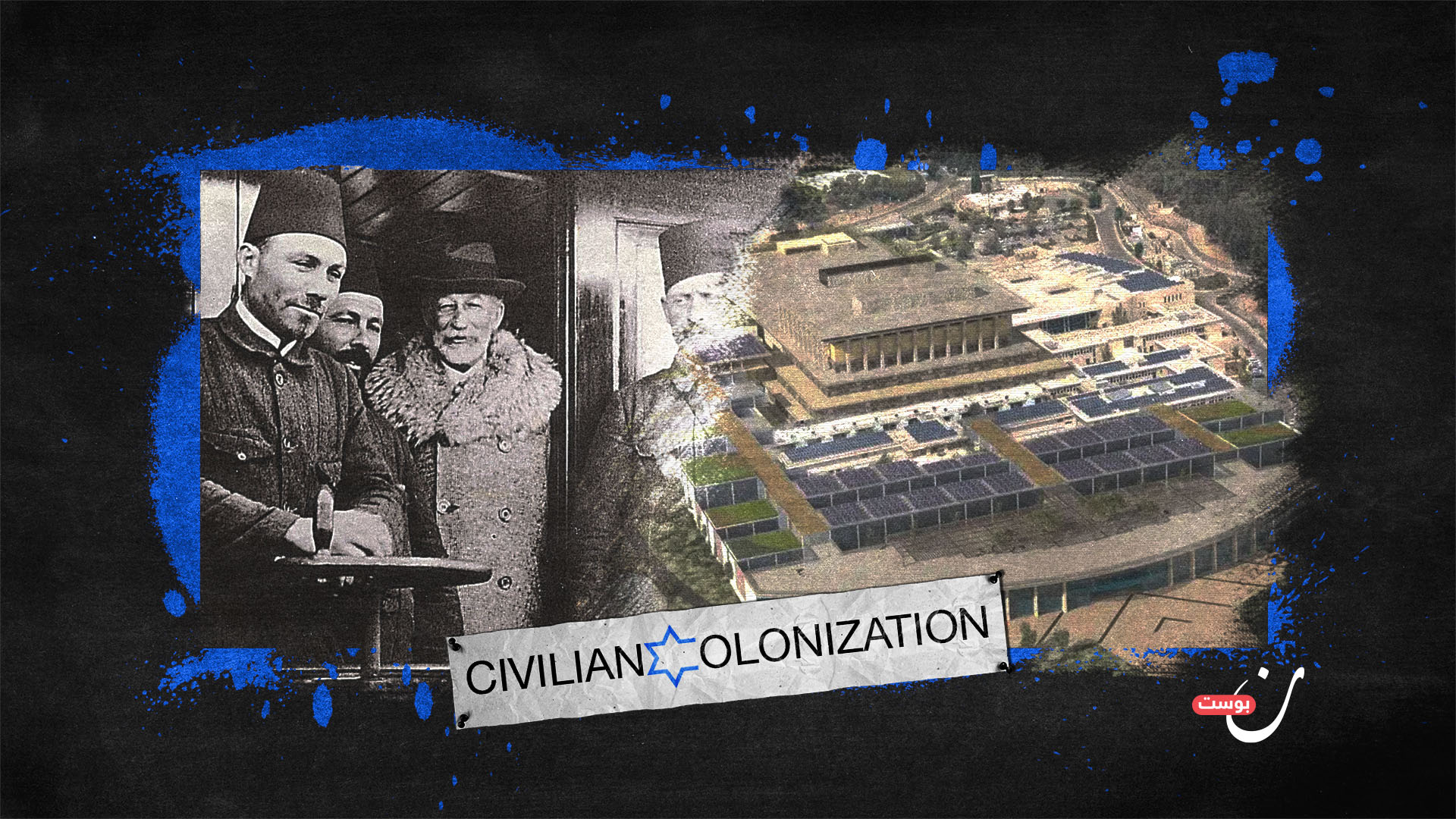
“Baron” is the title that Western and Jewish studies apply to the wealthy German Maurice de Hirsch, who contributed to founding one of the most prominent civil bodies that paved the way for the occupation of Palestine, Jewish settlement therein, and the displacement of its people, in exchange for bringing Jewish immigrants.
This exclusive title does not merely reflect the activity of the institution the man established, or its central role in drawing the map of Israel as it appears today; rather, it reflects the active role of the man who founded the concept of relocating Jews from their communities in Europe toward the “new land,” under a charitable and humanitarian guise, which would continue for a long period.
Again, in the “Civil Settlement” dossier, we cast light on another component of the network of Zionist support and services, which produced, strengthened, and contributed to the continued political, economic, regional, and international existence of the state of occupation.
This time we travel back through the pages of yesterday to read about the birth of one of the most prominent colonial institutions and among the most effective in serving the greatest Western liberal project in the Middle East: “establishing a national home for the Jews.”
That is the Jewish Colonization Association. We witness its first steps, its intertwined relations, its expansion simultaneous with the announcement of the creation of “Israel” on Palestinian land.
Settlement with Motives of “Pity and Compassion”
In the early 1890s, Europe was burdened by severe overpopulation and high levels of poverty. Its population was estimated at more than 400 million, forced to endure economic depression and successive epidemics, which raised the number of the poor and increased unrest.
As a result, the idea of relocating surplus population to other countries became popular, and societies were founded to promote emigration, promising a better future overseas, somewhat like modern migration offices. In that period, more than 130 societies in the United Kingdom alone encouraged emigration as the best option for solving issues of poverty, begging, and overpopulation.
Among these societies was the “National Colonization Society,” founded by the wealthy Briton Edward Gibbon to colonize southern Australia. It offered incentives like local self-governance, protection by the British Empire, and support via a special fund.
All these societies started from the idea of connecting emigrants to the land, making agriculture their livelihood, enabling them to own property and live and produce without needing constant aid. These features are what caught the attention of the German Jewish banker Baron Maurice de Hirsch, and made it quite possible for him to create a Jewish association with such characteristics and by the standards of this dream.
Baron de Hirsch launched the idea of founding a charitable fund in 1891, driven to develop and improve the conditions of poor Jews around the world—especially minorities in Europe suffering oppression and political and rights neglect.
This fund was tasked with raising money to encourage and finance Jewish emigration and settlement in another part of the world, where they could own land, farm it, and enjoy the rights of ownership and citizenship alike. In this regard he established the “Hirsch Savings Fund,” which came to be known in Jewish circles later as the “Jewish Colonization Association.”
With the adoption of the new name, a clear charter and a reliable board of directors were necessary. The charter of the Association stated in its third article: “The purpose of founding this association is to help and encourage emigration of Jews from any part of Europe or Asia, especially from the towns in which they are subjected to any special taxes or political disabilities, where the association works to relocate them to any other part of the world, and to establish colonies in various parts of North and South America and other countries for agricultural, commercial, and other purposes.”
Also in the charter the Association’s tasks included: “Contributing to establishing and maintaining educational and training institutions, model farms, loan banks, industries and factories and any other institutions or associations in any part of the world that are considered suitable for Jewish emigration and helping them settle in various parts of the world, except Europe; also contributing to funding any association or community already existing or to be formed in the future which has goals that may assist or enhance the implementation of the purposes of the association.”
Thus the Association’s activities began, standing as the first formation bringing Jews together with the aim of their emigration, settlement, and eventual property ownership. Through its financial and investment connections with institutions and links in France and England, the Baron launched the Association’s work, and indeed it was registered in London in 1893 as a charitable institution.
But the charitable principle did not prevent him from considering it a joint-stock company: its initial capital was set at two million pounds sterling. He embarked on offering better living options for oppressed Jews, assuming the task of achieving a “renaissance” for the Jewish nation away from Europe.
The board included wealthy Jews from Europe, among the most prominent: Lord Rothschild, Sir Julian Goldsmid, Sir Cassel, Sir Goldschmidt, Benjamin Cohen from London; and Goldschmidt and Solomon Reinach from Paris.
Because the prevailing pattern of migration at the time was toward the Americas, the Baron followed suit. He purchased lands in Canada, Argentina, and the USA, established Jewish farms, settlement and training projects, supporting them with no less than ten million pounds sterling. Over three hundred Jewish families migrated with the help of the Jewish Colonization Association to their new world.
By 1896, Zionist movement was still an idea in formation, accompanied by the efforts of the Austrian journalist Theodor Herzl to support and awaken it. He was among the first whom Baron de Hirsch contacted, proposing ideas for institutionalizing Jewish colonial efforts and financing them more broadly.
Among the proposals was inviting Herzl to help establish the Jewish Colonization Bank, assigning it an amount of two million pounds sterling from the Jewish Colonization Association.
Baron de Hirsch remained the sole director and supervising manager of the Association until his death in early 1896. At that time the Association already had a fund amounting to six million pounds sterling. After his death administration passed to the board chaired by Lord Edmond de Rothschild, with Goldschmidt as honorary president.
Once Rothschild assumed leadership, the alignment between the Association and the Zionist movement became high, especially given his advanced reputation as the “father of Jewish settlement in the land of Israel,” because of the large sums he devoted to encouraging Jewish immigration to Palestine, especially Russian Jews.
During the period 1883–1889, before the founding of the Colonization Association, Lord Rothschild bore the full financial burdens of the first Jewish colonies in Palestine—Rishon LeZion, Zikhron Ya’akov, Rosh Pina, Akkaurun [sic], and he provided 5 million pounds to assist other colonies.
Judaism as an Official Institution to Encourage Jewish Emigration and Colonization
While the Association had founded colonies in North America, Cyprus, Asia Minor, Palestine, Russia, and Romania, by early 1899 it focused its colonization work on Palestine. It also took over administration of all the colonies that Rothschild had established in Palestine in the mid-19th century numbering 44. These had been individual or enthusiast‑led efforts.
By the end of 1899, besides its work in bringing Jews from around the world to Palestine, the Association had built a number of commercial and industrial establishments in Jerusalem to strengthen the settlement: a silk and wool factory employing over a hundred settlers; a sewing‑machine plant; a dye works; a textile mill.
Alongside the factories, it built a neighborhood for male workers; a lending bank with approved interest specially for Jewish settlers; schools for teaching girls the craft of sewing, lace‑making, hair‑netting textile trades that were among the most in demand at the time.
The Widespread Influence of the Rothschild Family
Despite the clarity of steps and unity of purpose with the Zionist movement, the subsequent years of the Jewish Colonization Association represented its greatest period of activity. This was enabled by the colonial foothold that Rothschild colonies already provided in Palestine. The Association created a special fund capitalized at 15 million French francs.
Rothschild strove energetically to encourage Jewish emigration and settlement in Palestine, helping them overcome hesitation or fear in their decisions, founding a colonial infrastructure that ensured comfort in migration and assisted them to remain and develop.
By the end of 1900 the Association had purchased lands and built settlements in prime geographic locations in Palestine—those least densely Arab, nearest water, and nearest transportation lines. The colonies appeared in Eastern Galilee, around the Sea of Tiberias and its surroundings. The Association also funded agricultural experts and pioneering teams that mapped out the topography of the settlements in ways suited to objectives of security and expansion.
Throughout northern Palestine and Upper Galilee, the Association’s colonies—known as the “Rothschild colonies”—spread, some named after members of the Rothschild family, such as “Zikhron Ya’akov” after his father Jacob James; “Mizkeret Batia” after his mother Batia Betty; and “Giv’at Ada” after his wife Ada Adélaïde.
Along with settlement, the Association under Rothschild’s own vision pushed for reinforcing Jewish industry, establishing factories for wine and textiles and foodstuffs, agricultural factories and other vital industries—ensuring for the Jewish presence in Palestine self‑sufficiency vis‑à‑vis its Arab surroundings and independence from western consulates and patrons.
Zionist literature recalls that the nature of the Association’s work was not fully accepted by some Zionists, who continuously attacked it, describing it as inefficient, wasteful of funds, and having a surplus of varied goals.
Nevertheless, the Association continued its work and was careful to take advantage of political opportunities favorable to it. One such moment came after World War I, when Richmond found post‑war conditions favorable to bolstering the Association’s work and expanding its scope.
He led the decisive stage in 1924, four years after the British Mandate of Palestine, and following the extensive charitable contribution of the Rothschild family both militarily and financially to the Mandate, and after seven years from the Balfour Declaration, which the Rothschilds had played a fundamental role in securing.
At that time, Baron Edmond James de Rothschild declared the Jewish ownership right of his colonies in Jerusalem, and changed the name of the Association to the Palestine Jewish Colonization Association (PICA), emphasizing the focus of all Jewish colonial efforts in Palestine.
He opened its first branch in Jerusalem, in coordination with the World Zionist Organization, and under the supervision of his son James Armand de Rothschild, to represent the strongest organizational body managing lands, kibbutzim and moshavot in Palestine in favor of the continuation of Jewish settlement.
In 1929, the Association’s efforts and achievements had exceeded all other Jewish colonial institutions in success—especially its role in mitigating the effects of the Western Wall riots (“Buraq uprising”) on Jewish settlers by compensating them, repairing the affected colonies, and establishing a special emergency fund. This prompted the Zionist Organization to grant Rothschild the honorary title of general manager of the Jewish Agency.
During the pre‑Nakba period, the Palestine Jewish Colonization Association empowered Jewish settlers inside Palestine. It contributed to the development of agriculture as the central concept of linking the settler to the expropriated land, supporting agricultural research at the Hebrew University and the Weizmann Institute of Science.
It also established a series of agricultural training schools named “Maccabi Israel Agricultural Schools,” drained marshes in the Hadera region, and provided vaccines to Jewish farmers to protect them from the then‑spreading malaria.
On the level of supporting immigration and settlement, it funded the activities of two American Jewish organizations, “HIAS” and “Joint,” which provide aid to Jews reluctant to migrate to Palestine. It created new settlements such as Sejera, Kfar Tabor, Yavniael, Beit Gan, Matzpeh Kinneret, Kfar Giladi, Tel Hai, Yifat, Beit Gan, etc.
Economically, it launched a major industrial building campaign, including establishing an industrial zone in Rishon LeZion specializing in wine production, the region’s first electrical plant, Neshar Cement Factory, the salt packing plant in Atlit, large flour mills in Haifa for storing, grinding and packaging grain.
After the Nakba
During the height of war and skirmishes between 1947–1948, the activity of the Palestine Jewish Colonization Association decreased; it limited itself to reinforcing and supporting colonies and strengthening their existence and power against attacks by Palestinian fedayeen. But after the war ended, it resumed support for education, agriculture, and tourism projects, especially in the Upper Galilee in the north and the southern Negev, completing the draining of the Hula swamp, using its waters to irrigate colonies in the Negev.
It also overlapped projects with the Jewish National Fund, launching together the National Carrier project, building water wells and power stations, and founding several new settlements including Kfar Warburg, Nir Banim, Sedeh Moshe, Kfar Maimon, Lachish.
In 1955, amid formal transformations and rapid erasure of the Palestinian presence and history, the Palestine Jewish Colonization Association was renamed the “Israeli Colonization Association.” Although separated from the Jewish Agency since 1933, it participated in founding 50 immigrant settlements in the Upper Galilee, and its name headed the list of Jewish institutions contributing to the “Development of the Galilee” project.
The last turning point in the Association’s history came in 1957, when James de Rothschild, a short time before his death, decided to transfer all the properties and projects of the Jewish Colonization Association to the ownership of the Jewish National Fund, aiming to allocate 1.25 million pounds sterling for building the Knesset building in Jerusalem.
Although the Association’s “supposed” work ended with Rothschild’s passing, it returned in different modes, playing colonial roles covertly in Arab countries; continuing buying lands and properties there under fictitious or borrowed names. During the 1960s the Association established mortgage facilities in North African countries.
It also included setting up an agricultural training center in Morocco, founding an agriculture company for Moroccan Israelis; in Kenya providing agricultural loans; in Eastern Europe, Australia, Canada, France, Belgium, and the UK giving financial aid; establishing educational and cultural institutions.
At the same time, Jewish organizations around the world such as the World Jewish Congress (WJC), WOJAC, the World Organization of Jews from Arab Countries, Justice for Jews from Arab Lands (JJAC), and JIMENA (Jews Indigenous to the Middle East and North Africa) claimed there are Jewish properties in Arab lands that must be returned or compensated.
Their claims heard ear many times. After World War I, the Jewish Colonization Association submitted a request to King Faisal to return lands that the Ottoman state had obtained during the war to ownership of the company, which he agreed to. Also documents were submitted to Arab leaders about purchases in Lebanon, among them Emil Frank who had bought about 100,000 dunams in the villages of Sahm Al‑Jolan, Jeblin, Nabʿa, Boustas from Arab farmers, demanding compensations exceeding $1.4 billion in Syria alone.
What is evident from all the foregoing is that the ambitions of the occupation are not confined to Palestine, and its tools are not limited to the Jewish National Fund or the Colonization Association; its pursuit of expansion accompanies it in war and peace, by seizure and fraud. Therefore, efforts to counter it must be varied as its tools, wide in view as its ambitions, conscious of its capabilities, and determined in its resolve to end it as it is in its resolve to endure.