















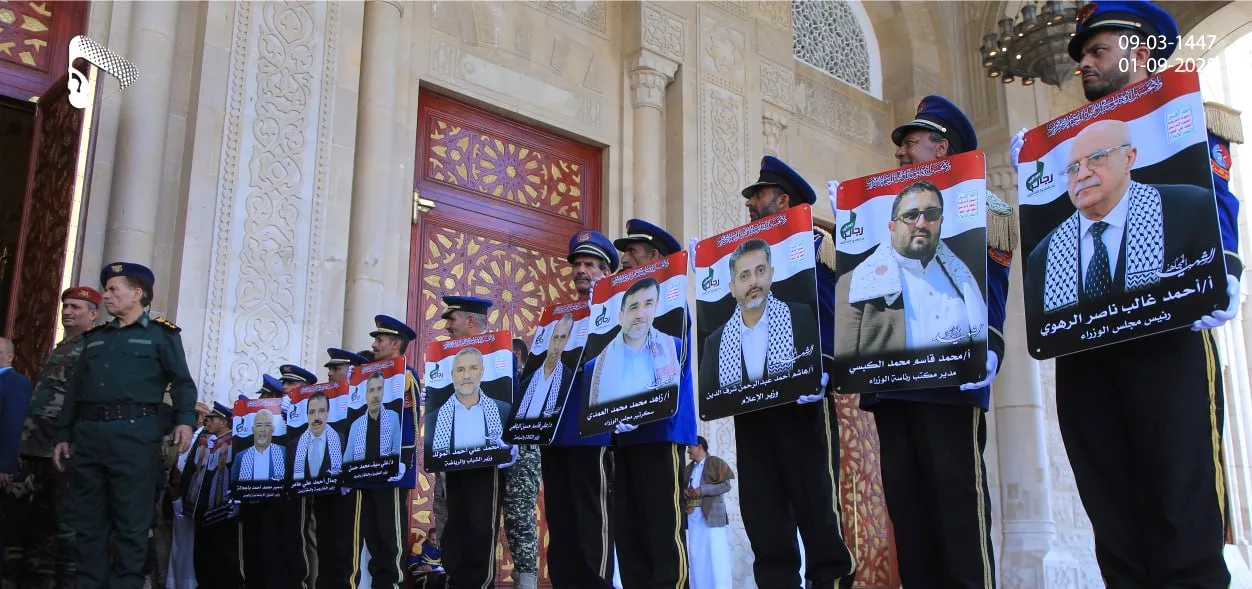
On August 28, as the leader of the Houthi movement Ansar Allah delivered a televised speech, the Israeli military assassinated Ahmed Al-Rahwi, the head of the group’s government, along with nine of his ministers. The attack, carried out through a series of successive airstrikes, targeted a residence in the Hadda district of Sana’a.
More than a week has passed since this unprecedented incident—the first of its kind since Israel began launching strikes on Sana’a and other Houthi-held areas in July 2024—but the death toll continues to rise. However, the Houthis have maintained a strict information blackout regarding Israeli airstrikes, a policy adopted since the group began targeting Israel in response to its war on Gaza.
Immediately after the attack, the Houthis did not disclose the identities of those targeted. The group also denied Israel’s claim that its air force had launched what it called a “precise strike” on a Houthi military site in the capital.
The Houthi political bureau responded by stating that Israel had once again demonstrated its military and intelligence failure, accusing it of fabricating a fictional victory for propaganda purposes.
The day after the strike, the Houthis officially confirmed the death of their prime minister and appointed Mohammed Ahmed Muftah as acting premier. Chief of Staff Maj. Gen. Mohammed Al-Ghamari vowed a “harsh and painful” response, promising impactful strategic options. Shortly afterward, Mahdi Al-Mashat, head of the Supreme Political Council, pledged retaliation.
Security Breach
The Houthis regarded Israel’s assassination of their ministers as a major intelligence breach. In response, the group launched a wide-scale crackdown, including the arrest of 11 United Nations employees, according to UN envoy to Yemen Hans Grundberg.
Houthi leader Abdul-Malik Al-Houthi claimed that his intelligence services had made significant progress in tracking down “spies” and promised further arrests. Indeed, more than 200 individuals were detained across Sana’a, Dhamar, Amran, Al-Hudaydah, and Ibb governorates. Many of them were government employees, accused of espionage on behalf of Israel.
In Sana’a neighborhoods, local leaders, tribal elders, and Houthi supervisors conducted renewed surveys of residents—gathering personal data, phone numbers, place of origin, profession, and information on their loyalty to the group.
Simultaneously, neighborhood supervisors held meetings with local figures, urging them to confront the Israeli aggression and establish community committees to handle potential emergencies, according to various security sources who spoke with Noon Post.
Security forces also banned the public consumption of khat after 1:00 a.m., leading to the arrest of hundreds of young men in Sana’a and other Houthi-controlled areas. They were released only after pledging not to violate the new restrictions, particularly during this sensitive period.
Meanwhile, the Houthis deployed a large number of security personnel across alleyways and residential areas to monitor suspicious activity. Shop owners and landlords were ordered to install surveillance cameras under threat of imprisonment.
Despite the gravity of the Israeli strike, the Houthis did not declare a national mourning period for their slain ministers and security officials. Instead, they issued statements of condolence and held public funeral services following a joint state and popular procession in Sana’a.
On the media front, Houthi outlets downplayed the significance of the assassinations, focusing instead on covering Mawlid al-Nabi (the Prophet’s birthday) celebrations.
A Forceful Response
The Houthis’ retaliation did not take long. Since August 28, the group has reportedly launched 14 drones and three ballistic missiles, according to pro-Houthi media.
But the most notable strike occurred on the evening of Tuesday, September 9. The Houthis carried out two major operations: the first involved a multi-warhead “Falasteen-2” hypersonic ballistic missile targeting the outskirts of Jerusalem, which they claimed hit its mark.
The second operation involved three drones targeting Ramon Airport and two strategic sites in the Eilat area, according to military spokesperson Yahya Saree.
Israeli media reported that the attacks caused significant disruption and chaos, especially after some missiles reached Ben Gurion Airport’s passenger terminals undetected by radar systems. Meanwhile, the Houthi maritime blockade on Eilat’s port remains in effect.
An Uncertain Path Ahead
Since the beginning of Israel’s assault on Gaza, the Houthis have launched 93 ballistic missiles and 350 drones, according to Israeli military data. The group has also targeted vessels linked to Israel in the Red Sea.
The Houthis claim these actions are part of their effort to support the people of Gaza, who have been facing a campaign of extermination by Israel since the launch of Operation Al-Aqsa Flood by Palestinian resistance fighters on October 7, 2023.
A security source close to the Houthis told Noon Post that the group’s leadership has credible intelligence indicating that Israel has launched a satellite to monitor Houthi movements.
The source, speaking anonymously, added: “The Houthis’ biggest challenge remains their weak telecommunications infrastructure, which has prompted the group to intensify its surveillance of telecom and internet networks in areas under its control.”
On September 10, Israel carried out its sixteenth round of airstrikes, targeting civilian infrastructure and Houthi positions, including the Defense Ministry complex, the Directorate of Moral Guidance, and a building affiliated with the Ministry of Oil in Sana’a. According to the Houthi-run Ministry of Health, these strikes left 129 people dead or wounded in initial reports.
Israel dubbed this new offensive “Operation Ringing Bells.” Following the strikes, the Israeli army released a statement: “Having eliminated the Houthi leadership, we continue to target their military infrastructure deep inside Yemen.”
In response, Mahdi Al-Mashat declared: “All Zionists must remain on high alert—the retaliation is inevitable.”
Military analyst Ali Al-Dhahab told Noon Post that Israel is increasingly concerned about the Houthis’ growing ballistic missile capabilities. This likely explains Israel’s announcement on September 10 that it had targeted missile launch platforms—an assertion denied by Houthi military spokesperson Yahya Saree. Still, many observers believe the trajectory of this conflict remains uncertain as the pace of reciprocal strikes continues to escalate.


