














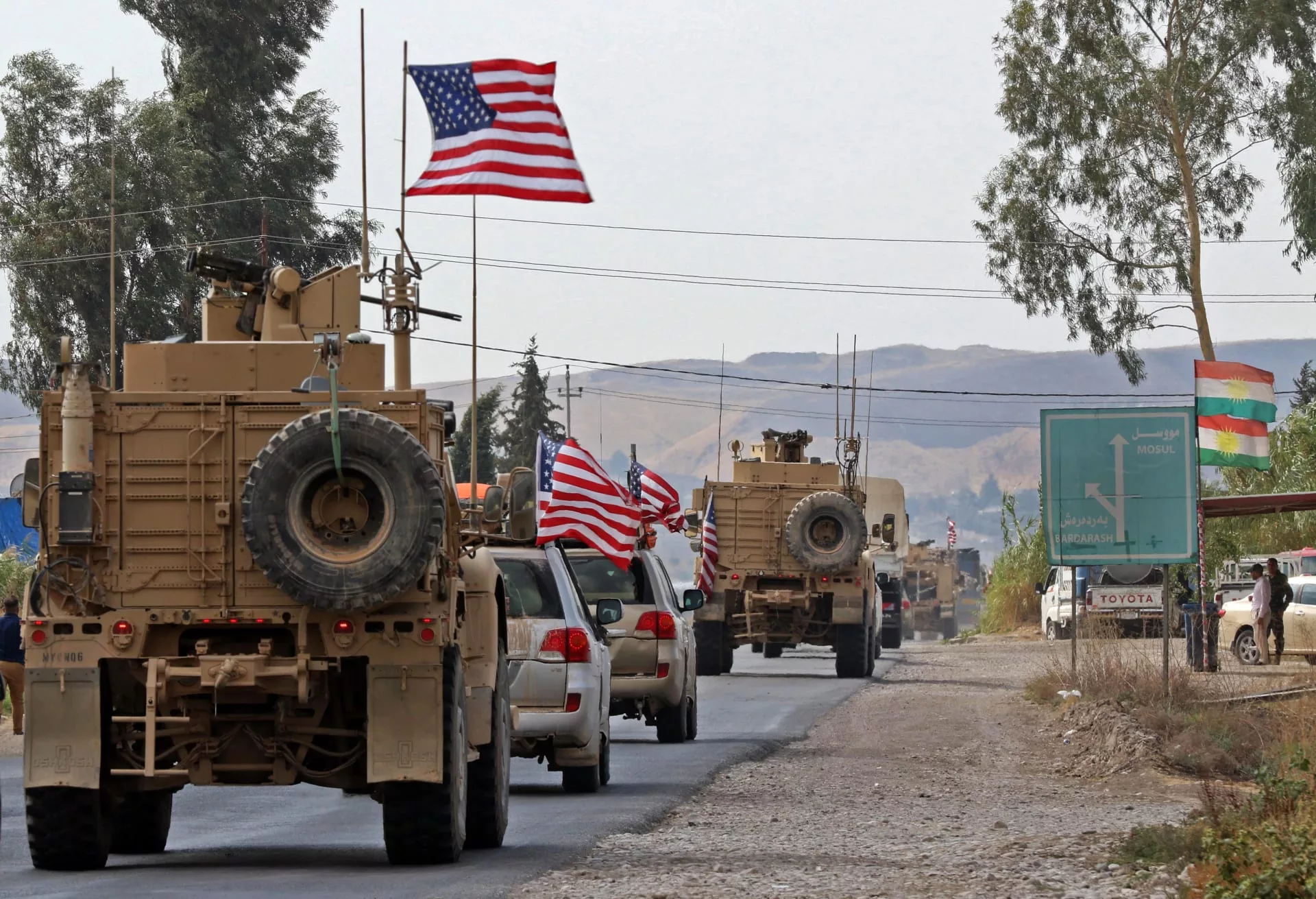
In a sudden and unannounced move, the United States has begun withdrawing its troops from two of its most strategic military bases in Iraq: Ain al-Asad in the western province of Anbar, and Victoria Base near Baghdad International Airport.
Troops are now gradually being relocated to Erbil in the north, effectively ending a decade-long presence in the Iraqi capital. This deployment began in 2014 at the request of the Baghdad government to help combat the rise of ISIS.
This step—interpreted in various ways comes at a highly sensitive moment: tensions with Iran are escalating, and talk of renewed military operations against Tehran and its regional proxies is mounting. The Israeli onslaught on Gaza and continued confrontations in Lebanon, Yemen, and Syria have only added to the volatility.
Compounding matters are the ongoing complexities of the war in Ukraine and the uneasy geopolitical dynamics between Washington on one side and Moscow, New Delhi, and Beijing on the other—fueled in part by former President Donald Trump’s protectionist policies. As polarization grows, speculation swirls around possible scenarios and regional outcomes.
While the withdrawal of U.S. forces from Iraq has long been a popular and political demand, the accelerated timeline earlier than originally agreed has raised questions. Given the fraught political and security landscape in the region, many are left wondering about the motives behind this move and its implications for both Iraq and the wider Middle East.
A Step Ahead of Schedule
In September 2024, Reuters reported that Washington and Baghdad had reached an understanding on a phased withdrawal of U.S.-led coalition forces. This plan included shutting down Ain al-Asad and pulling troops out of Baghdad by September 2025, with a continued American presence in Erbil until the end of 2026 to support operations against ISIS in Syria. However, this agreement, according to sources, was never legally or officially ratified.
On September 27, 2024, the Associated Press revealed that Iraqi officials had confirmed the phased withdrawal plan, but the Biden administration refrained from disclosing how many of the approximately 2,500 U.S. troops in Iraq would remain. Nor did it confirm whether the move constituted a full exit.
Sabrina Singh, then Deputy Pentagon Spokesperson, told reporters, “I think it’s fair to say our presence will change inside the country,” but offered no further details. U.S. officials noted the withdrawal would unfold in two phases one ending by September 2025, and a second extending through 2026 to sustain anti-ISIS operations in Syria.
According to the same AP report, U.S. forces were expected to begin withdrawing from Ain al-Asad and Baghdad’s airport after the previous year’s presidential elections, relocating to Harir base in Erbil, in the Kurdish north. The remaining U.S. troops would shift their mission to a bilateral security arrangement with Baghdad, though exact troop levels remained unspecified.
Given this timeline, the withdrawal was expected next month not this one. That early move has sparked concerns and speculation, as observers attempt to decipher the motivations behind the timing and its broader implications.
No Full Withdrawal—For Now
To begin with, this is not a complete U.S. military withdrawal from Iraq. Washington’s presence remains grounded in a legally binding framework: the 2014 memorandum of understanding signed by both governments following Iraq’s official request for help in combating ISIS.
Under this agreement, U.S. and coalition troops enter Iraq on diplomatic visas and enjoy considerable legal and logistical privileges. The memorandum remains valid until one party Baghdad or Washington formally requests its termination via written notice at least one year in advance.
This means that to end the U.S. and international military presence in Iraq, the Iraqi government must submit an official notice to Washington. As of this writing, that has not occurred. Even if it did today, the withdrawal process would take at least a year to complete.
As such, the Iraqi Parliament was unable to formally demand the U.S. departure in January 2020, following the killing of Quds Force Commander Qassem Soleimani at Baghdad airport. Instead, lawmakers requested the cancellation of the assistance agreement with the coalition—a prerequisite to expelling foreign troops.
Repositioning or Tactical Withdrawal?
Two major interpretations are emerging regarding Washington’s sudden move—timing being the key concern.
First: Repositioning.
In recent months, U.S. troops in Iraq have faced direct threats from Iran-backed militias, especially in the wake of the recent 12-day war involving Israel, during which Iran suffered significant military, intelligence, and economic losses.
Relocating troops could thus be a strategic attempt to minimize direct engagement with these groups, consolidate troop deployment in less exposed areas, and maintain operational flexibility from safer distances. Being based in Erbil gives U.S. forces greater reach across Iraq, Syria, and potentially Iran or the Gulf—while also reducing the risk of direct retaliation.
Second: Tactical Withdrawal.
The U.S. may be seeking to ease pressure on Iraq’s government, which has come under sharp criticism for allowing such a prominent American military presence. By partially withdrawing, Washington could be handing Prime Minister Mohammed Shia al-Sudani a political win—strengthening his domestic standing ahead of elections and deflecting attacks from pro-Iran factions.
Still, this approach could backfire. Al-Sudani’s government already walks a fine line—balancing U.S. ties with demands from armed groups and political factions. A continued U.S. presence offers opponents an easy opportunity to accuse him of selling out Iraq’s sovereignty, while a rapid withdrawal risks creating a security vacuum and emboldening ISIS or Iran-backed militias.
If al-Sudani manages a gradual, orderly pullback, he could emerge as a leader who balances national sovereignty with security. A hasty exit, however—especially one not favored by Washington—could plunge Iraq into chaos and shift greater influence to Tehran.
What Are the Possible Scenarios?
The accelerated U.S. departure from Ain al-Asad and Victoria bases—earlier than planned and amid regional volatility—suggests that major developments may be imminent. Two scenarios stand out:
1. A Targeted Strike on Iran-Backed Militias.
Washington has escalated its rhetoric against these groups. In March 2025, U.S. Secretary of Defense Pete Hegseth warned Baghdad that any militia interference with American operations in Yemen would be met with “direct military retaliation inside Iraq.” In October 2024, stern warnings were issued against attacks on U.S. interests in Iraq or Syria, or against escalations targeting Israel.
In July 2025, State Department spokesperson Tammy Bruce labeled Popular Mobilization Forces as a threat to Iraq’s stability, urging Baghdad to hold their leaders accountable.
This heightened tone—military and diplomatic—suggests a possible U.S. plan to neutralize these militias, which are now Tehran’s most active regional arm after setbacks suffered by Hezbollah, Assad, and the Houthis.
2. Preparations for a New Military Campaign Against Iran.
Some analysts argue that repositioning to Erbil signals a build-up for strikes against Iranian targets. The earlier offensive—widely claimed to be successful—did not achieve all of its goals. A follow-up strike may be in the works.
A pullout from Baghdad bases would reduce the risk of immediate retaliation from Iran-aligned groups, who often use drones and mortars to target U.S. installations.
The Syria Connection
Some observers believe the Iraq withdrawal cannot be viewed in isolation from developments in Syria. They point to what they describe as a joint U.S.-Israeli effort to establish a buffer zone in southern Syria, stretching from Sweida to the fringes of Deir ez-Zor, along the Iraqi border.
The stated purpose: to protect Syria’s Druze minority. The real goal, these analysts claim, is to cut off cross-border coordination between Iranian-backed militias and ISIS factions in both countries—thus giving Israel and the U.S. more freedom to maneuver in a “new Syria.”
The sudden U.S. redeployment from Ain al-Asad and Victoria does not mark a full withdrawal, but rather a calculated repositioning to Erbil and other border regions. It’s part of a broader regional strategy tied to Iran, Syria, and Gaza—as well as internal Iraqi politics.
For Prime Minister al-Sudani, the move may bring temporary political relief. But it also presents him with a complex and perilous future, full of security dilemmas and geopolitical entanglements.


