
More than 14 years after the fall of Muammar Gaddafi’s regime, Libya remains trapped in a vicious cycle of political and military fragmentation, split between two rival governments and armies. In the west, Abdul Hamid Dbeibeh leads one faction, while in the east, retired Field Marshal Khalifa Haftar maintains his dominance through his forces and a web of tribal and regional loyalties.
Amid this turmoil, Haftar surprised observers with a bold step toward consolidating a hereditary grip on power in eastern Libya, positioning two of his sons in pivotal leadership roles within his military hierarchy. The move has been widely interpreted as part of a succession strategy, shedding light on the future of power dynamics in the east.
This maneuver appears to be a deliberate attempt to institutionalize family control an echo of Gaddafi’s model with his own sons and has reignited pressing questions: What is driving Haftar’s push to embed his sons in positions of power? Will this hereditary project succeed, or will it collapse under the weight of internal divisions and a long-delayed UN roadmap that promises presidential and legislative elections?
Inheritance by Appointment
In February, Haftar’s sons, Saddam and Khalid, accompanied their father on an official trip to Belarus—their first joint public appearance abroad. Since then, they have become increasingly visible, culminating in their appointments to sensitive military positions under the banner of the so-called “2030 Vision for Developing the Libyan Army.”
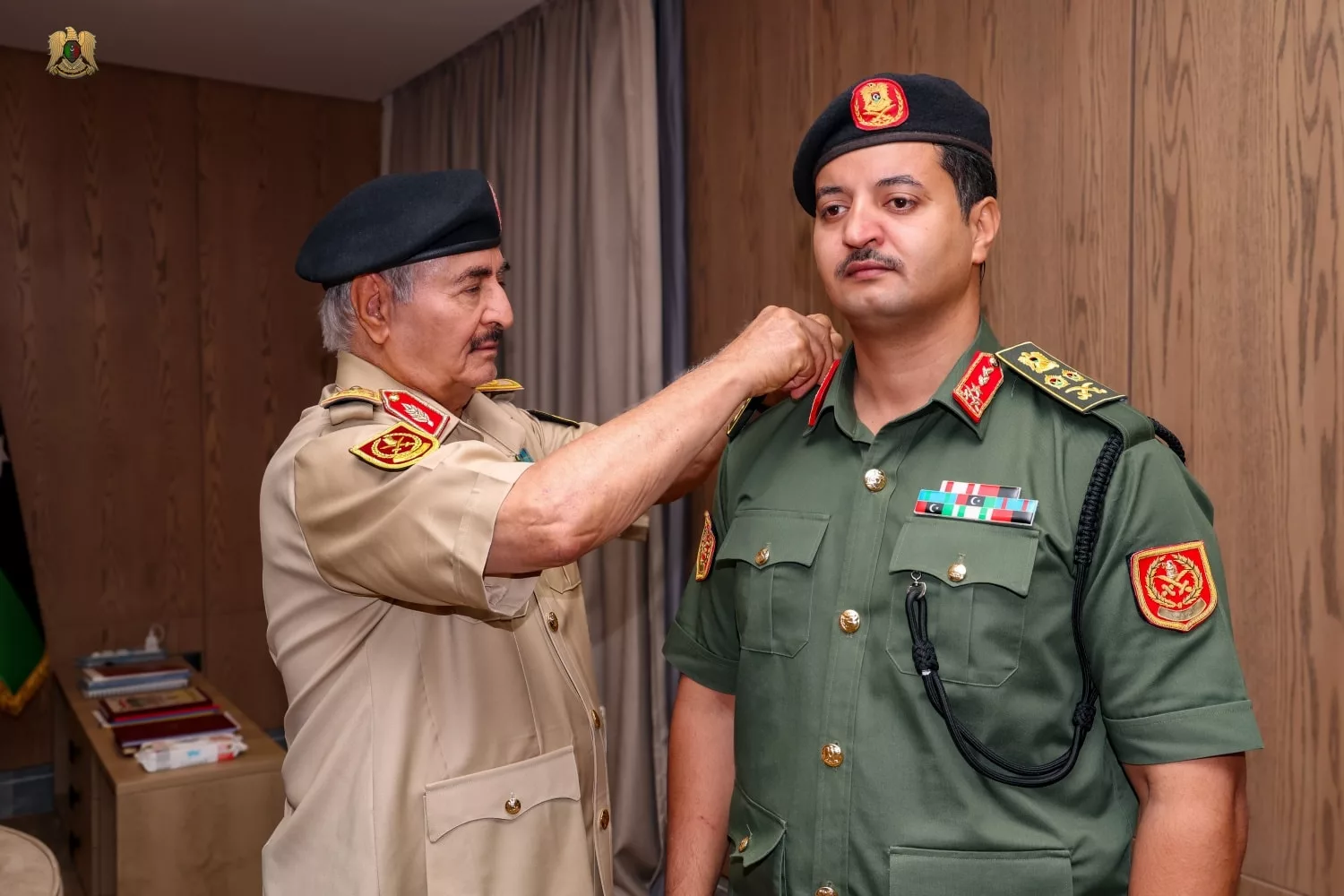
On August 12, during celebrations marking the 85th anniversary of the army’s founding, Haftar promoted Saddam to the rank of First Lieutenant General and named him Deputy Commander-in-Chief. This came after Saddam had already assumed command of the ground forces in May 2024.
The move was widely seen as preparation for the post-Haftar era and an effort to entrench a family-led rule that runs counter to the principles of a civilian state.
The decision stirred legal controversy, as the newly created position lacked formal precedent. To legitimize it, the Tobruk-based House of Representatives amended Law No. 1 of 2015, which defines the powers of senior military leadership an indication of legislative alignment with Haftar’s trajectory.
A few days later, Haftar expanded his familial consolidation further by appointing his other son, Khalid, as Chief of the General Staff, after promoting him to the rank of First Lieutenant General.
General Abdelrazek al-Nadhouri, the former chief, was moved to an honorary advisory role. This reshuffle was perceived as a structural overhaul aimed at cementing the family’s hold over the military institution.
In practical terms, supreme military authority now rests with Haftar and his sons backed by the political cover provided by the Tobruk Parliament. This move also marked an upward trajectory for Saddam, who, since taking his oath, has handled sensitive foreign affairs.
Notably, he hosted Turkish military delegations to discuss naval and defense cooperation despite past tensions between Ankara and Benghazi signaling his capacity to manage regional friction and foster pragmatic engagement.
Saddam’s rise was hardly unexpected. He first gained prominence by founding the notorious 106th Battalion and later leading the infamous Tariq Bin Ziyad Brigade. His name has been linked to seizing funds from the Central Bank and overseeing a tax-exempt military investment authority granting him both financial clout and battlefield influence.
On the international stage, Saddam has acted as his father’s unofficial envoy, building ties with regional and global actors and managing complex files in Libya’s south and central regions, where smuggling networks overlap.
He is believed to control illicit trade routes dealing in drugs, gold, oil, and migrants to Europe. His dealings have extended to actors such as the former Syrian regime, Sudan’s Rapid Support Forces, and Russia’s Wagner Group.
Following the 2023 Derna floods, Saddam headed the disaster response committee, while one of his brothers led the reconstruction fund placing them as key interlocutors for international aid. It’s believed that Saddam changed his legal name to conceal assets and origins in the US, where lawsuits accuse the Haftar family of war crimes.
Khalid, the youngest person ever to hold the Chief of Staff role in Libya, previously commanded the Hamza bin Abdul-Muttalib Brigade. He was promoted to the rank of general, accompanied his father on diplomatic visits, and inaugurated Libya’s consulate in Belarus. His role, however, serves a broader strategy aimed at securing enough stability to attract foreign investment.
Controversy and Resistance
The recent appointments have reignited political tensions. The High Council of State in Tripoli sent a letter to the UN mission condemning the “unilateral measures” as a “breach of the political agreement,” explicitly rejecting Khalid Haftar’s appointment.
In response, Presidential Council member Abdullah al-Lafi called for an emergency meeting, citing the Skhirat Agreement of 2015, which defines the council as the army’s supreme commander. This reflects the western Libyan interpretation of Haftar’s move as a calculated attempt to impose a new military reality.
Observers have also linked the timing of these appointments to a recent UN survey involving 26,000 Libyans, where 42% expressed a strong desire for urgent presidential and parliamentary elections to end the political deadlock and restore legitimate governance.
A Calculated Family Consolidation
These appointments must be read within the broader Libyan context and Haftar’s personal calculus as an octogenarian powerbroker. The maneuver merges two overlapping objectives: managing complex internal dynamics and engineering a family-based succession plan.
Haftar understands that his power is not solely military it hinges on a tapestry of tribal loyalties, regional alliances, and war-time economic fronts. Entrusting his sons with critical roles is intended to secure tribal loyalty and assure senior officers that decision-making will remain within the family, not be subject to volatile alliances.
He is also presenting his sons as stabilizing forces for the post-Haftar period: Saddam as the authority over financial and security matters, and Khalid as the field commander of elite units. This strategy is designed to preempt succession struggles or military fragmentation.
Yet the project is fraught with risks. Saddam faces resistance from senior commanders within his father’s ranks, rivalries with tribes aligned with Saif al-Islam Gaddafi, and disputes with his own siblings over eastern Libya’s power balance.
He also maintains a tense relationship with Tobruk Parliament Speaker Aguila Saleh, who once attempted to remove him before Cairo’s intervention. Moreover, Saddam’s rapid promotion over his older brothers could trigger internal family rifts.
Regional Messaging and Fragile Legitimacy
The appointments send multiple signals to regional backers of eastern Libya particularly Egypt and the UAE suggesting that the leadership transition will be orderly and won’t create a power vacuum exploitable by rivals or armed factions.
Egypt, where Saddam recently met military leaders, appears especially invested in preserving unity in the east. His warm reception and official congratulations underscore Cairo’s security interests and economic priorities, such as the reconstruction of Derna and cross-border cooperation.
For the UAE, which views Haftar as a bulwark against political Islam, Saddam’s ascent represents continuity. His close ties to Abu Dhabi especially during the Tripoli war (2019–2020) cemented his status as a trusted operative, capable of maneuvering between alliances, including overtures toward Dbeibeh’s government.
Even Israel, which Saddam reportedly visited secretly in 2021, might see this realignment as an opportunity to establish strategic channels with Libya’s future leadership. Such pragmatism aims at gaining international legitimacy and securing security or political arrangements beyond internal turbulence.
Behind all this lies a deeper health and political calculus: Haftar is reportedly in frail health and recognizes the need to delegate power before external shocks or internal crises undermine his legacy amid regional instability, including the conflicts in Sudan and Chad, and the West Russia rivalry in Libya.
In essence, Haftar is not merely reshuffling military titles. He is methodically orchestrating a succession plan. Yet this engineered transition despite its veneer of discipline reveals the fragility of Libya’s military-political order and raises a fundamental question: Can Libya break free from dynastic politics, or is it doomed to repeat them?
Reproducing the Gaddafi Family Model
Haftar’s move to thrust his sons into the political-military spotlight inevitably recalls Gaddafi’s dynastic statecraft. Yet the vastly different contexts make the comparison essential for understanding whether eastern Libya is headed toward a fragmented version of a family regime or simply a temporary arrangement.
Like Gaddafi, who divided power among his sons Saif al-Islam for politics, Mutassim for security, Khamis for the army, and Saadi for sports and business Haftar has gradually projected his six sons as international actors, each assuming growing roles in politics, the military, and economics.
Beyond Saddam and Khalid, Haftar’s son Belqasim has become a prominent economic figure, leading foreign delegations and overseeing large, opaque financial transactions. His eldest, Sadiq, handles reconciliation and tribal affairs. Others including Omar, Ajmi, and sons-in-law occupy lesser roles, further illustrating the family’s expanding influence across eastern Libya’s power structures.
But the key difference lies in the scope and legitimacy. Gaddafi ruled a unified state with full institutional control, backed by an ideology enshrined in his “Green Book.” Haftar, by contrast, commands a security-military authority in a divided territory without international recognition, making his family project narrower and more precarious.
The two families also differ in qualifications: Gaddafi’s sons were groomed amid oil wealth, diplomatic grooming, and access to statecraft. Haftar’s sons, by contrast, lack independent political or military credibility.
Their legitimacy is largely inherited, with Saddam in particular facing allegations of war crimes tied to the controversial Tariq Bin Ziyad Brigade undermining his chances of broad-based acceptance.
Since 2011, Libya’s popular mood has also changed. Public sentiment has grown increasingly averse to any revival of family rule. Libya’s political scene is more fragmented than ever, marked by widespread arms proliferation and conflicting loyalties.
Any attempt to enshrine “the House of Haftar” as a singular authority risks facing both domestic resistance and international opposition, especially with ongoing calls for elections and a unified military.
If Gaddafi built a dynastic state, Haftar appears capable only of constructing a localized, contested version within an unstable military framework. The question remains: Can Libya transcend familial power structures, or is it destined to reproduce them?
Ultimately, this will not be determined by Haftar alone, but by the choices of Libyans themselves, regional power plays, and the seriousness of commitment to the UN roadmap. Libya now stands at a crossroads: either it embarks on a new chapter grounded in national legitimacy or it further entrenches family rule under the guise of military order.