







With the fall of the Assad regime at the end of last year, and Israel’s exploitation of Syria’s vulnerable state to decimate the Syrian National Army’s military capabilities effectively paralyzing its entire defense infrastructure the urgent need arose to build a strong Syrian army. This necessity became even more pressing as the sectarian Assad-era military structure dissolved within mere days.
The events in Suwayda served as an early rehearsal for a larger separatist project, backed internally by remnants of the old regime and certain factions, and externally by Tel Aviv and possibly some regional capitals.
These developments deepened the crisis and made the rapid formation of a national army a strategic imperative to preserve the state before its disintegration especially after the true scale of the fragmentation scheme became apparent.
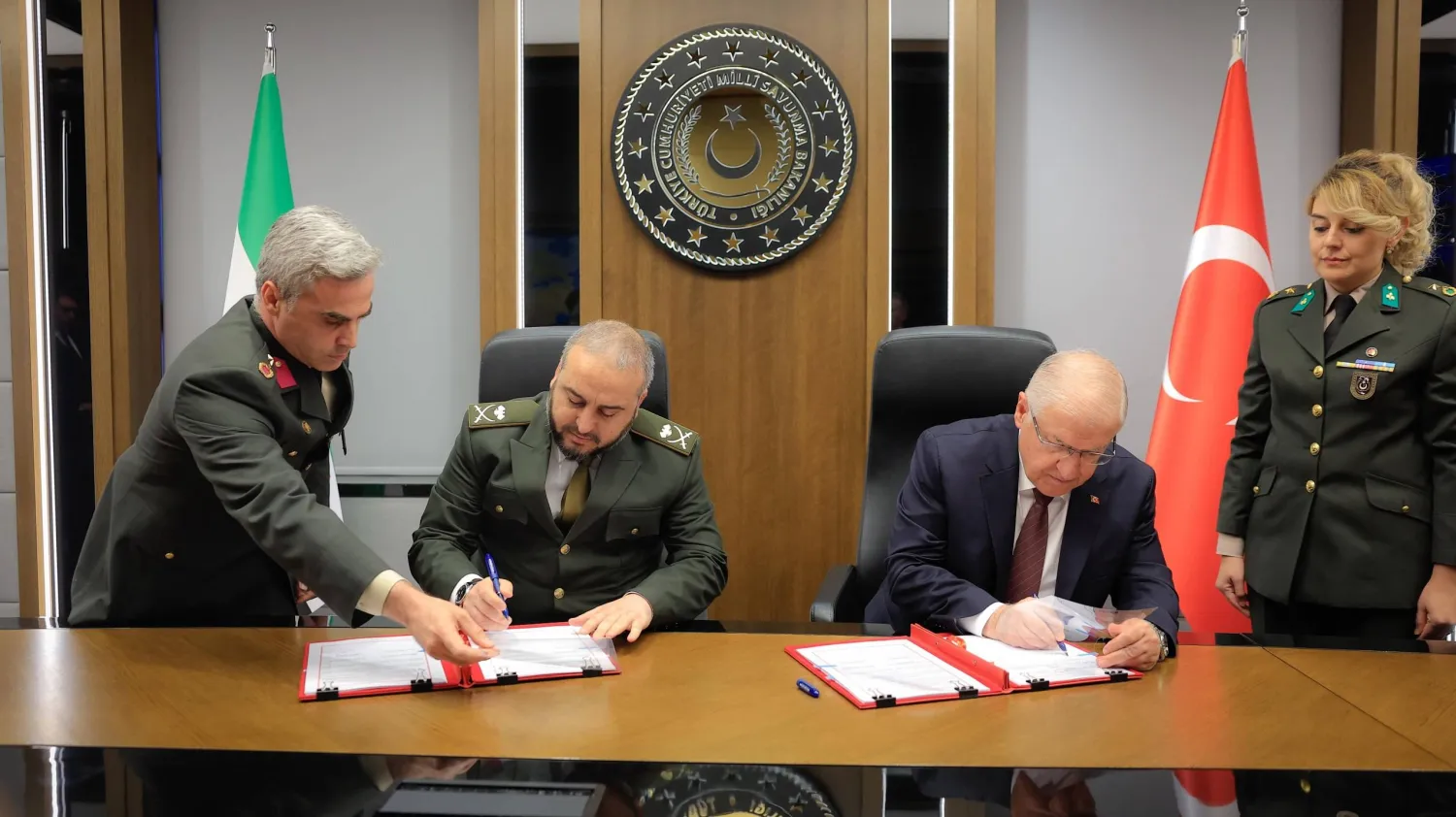
This backdrop set the stage for the Memorandum of Understanding (MoU) signed between Turkey and Syria on August 3 in Ankara. The agreement was formalized by Turkish Defense Minister Yaşar Güler and his Syrian counterpart Murhaf Abu Qasra, in the presence of Syrian Foreign Minister Asaad al-Shibani and intelligence chief Hussein Salameh, following months of negotiations.
The MoU includes provisions for supplying weapon systems and logistical equipment to the Syrian army, offering technical training and advisory services on request, and conducting specialized training programs in counterterrorism, military engineering, cyber defense, logistical support, and military rehabilitation.
The restructuring of Syria’s armed forces is already underway, with ongoing technical support, training programs, and reciprocal visits being implemented in coordination with the Syrian Ministry of Defense. Turkish military delegations are conducting field visits to assess Syria’s defense needs and draft a joint roadmap.
However, achieving the ultimate goal building a powerful, cohesive Syrian army that is responsive to the current geopolitical landscape is no easy feat. Numerous obstacles lie ahead, demanding multifaceted strategies to avoid falling back into instability.
Obstacles and Hurdles
The path toward constructing a formidable Syrian national army is strewn with complex challenges:
– Devastated Military Infrastructure: The newly installed Syrian administration inherited a virtually non-functional army. Within 48 hours of Assad’s fall, Israel launched what it described as the largest aerial offensive in its history, striking over 320 targets across Syria.
This operation decimated military infrastructure, airbases, research centers, MiG and Sukhoi fighter squadrons, dozens of helicopters, chemical weapons facilities, heavy weapons depots, and long-range missile installations. Israel’s navy destroyed Syria’s naval assets in Latakia and Baniyas, including dozens of sea-to-sea missiles. According to The Times of Israel, over 70% of Syria’s strategic military capabilities were obliterated.
– The Doctrinal Dilemma: Syria’s new constitutional declaration does not define a unified military doctrine for its emerging army. This poses a serious challenge, especially considering the various military groups with divergent loyalties—such as Turkish-backed National Army factions, the Southern Front in Daraa with ties to Russia and Jordan, factions from Suwayda, US-backed Free Syrian Army forces, and the Kurdish-led Syrian Democratic Forces (QSD).
These divisions make unification nearly impossible, as each faction remains more loyal to its field commanders than to the Syrian state.
– Proliferation of Armed Factions: Syria hosts more than 60 armed groups. Of these, 41 fall under the Turkish-backed Syrian National Army, comprising between 70,000 and 90,000 fighters. QSD boasts around 100,000 fighters. These two are the most significant in terms of manpower and firepower, yet their integration is hindered by ideological and strategic divergences.
– Widespread Weaponization: Weapons are vertically concentrated among minorities—such as US-supplied arms with QSD in the north and factions in Suwayda in the south—and horizontally dispersed across ideologically driven groups throughout Syria’s geography.
– Factional Mentality vs. Institutional Army: Shifting from a factional to a professional military mindset remains one of the most pressing challenges. Even if militias are officially merged into the army, failing to institutionalize discipline and hierarchy could turn these groups into ticking time bombs.
The Funding Dilemma
Even middle-income countries struggle to modernize their armed forces. For Syria—a state without an army or economy the challenge is monumental. Building a modern military from scratch requires massive investments in arms, infrastructure, personnel salaries, and long-term training programs. Most recruits currently lack any professional military background.
Syria’s economic outlook is bleak, with GDP levels barely 25% of what they were a decade ago. Years of war drained state resources, which Assad directed primarily toward suppressing internal dissent. The transitional government or any future authority cannot fund the army’s reconstruction alone without external support. While Iran and Russia previously shouldered this responsibility, Moscow’s presence is now minimal.
This vacuum may create space for new patrons chiefly Saudi Arabia, alongside Turkey, the US, and potentially European nations especially as Syria’s new leadership garners regional and international legitimacy. However, such support is likely to come with conditions, reforms, and oversight mechanisms.
Turkey’s experience in Afrin offers a possible model. The effort began in January 2018 with Operation Olive Branch against the PKK-affiliated YPG the backbone of QSD. Within two months, Turkish forces and their Syrian allies took control of Afrin, initiating a military restructuring process. Yet, today’s circumstances are vastly different, and Turkey cannot bear the burden of building Syria’s army alone.
QSD at the Center of the Equation
Since the regime’s fall, the Kurdish-led QSD has remained a key player and a major obstacle in state-building efforts. After extensive negotiations, a landmark agreement was signed on March 10, 2025, to integrate QSD into the planned national army.
The deal includes guarantees of political representation, recognition of Kurds as a foundational component of Syria, and the protection of their constitutional rights.
In return, QSD’s military and civil institutions border crossings, airports, and oil and gas fields—are to be folded into the Syrian state framework. Joint executive committees aim to implement the agreement by the end of 2025.
However, several issues remain unresolved chiefly the lack of clarity around QSD’s military integration. No provisions were made regarding their weaponry, chain of command, or operational independence, sparking international concerns.
Turkey remains wary, viewing QSD as a terrorist entity. Ankara has insisted on monitoring the deal, particularly concerning infrastructure control. Recent sectarian and tribal unrest in Suwayda and elsewhere has further clouded the agreement’s viability.
One sticking point: QSD demands to join the army as a cohesive unit—not as individuals—retaining its structure, command, and geographic control in the east. The Syrian government has flatly rejected this, leading to a growing trust deficit.
While Kurdish commander Mazloum Abdi remains optimistic that issues will be resolved by year’s end, President Ahmad al-Sharaa suggested progress may come in a few months. Yet, some QSD leaders claim talks have already collapsed.
Balancing Security and Politics
Turkey’s strategy in supporting Syria’s new administration is rooted in balancing security concerns with broader political ambitions. On the security front, Ankara considers QSD and its military wing (YPG) a direct national threat due to ties with the PKK. Thus, Turkey seeks to dismantle any prospect of Kurdish autonomy in northern Syria by pushing for the integration of Kurdish fighters into Syria’s national army under the banner of “one state, one army.”
This aligns with Turkey’s aim to dissolve Kurdish separatist aspirations through cooperation with Damascus, culminating in the August 13, 2025 MoU. This agreement reflects Ankara’s vision for a long-term defense partnership—training, arming, and restructuring the Syrian army, coupled with joint intelligence operations to combat terrorism and secessionism.
Politically, Turkey has pivoted toward gradual normalization with Damascus after years of hostility. It now positions itself as a regional guarantor for Syria’s unity, aiming to contain Iranian and Russian influence through direct engagement with the new Syrian leadership.
On the economic front, Turkey hosts over 3.5 million Syrian refugees. Stabilizing and rebuilding Syria could facilitate their organized repatriation while enabling Turkish companies to play a significant role in reconstruction projects.
Nevertheless, Ankara’s approach faces resistance—particularly due to Kurdish sensitivities. Forcibly merging QSD without diplomacy could reignite conflict. Moreover, Syrian political and tribal factions remain cautious of Turkey’s expanding influence, with critics warning of a “new Turkification.”
Both Syria and Iran view Turkey’s growing footprint with suspicion, seeing it as a threat to their strategic interests. There’s also concern about a potential clash with residual Russian forces. Ankara and Moscow are currently working to avoid such escalation.
With the US drawing down its presence and Israel watching closely for any signs of Syrian independence, Turkey finds itself playing a difficult dual role—mediator and guarantor. Whether Ankara can navigate these complexities remains an open question.