















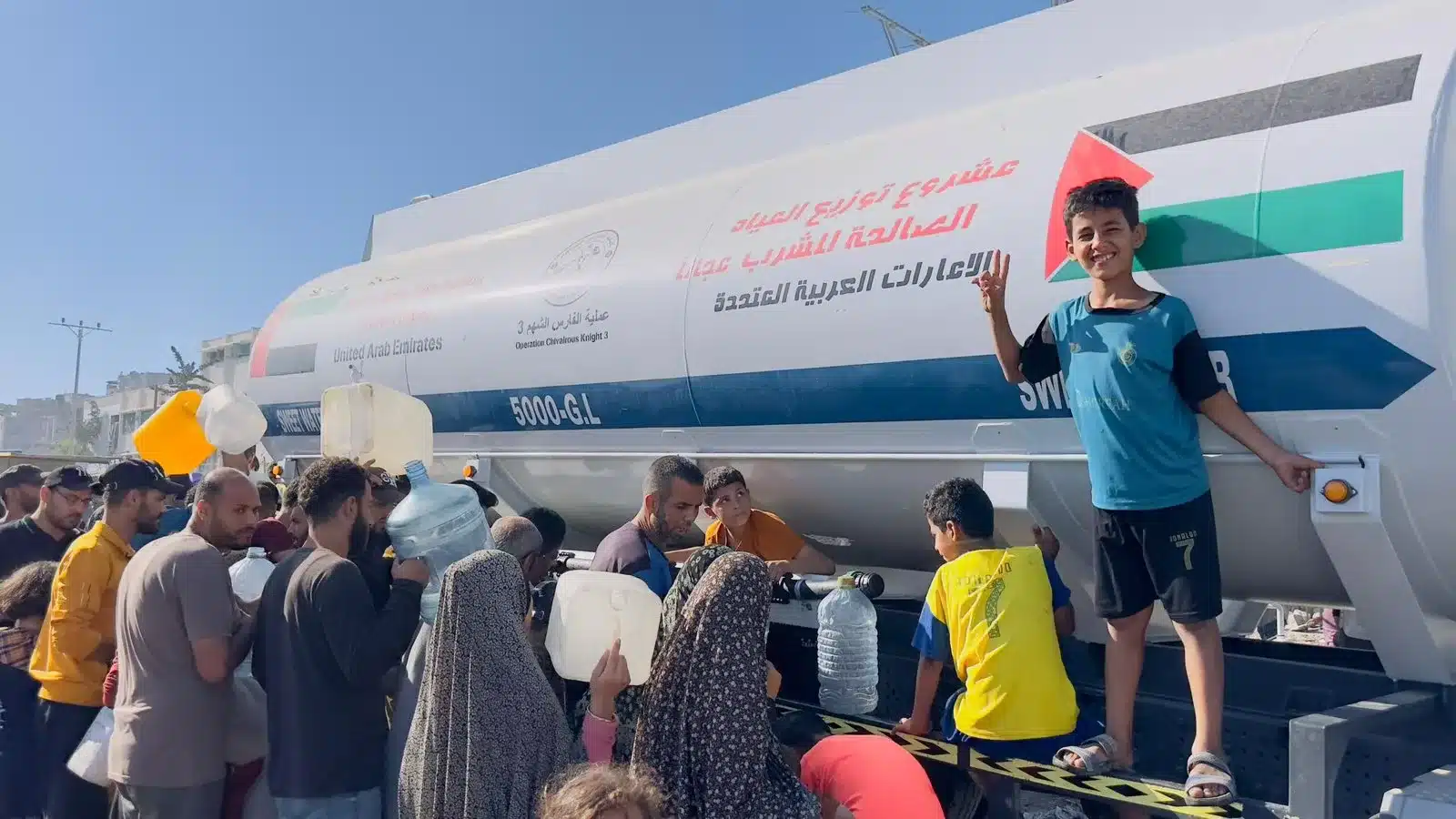
Amid Israel’s ongoing war of extermination in Gaza, as daily per capita access to water plummets to unprecedented lows, a new initiative has emerged. Backed and financed by the United Arab Emirates, approved by Israel, and reliant on Egyptian water, the project purports to partially ease the crisis.
It presents itself as a humanitarian intervention but has swiftly triggered wide political concerns.
This initiative falls under the broader UAE relief campaign dubbed “Operation Gallant Knight 3,” and is marketed as an emergency effort to alleviate the suffering of hundreds of thousands of displaced people.
Yet even among desperate Palestinians, the project has raised deep suspicions, with many questioning whether it serves political and demographic agendas that extend far beyond its stated humanitarian purpose.
The Devil in the Details
In mid-July 2025, it was announced that the UAE would construct a 7-kilometer water pipeline capable of delivering 10,000 cubic meters of desalinated water daily. The water would come from a desalination plant the UAE built in Egypt in December 2023, just 500 meters from the Gaza border, intended to serve 1.4 million people.
The water will flow directly to the coastal area of Al-Mawasi in southern Gaza, now densely populated with displaced people and far from water networks controlled by Israel.
Technically, the pipeline connecting the Emirati plant to displacement zones in Khan Younis and Rafah aims to address severe water shortages in the most affected areas. It will reactivate a desalination plant that ceased operations in May 2024 due to Israeli military activity in Rafah.
According to official plans, the project will raise per capita water access above 20 liters a day—the minimum emergency standard set by international humanitarian guidelines. Still, no details have been disclosed about the timeline for operations or total costs, although the UAE has pledged to fully finance and operate the project.
By late July, Israel confirmed it had approved the pipeline from Egypt to Gaza, describing the move—ironically—as a “humanitarian response to improve living conditions” in the Strip, despite its central role in creating the crisis.
Israel’s endorsement of the project is about more than humanitarianism—it’s a strategic move to relieve international pressure, dodge potential sanctions, and polish its global image. Should the project fail, Israel can claim no direct responsibility for worsening Gaza’s water crisis, sidestepping its obligations under international law.
Strikingly, the project is being carried out under strict Israeli oversight and heavy security supervision, raising concerns that it could be used to control water flow—or restrict it. It could also serve to collect logistical data that monitors population movement and access to services.
This level of control transforms water from a humanitarian necessity into a security tool, heightening fears that the project’s goals extend well beyond relief. It could support broader demographic engineering plans that aim to redraw Gaza’s internal geography or enforce internal displacement.
Israel has long sought to undermine Palestinian autonomy in Gaza through seemingly humanitarian initiatives—whether water access or temporary “safe zones”—that later evolve into permanent geographic realities.
This latest project plays into that strategy by focusing infrastructure in one area, thereby weakening the case for displaced residents to return to the devastated north and central parts of the Strip.
Despite the existence of the pipeline, Israeli approval, and physical infrastructure near a fortified border, Cairo has maintained official silence about its involvement. Yet it is evidently coordinating with both Israel and the UAE.
Instead of issuing statements, Egypt has allowed its state media to highlight the project, featuring Emirati officials promoting the UAE’s so-called humanitarian efforts, including the desalination pipeline.
A Project That Serves the Occupation’s Plans
This announcement comes amid an unprecedented water crisis in Gaza that began with the war in October 2023. Beyond bombing and starvation, Israel has waged a brutal campaign to cut off water, weaponizing its control by halting electricity and banning fuel imports. For many, water is now a vanishing mirage.
According to the Palestinian Water Authority, around 85% of Gaza’s water and sanitation infrastructure has been destroyed or severely damaged. Available water supplies have dropped by 80%, and daily per capita access has plunged by 97%, now ranging between 3 and 5 liters—well below international humanitarian minimums.
Given these dire conditions, such projects might seem like a lifeline. But concerns extend well beyond their stated goals. Questions have grown particularly pointed after it emerged that the project coincides with Israeli plans for internal population redistribution.
Just weeks before the UAE pipeline was announced, Israel unveiled a strategy to confine nearly 2 million Palestinians to three designated areas—one of them being Al-Mawasi, the very area targeted by the pipeline.
The link between the desalination plant built in late 2023, its shutdown in May 2024, and its sudden reactivation now raises questions about the project’s timing and alignment with broader strategic interests. The overlap suggests that this initiative may be part of a larger scheme rather than a mere response to water scarcity.
The geographic choice of Al-Mawasi further politicizes the project. The UAE announced that the water line would stretch from the Egyptian border into central Khan Younis, where the largest concentration of displaced people from Rafah and Khan Younis is currently located—precisely where Israel intends to build its so-called humanitarian city.
Al-Mawasi is an open coastal area, easily isolated and monitored. Its proximity to the Egyptian border and the newly restored desalination plant makes it ideal for a dual-purpose strategy: meeting urgent needs while laying the groundwork for forced relocation in line with Israeli objectives.
Providing a stable water source to an area packed with displaced people risks making it a permanent population center. Many now see the project as part of a plan to redraw Gaza’s demographic map.
It could entrench population clusters that align with occupation plans and offer Israel a pretext to label these zones as “permanent” rather than allowing displaced people to return to their original, destroyed homes.
The UAE has stated the project will serve about 600,000 Gazans—the same number identified by Israel in its relocation plan. According to this plan, these people would be moved south, subjected to security screenings, denied the right to leave, and placed under tight restrictions—conditions human rights groups have compared to Nazi-style internment camps.
This suggests that the water project helps lay the foundations for Israel’s proposed city in southern Gaza. A consistent water supply would make the area more habitable and thus support the confinement of large groups within restricted zones.
If realized, such a scenario could enforce a new demographic order that aligns with Israel’s long-term goals. The water pipeline would enable residents to remain in Al-Mawasi for extended periods. Coupled with administrative and security measures that prevent return or relocation, temporary resettlement could become permanent.
In short, while the UAE portrays the project as a lifesaving initiative, its location, timing, and the conditions of its implementation suggest that it could—directly or indirectly—facilitate Israel’s plans for a “model city” in Gaza.
From Humanitarian to Political Actor
The initiative also underscores the UAE’s growing role as a regional power broker, particularly in light of its close ties with Israel following normalization and its talks with Washington and Tel Aviv about a possible role in Gaza’s postwar governance and reconstruction.
Though it draws on the UAE’s experience in humanitarian operations, the country’s recent diplomatic and operational history reveals that it is more than a benevolent donor. The UAE is positioning itself as a political actor with tangible influence in the Palestinian arena—casting the Al-Mawasi project in a distinctly geopolitical light.
By funding and operating key infrastructure in Gaza, the UAE becomes a stakeholder with potential leverage. Control over water could be used as a bargaining chip in future security or reconstruction negotiations involving regional and international players.
Under such conditions, water—a basic human necessity—becomes an instrument of political and security arrangements. Whoever controls its supply can attract populations to specific areas, enabling authorities to manage movement, service delivery, and the establishment of semi-permanent population clusters.
This is not unprecedented in conflict zones: access to basic services has long shaped population distribution. In the case of Al-Mawasi, stable water access may encourage long-term settlement, aligning with the concept of “internal resettlement” under Israeli security control.
Many now view the UAE’s role with suspicion. Since the start of Israel’s assault on Gaza, Abu Dhabi has largely adopted the Israeli narrative. Now, under the guise of humanitarian aid, it is effectively supporting the occupation’s plans—logistically enabling the creation of Israel’s proposed humanitarian city.
The UAE’s opaque, often contradictory policies raise further questions. While promoting the initiative as a relief mission, it maintains high-level political contact with Israel over Gaza’s future. This despite widespread allegations of forced displacement and demographic manipulation. The UAE’s past interventions in other Arab crises under security and political pretexts only heighten concerns.
The lack of transparency around operational agreements, legal safeguards, and the project’s governance leaves open the possibility of misuse—striking at the heart of longstanding Palestinian fears surrounding externally managed infrastructure under strict security controls. Past precedents have already inflicted lasting harm on Gaza’s environment and people.
In the end, the project stands at a crossroads between emergency relief and political reconfiguration: a potential lifeline for hundreds of thousands in desperate need, or a tool in a broader scheme to reshape Gaza’s future. For Al-Mawasi’s residents, it may offer water in the short term but to policymakers and observers, it signals yet another thread in the web of interests shaping postwar Gaza.
As the water crisis intensifies arguably the most urgent humanitarian challenge in Gaza today the project may offer short-term salvation. But without firm legal and political guarantees, it risks becoming a lever for imposing a new status quo that prioritizes security and geopolitical goals over the Palestinian right to live freely on their land.


