











Since the outbreak of Israel’s war of annihilation against the Gaza Strip, a parallel front has opened behind prison walls—one targeting Palestinian prisoners through a systematic campaign aimed at stripping them of basic rights and subjecting them to the harshest incarceration conditions.
This campaign, intensified by Israel’s far-right National Security Minister Itamar Ben-Gvir since assuming office, has not merely affected prisoners at large—it has zeroed in on the leadership of the Palestinian prisoners’ movement through escalating torture, prolonged solitary confinement, and a complete denial of medical care.
The behavior of the Israeli authorities suggests a race against time to inflict maximum physical and psychological harm on these leaders before any potential prisoner exchange. This strategy has coincided with Israel’s deliberate refusal to release prominent prisoner leaders in the first phase of any deal, stalling for time and prolonging their detention.
What is unfolding surpasses medical negligence or punitive conditions; it edges dangerously close to what can only be described as “slow-motion executions,” driven by a desire to exact revenge on national Palestinian figures who have spent over two decades in Israeli prisons and are now paying an even steeper price under dire health conditions and unrelenting abuse.
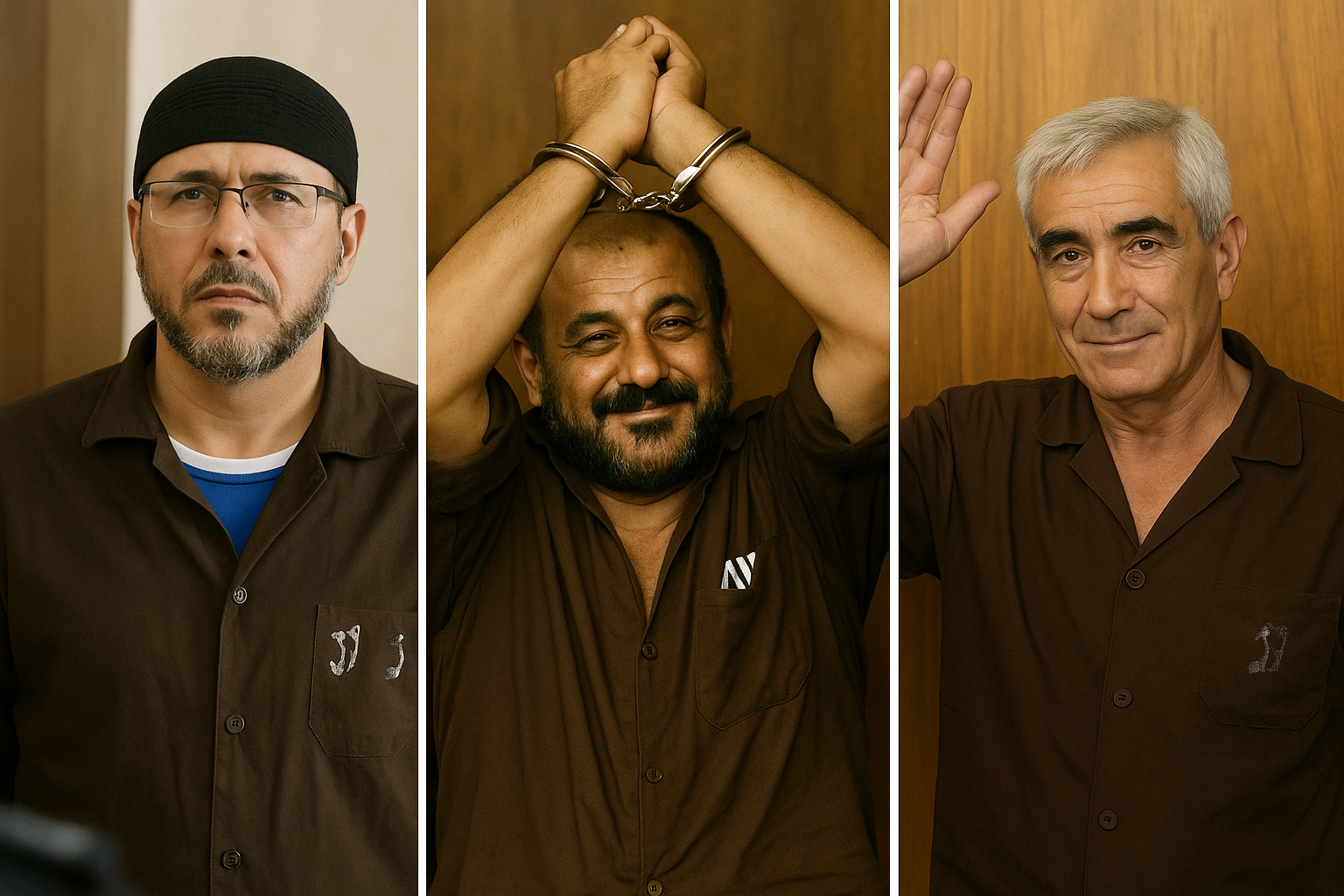
Prisoner Leaders Under the Blade of Slow Execution
Amid unprecedented escalation within Israeli prisons, the occupation authorities continue to implement systematic policies against the leadership of the prisoners’ movement—enforcing long-term isolation, repeated abuse, and deliberate medical neglect that appear to amount to slow, calculated killings behind bars.
In this context, the Popular Front for the Liberation of Palestine (PFLP) warned of the imminent danger facing its imprisoned General Secretary, Ahmad Sa’adat, held in solitary confinement in Megiddo Prison.
The group reported that Sa’adat was brutally assaulted during his recent transfer, denied family visits and legal rights, and left in deteriorating health without medical attention.
The PFLP described the abuse of Sa’adat as a “deliberate crime,” part of a campaign targeting prisoner leaders both physically and psychologically. Another senior PFLP figure, Ahed Abu Ghoulmeh—a member of the Political Bureau and head of the prison branch—was transferred to Gilboa Prison under harsh conditions as part of arbitrary relocation tactics designed to exhaust and destabilize the prisoners’ cohesion.
Meanwhile, the Palestinian Prisoners’ Media Office reported that senior prisoner Abbas Al-Sayyid, serving 35 life sentences since 2002, is being held in extreme solitary confinement in Ramon Prison. He faces repeated torture and medical neglect that has led to widespread skin infections and severe vision loss.
Even more harrowing is the case of Abdullah Al-Barghouti, subjected to multiple assassination attempts involving vicious beatings, the use of attack dogs, and scalding substances poured onto his body, leaving him in a coma with no meaningful medical intervention.
Prisoner Hassan Salama, who has been in solitary confinement for months, also suffers from severe health deterioration, including near-total vision loss, tooth loss, and emaciation—his weight has dropped to 62 kilograms. Another leader, Muhannad Shreim, has reportedly lost about 45 kilograms and now struggles with speech and mobility.
Muammar Shahhour, another prisoner leader, is afflicted with untreated rheumatism and held in a damp, freezing cell where he is subjected to daily beatings and starvation, exacerbating both his physical and mental anguish under a deafening international silence.
One of the most alarming cases involves 67-year-old prisoner Muhammad Al-Natsheh, who recently slipped into a coma due to internal bleeding and kidney failure following severe torture after his arrest in March 2025.
Despite being transferred to Hadassah Hospital, neither his family nor his lawyer has been allowed to visit or receive information about his condition, fueling suspicion of a deliberate cover-up of the abuse he endured.
According to his wife, Al-Natsheh was taken immediately after arrest to the Ofer Interrogation Center, where he was subjected to prolonged and brutal interrogation before being transferred—unconscious—to the hospital.
“My husband is an elderly man with chronic health issues. I don’t understand how they can subject him to such torture. It was as if they wanted to destroy him, not interrogate him,” she said.
The Palestinian Commission of Detainees’ Affairs and the Palestinian Prisoners’ Society also confirmed that Fatah Central Committee member Marwan Barghouti has faced repeated assaults in Megiddo Prison, including severe beatings to his head, ears, and chest, causing internal bleeding and acute infections. These attacks have occurred alongside systematic medical neglect.
The Fatah Central Committee has described what is happening to Barghouti as a “political assassination attempt sanctioned by the Israeli government,” especially given the repeated denial of medical care and legal access.
The targeting is not limited to those serving sentences. Senior prisoner Zahir Al-Shishtari, 60, held under administrative detention for over eight months, suffers from multiple ailments—including multiple sclerosis, diabetes, and Bell’s palsy—and is now immobile, in constant pain, and entirely dependent on fellow prisoners for basic needs, without any medical care or consideration for humanitarian release.
Israeli Prisons: A Living Hell
In his first testimony after release, former prisoner Wael Al-Jaghoub told Noon Post that since October 7, 2023, Palestinian prisoners have faced unprecedented conditions after Israeli authorities declared an “open war” inside prisons. This manifested in four central policies that together formed the contours of a daily, living hell.
First is systematic starvation. Prison authorities have drastically reduced food portions to levels insufficient for survival. Prisoners no longer receive even the bare minimum of essentials like sugar and salt, and meals resemble symbolic bait more than nourishment—leaving prisoners skeletal and frail.
Second is deliberate medical killing. Medical neglect has become a tool for slow execution, with all forms of care cut off for sick prisoners, including those with chronic or critical illnesses. Several have died as a result, while others teeter on the brink of death amid Israel’s refusal to provide treatment.
Third is daily intimidation and abuse. Prisoners endure relentless violence, including vicious beatings, invasive searches, and routine humiliation. All prisoners—without exception—bear the scars of this brutality, inflicted during savage raids by special units inside their cells.
Fourth is humiliation and psychological breakdown. The Israeli regime does not stop at physical assault—it wages a systematic campaign to crush prisoners’ morale through racist insults, deliberate humiliation, and the stripping of human dignity, in an attempt to instill fear and defeat.
These policies go beyond human rights violations—they constitute the pillars of a comprehensive war crime. Making matters worse, prisoners detained after October 7, especially from Gaza, are subjected to even harsher torture and abuse, with no legal safeguards or procedural protections.
Many released prisoners agree: anyone who has not experienced detention since that date has not truly known the hell that Israeli incarceration has become. Every guard now operates under a “personal law” that allows for unbridled brutality without consequence, rendering prison life a daily, unbearable torment.
In this context, the Commission of Detainees and Ex-Detainees Affairs revealed in its latest report that, for the first time, its legal team was able to visit Gaza detainees held in the lower section of “Nitzan-Ramla” prison—known as the “Rakevet” section, one of the harshest facilities used for those labeled by Israel as “elite” or “unlawful combatants.”
According to the report, the visit took place under heavy security. Lawyers were ushered in through an abandoned, warehouse-like gate leading to a narrow, foul-smelling stairwell infested with cockroaches.
Surveillance was so intense that they were initially barred from communicating with detainees at all. Only after repeated attempts were they able to reassure prisoners that they had come as legal representatives to assess their conditions.
Lawyers noted visible exhaustion and fear among the detainees. Many of them have been completely cut off from the outside world, with families unaware of their whereabouts or health conditions—part of a deliberate blackout imposed by prison authorities.
Gross Abuses and a Continuation of the War of Annihilation
Alaa Skafi, Director of the Al-Dameer Association for Human Rights, told Noon Post that the organization has documented, through direct testimony and legal affidavits from current and recently released prisoners, a broad range of severe abuses—many of which rise to the level of war crimes and crimes against humanity.
Among the most egregious are the violent crackdowns carried out by Israeli special units using attack dogs, pepper spray, and heavy batons or rifle butts—targeting all parts of prisoners’ bodies in direct violation of international standards protecting detainees.
Al-Dameer also documented a chilling new pattern: death by torture. Available evidence suggests the number of prisoners who have died is significantly underreported. Many succumbed to brutal torture during interrogation or to the inhumane conditions of their confinement—reflecting an unprecedented escalation in Israel’s treatment of prisoners, devoid of international oversight or accountability.
In the same vein, the Palestinian Prisoners’ Society confirmed that conditions for prominent prisoners and leaders worsened significantly following the onset of the war on Gaza. Measures included solitary confinement, beatings, and denial of medical care—all part of a sweeping crackdown.
According to the society’s data, the number of prisoners who have died in custody has risen to 66, including one child and at least 40 from Gaza. Most recently, administrative detainee Muhyiddin Fahmi Said Najm (60), from Jenin, died at Israel’s Soroka Hospital due to torture and medical neglect.
In response to Najm’s death, both the Commission and the Prisoners’ Society warned that the toll is likely to rise, as thousands remain detained under catastrophic conditions—facing systematic torture, starvation, physical and psychological abuse, sexual violence, and complete denial of medical care amid outbreaks of contagious diseases such as scabies. The two institutions stated that these policies constitute an organized system of abuse that qualifies as crimes against humanity and demands urgent international intervention.
Execution Before Release
Testimonies and data converge on one conclusion: what is happening to the leadership of the prisoners’ movement is not a random escalation—it is a deliberate policy of physical and psychological liquidation. Using isolation, torture, and medical neglect, Israel seeks to accelerate their deaths behind bars—far from legal scrutiny or media attention.
This strategy echoes the death of Islamic Jihad leader Khader Adnan, who was allowed to die in his cell after a prolonged hunger strike—a criminal scene emblematic of a policy aimed at extinguishing symbols of resistance.
Israel’s refusal to include prisoner leaders in the early phases of any exchange deal reveals its intent to use the remaining time to eliminate them before any political or negotiation milestone is reached.
This reflects Israel’s recognition of these leaders’ central role in the Palestinian national movement and the profound political ramifications their release would carry, both domestically and internationally.
What is happening behind bars today is not merely a crime against individuals—it is an attempt to assassinate a living national memory and erase symbols of resistance that embody Palestinian endurance and defiance.
The international community’s silence in the face of this blood-soaked path provides tacit cover for the continuation of these slow-motion executions, hidden from the world’s gaze.