






NoonPost NoonPost

NoonPost

  • Politics
  • Economy
  • Society
  • Culture
  • In Depth
  • Focus
  • Explainers
  • Stories
AR
Notification Show More
نون بوست
How Is Turkish Military Technology Redrawing the Balance of Power in North Africa?
"أراد" هي وحدة "تدخل" مستحدثة في سلاح الجو التابع لجيش الاحتلال
“Arad”.. Why Did the Occupation Create an All-Female Force to Protect Its Air Bases?
عاد قطار الخليج إلى الواجهة بعد الإعلان عن إنجاز 50 ٪ من المشروع
A Revolution on Iron Rails: The Gulf Railway from the 2009 Dream to the 2030 Race
يقدّم عناصر من الحرس الثوري والباسيج دورات قصيرة للمدنيين على التعامل مع الكلاشينكوف
Kalashnikovs in the Squares.. How Is Iran Mobilizing Civilians for War?
نون بوست
From Public Service to Crisis Commerce: Commercial Electricity Deepens Taiz’s Suffering
سفن في مضيق هرمز، مسندم، عُمان، 27 أبريل/نيسان 2026 (رويترز)
A Digital Artery in a Minefield.. What Do We Know About Gulf Cables Beneath Hormuz?
نون بوست
Gaza Exposes the World’s Double Standards, and Ben-Gvir Destroys the Occupation’s Narrative
نون بوست
Why Washington Is Betting on Eritrea After Hormuz and the Red Sea Crisis
مقاتلون من بي كا كا خلال حفل نزع سلاح في جبال قنديل، 26 أكتوبر/تشرين الأول 2025 (رويترز)
Suspended Peace: 8 Questions About Why the PKK’s Disarmament Has Stalled
نون بوست
How Is the Pakistani Army Engineering Its Country’s Influence in the Region?
أرسلت تركيا مساعدات كبيرة إلى السودان في إطار جهودها لتقديم الإغاثة الإنسانية وسط الحرب (AA)
Relief and Development Diplomacy: A Map of Türkiye’s Quiet Presence in Sudan
نون بوست
“Aviation Diplomacy”: The Bet That Paid Off Economically but Collided Politically
NoonPost NoonPost
AR
Notification Show More
نون بوست
How Is Turkish Military Technology Redrawing the Balance of Power in North Africa?
"أراد" هي وحدة "تدخل" مستحدثة في سلاح الجو التابع لجيش الاحتلال
“Arad”.. Why Did the Occupation Create an All-Female Force to Protect Its Air Bases?
عاد قطار الخليج إلى الواجهة بعد الإعلان عن إنجاز 50 ٪ من المشروع
A Revolution on Iron Rails: The Gulf Railway from the 2009 Dream to the 2030 Race
يقدّم عناصر من الحرس الثوري والباسيج دورات قصيرة للمدنيين على التعامل مع الكلاشينكوف
Kalashnikovs in the Squares.. How Is Iran Mobilizing Civilians for War?
نون بوست
From Public Service to Crisis Commerce: Commercial Electricity Deepens Taiz’s Suffering
سفن في مضيق هرمز، مسندم، عُمان، 27 أبريل/نيسان 2026 (رويترز)
A Digital Artery in a Minefield.. What Do We Know About Gulf Cables Beneath Hormuz?
نون بوست
Gaza Exposes the World’s Double Standards, and Ben-Gvir Destroys the Occupation’s Narrative
نون بوست
Why Washington Is Betting on Eritrea After Hormuz and the Red Sea Crisis
مقاتلون من بي كا كا خلال حفل نزع سلاح في جبال قنديل، 26 أكتوبر/تشرين الأول 2025 (رويترز)
Suspended Peace: 8 Questions About Why the PKK’s Disarmament Has Stalled
نون بوست
How Is the Pakistani Army Engineering Its Country’s Influence in the Region?
أرسلت تركيا مساعدات كبيرة إلى السودان في إطار جهودها لتقديم الإغاثة الإنسانية وسط الحرب (AA)
Relief and Development Diplomacy: A Map of Türkiye’s Quiet Presence in Sudan
نون بوست
“Aviation Diplomacy”: The Bet That Paid Off Economically but Collided Politically
  • Politics
  • Economy
  • Society
  • Culture
  • In Depth
  • Focus
  • Explainers
  • Stories
Follow US

Between Starvation and Security Control: A U.S. Plan to Engineer Gaza Under a Humanitarian Pretext

أحمد الطناني
Ahmad Tanani Published 12 May ,2025
Share
نون بوست

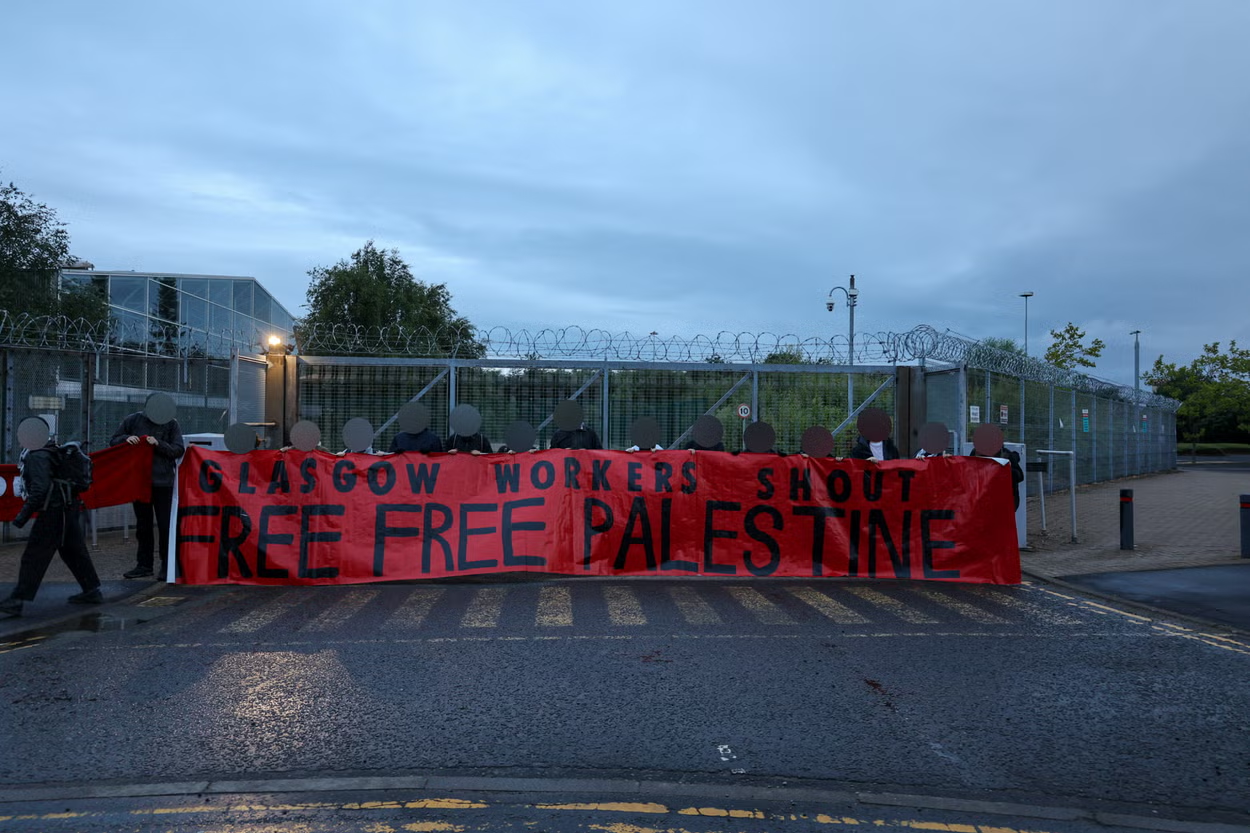
As warnings intensify over an unprecedented humanitarian catastrophe in the Gaza Strip due to siege and starvation, the U.S. administration has rushed to unveil a new aid distribution plan ahead of President Donald Trump’s visit to the Middle East.

Although the plan is presented under a humanitarian guise, it raises serious concerns about its true objectives—particularly as a private American organization, reportedly to be led by a figure close to Republican power centers, has been tasked with directly managing the aid effort in Gaza. This will operate under tight security oversight, independent of international institutions and Palestinian civil society.

At first glance, the initiative may appear to be Washington’s attempt to deflect Arab pressure and temper international outrage before Trump’s visit. However, a closer reading reveals that the plan is a continuation of earlier projects aimed at reshaping Gaza’s political and social landscape.

This effort is part of a shared U.S.-Israeli vision to impose an “alternative order” atop the ruins of the existing national framework, using aid as a tool of coercion and compliance in the context of a broader “day-after” strategy.

نون بوست

Washington’s Humanitarian Engineering in Gaza

The United States has announced the launch of a new “foundation” that will soon oversee the management and distribution of humanitarian aid in Gaza, though few details have been disclosed about the nature or mechanisms of the initiative.

According to press sources, the plan will unfold in two phases: the first targeting approximately 1.2 million residents, and the second covering the remaining one million—without a specific start date.

As presented by U.S. envoy Steve Witkoff at the United Nations, the plan will be administered by the newly established “Gaza Humanitarian Foundation” (GHF), likely to be headed by David Beasley, former executive director of the World Food Programme.

The blueprint outlines the creation of four distribution hubs, each intended to serve around 300,000 people. These operations will reportedly proceed without direct intervention from the Israeli military.

However, U.S. Ambassador to Israel Mike Huckabee stated at a press conference at the U.S. Embassy in Jerusalem that American private security firms will secure the distribution sites, while the Israeli army will provide military protection for the surrounding areas.

The centers are expected to distribute ready-to-eat food rations, hygiene supplies, and basic medical materials.

The 14-page plan stipulates that the foundation will be led by “experts with extensive experience in humanitarian operations and financial systems.”

Despite being marketed as a humanitarian initiative, the plan has been widely rejected by both international and local relief organizations, including UN agencies. Critics argue that it lacks effectiveness, violates core humanitarian principles, and could exacerbate forced displacement rather than provide real solutions to civilian suffering in Gaza.

In closed-door discussions at the UN, where Witkoff sought to rally broader international support for the plan, several ambassadors harshly criticized Israel, accusing it of deliberately using starvation as a weapon of war against Gaza’s population.

Israeli Plans in American Garb

The U.S. aid initiative cannot be seen in isolation from ongoing debates within the Israeli government over Gaza’s future—particularly in light of its persistent failure to achieve military objectives, more than 19 months into a campaign marked by extreme violence and destruction.

Elements of the U.S. plan revive earlier Israeli proposals developed by government and military circles aimed at dismantling Gaza’s social structure and installing cooperative local substitutes.

The current version appears to be an updated iteration of past Israeli schemes introduced during the early months of the war of extermination—ideas like “safe zones,” “humanitarian islands,” and “humanitarian bubbles” intended to confine Palestinians to tightly controlled areas administered by private security firms, with strict regulation of movement.

However, the failure of these approaches—due to the resilience of Gaza’s national fabric and the people’s refusal to capitulate or turn on their identity and resistance—has prompted a rethinking. From the Israeli perspective, the new American-led plan is a revised strategy pursuing the same objectives via different instruments.

By outsourcing the operation to a neutral-sounding American foundation and avoiding direct involvement by Israeli forces, the plan seeks to sidestep the acute sensitivities of Palestinian nationalism and social cohesion.

The hope is that this new actor will be more acceptable to locals and provoke less resistance than direct Israeli engagement.

The plan also resolves a heated internal Israeli debate over who should manage aid distribution. While the political leadership pressures the military to assume responsibility, the army staunchly resists, wary of the risks to its personnel and the implication of reestablishing formal military occupation.

Politically, the creation of a U.S.-branded institution bypassing existing UN agencies—most notably UNRWA—clearly aligns with the U.S.-Israeli effort to dismantle the organization, which remains a living witness to the Palestinian Nakba and a symbol of enduring historical rights in the global conscience.

Aid as a Tool for ‘Day-After’ Engineering

Control over humanitarian aid in Gaza is central to understanding Israel’s failure to dismantle the existing governmental structure or impose alternative political and social models.

Within Israeli military and political circles, a dominant narrative holds that Hamas’s continued control over aid distribution bolsters its social influence and reinforces its political legitimacy—either through direct management or alleged diversion of aid to support its organizational infrastructure.

Despite lacking concrete evidence, this narrative hinges on the desire to bypass and dismantle Palestinian national structures and civic networks, replacing them with a new apparatus aligned with Israeli interests. This vision lies at the heart of the U.S.-Israeli project to “engineer the day after” in Gaza.

Throughout months of war, all attempts to establish an alternative governance model have collided with the steadfastness of Gaza’s society, the unity of its political and religious factions, and public rejection of any framework aligned with occupation goals.

As these efforts failed, Israeli strategies grew more aggressive—chiefly the use of starvation as a form of social engineering to manipulate civilian behavior and impose predetermined political outcomes.

This approach echoes post-colonial theories, particularly “forced modernization,” which posit that when colonial powers cannot dominate through military force, they turn to softer forms of control—reshaping values, redefining survival as a conditional privilege, and distributing aid in ways that reinforce their political and security agendas.

In this context, Reuters has revealed the outlines of a U.S.-Israeli plan being developed in the White House concerning Gaza’s “day after.” Leaks suggest the possible establishment of a temporary transitional authority under direct U.S. oversight, potentially led by an American official, to govern the Strip until full disarmament is achieved and conditions are ripe for the emergence of a “new” Palestinian administration consistent with the post-war landscape.

According to those sources, no fixed timeline exists for this transitional government, leaving the door open for indefinite rule should Washington’s political and security conditions remain unmet.

In this light, the establishment of a U.S.-run aid agency—headed by a Republican closely tied to decision-making circles, conducting field-level interactions with the population and sorting them based on undisclosed criteria—appears to be a phased operational step toward creating the first administrative nucleus of the “alternative governance” model envisioned by the U.S. for Gaza’s future.

Expanding the War, Not Ending It

The U.S. rush to announce the new aid plan coincides with an escalating Israeli offensive. Recently, Israel’s security cabinet approved an aggressive new plan known as “Gideon’s Chariots,” aimed at reoccupying the Gaza Strip through a full-scale military invasion to obliterate what remains of life there.

In this context, Washington’s humanitarian rhetoric—emerging after months of siege and systematic starvation—does not mark a departure from escalation but rather an extension of it.

The plan underscores that the United States does not anticipate an imminent end to the war. The proposed negotiations are, at best, stalling tactics meant to buy time and obscure the real aim: maximizing strategic gains, particularly concerning the hostages, without offering a genuine path to ending the aggression.

This mirrors the Biden administration’s conduct ahead of the Rafah invasion, when it posed as a concerned mediator and floated the so-called “Biden Proposal” for a ceasefire, all while laying the groundwork for the controversial “temporary port” project off Gaza’s coast—meant to deflect criticism over Israeli control of the Rafah crossing.

In reality, the port project provided implicit U.S. cover for an invasion that has dragged on for over a year, with no Israeli withdrawal even during declared ceasefires.

By the same logic, the new U.S. aid initiative aligns explicitly with Israeli goals to expand the war and underscores Washington’s complicity—both politically and operationally—while shielding itself from the moral backlash of supporting a campaign of destruction.

Direct U.S. management of aid, circumventing international bodies and Palestinian civil society, creates space for implementing Israeli plans to dismantle Gaza’s geographic and demographic structure.

This includes forcing civilians into designated aid centers that could gradually become closed camps—or, as Israeli media has described them, massive “humanitarian prisons.”

The declared intent to turn Rafah into the largest of these camps is a chilling indicator of this dangerous trajectory.

Thus, despite its humanitarian packaging, the U.S. plan structurally extends the war against the Palestinian people in Gaza.

It functions as a strategic tool to entrench displacement and destruction, advancing the vision long championed by President Donald Trump and still invoked in Israeli circles as a framework for ending the war through the depopulation of Gaza.

TAGGED: In Depth
Download this article as PDF
Share this Article
Facebook Twitter Whatsapp Whatsapp Telegram Email Copy Link
أحمد الطناني
By Ahmad Tanani Political Writer and Researcher
Follow:
Writer and researcher in political affairs
Previous Article نون بوست From Campus to Border: Trump’s Vision of a White and Loyal America
Next Article نون بوست “Palestinian Tales”: A Personal Archive to Safeguard Collective Memory – An Interview with Initiative Founder Samar Dwidar

Read More

  • How Is Turkish Military Technology Redrawing the Balance of Power in North Africa? How Is Turkish Military Technology Redrawing the Balance of Power in North Africa?
  • "Arad".. Why Did the Occupation Create an All-Female Force to Protect Its Air Bases?
  • Kalashnikovs in the Squares.. How Is Iran Mobilizing Civilians for War?
  • A Digital Artery in a Minefield.. What Do We Know About Gulf Cables Beneath Hormuz?
  • Why Washington Is Betting on Eritrea After Hormuz and the Red Sea Crisis
part of the design
NoonPost Weekly Newsletter

You May Also Like

Why Washington Is Betting on Eritrea After Hormuz and the Red Sea Crisis

Why Washington Is Betting on Eritrea After Hormuz and the Red Sea Crisis

محمد مصطفى جامع Mohamed Gamie 20 May ,2026
“Aviation Diplomacy”: The Bet That Paid Off Economically but Collided Politically

“Aviation Diplomacy”: The Bet That Paid Off Economically but Collided Politically

محمد عادل Muhammed Adel 20 May ,2026
15 Years After the Revolution: How Has Syrians’ Political Consciousness Changed?

15 Years After the Revolution: How Has Syrians’ Political Consciousness Changed?

فريق التحرير Noon Post 16 March ,2026
NoonPost

An independent media platform founded in 2013, rooted in slow journalism, producing in-depth reports, analysis, and multimedia content to offer deeper perspectives on the news, led by a diverse young team from several Arab countries.

  • Politics
  • Society
  • Economy
  • Culture
  • Interviews
  • In Depth
  • Explainers
  • Stories
  • Profiles
  • Focus
  • Latest Reports
  • Long Reads
  • Interviews
  • Interactive
  • About Us
  • Our Writers
  • Write for Us
  • Editorial Policy
  • Advanced Search
Some rights reserved under a Creative Commons license

Removed from favorites

Undo
Go to mobile version