













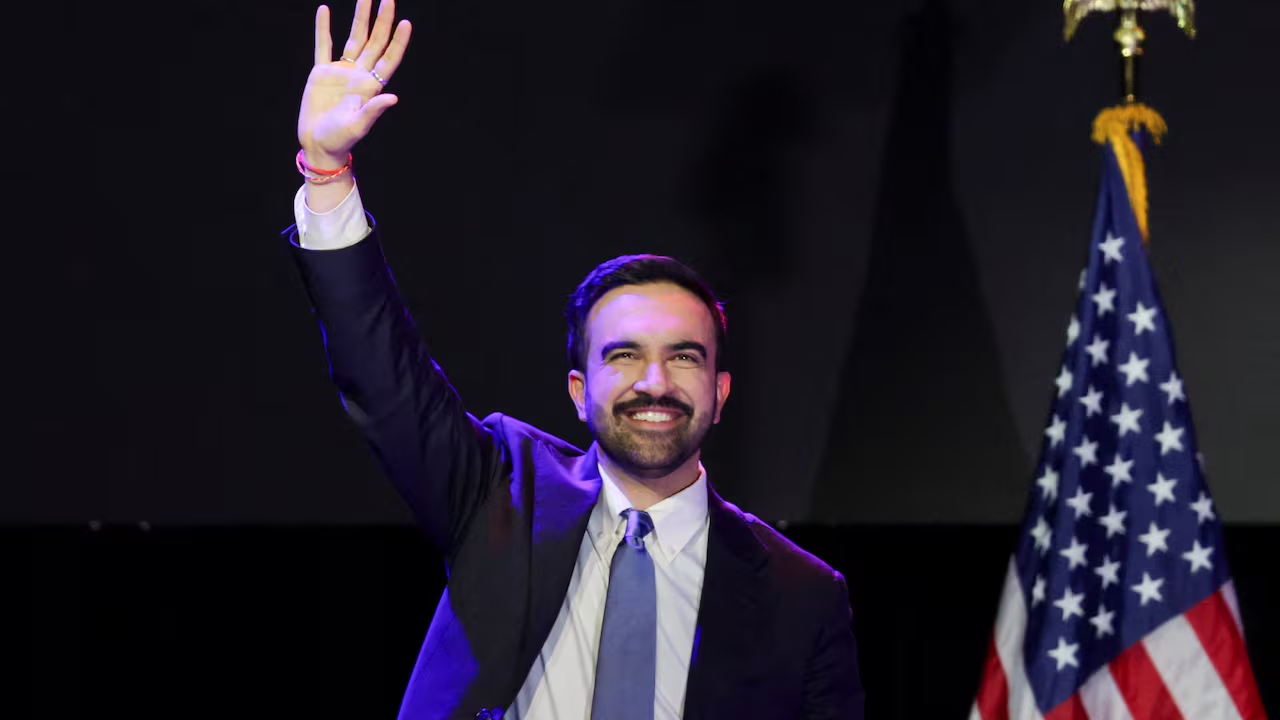
In a historic political shift that redrew the contours of one of the world’s most diverse cities, Zohran Mamdani an American politician of Ugandan and Indian descent was elected Mayor of New York City on November 5, 2025. With this victory, Mamdani becomes the first Muslim to hold the office in the city’s history and emerges as one of the most prominent rising figures within America’s progressive left.
Beyond the immediate electoral implications, his win carries profound symbolism in the broader American landscape. It marks a triumph for a multi-rooted identity in a city long regarded as a mirror of the immigrant experience and an arena of persistent racial, religious, and power-related tensions.
Born in Uganda to Indian-origin parents, Mamdani migrated to the United States during childhood. His political trajectory embodies the very intersectionality that defines the new American reality: a brown, South Asian Muslim socialist who launched his campaign in a city that has served as a hub of American political discourse since the 9/11 attacks.
His victory must be understood in this context a reflection of a shifting national mood, driven by a new generation of voters rejecting traditional political narratives and rewarding candor over compromise.
Identity as a Bridge to Power
Mamdani’s victory represents more than just a first for Muslims in New York it’s a resounding statement from an identity that defies the archetypes shaping American consciousness for decades. Born in Uganda, raised in working-class Queens, and molded by the lived experience of Islam, Blackness, and immigration, Mamdani embodies three historically marginalized spheres in public American life.
His election doesn’t merely reflect a growing openness to religious diversity; it redefines the idea of who is entitled to lead a city that serves as the face of the United States to the world.
It’s an achievement made more significant by timing and context. As the US drifts toward a more conservative, isolationist posture driven by a recharged Trumpian discourse Mamdani’s win serves as a symbolic act of resistance.
It challenges the hard-set boundaries of national belonging and compels both media and politics to reexamine an overdue question: Who counts as a “real American,” and who remains excluded?
When certain media outlets revived controversy over his racial self-identification on college applications, Mamdani offered a response far more powerful than any press release: “I answered through the ballot box, not administrative checkboxes.”
Yet his strength wasn’t rooted solely in identity politics. Mamdani translated his multiplicity into a political coalition. His campaign spoke the language of the city itself multilingual, multicultural, and united under a single progressive umbrella that brought together Africans, South Asians, Arabs, Muslims, Latinos, and youth.
It was a civic movement built on social justice and economic accountability bigger than identity politics, yet never dismissive of them.
Unflinching Honesty
Mamdani’s win also represents the triumph of a rare political style in America one grounded in authenticity rather than alliances or donor backing. A candidate with Afro-Asian immigrant roots who spoke the language of working-class Queens, Mamdani ran a campaign defined by radical honesty, both domestically and internationally. His candidness became a political asset, drawing supporters who valued principled clarity over scripted ambiguity.
This bold identity was most apparent in his stance on sensitive issues long tiptoed around in New York politics. In a city home to powerful pro-Israel lobbies, Mamdani broke electoral norms by labeling Israel’s actions in Gaza as “genocide” and describing the West Bank as an “apartheid system.”
He rejected what he called “loyalty tests” requiring candidates to express unconditional support for Tel Aviv, instead taking a singular principled stand: equal rights for Palestinians and Israelis.
In past elections, such a position would have been a political death sentence in New York. But Mamdani’s victory signals a seismic shift in public sentiment. The Jewish Telegraphic Agency called his win “a rupture in New York’s historic foreign policy consensus,” while The New York Post found that a majority of Democrats under 40 now support holding Israel accountable and reject American double standards.
When major Jewish organizations accused him of antisemitism over his views on Gaza and national media mounted coordinated attacks, Mamdani stood firm. He refused to soften his tone, responding with a slogan that became one of the most viral clips from his campaign: “Truth does not need permission.”
It was not just a defiant message but a portrait of the new American politician one who refuses to apologize for his values or trade them for media favor or financial support.
His fearlessness wasn’t limited to foreign policy. Domestically, Mamdani confronted New York’s financial elite head-on, advocating for rent freezes, progressive taxation on the wealthy, and free public transit. “Social justice,” he declared, “is not a luxury it’s national security.”
This language combining moral clarity with urban pragmatism led The Guardian to call him the first mayor with the democratic legitimacy to challenge Wall Street from within the ballot box.
A New Political Base
Though official post-election data is still pending, pre-election polling suggested Mamdani’s win was not the product of identity-driven bloc voting, but rather the reshaping of the electoral map around three intersecting constituencies: youth, immigrants, and the working class.
A Quinnipiac University poll (Oct. 23–27) showed Mamdani leading citywide but trailing among Jewish voters, who leaned toward rival Andrew Cuomo. A Marist poll a week before the election revealed divisions within the Jewish electorate, showing no uniform bloc but rather generational and ideological splits.
These divisions signal a deeper transformation in New York’s political life. For decades, Jewish voters especially older, middle-class whites were a linchpin of the “safe consensus”: support for pro-Israel candidates, financial elites, and centrism. Mamdani’s victory even with open criticism of Israeli policy shows that consensus no longer dominates and that Jewish voters are no longer a monolith.
If this shift defined Manhattan’s center, Mamdani’s broader coalition flourished at the city’s edges, gaining strong support from Black and immigrant voters demographics known for their grounded political realism. While precise data is pending, early analyses suggest Mamdani performed well in African- and Latino-majority neighborhoods, especially among renters, workers, and those in underserved areas.
New York Has Chosen
In the early 2000s, New York became a global symbol of post-9/11 suspicion toward Muslims. During that era, the NYPD created a “Demographics Unit” to surveil mosques, cafés, and Islamic centers an openly acknowledged attempt to “prevent radicalization.”
Later investigations by the Associated Press revealed that the unit produced no terror-related intelligence, yet sowed deep fear among thousands of ordinary Muslims from students to shop owners.
Against that backdrop, Mamdani’s election delivers a diametrically opposed message: Muslims in New York are no longer watched they are stakeholders in governance. His win builds on a trajectory that began in 2015 when the city officially added Eid al-Fitr and Eid al-Adha to its public school calendar, a symbolic step toward acknowledging Islam’s place in civic life.
In this sense, his election represents a long-delayed civic maturity a city moving from suspicion to pluralism. The Muslim is no longer the “other” in a security equation, but a full subject in the equation of citizenship. It’s a symbolic shift difficult to overstate in a country where Islam was long associated with terror.
The symbolism of Mamdani’s win extends well beyond New York’s five boroughs. The office of mayor is not just a local post it’s a national political springboard. And with a Muslim, Afro-Asian immigrant now holding that post, the archetype of the “typical New Yorker” once imagined as a white, middle-class male is being reshaped to include the multilingual son of immigrants who wears his roots as an asset, not a burden.
Ultimately, Mamdani’s election marks a loud backlash to the politics of fear that has dominated American discourse for over two decades. Campaigns that sought to vilify him as “antisemitic” ended up validating him. In a poetic twist, the birthplace of Islamophobia has chosen a Muslim who never once compromised his values.
This moment might very well signal the start of a new chapter in American municipal politics one where credibility and community representation matter more than allegiance to oligarchic or Zionist power.


