






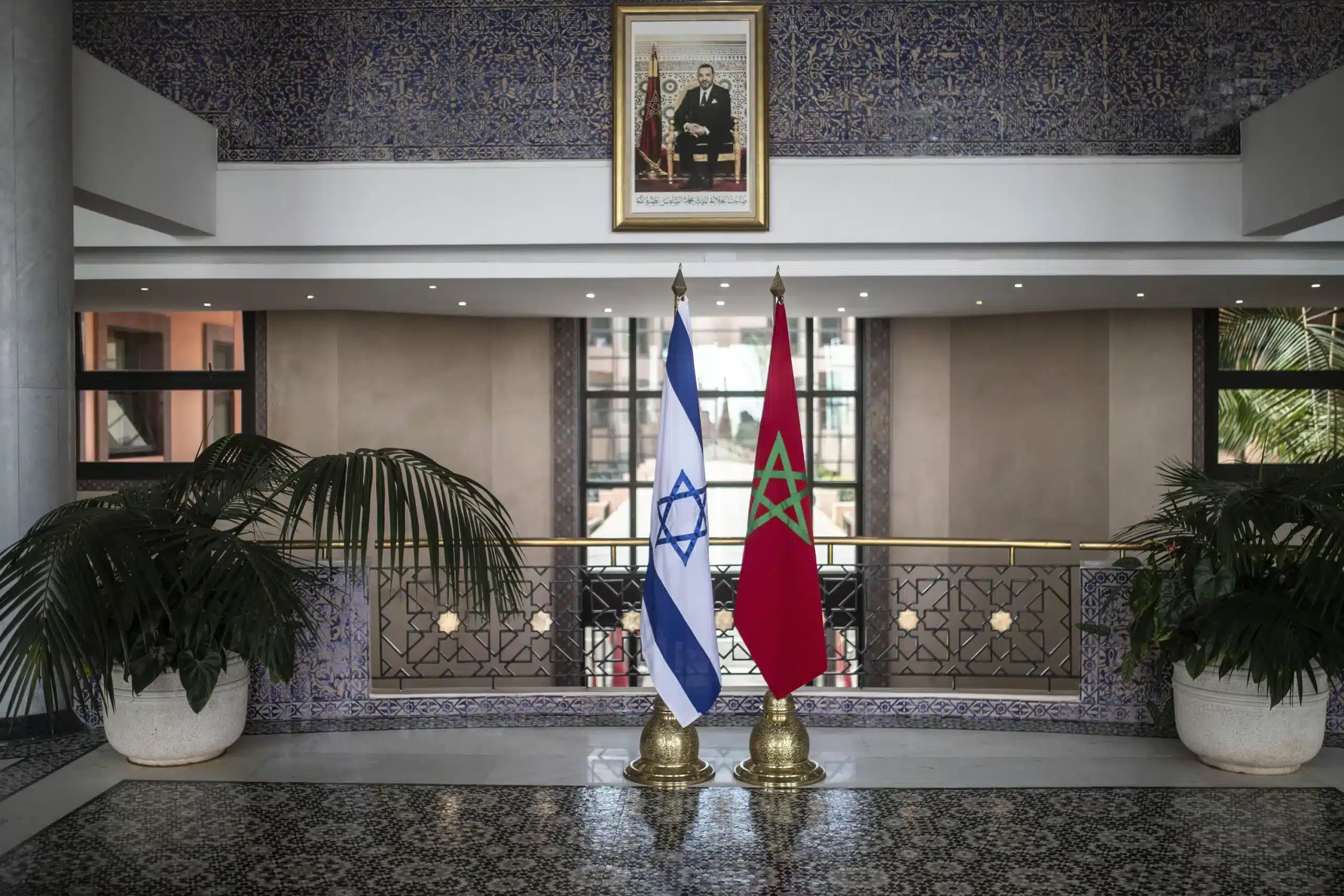
Israeli interests in Morocco are intertwined through a network of arms deals, factories, joint ventures and investments. Over the past six years, these ties have expanded from military and intelligence cooperation into agriculture, water and energy, including oil and gas exploration off the Atlantic coast. Israeli companies have also moved into local manufacturing, technology transfer and partnerships with Moroccan business groups whose operations and interests extend beyond the kingdom.
This expansion has continued despite Israel’s assault on Gaza and growing Moroccan protests against normalisation, culminating in the opening of the Israeli Ministry of Defence’s first official pavilion at the Marrakech Air Show on 8 October 2026. Eight Israeli defence companies took part, including Elbit Systems, Rafael and Israel Aerospace Industries (IAI).
The move came weeks after Rabat and Tel Aviv agreed, under US auspices, to raise diplomatic representation to ambassadorial level, while working on agreements to facilitate investment and trade. The significance of these projects extends beyond the size of the Moroccan market, given the kingdom’s location between Europe, West Africa and the Atlantic Ocean, as well as its ports, industrial zones and international trade agreements.
These advantages have led Israeli researchers to propose Morocco as a potential hub for Israeli trade and manufacturing serving African and European markets. This vision is beginning to take shape in the plans of companies already operating in the kingdom, which are seeking to expand production and export to overseas markets.
Israel’s Growing Foothold in Morocco
The political foundations of this expansion date back to 22 December 2020, when Morocco, Israel and the US signed a tripartite declaration to resume diplomatic relations. This coincided with US President Donald Trump’s administration recognising Moroccan sovereignty over Western Sahara.
In July 2021, the two sides signed a cybersecurity cooperation agreement covering the exchange of information and expertise, as well as research and development. On 24 November that year, Rabat hosted the signing of the first memorandum of understanding on military cooperation. The memorandum was signed during a visit by Israel’s then defence minister, Benny Gantz, who met Abdellatif Loudiyi, Morocco’s minister-delegate in charge of national defence administration. The agreement paved the way for intelligence cooperation, training, arms purchases and the development of military industries.
Data published by the Stockholm International Peace Research Institute (SIPRI) in March 2026 showed the extent of the shift in Morocco’s arms procurement. Israel became Morocco’s second-largest supplier of major arms in 2021–2025, accounting for 24 per cent of imports, compared with 60 per cent for the US and 10 per cent for France.
Israel’s share had stood at 11 per cent in 2020–2024. Meanwhile, Morocco’s total imports of major arms rose by 12 per cent compared with 2016–2020, making it Africa’s largest arms importer. Moroccan purchases included the Barak MX air defence system, manufactured by Israel Aerospace Industries, which specialises in aviation, missile and satellite systems. The deal was valued at an estimated $500m. Military cooperation has also covered artillery systems, drones, reconnaissance and electronic warfare.
In July 2024, Israel Aerospace Industries announced a $1bn contract to be implemented over five years. Moroccan reports linked the deal to the supply of an Ofek 13 reconnaissance satellite to the kingdom, although the Israeli company did not identify the client in its financial disclosure. Cooperation has also expanded into manufacturing through Moroccan Military Industry (MMI), a Moroccan company that produces weapons systems and ammunition and maintains technological and commercial ties with Elbit Systems, one of Israel’s largest defence companies.
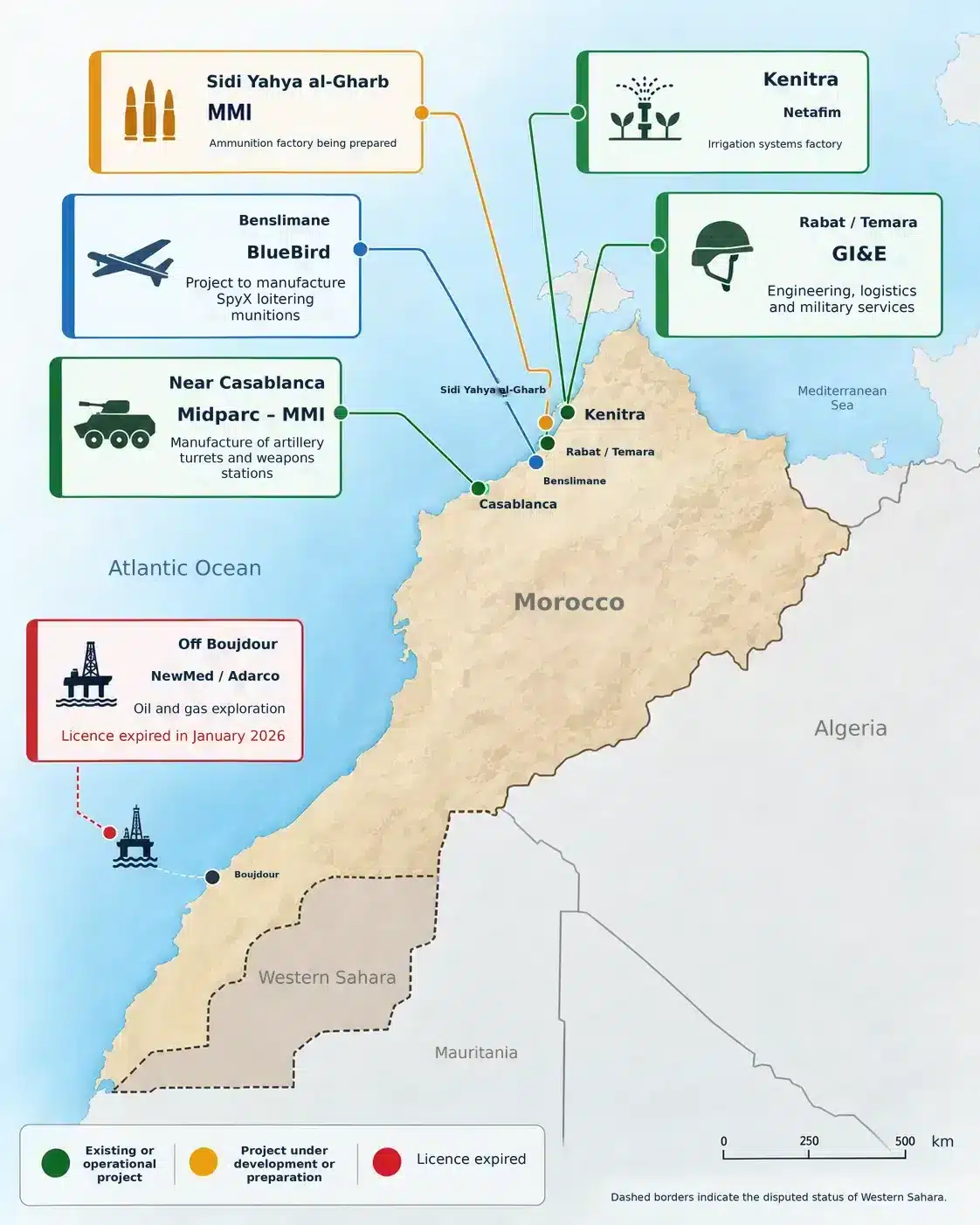
On 8 October 2026, Uri Naor, managing director of MMI Weapon Systems, told Moroccan business news outlet Medias24 that the company operates a facility in the Midparc industrial zone near Casablanca. It specialises in engineering, manufacturing and the complete assembly of armoured vehicle turrets and remotely operated weapon stations.
A second factory is being prepared in Sidi Yahya El Gharb to produce 155mm artillery shells and 30mm ammunition. The company is working to install 30mm weapon turrets on eight-wheeled WhAP armoured vehicles manufactured in Morocco by India’s Tata Advanced Systems. It is also involved in a programme to upgrade the Moroccan army’s M113 armoured personnel carriers with the UT30 turret, developed using Elbit technology.
Naor said the company had completed field and live-fire tests of the upgraded vehicle prototype. It is also developing counter-drone systems using 30mm ammunition equipped with radar sensors and tungsten fragments, and plans to manufacture 120mm self-propelled mortar systems. He set March 2027 as the target for the first deliveries of armoured vehicle turrets to the Moroccan army. At the time of the interview, the ammunition factory was still being prepared.
Behind these projects is a network of Moroccan and Israeli shareholders. An investigation published by Moroccan news outlet Le Desk on 8 October 2026 revealed Elbit’s involvement in the ownership structures of companies associated with MMI’s factories. These structures also included a holding company linked to businessman Yariv Elbaz, owner of food-processing group Forafric.
The investigation also identified preparations for a third company specialising in military communications systems. In June 2023, Shai Cohen, the former head of Israel’s liaison office in Rabat, had announced Elbit’s plans to establish two factories in Morocco.
Manufacturing projects have also extended to drones through BlueBird Aero Systems, a subsidiary of Israel Aerospace Industries. The company is working to establish a production line for SpyX explosive drones in Benslimane, near Casablanca.
In November 2025, Moroccan and Israeli reports revealed that Moroccan technicians were being trained at the Israeli company’s facilities in preparation for local production. Other reports said the project was inaugurated that month, although Morocco had issued no official confirmation that operations had begun.
The project is proceeding alongside Morocco’s efforts to develop a domestic drone industry through other partnerships, including cooperation with Turkish company Baykar. In technology and engineering services, GI&E Technology Services was established as a Rabat-based joint venture between Israeli company Eltel Technologistics and Moroccan company Gilia Holding, each with a 50 per cent stake.
Eltel itself is jointly owned by Israel’s Malam Team group and Elta Systems, a subsidiary of Israel Aerospace Industries. This ownership chain links the Moroccan venture to one of Israel’s largest defence companies. The joint venture provides engineering, maintenance, logistical support, training and technological systems for the civilian and military sectors. Czech truck and vehicle manufacturer Tatra Trucks lists it among its authorised service centres in Temara, near Rabat.
On 22 May 2023, the private International University of Rabat also signed an agreement with Israel Aerospace Industries to establish a centre of excellence in aviation and artificial intelligence. The agreement covers applied research, knowledge transfer and the development of technical skills. In the civilian sector, Netafim, which specialises in precision irrigation and agricultural management technologies, opened a factory in Kenitra in early March 2023. It was the company’s first production facility in North Africa and was expected to create around 200 jobs.
The company originated in Israel, but Mexico’s Orbia group owns 80 per cent of its shares, while the Israeli kibbutz of Hatzerim holds the remaining 20 per cent. Gal Yarden, the company’s then vice-president for Europe, the Middle East and Africa, said the factory would enable Netafim to serve farmers in Morocco and North Africa, benefiting from its location in one of the kingdom’s main agricultural regions.
Earlier, Israel’s state-owned water company Mekorot had entered into cooperation with Morocco through a memorandum of understanding signed on 17 November 2022. The signatories were Mekorot’s then chairman, Yitzhak Aharonovitch, and Abderrahim El Hafidi, director-general of Morocco’s National Office of Electricity and Drinking Water.
The agreement covers seawater desalination, improved facility management, the development of geographic information systems, water quality, the reuse of treated wastewater, and research and development. El Hafidi said the cooperation would allow Morocco to benefit from Israeli expertise in managing water resources and tackling drought through the exchange of technology and experience between the two institutions.
Renewable energy has emerged as another area of Israeli investment. Marom Energy, part of Israel’s Gandyr investment group, became a partner in Moroccan company Gaia Energy, founded by Moroccan businessman Moncef Znidbar. On 24 February 2022, the two sides signed an agreement under which the Israeli company became a minority shareholder in Gaia. They announced planned investments of 13bn Moroccan dirhams over two years, covering solar and wind power, green hydrogen and electricity exports.
Znidbar explained that the investments included contributions from the partners and anticipated bank financing, which could cover 75 per cent of project costs. International law firm DLA Piper, which advised on the transaction, described the investment as the largest of its kind involving private Israeli capital in Morocco since the resumption of relations.
Marom’s portfolio includes 785 megawatts of wind power projects under development in Morocco, alongside solar power projects. On its green hydrogen webpage, the company says it is developing projects with Gaia in Morocco with a combined capacity exceeding 11 gigawatts.
Gaia operates in nine African countries and has a solar and wind power project portfolio exceeding five gigawatts, according to figures announced by the two companies when they signed the agreement. Delivering the planned investments and capacity, however, remains dependent on development, financing and licensing.
Israeli involvement has also extended to oil and gas exploration in Atlantic waters off Western Sahara. NewMed Energy, which is associated with Israel’s Delek Group, signed an exploration agreement in late 2022 covering the Atlantic Boujdour area, in partnership with Adarco Energy and Morocco’s National Office of Hydrocarbons and Mines.
Under the agreement, NewMed and Adarco each obtained a 37.5 per cent stake, while the Moroccan institution retained 25 per cent. The exploration area covers approximately 33,800 square kilometres. The work includes surveys and geological studies, with the possibility of proceeding to drilling once technical and legal requirements are met.
A disclosure submitted by NewMed to the Israel Securities Authority and the Tel Aviv Stock Exchange on 6 December 2022 identified Yariv Elbaz and members of his family as the ultimate beneficial owners of Adarco’s shares. Elbaz is the same businessman named in Le Desk’s investigation into shareholders in military manufacturing facilities linked to Elbit.
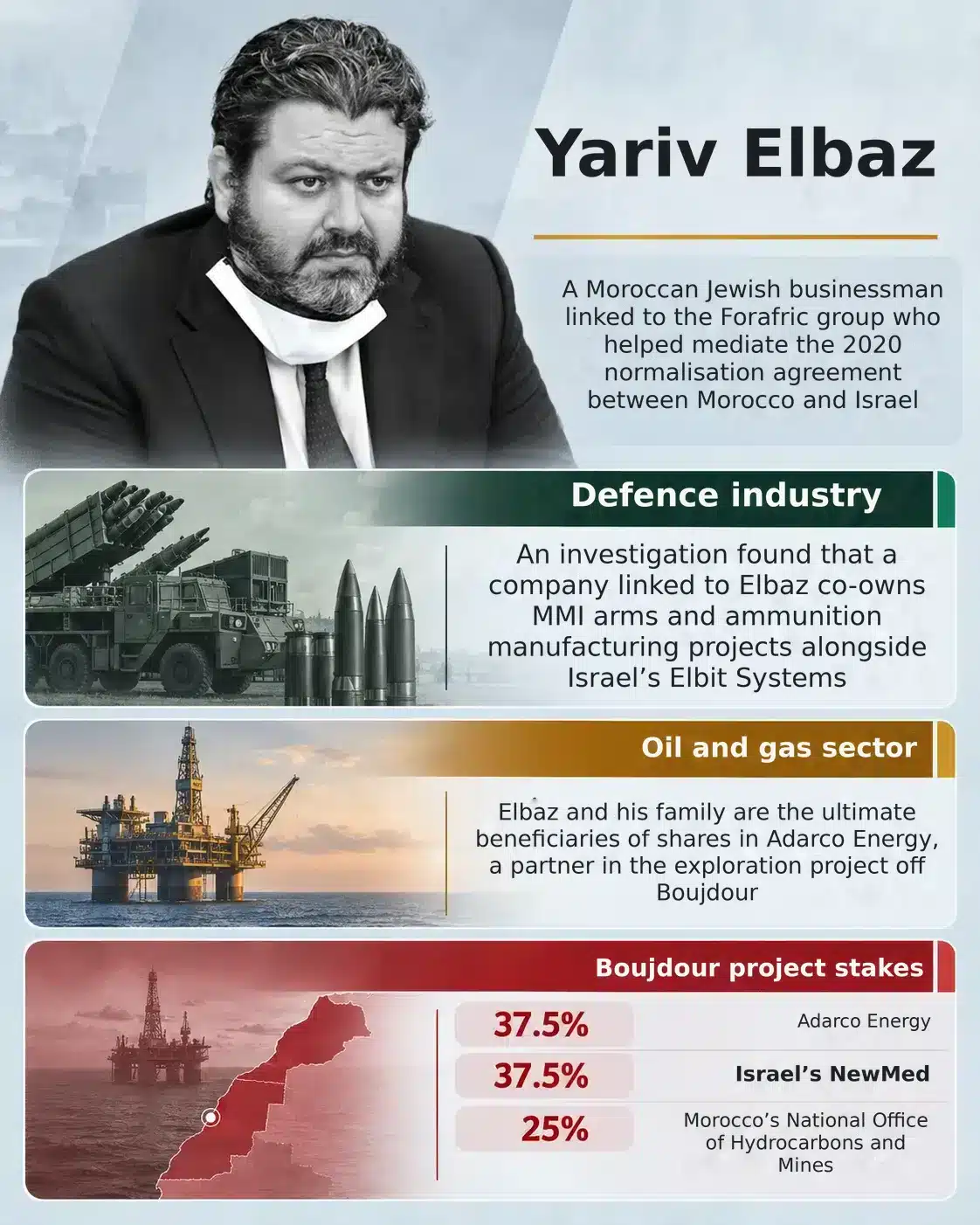
The disclosure links Elbaz’s interests to an energy project led by an Israeli company, alongside his stake in military manufacturing projects identified by the Moroccan investigation. His interests span both military manufacturing and the exploration venture off Boujdour, although the partners and ownership structures differ between the two sectors.
NewMed’s financial statements for 2025 indicate that the Boujdour licence expired on 31 January 2026 and that the partners were negotiating with Morocco’s energy ministry to extend it by a year. Approximately $6.1m had been allocated for work in 2025–2026. Morocco’s Ministry of Energy Transition lists the project among activities involving seismic data processing and the assessment of geological potential. Israeli company Ratio Petroleum had previously conducted exploration off Dakhla before its permit expired. Neither project has reported commercial production.
Trade data published by Israel’s Central Bureau of Statistics on 20 July 2026 showed that recorded merchandise trade, measured on a customs-clearance basis, reached $105.5m in the first half of the year, up 69.6 per cent from the same period in 2025.
This included $94m in Israeli exports to Morocco and $11.5m in Moroccan exports to Israel. However, the bureau’s country-of-origin data put the value of Moroccan goods entering the Israeli market at $44.6m, bringing total trade under this measure to approximately $138.4m, an increase of 34 per cent. The difference between the two statistical measures points to Moroccan goods being invoiced through intermediary countries.
At the Marrakech Air Show in October 2026, Israel’s International Defence Cooperation Directorate, known as SIBAT, presented drone technologies, explosive drones, robotics, satellite communications and artificial intelligence. Participating companies included UVision, XTEND and Orbit, alongside major defence groups.
The directorate’s head, Yair Kulas, described the participation as a milestone in expanding military cooperation and building long-term partnerships. On 8 October, the Israeli defence ministry said increased arms exports were a means of strengthening the occupation army’s capabilities and serving Israel’s foreign policy and economy.
The Interests and Limits
The Moshe Dayan Center for Middle Eastern and African Studies at Tel Aviv University has proposed expanding economic relations with Morocco by using its Atlantic location and industrial and commercial networks to reach African and European markets.
In a study published on 26 February 2026, the centre argued that Morocco could serve as a hub for Israeli trade with West Africa, North Africa, south-western Europe and the South Atlantic. It estimated that multilateral cooperation could eventually develop into a trade corridor worth billions of dollars.
The centre linked these opportunities to the expansion of Morocco’s ports and industrial capabilities, highlighting clean energy, water, agriculture, technology and healthcare services. It estimated civilian trade between Morocco and Israel at around $180m in 2024. It argued that developing joint projects and using Rabat’s trade relationships with Europe and Africa offered a way to expand economic cooperation amid the region’s security and economic challenges.
The plans of companies operating in Morocco offer an early indication of how this vision might be put into practice. On 8 October 2026, Uri Naor, managing director of MMI Weapon Systems, said the company intended to use Morocco as a base for exporting military equipment. He also discussed plans to export its products to a European member state of the North Atlantic Treaty Organization (Nato), without identifying the country or disclosing the size of the orders or the delivery schedule.
Agricultural, energy and engineering services projects involving Israeli companies are also targeting African markets, drawing on Moroccan partners and their business networks across the region. This expansion rests on Morocco’s existing industrial base. On 8 October 2026, Mohamed Bellatki, president of the Moroccan Aerospace Industries Association, said the sector comprised around 160 companies employing approximately 25,000 people.
It generated exports worth around $3bn in 2025, with projections that this figure could reach $5bn within three years. He explained that companies operating in the kingdom were moving towards manufacturing more complex systems, including engines and aircraft landing gear, benefiting from suppliers serving global groups such as Airbus, Boeing and Safran. This is taking place alongside the expansion of military and industrial cooperation with French, Turkish, Indian and US companies.
Ports are central to this network, particularly Tanger Med, on the Strait of Gibraltar. The port handled approximately 11.1 million twenty-foot equivalent units (TEUs) in 2025 and is connected to an extensive network of ports across Europe, the Americas, Asia and Africa.
Industrial and logistics zones, road networks and railways surround the port, enabling companies operating in Morocco to reach foreign markets through international supply chains. The port also has regular shipping services to numerous African ports.
Israeli shipping company ZIM, founded in 1945 and providing international container transport services, has a direct presence in the maritime network linked to Tanger Med. On 28 October 2024, the company announced a restructuring of its transatlantic routes, effective from February 2025. This included the ZCT service, linking Turkish and Italian ports with Tanger Med before continuing to New York, Norfolk, Savannah and Port Everglades in the US.
The route connects, via the Italian port of Livorno, with another service that passes through the Israeli ports of Ashdod and Haifa. This links the company’s Mediterranean network with its Atlantic services. Tanger Med’s 2025 maritime connectivity guide lists ZIM among the shipping companies using the port. Its container terminals are operated by international groups, including APM Terminals, Eurogate and Tanger Alliance.
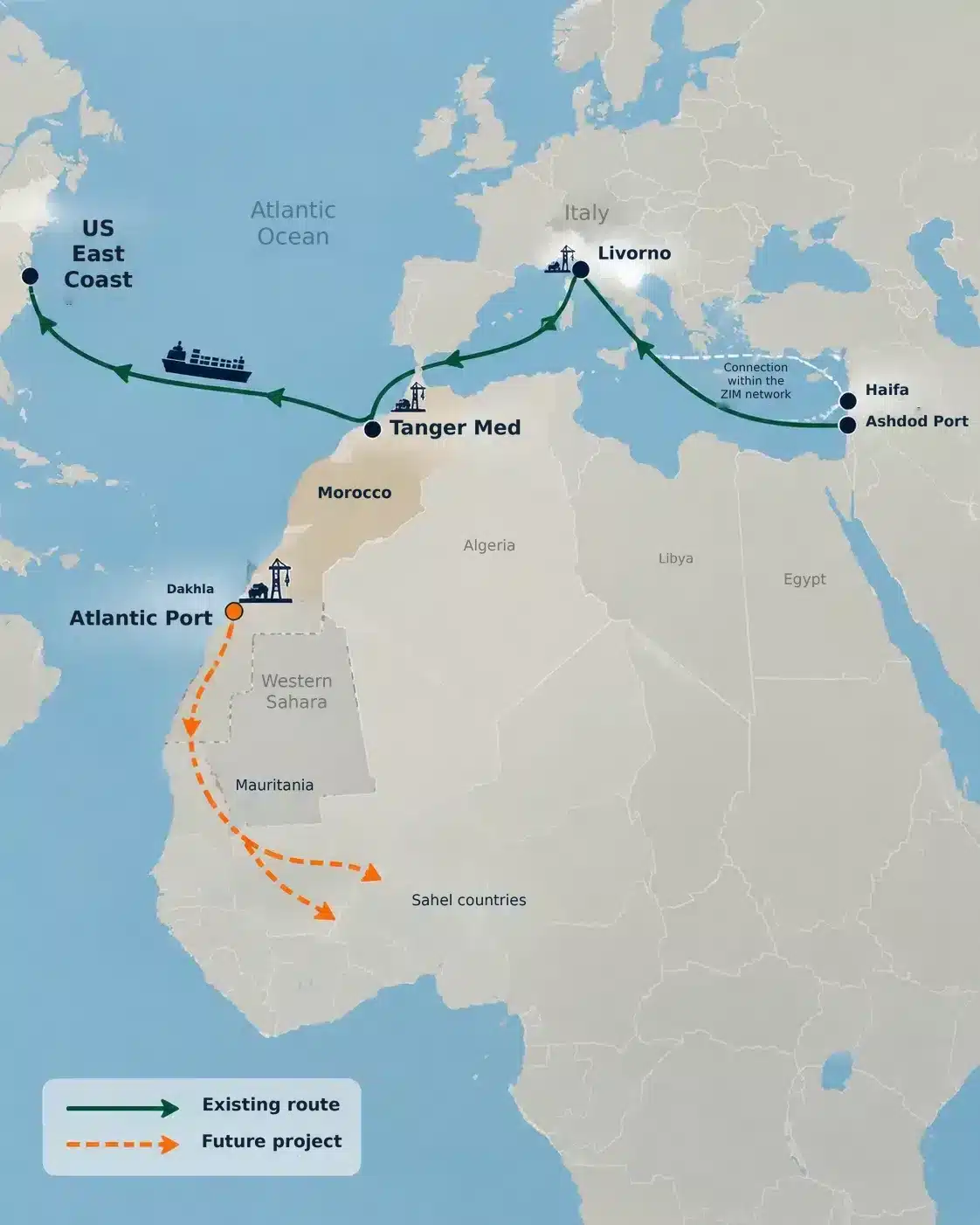
On the Atlantic coast, Rabat is banking on the Dakhla Atlantic Port project in Western Sahara, which is expected to cost around $1bn and is linked to industrial and logistics zones, renewable energy projects and green hydrogen. On 12 July 2026, a source at Morocco’s Ministry of Equipment and Water told Medias24 that the project was approximately 65 per cent complete. The target is to complete construction by the end of 2028, with operations expected to begin in 2029.
The port is expected to handle raw materials and goods from Sahel countries as part of Morocco’s initiative to provide landlocked African countries with access to the Atlantic. In a study published on 5 February 2026, the Rabat-based Policy Center for the New South linked the success of the Atlantic initiative to Dakhla port’s ability to offer competitive maritime services, develop transit routes through Mauritania and generate economic demand among Sahel countries.
Researchers Amine Guelidi and Reda Lyammouri explained that Mauritania was a pivotal link in the corridor. Transport costs, security disruptions and political complexities would affect its economic viability. Foreign companies’ ability to benefit from the project would therefore depend on infrastructure development, transit agreements and regional stability.
Israeli interest also extends to Morocco’s trade agreements, particularly those with the US and the European Union. This was evident during a visit to Rabat in February 2022 by Israel’s then economy and industry minister, Orna Barbivai.
She and Morocco’s industry and trade minister, Ryad Mezzour, agreed to develop industrial and commercial cooperation and work towards establishing qualified industrial zones that could facilitate trilateral production partnerships with the US.
The understanding covered the automotive, aviation, textile, pharmaceutical, water and renewable energy sectors, with the aim of facilitating access to the US market for products manufactured in these zones.
The proposed trilateral industrial zones had not progressed beyond announced understandings. The US Department of Commerce lists Egypt and Jordan among the countries benefiting from the Qualified Industrial Zones (QIZ) programme, which grants customs privileges to products meeting specified requirements for Israeli components.
Morocco has a separate free trade agreement with the US, subject to its own rules of origin. Whether products manufactured using Israeli technology qualify for US trade preferences therefore depends on the proportion of local manufacturing, the components used and the legal requirements of each agreement. Western Sahara presents further legal complications for investments linked to the Atlantic coast. On 4 October 2024, the Court of Justice of the European Union ruled that the Sahrawi people’s right to self-determination and their consent to agreements concerning the territory’s resources must be respected.
In October 2025, the European Union and Morocco concluded a new trade arrangement, applied provisionally from 4 October that year. It allows products originating in Western Sahara to continue benefiting from trade preferences under new rules for determining origin, including references to production areas. Legal and political disputes over the treatment of the territory’s resources have nevertheless continued.
These complications have also affected the Israeli energy project in Boujdour. On 18 December 2023, Norway’s central bank excluded Israel’s Delek Group from Oslo’s sovereign wealth fund investments, following a recommendation by the independent Council on Ethics. The council’s members are appointed by Norway’s Ministry of Finance and are responsible for assessing the fund’s investments.
The council considered the group’s involvement in exploration off Western Sahara to pose a risk of contributing to serious violations of ethical standards, given the territory’s status and its people’s rights over their natural resources. Israeli projects in the area consequently face legal and financial risks arising from the positions taken by international investment institutions.
Politically, the partnership is tied to the gains Rabat has secured over Western Sahara. Washington recognised Moroccan sovereignty over the territory in late 2020. In July 2023, Israeli Prime Minister Benjamin Netanyahu announced that his government recognised Morocco’s position.
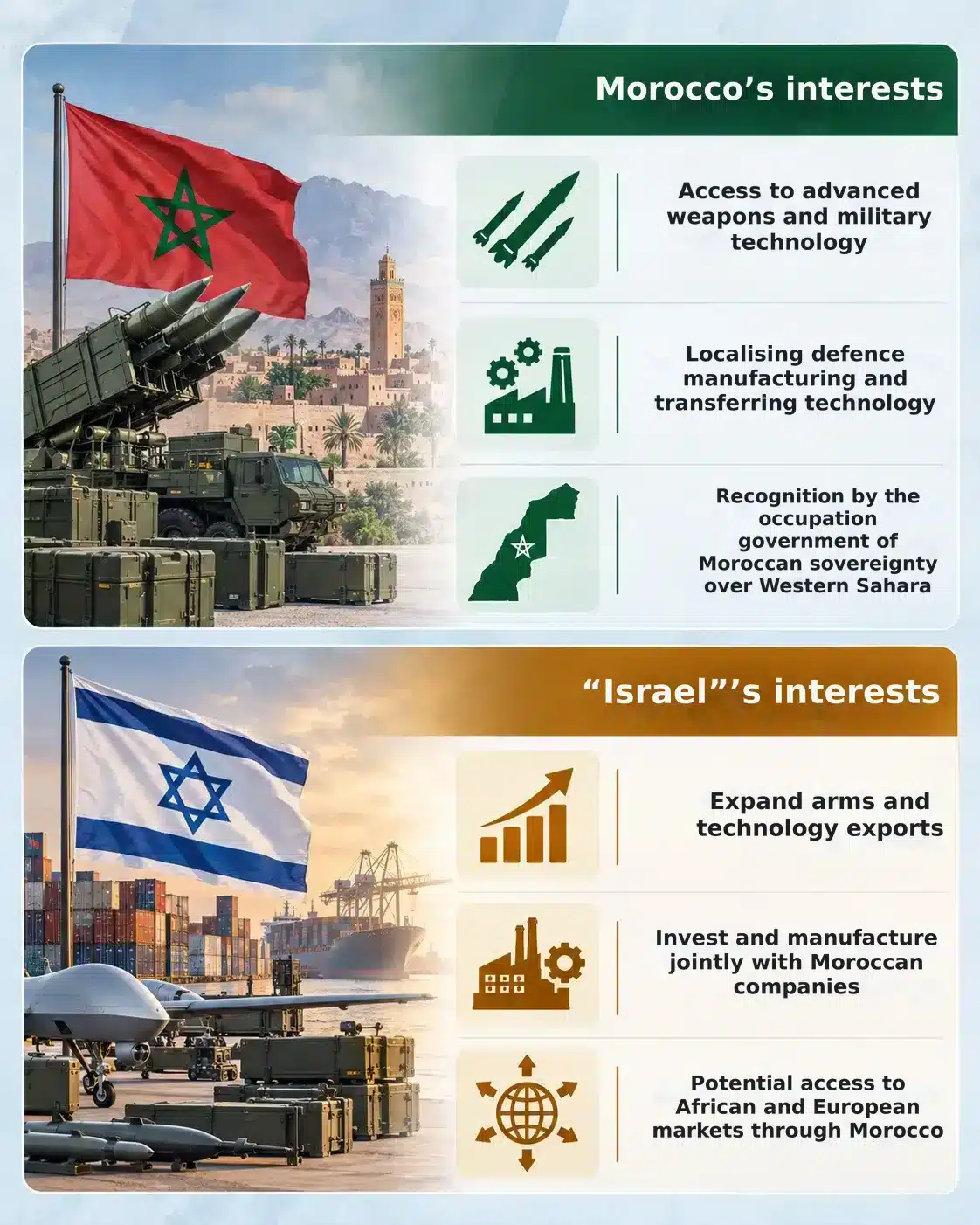
In a study published in late 2022, the Middle East Institute in Washington argued that rapprochement had given Morocco broader access to Israeli military technology and strengthened the deterrent capabilities Rabat seeks to develop in its confrontation with the Polisario Front and its competition with Algeria. For Israel, the relationship offered an opportunity to expand its political and security presence in North Africa.
The institute warned that expanding military cooperation could heighten regional tensions and fuel an arms race. It could also create technical and financial challenges associated with having multiple arms suppliers and integrating and maintaining different systems. In September 2026, Moroccan Foreign Minister Nasser Bourita met his Israeli counterpart, Gideon Sa’ar, in New York under the auspices of Mike Waltz, the US ambassador to the United Nations.
The two sides agreed to raise diplomatic representation to ambassadorial level and appoint ambassadors, expand air links, and work towards concluding two agreements before the end of the year: one to protect investments and another to prevent double taxation. The agreements are intended to provide investors and companies with legal and tax guarantees, as both sides seek to facilitate capital flows and expand joint economic projects.
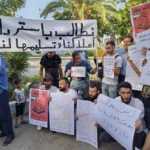
These efforts face growing Moroccan public opposition, which has intensified since the beginning of Israel’s assault on Gaza. Data from Arab Barometer, a research project specialising in public opinion surveys, showed that support for normalisation in Morocco fell from 31 per cent in its 2022 surveys to 13 per cent in surveys conducted in 2023–2024.
An analysis published by the project in early 2025 identified the assault on Gaza as a major factor behind the decline, alongside continuing public protests demanding an end to official relations with the occupation. In an analysis published on 12 March 2026, Daniela Julia Traub, a researcher at the Moshe Dayan Center, argued that Israel’s relations with Morocco, the United Arab Emirates and Azerbaijan owe part of their durability to the overlap between security cooperation and economic and technological transformation projects.
These interests, she said, had helped sustain relations despite the tensions that followed 7 October 2023. She linked the resilience of such partnerships to the interests of government institutions, companies and economic elites in technology transfer, investment and the development of security capabilities. She also noted that public opinion and political developments continued to influence the public face of these relationships.
The past six years show how military and industrial cooperation between Morocco and Israel has advanced, while progress on civilian investments and plans to expand into overseas markets has been uneven. Local facilities have begun manufacturing military equipment, and joint ventures have emerged in engineering services, agriculture and energy. Other projects are still awaiting financing, licences or the completion of infrastructure needed for exports.
This gap puts Israel’s ambition to turn Morocco into a commercial and industrial hub serving African and Atlantic markets to the test of actual production and foreign contracts, amid continuing Moroccan public opposition to normalisation and the legal and political complications surrounding Western Sahara.