









هذا التقرير متاح أيضًا بـ العربية
For more than a year and a half, the family of Ahmed, a student at Zagazig University, lived with agonising uncertainty. They did not know whether he was safe, where he was being held or even which authority was detaining him. It began on a summer night in 2022, when five masked, heavily armed men entered the family’s home in a village in Sharqia province. They took away Ahmed, who had not yet turned 20, and left without explaining what had happened or providing any information that might help the family find him.
In the first hours, Ahmed’s older brother thought there must have been a mistake. According to the family, Ahmed had not been involved in any political or organisational activity and had no criminal record that could explain the manner of his arrest. The next morning, his brother went to the relevant police station. The answer he received deepened the family’s fear: no one knew anything about Ahmed, he was not being held there, and, the family was told, the men who had taken him away did not belong to the station.
An exhausting search followed, taking the family to police stations and precincts across Sharqia, then to the General Security Directorate in Zagazig and the National Security Agency’s office there. They also sent a stream of urgent telegrams and appeals to the interior minister, prime minister and president. Almost every time, they received the same answer: We know nothing about your son, and we have nothing indicating that he is in our custody.
About 18 months passed. Throughout that time, the family searched not only for Ahmed’s whereabouts but for any information that might reassure them he was still alive. Then, without warning, an unknown caller told them their son would be brought before the State Security Prosecution within hours. It was the beginning of another ordeal that appears likely to continue.
أكثر من 20 ألف مصري وقعوا ضحايا للإخفاء القسري في مصر خلال السنوات الـ13 الماضية؛ مأساةٌ مستمرة لآلاف العائلات التي تنتظر الحقيقة والعدالة. pic.twitter.com/KPjd0Bq463
— نون بوست (@NoonPost) August 30, 2026
This report examines the strategy of denial as a central feature of Egypt’s official discourse on enforced disappearance. How is that denial constructed? What legal, political and security foundations support it? And why does the state continue to deny the phenomenon’s existence despite mounting testimony and human rights reports documenting it?
From an examination of the authorities’ discourse, the report turns to the issue’s most brutal human dimension: the suffering of families whose demands begin less with calls for their loved ones’ release than with more basic questions. Where are they? Who detained them? Why were they detained? Where are they now? And are they still alive?
No official record: The first pillar of denial
The Egyptian government’s official discourse on enforced disappearance consistently relies on denial and on questioning whether detentions outside the legal framework have occurred. Since 2013, the authorities have maintained that there are no cases of enforced disappearance as described by human rights organisations, and that anyone whose detention is established is held within an officially declared legal system under the supervision of the relevant judicial authorities.
This position has persisted despite mounting international and local human rights reports describing disappearances in which, according to those reports, official bodies did not disclose the victims’ fate or whereabouts. The government’s explanations rest on three main pillars that underpin its official narrative.
The first is reliance on official records as the primary means of establishing whether someone has been detained. In the government’s view, if a person’s name does not appear in the records of police stations, prisons or legally recognised detention facilities, no detention can be attributed to state institutions.
This position appears in several official responses submitted to international institutions. In a document Egypt submitted to the UN Human Rights Committee in 2022, the government stated that “no person is detained” in reform and rehabilitation centres without a judicial order or ruling, and that no one enters these facilities without a decision from a competent authority. It also said all detention facilities were established through legal decisions and made known to oversight bodies and the public.
The Egyptian government repeated this position in its response to the UN Committee Against Torture in 2023. It said official detention centres kept records of inmates, visits and judicial files, which the Public Prosecution supervised and inspected. It also maintained that no detention sites existed outside the legal framework.
Yet this argument contains a fundamental paradox. A complaint of enforced disappearance rests precisely on the allegation that someone is being held outside the official framework, without their detention being registered or their whereabouts disclosed. If the detainee were registered through normal procedures and their location known, the disappearance complaint would lose its meaning. The absence of a name from the records therefore does not settle the question. It is one of the very things the family is trying to explain: where is the person if they are not registered? Who is holding them? And how can their unacknowledged absence be resolved into a known legal status that their family and lawyers can follow?
Challenging the sources: Shifting the debate to those raising the allegations
The second pillar involves redirecting discussion from the substance of the complaint about a missing person’s fate to the organisations or individuals raising it. In many cases, the official response goes beyond denying the detention to questioning the backgrounds of those filing complaints or the human rights groups handling them.
Some complaints of enforced disappearance are presented in official discourse as part of campaigns to damage the state’s image abroad, or as linked to political opposition groups. These include, above all, the Muslim Brotherhood and other groups the authorities regard as adversaries or security threats. The discussion shifts from the basic questions of where the person is and what has happened to them to the family’s identity, its political background or the organisation or individual that raised the case.
In the official narrative, this shift leads to some reports being labelled politically motivated or “malicious” before the incidents themselves have been examined. Human rights groups argue that focusing on the complainants’ identities or political affiliations can divert attention from the central issue: establishing the fate of those reported missing and investigating the circumstances of their disappearance.
This approach is evident in several official Egyptian responses. In its comments on the National Council for Human Rights’ report on enforced disappearances in 2015 and 2016, the Interior Ministry said it had no information about some reported cases and stressed that it had not arrested those individuals. In some cases, it suggested other possibilities, including travel to conflict zones or links to armed groups.
The Egyptian government also addressed this issue in the document submitted to the UN Human Rights Committee in 2022. It said the Muslim Brotherhood sent some members to armed groups abroad and then used enforced disappearance reports to exert political pressure on the state. It added that investigations had, in some cases, found that people reported missing were in the ranks of ISIS.
The State Information Service took the same position in its responses to reports by international media and human rights organisations. It questioned the methodology and sources of some reports, including a BBC report, objecting to their reliance on testimony from people whose identities were not disclosed. It also alleged political ties between some human rights groups documenting disappearances and the Muslim Brotherhood. In its response to a Human Rights Watch report, the service accused it of political bias and criticised what it described as reliance on sources sympathetic to the opposition.
Demanding proof from families: An impossible burden
The third pillar, and the most complex element of official discourse, concerns the burden of proof. Families who say their relatives have been subjected to enforced disappearance are asked to provide detailed evidence of an incident defined by the absence of official information.
Rather than focusing solely on establishing the fate of someone whose family says they were taken by a security body, the family is often required to prove several elements. These include the identity of the body that made the arrest, the nature of the force involved, the route taken after detention and the likely detention site. Families may also be asked to prove that the person entered a detention facility or identify locations where entry and exit logs or surveillance footage can be checked.
The problem lies in the nature of this evidence. Much of it consists of information and records held by state institutions: detention records, troop movements, information about security facilities, surveillance footage and entry and exit logs. This creates a practical gap between a family’s ability to file a complaint and its ability to prove every element, particularly when the complaint alleges detention outside official procedures and records.
The burden of proof in some cases thus becomes circular. Official bodies cite the absence of registration as evidence that no detention occurred. Families and human rights groups argue that the absence of registration is itself part of the complaint and requires investigation and disclosure. The demand for evidence then becomes a procedural obstacle rather than a means of verifying what happened: official documentation is required to prove an incident alleged to have occurred outside the official framework.
This issue appears in official Egyptian responses. Answering questions under the Universal Periodic Review in 2019, the Public Prosecution said investigations had established that most allegations of enforced disappearance were false. It attributed some cases of absence to irregular travel, joining armed groups or social reasons. It also denied the existence of secret detention sites.
At the same time, the Public Prosecution said it was prepared to examine any report of enforced disappearance “if sufficient evidence of its occurrence is provided.” This condition raises a fundamental question for families and human rights groups: how can they provide detailed evidence when basic facts, such as the detention site or the authority responsible, are beyond their reach and largely held by state institutions?
This is one of the issue’s most complex points of dispute. The authorities maintain that an investigation cannot begin without indications and evidence that a crime occurred. Human rights groups argue that the nature of enforced disappearance means the responsibility for uncovering the truth cannot rest with the family alone. A central part of the evidence is available only to bodies with the power to detain people or oversee detention facilities.
The cost of acknowledgement
Despite the repeated incidents revealed by victims’ testimony, documents and video recordings, abandoning official denial would be a radical change. It would dismantle a narrative the state has maintained for years: that such crimes do not occur.
Acknowledgement would involve more than issuing a statement or admitting an administrative error that could be contained. It could raise a series of legal and political questions. Who gave the orders? Who carried them out? Where were the disappeared held while they were beyond legal oversight? What is the nature of the undisclosed detention sites? It could also lead to a review of arrest reports and related legal procedures, potentially resulting in officials, security commanders and perhaps political figures being held accountable.
Any such official acknowledgement would also directly undermine the security and political discourse that, since 2013, has denied enforced disappearance and insisted that all arrests and detentions comply with laws and regulations. Abandoning that position could put the official narrative under severe pressure and weaken part of the credibility on which the authorities have based their defence of security policies in recent years.
بين أمل العودة ومرارة الغياب، وفي اليوم العالمي لضحايا الاختفاء القسري، تترقب آلاف العائلات خبرًا يُنهي سنوات من الانتظار القاسي. pic.twitter.com/JStHlV4HWV
— نون بوست (@NoonPost) August 30, 2026
The consequences would extend beyond Egypt. Acknowledging crimes of enforced disappearance could have wide-ranging implications for the country’s standing with international human rights organisations and UN institutions. It could increase legal and political pressure and bring human rights issues back before international forums with greater urgency, potentially imposing lasting diplomatic and legal costs on the ruling authorities, and perhaps economic and political costs later.
For these reasons, official bodies have concluded that the cost of acknowledgement far exceeds that of continued denial, however much testimony, reports or human rights pressure mount. Viewed in this light, denial has become more than a defensive response. It is an integrated political and security strategy to protect the official narrative and avoid the legal and political responsibilities that acknowledgement could bring and that would be difficult to contain.
Ongoing suffering
Ahmed’s family spent more than 500 days searching for any trace of him before he appeared before the State Security Prosecution, about a year and a half after his disappearance. His brother says the period exhausted the family psychologically and financially beyond what they could bear. Ahmed’s older sister suffered a severe psychological crisis caused by the long wait and relentless anxiety.
Ahmed’s brother told NoonPost that every week or two, the family made another round of visits to police stations and detention sites in the province. A lawyer accompanied them, charging a fee for each trip. They often received calls claiming Ahmed was being held somewhere, prompting them to hire a car and travel dozens of kilometres, only to encounter another denial. At times, security personnel asked for money in exchange for any information they might have. The search became a constant financial drain, yielding neither confirmed information nor results.
Over time, anxiety was only part of the suffering. Travel costs, lawyers’ fees and other payments exhausted the family’s savings. Ahmed’s brother said some police officers simply told them to “forget the matter” and wait at home for a call when he was brought before the prosecution. It was as though his prolonged absence had become routine, despite no one being able to explain it or say where he was.
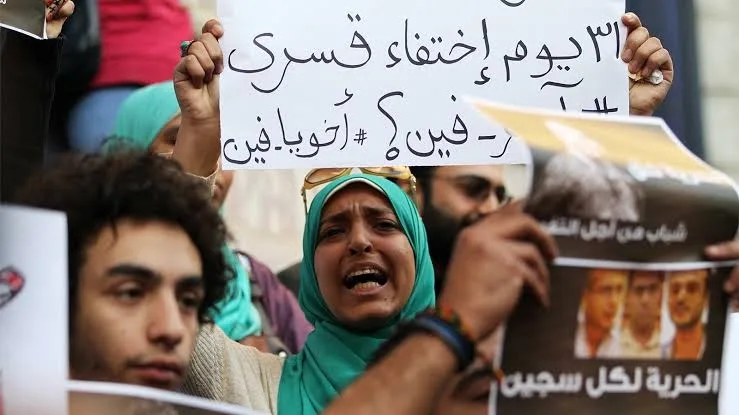
During repeated visits to the Sharqia Security Directorate, the family discovered they were not alone. They met other families carrying the same photographs and asking the same questions, also searching for sons or relatives. Most painful, Ahmed’s brother said, were the stories of people who had been missing for eight or 10 years, whose families still did not know where they were or what had happened to them.
With no confirmed information, no answers and no clear hope, the family’s despair reached its lowest point. Ahmed’s older brother makes a shocking admission: in some moments, they wished they knew he was dead, if only to end the wait that consumed them day after day. They were trapped between the hope of news that he was alive and the constant fear that the next call would ask them to collect his body.
The human and political questions remain. When will this suffering end, when its effects continue to shape victims’ and families’ lives year after year? What would persuade the authorities to stop pursuing and subjecting those they regard as opponents to enforced disappearance, even when some have little or no political involvement? And what logic could justify continuing such a cruel policy, beyond its clear message of intimidation and the fear it spreads throughout society?
What can any authority gain from the wasting away of victims’ lives and those of their families as they spend years searching for information that never comes, a detention record number that does not exist or a record whose traces were deliberately erased? What kind of stability can be built on so much anxiety and waiting, when even knowing a person’s fate becomes a demand deferred and truth itself a right denied?
