














هذا التقرير متاح أيضًا بـ العربية
In mid-November 2023, about two months after October 7 and the start of the genocidal war on the Gaza Strip, dozens of Israelis, including male and female soldiers, gathered anxiously outside an operating theatre at Shamir-Assaf Harofeh Hospital in Be’er Ya’akov, south of Tel Aviv. They were waiting to learn the fate of “Mikey.”
Two hours later, the door opened and a doctor made her way through the crowd carrying “Mikey” in her arms. Those gathered applauded and cheered her survival. Mikey was a dog injured by an explosive device on 12 January 2024 after a military battalion entered a residential apartment in northern Gaza.
A televised report broadcast on Israel’s Channel 12 later that month described the medical care Mikey received. Over several days, she was transferred between hospitals and veterinary clinics in the suburbs of Tel Aviv before eventually settling in the home of a soldier from Oketz (“Sting”), the unit responsible for training and handling combat dogs in the Israeli army. This is how combat dogs retire, if they survive their service.
More than 100 male and female dogs accompanied the Israeli army and its advancing battalions in its genocidal war on the Strip from 8 October 2023, according to a report published in late August 2024 by the Hebrew-language website LaIsha, affiliated with Yedioth Ahronoth.
Throughout the year of war, Israelis have produced accounts celebrating the “heroism” and “glorification” of the Israeli army’s dead and wounded in Gaza. Oketz’s “warriors on four legs” have received their share of that “glorification”: for sinking their claws into the chest of Hajja Dawlat Abdullah al-Tanani in her home in Jabalia camp, and for tearing with their fangs at the face of Mohammed Salah Bahar, a young man with Down syndrome, on his couch in his home in Shujaiya. The dog tore Bahar’s body apart, killing him.
The dogs of the Israeli army’s “Kalvanim” unit, also known as “Oketz,” play a role no less brutal than that of their handlers. In Gaza and Israeli prisons, the dogs have been assigned tasks unlike any they had previously been given, matching the unprecedented savagery of the Israeli army’s treatment of Gaza’s people and prisoners in its jails. This has extended to training dogs to rape prisoners, according to lawyer Khaled Mahajneh, citing his client, detained journalist Mohammed Arab, who had been held months earlier in the Sde Teiman detention camp.
These accounts prompted this report, which traces the history of the “colonial dog”, known in Zionist parlance as the “warrior on four legs”, in Palestine’s colonial history since before the Nakba.
South African dogs in Palestine
“I insisted, saying: But there is no evidence linking those people to yesterday’s ambush. He looked astonished, then said in a protesting tone: Come on, man! Didn’t the dogs lead us there?” This was part of a lengthy exchange between two senior British police officers on the edge of the depopulated village of Ijzim in the summer of 1938, during the Great Palestinian Revolt of 1936–1939.
The exchange took place a day after rebels who had taken refuge in the village carried out an ambush, killing a British Royal Air Force officer and wounding a British woman passing by, as Matthew Hughes recounts in his book “Britain’s Pacification of Palestine.” Acting on the tracking dogs’ indications, British army patrols stormed Ijzim and wreaked havoc.
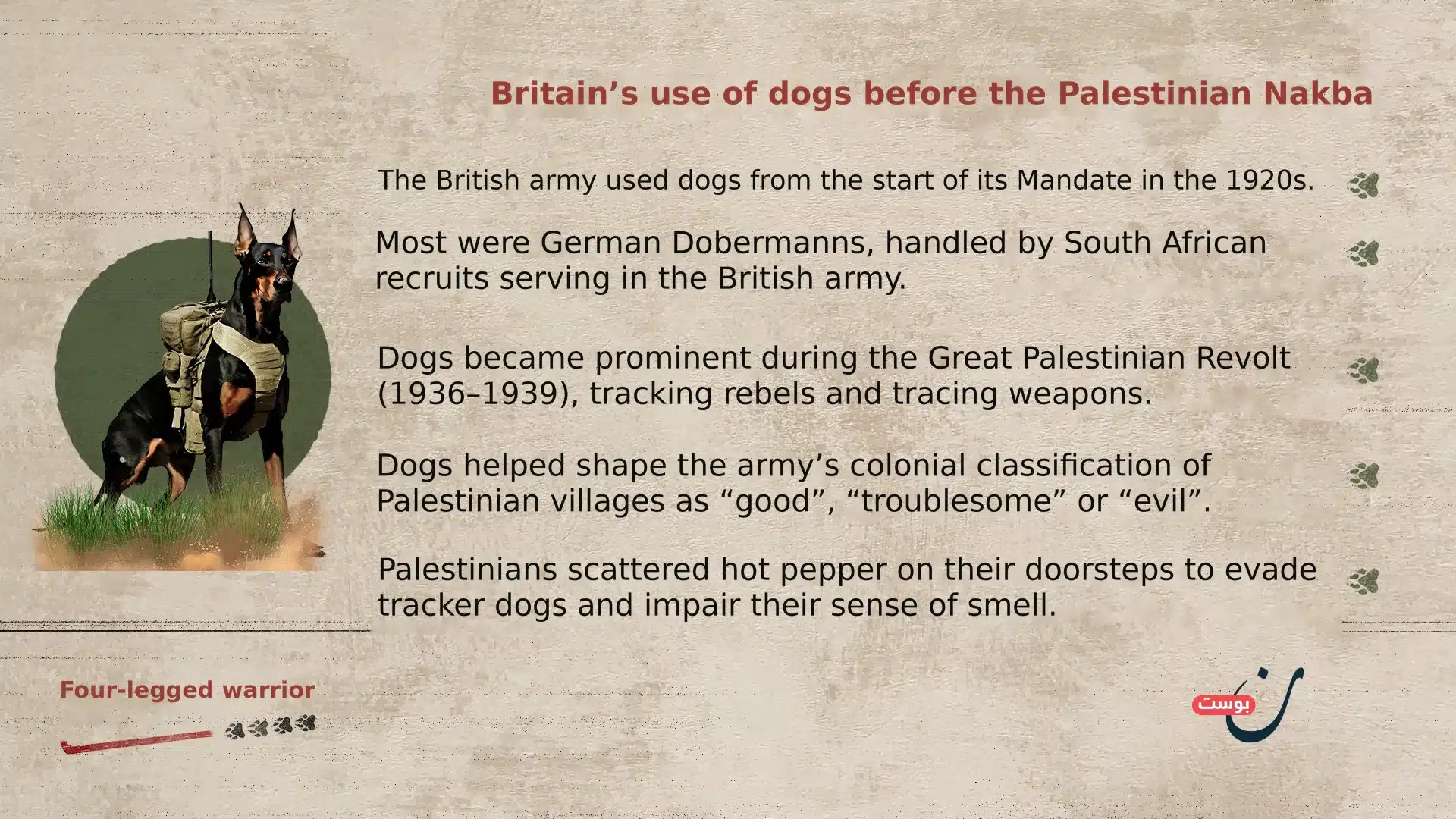
The British army used trained dogs, with soldiers assigned as their handlers, from the beginning of the Mandate over Palestine in the 1920s. Dogs imported from South Africa were the best known at the time, not because they were bred there — most were German Dobermanns — but because their handlers were South African recruits serving in the British army in Palestine. As Hughes recounts, the handlers “wore civilian clothes, carried pistols, stood out with their broad-brimmed South African hats, and spoke to them in Afrikaans, whereupon they lunged for throats.”
With the outbreak of the Great Palestinian Revolt of 1936–1939, the British police’s South African dogs played a central role in tracking and pursuing Palestinian rebels. Tracking dogs also helped shape the British army’s colonial classification of Palestinian villages as “good”, “wicked” or “evil”.
Discussing this classification and the condemnation of Palestinian villages during the revolt, Hughes writes: “The British authorities resorted to prior condemnation or judgment based on communal affiliation, proximity to the crime scene, or the dogs’ sense of smell.” A Mandate police dog merely had to follow a trail towards a Palestinian village for the authorities to treat that village as a suspect.
“The dogs did splendid work, but unfortunately they cannot give evidence in courts under the law,” said Field Marshal Archibald Wavell, who took part in the campaigns to crush the revolt. A dog tracking a scent to someone’s house or field was not considered sufficient evidence to convict its owner in the Mandate courts in Palestine.
British army patrols operated differently. A dog merely passing a house while following a trail was sufficient grounds to blow it up, according to al-Hajj Sami Ahmad Khattab, speaking about his village, Ayn al-Zaytun in the Safad district, in an interview on the Palestine Remembered website. He witnessed several homes in his village being demolished during British patrol operations.
Oral histories of the Great Revolt repeatedly describe British dogs pursuing rebels and tracking weapons during army searches and cordons around Palestinian villages and cities. Local people devised traditional ways to outwit the colonial dogs as they entered neighbourhoods and homes.
In an interview on Palestine Remembered, Hajja Halima al-Mansi, from al-Ubaydiyya in the Tiberias district, recalls an incident from her childhood in the late 1930s, towards the end of the Great Revolt. When a colonial patrol arrived to search her family’s home with a tracking dog, her father scattered hot pepper across the threshold. He was trying to outwit the dog, she says, because hot pepper helps impair or confuse dogs’ sense of smell.
Zionist use: a fragmented history
Reports and sources rarely mention the Zionists’ use of trained dogs in their armed seizure of Palestine during the 1948 Nakba. Even Palestinian oral accounts of uprooting and displacement contain almost no references to Zionist gangs bringing trained dogs with them, unlike accounts of the Great Revolt of 1936–1939 described above.
This was because, in the year of the Nakba, the Zionists sought to empty Palestinian towns and villages of their inhabitants through expulsion and displacement, rather than track people and search those places. There was therefore no role requiring trained dogs in the cleansing operations at the time. Moreover, Zionism did not become a governing authority and a state until late 1948, although the first Zionist “Kalvanim/dog handlers” unit dated back to the 1930s.
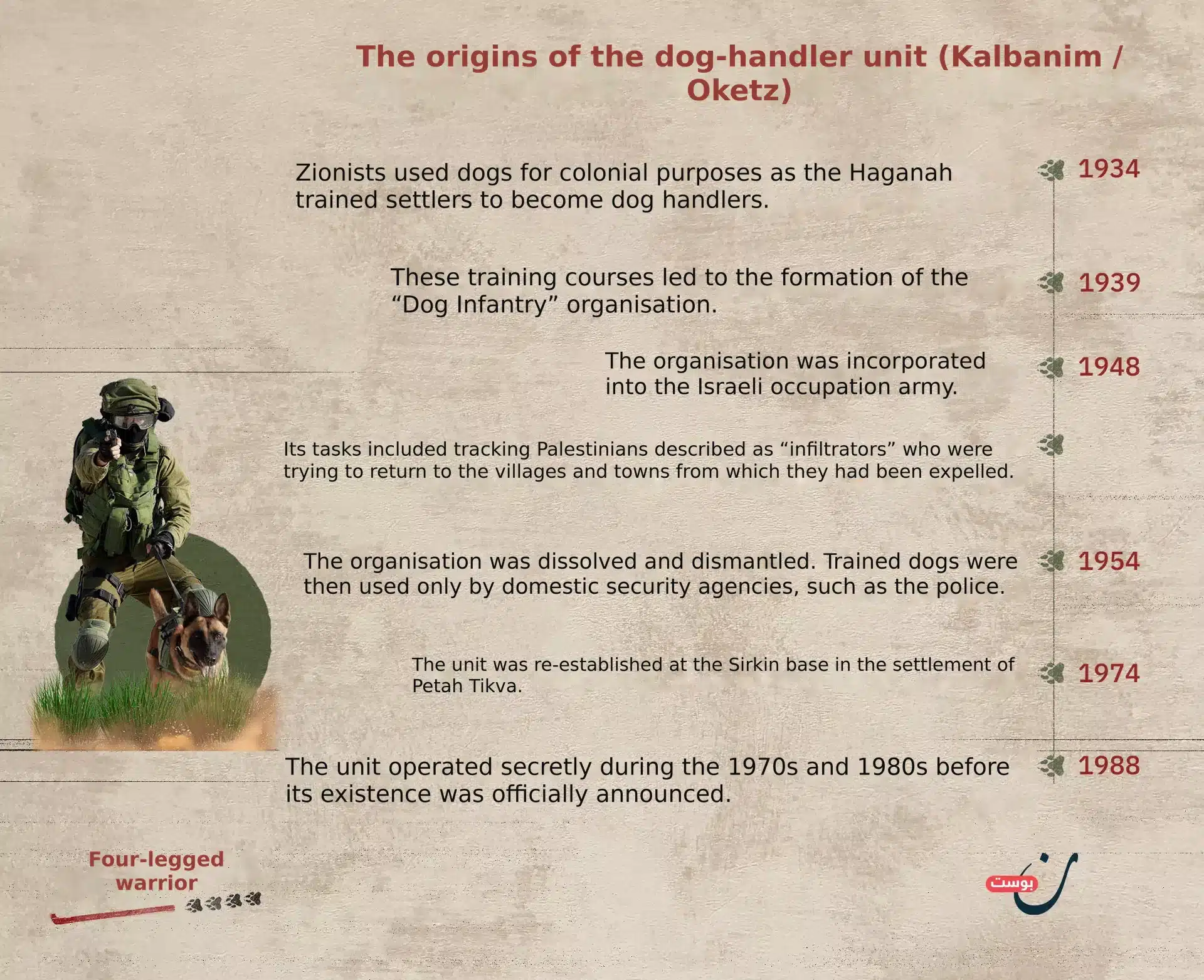
In 1939, the Zionists established their first dog unit for security purposes. Known in Hebrew as “Irgun Nohagei Klavim,” or “Dog Walkers Organization,” it belonged to the Haganah military organisation. However, a report documenting the history of the dog handlers unit on the Hebrew-language website Amutat Holchim Barosh dates the use of dogs for Zionist colonial purposes to 1934. That year, Haganah-sponsored courses began training members of Jewish settlements as dog handlers to protect Hebrew settlement in Palestine. These courses led to the establishment of the “Dog Walkers Organization” in 1939.
When Zionist military organisations were dissolved and merged into what became known as the “Israel Defense Forces” in late 1948, the “Dog Walkers Organization” was incorporated into the army and renamed the “Dog Services Unit.” Its military duties were limited to tracking Palestinians described in Hebrew as “mistanenim,” or “infiltrators”. They were crossing back into Palestine to return to the villages and towns from which they had been expelled during the Nakba. In 1954, however, the army decided to disband the unit permanently.
“A warrior, or a Jewish warrior, accompanied by a dog is not a good thing …” says an Oketz dog-handling officer in a televised report broadcast on Hebrew Channel 13, titled “Warrior on Four Legs: The Full Story,” as he attempts to explain the decision to disband the “Dog Services Unit” in 1954. The use of trained dogs was then confined to internal security agencies such as the police.
Although Jewish religious tradition’s attitude towards dogs and their use is tied to their impurity, religion played no part in the army’s decision to stop using trained dogs. Rather, the secular leadership of the Israeli army rejected their use as incompatible with its view of military honour.
Trained dogs also evoked memories of the Holocaust: Nazi Germany used dog units to terrorise and torture Jews, particularly in concentration camps. This generated negative attitudes towards using dogs on official military assignments, according to “Warrior on Four Legs: The Full Story.”
The dogs’ secret return
Throughout the 1950s and 1960s, dogs remained absent from the Israeli army and its units. Meanwhile, following the establishment of the Hebrew state on Palestine’s ruins, Jewish settlers arriving from Europe brought a growing number of dog breeds previously unfamiliar to Palestinians.
From the 1950s onwards, some Arabs in Palestine and the wider region began giving their dogs Hebrew names. In his memoir “Palestine Notebooks,” Palestinian poet Muin Bseiso recalls a female dog used by Egyptian jailers to control and terrorise communist detainees during his imprisonment in Egypt in the early 1950s. They had named her “Golda,” after Israeli Prime Minister Golda Meir.
Zionists, in turn, gave their dogs Arabic names, an expression of the mutual hostility and contempt between Arabs and Zionists from that period onwards.
The “Kalvanim” dog handlers unit was re-established in 1974 but remained secret for more than a decade. The Israeli army’s renewed use of dogs as colonial instruments was linked to “Israel’s” Israeli of the West Bank and Gaza Strip since June 1967.
Policies and practices of surveillance, control and confrontation with Palestinian fedayeen created a need for trained army dogs to perform various tasks. Chief among these was supporting what was then Military Intelligence Unit 269, later Sayeret Matkal, in confronting what Zionists describe as “terrorist” activity — meaning fedayeen operations. The dog unit was given the number 7142 and based at “Camp Sirkin” or “Alon Base” in the settlement of Petah Tikva.
Unit 7142 was first deployed during the Savoy Hotel operation in Tel Aviv on 5–6 March 1975. Two Fatah fedayeen groups carried out the operation in response to the Verdun operation in Beirut, in which Kamal Nasser, Kamal Adwan and Abu Youssef al-Najjar were killed.
The fedayeen seized the hotel and held hostages inside, demanding the release of prisoners from Israeli jails. A report on the operation, published on 2 April 2015 by N12, the website affiliated with Hebrew Channel 12, includes declassified documents and audio recordings. It describes how Unit 7142’s trained dogs helped Sayeret Matkal rescue hostages from the Palestinian fedayeen barricaded inside the hotel.
The unit was deployed again a year later, during the well-known Entebbe hostage rescue operation at Uganda’s airport on 4 July 1976.
At the time, Unit 7142’s trained dogs were used in operations to rescue hostages held by Palestinian fedayeen. Their role was to locate the hostages and the fedayeen “hijackers” at the scene and distract the latter. Even so, leaders of the Israeli army and the wider military establishment remained unconvinced of the dogs’ effectiveness as colonial instruments or the case for their official deployment in army units. The unit remained secret.
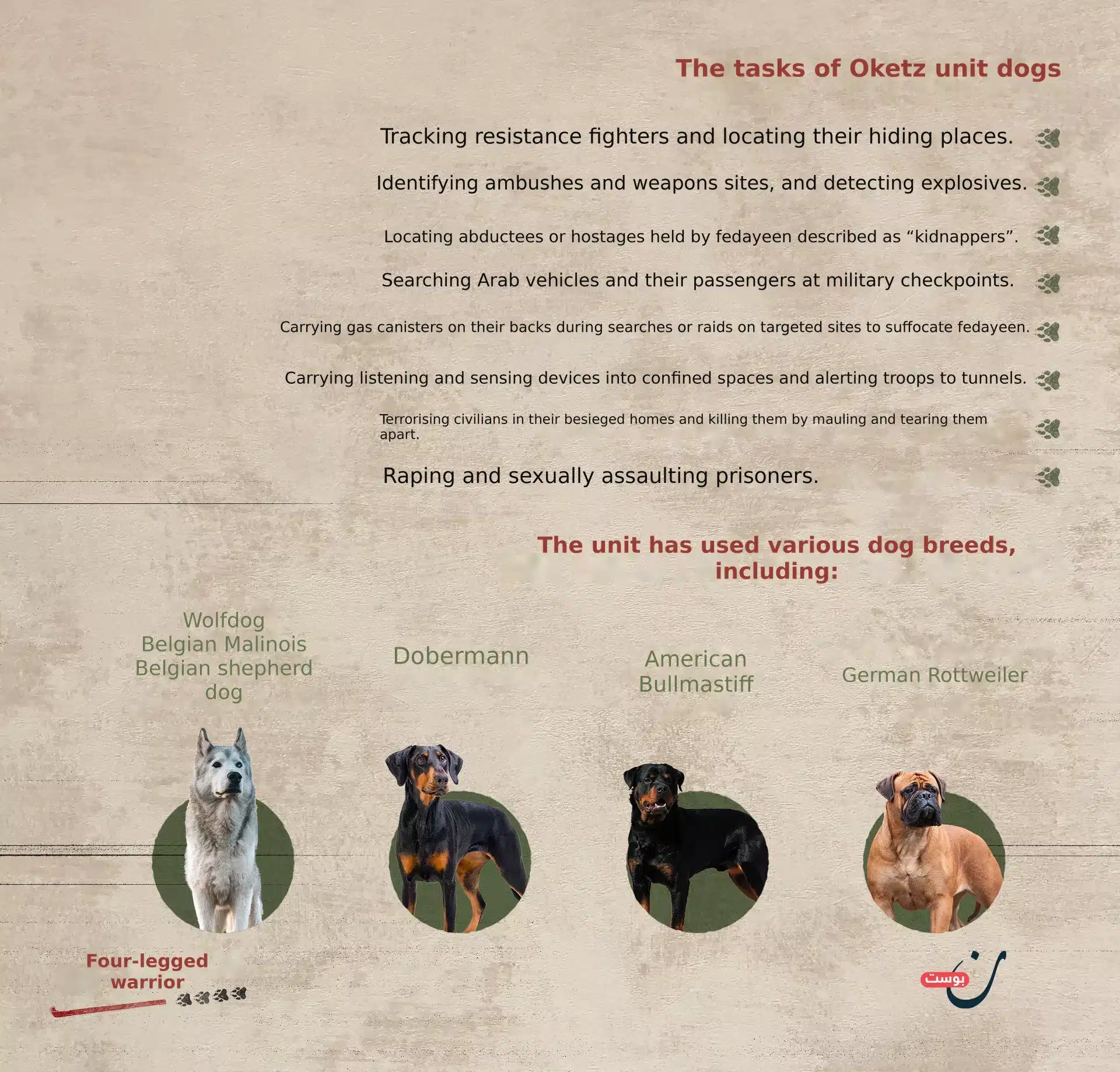
When Unit 7142 was established in the mid-1970s, it did not specialise in a particular breed, according to one of its dog-handling officers in “Warrior on Four Legs: The Full Story.” It used several breeds, including the German Rottweiler, named after the German city of Rottweil, the American Bullmastiff, the Dobermann and the Wolf dog.
Unmasked, then masked
The “Kalvanim” dog unit took part in the Israeli invasion of Lebanon in 1982. During that period, its designation changed from Unit 7142 to “HaKalbiya,” meaning “the dog house.” It was also deployed on military missions in the West Bank and Gaza in the early 1980s, under the Israeli occupation of the Strip, according to the report on Amutat Holchim Barosh.
The unit and its handlers remained secret until 1988. On 8 December that year, a Zionist commando force carried out an operation known in Israel as “Kahol Vahum” (Blue and Brown), attacking a fedayeen group affiliated with the Popular Front that was holed up in caves in Lebanon’s Naameh hills.
The attacking force used “Kalvanim” dogs that had been rigged with explosives and trained to explode at the cave entrance, according to Najm al-Hashem’s article “Ahmad Jibril has died … Why do his bases remain?”
But Gil Bender, a Zionist officer from “Kalvanim” who took part in the operation, gives a different account in the televised report “Warriors on Four Legs …” He says the two dogs, both Rottweilers, carried gas bombs rather than explosives, strapped to their backs and connected by wire to the assault force. The bombs were activated after the dogs entered the cave to suffocate the fedayeen and force them out so they could be killed.
The operation failed. The officer leading the assault unit was killed, along with the two dogs. The next day, photographs of the failed operation, showing the dogs lying on the ground after being shot by the fedayeen, appeared throughout the Hebrew and international press. “Do our forces use dogs?” Israelis asked in astonishment. The existence of “Kalvanim” had been exposed. Just as the public learnt of the Israeli army’s dog-handling unit, its handlers began wearing masks when leading the dogs.
Institutionalising the “bite”
Throughout the 1970s and 1980s, the Zionist “Kalvanim” dog-handling unit lacked the organisation and institutional structure it would later acquire. It neither relied on a particular breed nor trained its dogs for a defined set of tasks. Instead, it used Rottweilers, Dobermanns and other breeds donated by civilian owners because of their ferocity or for fear they would be stolen, as unit officer Amir Shvartz recounts.
The unit also accepted civilian dog breeders as volunteers, along with dogs they had trained themselves for service in “Kalvanim”. Among those who volunteered during the First Intifada was Zionist recruit Dorit Damfen. She enlisted only after approaching the unit with her trained dog “Kitty,” offering to volunteer and serve in the occupied West Bank and Gaza.
The dogs’ task at the time was to track and pursue Palestinians wanted in connection with the First Intifada in the West Bank and Gaza. For private dog owners, volunteering with the unit to hunt down and terrorise Palestinians in the occupied territories was also an experience of “fun and excitement” and a route to formally joining the Israeli army, as Damfen recounts in an interview included in “Warriors on Four Legs …”
By the early 1990s, during the Israeli occupation of southern Lebanon, army unit commanders increasingly recognised the need for trained dogs to detect mines and explosive devices planted by the resistance in the path of occupation infantry there. Mines were killing an average of 19 Israeli soldiers a year. From that point, “Kalvanim” took on a greater role in supporting army units.
From the early 1990s, the unit gradually moved away from breeds that tired quickly, such as Rottweilers and Bullmastiffs, seeking smaller, lighter, faster dogs with greater stamina. In 1994, it adopted the Belgian Shepherd as its official dog, a status the breed retains today.
That year, the unit also adopted its well-known name, “Oketz,” which literally means “sting,” softening the dog’s bite in name. According to Oketz officer Amir Shvartz, Gaza’s climate was one reason for abandoning large breeds that tired quickly. In the same report, he says the Strip’s dry coastal climate meant its occupation required faster, smaller dogs with greater stamina.
Since the outbreak of the Second Intifada at the start of this century, “the Palestinian knows we are coming for him on six feet,” says an Oketz dog-handling officer, referring to the four-legged warrior and its handler during night raids on Palestinian homes. Dogs were sent ahead of raiding forces to search targeted sites and sniff out weapons and explosive materials. From the Second Intifada onwards, they were also used at military checkpoints in the occupied territories to inspect Arab vehicles and their passengers.
“Oketz” in the genocidal war on Gaza
Accounts of the 7 October Al-Aqsa Flood breach of settlements surrounding the Gaza Strip included dogs in settlers’ homes among its victims. Over the months of war, Israelis produced written and televised reports devoted to what they considered the dogs’ exceptional role in defending settlers’ homes.
The latest was an article published by the Hebrew-language newspaper Yedioth Ahronoth to mark “International Dog Day,” which falls on 26 August. Titled “Heroes on Four Legs on Oct. 7,” it described dogs that protected their owners in the settlements surrounding Gaza on the day of the Flood, and others killed by the attackers’ gunfire. It named them and recounted their full life stories as though they were human beings. It also covered dogs deployed in the war on the Strip and their acts of savagery against the bodies of Gaza’s residents.
Since the start of the genocidal war on Gaza, “Kalvanim” has deployed more than 100 trained male and female dogs to support paratroopers and other occupation army units. In a report published in June 2024 on Ynet, the website affiliated with the Hebrew-language newspaper Yedioth Ahronoth, Yoav Zitun wrote that more than 30 “Kalvanim” dogs had been killed in Gaza by Al-Qassam gunfire or explosive devices by the time of publication.
According to the report, the unit, including its dogs and handlers, is expected to double in size over the following two years because of the brutal role its dogs are playing in the genocidal war on the Strip — a role regarded as effective by those deploying them.
During the war, “Kalvanim” has used dogs equipped with the latest technology for military and security missions, as well as brutal acts of retaliation. In their military and security role, the dogs alert their handlers and the infantry behind them to potential danger.
They also search targeted sites ahead of the paratroopers, including buildings whose residents have been displaced and the rubble of demolished homes. Their task is to sniff out explosive materials or devices planted in the path of advancing or raiding forces.
Beyond alerting the forces behind them and protecting them from possible ambushes in neighbourhoods and alleyways, the dogs’ most important assignment during the war has been detecting resistance tunnels and their entrances in the Strip.
According to reports and videos published by the occupation army during the war, it would not have discovered some tunnels or entered some of them without “Kalvanim” dogs, which were the first to detect and enter them. On these missions, the dogs carry the latest technology, including back-mounted cameras and listening and sensing devices to survey the tunnels and determine what is inside.
Sometimes, dogs also carry gas bombs, which are activated after they enter a tunnel if their equipment indicates someone is inside. In such cases, the dogs are sacrificed. Most of the dogs that “fell,” according to Yoav Zitun’s report, were killed on this mission of “detecting and exploring the tunnel.”
The “Kalvanim” dogs are also being used in the ongoing war on Gaza with a brutality that makes them one of the most horrific and grotesque instruments of the occupation army’s savage revenge against Gazans.
For these acts of retaliation, the unit uses dogs it calls “tokfinit,” meaning attack dogs. These include German Shepherds and Dobermanns, breeds different from those assigned to warning, reconnaissance, search and tracking duties. They are selected and trained to attack and maul people once their handlers remove their muzzles.
The image of a “Kalvanim” dog digging its claws into the chest of the elderly Dawlat al-Tanani in Jabalia camp, saliva dripping from its fangs onto her face, remains etched in all our minds whenever we hear about the occupation army’s dogs in the war on Gaza. Dogs have also been used to kill some Gazans, tearing their bodies apart.
“They took the blindfolds off our eyes after 40 days of being blindfolded; they wanted to show us something. They called in a young prisoner, laid him on his stomach, stripped him of his clothes, and set a dog on him …” You can imagine the rest. This was the account of Fadi, a detainee released from the “Sde Teiman” camp in Beersheba, which was brought into use the day after the Flood.
In a YouTube interview after his release, Fadi testified that occupation soldiers at the camp sexually assault Gazan detainees using dogs trained to carry out such assaults — a previously unheard-of level of savagery and violation of human dignity. Testimonies about these practices continue to mount amid the ongoing war on the Strip and the continued detention of prisoners in the occupation’s prisons and detention camps.
The dog turned against its handlers
For “Kalvanim” officers and trainers, a trained dog remains a tool, whatever its relationship with its handler. Ultimately, the dog is there to protect the handler, not the other way round.
The unit’s dogs have long been among the ugliest instruments used in the war on the Strip. The resistance has devised traditional ways to outwit them during the war, including releasing a dog, usually female, towards an occupation dog to distract it and divert it from its military and colonial mission.
In his Hebrew-language article “Hamas killed a dog from the Oketz unit …” on Ynet, Yoav Zitun recounts how Israeli army paratroopers stormed Jabalia camp in mid-May 2024 after most residents had fled.
The attacking unit surrounded an abandoned building where resistance fighters were holed up. The accompanying “Kalvanim” unit released a dog to search and scout the building before the force entered. The dog did not return, and the soldiers heard no barking or other indication that it had attacked anyone.
The soldiers therefore sent a camera-equipped drone to an adjacent building to establish the dog’s fate. The camera showed the dog lying on the ground inside that adjacent building. They concluded that Hamas fighters had somehow killed it without firing a shot or otherwise alerting Israeli soldiers to their presence in the building.
The paratroopers then entered that building to retrieve the dead dog. As they approached its body, some shouted, “Melkodedet” — trap. Resistance fighters had rigged the dog with explosives after killing it. According to Zitun, no one in the attacking unit was injured because the soldiers discovered the booby trap before lifting the body.
In the end
The dog booby-trapped in Jabalia was taken to the cemetery set aside for “Kalvanim” dogs and buried there. Many dogs had been buried before it in this cemetery, which Oketz maintains on the outskirts of Modi’in, west of Jerusalem. The unit holds burial rituals and ceremonies for its dogs as though its officers were burying one of their own. The dogs lie side by side, each grave marked with a headstone bearing the dog’s name, serial number and date of death.
The Zionist use of trained “Kalvanim” dogs as colonial instruments, especially in the ongoing war on the Gaza Strip and the Palestinian people more broadly, reflects the savagery to which the Israeli government and its army have descended. They train and deploy dogs as effective instruments of brutality, stripping Palestinians of their humanity through humiliation and violation as an act of revenge, not discipline.
According to Yoav Zitun’s reports, this has prompted talk of the Israeli army’s intention to strengthen and double the size of the “Kalvanim” dog-handling unit, “Oketz”, in the coming years, allowing what they call the “warrior on four legs” to continue its mission.
A photograph of stray dogs in the Gaza Strip, taken by “Kalvanim” during the war and published on the Hebrew-language website Hadashot, carried the Hebrew caption: “Hafim mibesha b’Retzuat Aza”, “Innocents in the Gaza Strip”, as though they saw no innocents in Gaza except its stray dogs.