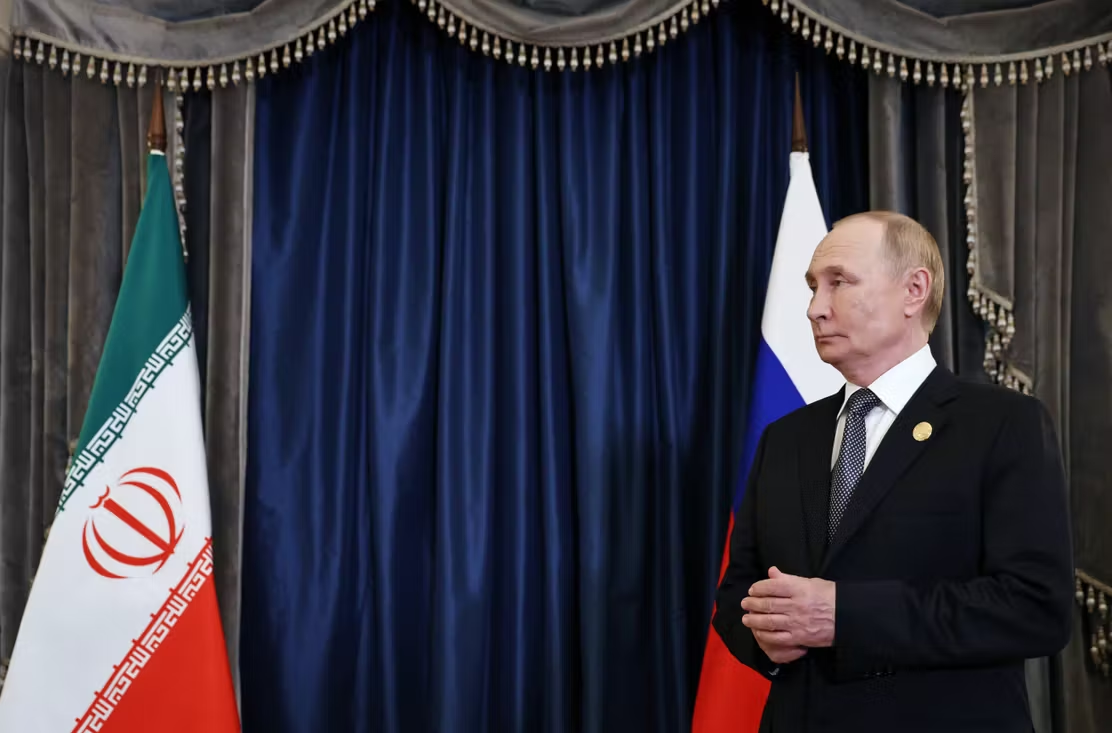
The regional landscape appears to be growing more complex and volatile by the day, amid the U.S.–Israeli war against Iran that has been intensifying since February 28. Concerns are mounting that the conflict may expand beyond its currently limited scope, evolving into a broader regional confrontation or even an international clash carrying deeply dangerous implications.
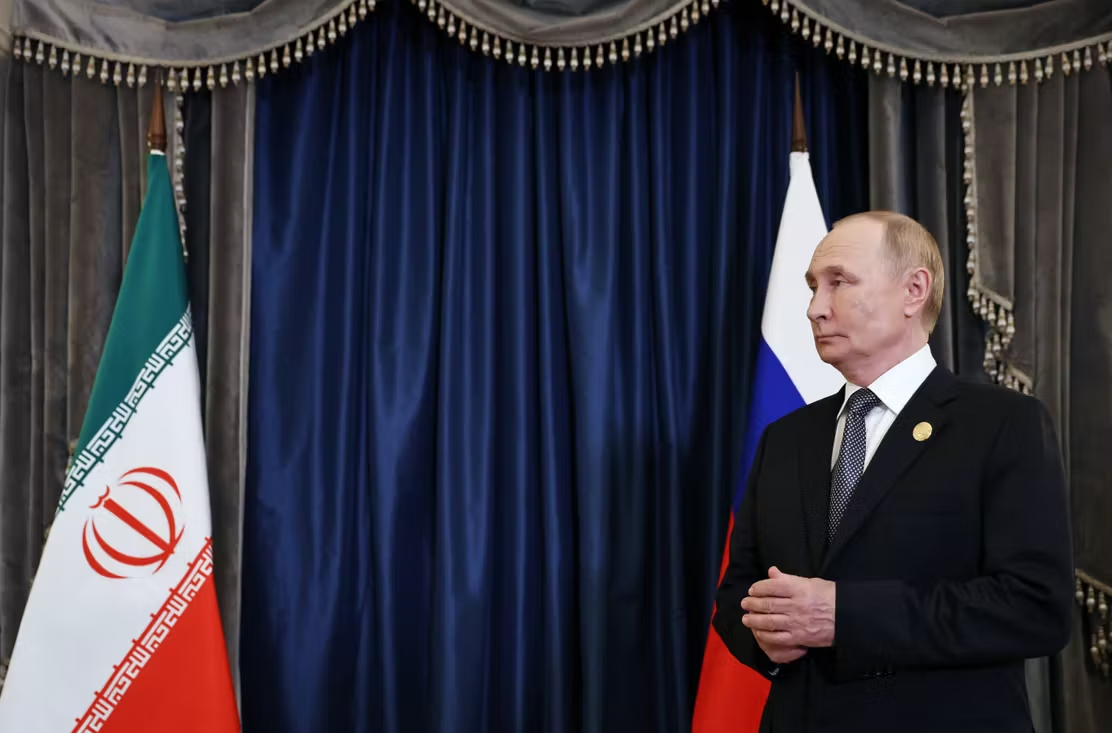
In this context, The Washington Post reported on March 6 that Russia had supplied Iran with sensitive intelligence that could help it target U.S. forces in the Middle East. If accurate, such information would add a highly consequential dimension to the conflict and could significantly reshape the balance of forces within it.
These revelations carry exceptional significance because they suggest that Moscow Tehran’s most consistent ally may have moved from the position of a cautious international observer to that of an indirect participant in the ongoing war. Such a shift raises the possibility of a wider escalation and deepens fears that the conflict could slide into a broader confrontation among major global powers.
Since the outbreak of hostilities at the end of last month, the conflict appears to be expanding steadily beyond the immediate parties involved. Its repercussions are already being felt across the Gulf states, extending to Azerbaijan and Turkey and even reaching Russia itself. Amid this tangled geopolitical landscape, a central question emerges: what strategic logic governs Moscow’s approach to the war?
What Do the Leaks Say?
According to the report, citing three officials familiar with U.S. intelligence assessments, the information reportedly shared with Iran included the locations of U.S. warships, the positions of military aircraft stationed in the region, and other American military assets deployed across several countries.
Such precise intelligence could offer Tehran a significant operational advantage. It would allow Iranian planners to pinpoint the deployment of U.S. forces with greater accuracy, improving the efficiency of attack planning and enhancing their ability to select more sensitive targets for missile strikes or drone operations.
The value of such information extends beyond merely reducing the costs associated with indiscriminate attacks though that alone would be strategically significant for Tehran. More importantly, it could increase the likelihood of hitting targets with greater precision, potentially inflicting more consequential losses on U.S. forces.
Although the leaks rely on anonymous sources making definitive verification difficult several recent developments lend them a degree of plausibility. Notably, some Iranian strikes have succeeded in inflicting direct hits on U.S. bases in the region, prompting analysts to consider that the reported intelligence assistance may contain at least a measure of truth.
For its part, Washington has attempted to downplay the significance of the alleged intelligence sharing. Several officials within the U.S. administration, led by President Donald Trump, have suggested that even if Russian support were confirmed, it would not represent a decisive factor in the war. Trump insisted that the United States remains on track to achieve its objectives more rapidly than expected.
Beyond Intelligence Support
Russian assistance to Iran, according to reports cited by The Washington Post, has not been limited to intelligence related to the deployment of U.S. bases and forces in the Middle East. It has also reportedly extended to direct military support through advanced weapon systems with both defensive and offensive capabilities a development highlighted in a Financial Times report published last February.
According to that report, Moscow signed a $589 million military agreement with Tehran in December, based on leaked Russian documents reviewed by the newspaper and accounts from individuals familiar with the deal.
The agreement reportedly includes the supply of 500 portable Verba launch platforms and 2,500 9M336 missiles. These advanced air defense systems could significantly enhance Iran’s ability to engage low-altitude aerial threats, including aircraft, helicopters, cruise missiles, and drones.
Analysts believe that integrating such systems into Iran’s arsenal could substantially improve its defenses against low-level air strikes particularly those targeting critical infrastructure or sensitive installations.
Additional reports suggest that Iran received as many as six Russian Mi-28 attack helicopters in January. Other reports in late 2025 indicated that Tehran might acquire 16 Russian Su-35 fighter jets, reflecting a clear trajectory toward deeper military cooperation between the two countries.
This growing partnership unfolds within a broader framework defined by the Comprehensive Strategic Partnership Treaty signed by Moscow and Tehran in January 2025. The agreement aims to expand economic, military, and security cooperation between the two countries over the next two decades.
The treaty covers a wide range of areas, including defense, counterterrorism, energy, finance, and cultural exchange. It also includes cooperation in technology, information systems, cybersecurity, peaceful nuclear energy, regional coordination, environmental issues, and efforts to combat money laundering and organized crime.
Viewed through this lens, Russian assistance to Iran—if confirmed—appears less like a tactical wartime maneuver and more like part of a broader strategic trajectory designed to consolidate a long-term partnership that could reshape elements of the regional balance of power.
What Impact Could This Have on the War?
Potential Russian intelligence support appears to have left a clear imprint on battlefield developments particularly in the selection and accuracy of U.S. targets.
This stands in contrast to the twelve-day war in June, when the majority of Iranian attacks targeted Israel through missile barrages that were largely characterized by randomness and limited accuracy.
In the current round of hostilities, however, the picture appears markedly different. The attack on U.S. bases in Kuwait resulting in the deaths of six American soldiers represented an unprecedented escalation and strengthened the hypothesis that Tehran may have received precise intelligence about troop positions within the base.
Similar patterns emerged in attacks targeting residential compounds housing U.S. soldiers in Bahrain and the United Arab Emirates. In addition, American missile-launch platforms in several Gulf states were struck after their locations had apparently been identified with striking precision. This suggests that the target lists were not the product of conventional surveillance or operational guesswork, but rather of deeper intelligence inputs.
The same observation applies to the two U.S. aircraft carriers operating in the region, both of which were targeted by Iranian missile and drone attacks. Regardless of the ongoing debate over whether those attacks resulted in direct hits, the mere ability to identify the carriers’ positions with such precision points to access to highly sensitive intelligence an element that appears to have complicated U.S. strategic calculations.
Moscow’s Balancing Act Between Tehran and Washington
Russia’s approach to the war appears to rest on two core principles.
The first is avoiding a direct and overt military confrontation with the United States. The second is preserving its strategic alliance with Iran while preventing that alliance from collapsing—without becoming entangled in an open conflict that could impose heavy political, military, and economic costs.
From Moscow’s perspective, Iran represents an important political and security buffer that cannot be easily sacrificed. A major weakening—or collapse—of the Iranian state would have profound consequences for regional balances favorable to Russian interests, potentially granting the United States and the Western bloc additional strategic advantages in a region of great importance to Moscow.
Preventing such an outcome has therefore become a priority nearly as important as avoiding direct involvement in the war itself.
This helps explain the calculated nature of Russia’s involvement. Moscow does not appear to be seeking a decisive Iranian victory that might provoke an unpredictable American retaliation. At the same time, it does not wish to see Washington impose total dominance over Iran or force Tehran into a crushing strategic defeat.
Instead, Russia’s objective appears to be managing the rhythm of the conflict in a way that maintains a degree of balance not allowing the United States to advance too far in Russia’s geopolitical sphere, nor allowing one of Moscow’s key regional partners to suffer a devastating defeat.
Within this framework, Russian assistance to Iran can be understood as an attempt to narrow the power gap—at least temporarily—between Tehran and Washington. While such support may not fundamentally transform the strategic equation, it could prolong the war, a scenario that may align with Russian calculations.
From Moscow’s perspective, a protracted conflict would gradually drain U.S. military resources, increase pressure on the American economy, and complicate domestic politics in the United States. It would also redirect part of Washington’s strategic attention toward the Middle East, potentially easing pressure on the Ukrainian front outcomes that would, to varying degrees, serve Russian interests.
Another interpretation suggests that the support may also carry a retaliatory dimension, serving as an indirect response to the extensive military and intelligence assistance the United States has provided Ukraine in its war with Russia. In this sense, the region may be drifting toward a broader pattern of proxy conflict: indirect U.S. support for Ukraine against Russia, countered by indirect Russian support for Iran against the United States.
That said, Russia economically and militarily strained by nearly four years of war in Ukraine does not appear eager to open another direct front with Washington, particularly at a moment when President Donald Trump has sought to reduce tensions with Moscow through a more pragmatic tone than the harder line adopted by the administration of his predecessor, Joe Biden.
What Does This Mean for the International Order?
If Russian support for Iran whether intelligence or military were confirmed, the region could be approaching a highly sensitive turning point in the conflict.
The confrontation might move beyond its current triangular structure involving the United States, Israel, and Iran, potentially extending beyond the regional arena encompassing the Gulf, Azerbaijan, and Turkey. It could even approach the threshold of a broader international confrontation involving major powers including nuclear-armed states.
From this perspective, the issue is no longer simply one of temporary military escalation. Rather, it may signal deeper shifts affecting the very structure of the international system, potentially opening the door for other powers to enter the conflict either directly or through various forms of indirect support.
From the first moments of the war, attention turned toward Moscow and Beijing as two of Iran’s most prominent international partners. Both faced sharp criticism for what was described at the time as “neutrality” or even “abandonment.”
Yet the emerging leaks and information now suggest that this posture may not necessarily have reflected an absence of support, but rather a different model of engagement whose contours may become clearer as the conflict expands and moves closer to becoming a major international crisis.
Ultimately, these revelations reopen fundamental questions about where the war may be headed, how far escalation might go, and what consequences it may hold for both the region and the global system.
Day by day, events appear to be sliding along an open trajectory of escalation both vertically and horizontally amid the near-total absence of effective mediation efforts capable of containing the crisis. All parties seem, to varying degrees, to be adapting to this escalation or implicitly accepting it despite the catastrophic risks it carries for everyone involved.