
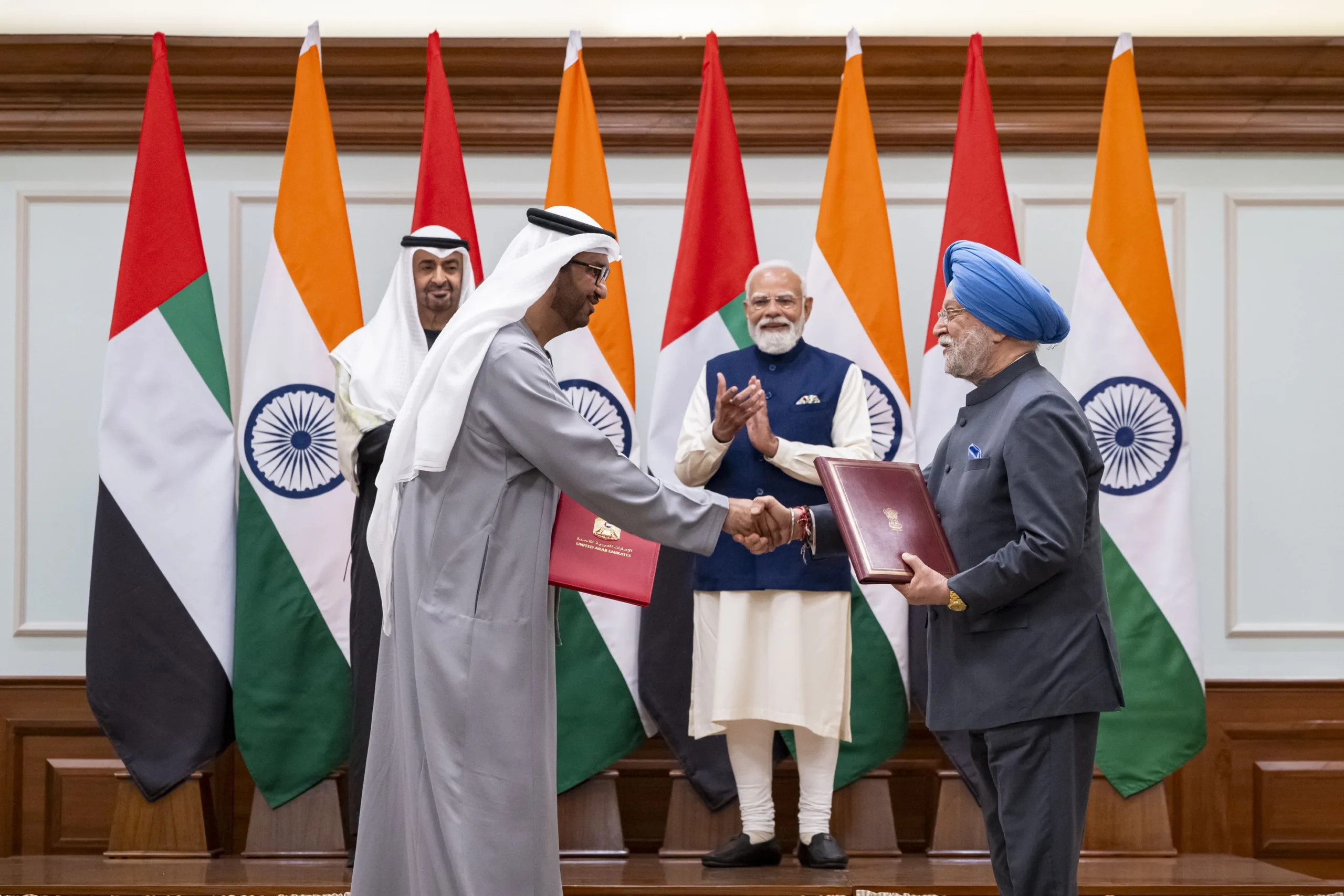
The talks held on January 19, 2026, between Indian Prime Minister Narendra Modi and UAE President Mohammed bin Zayed Al Nahyan marked the beginning of a new phase of cooperation defined by a distinct security and defense character, culminating in the signing of a strategic “letter of intent.”
The agreement reflects a shift in the political doctrine of both countries. Their relationship is no longer confined to trade and investment; it has expanded into the architecture of regional security. This development raises serious questions about the implications of positioning India as a security partner in a region fraught with international and regional rivalries.
India as a New Player in the Gulf Security Equation
Relations between the UAE and India are no longer merely a story of expanding trade or reciprocal investment. With their formal elevation to a strategic defense partnership spanning both security and economic domains, the relationship has acquired broader geopolitical dimensions, stretching from the Gulf to the Eastern Mediterranean. It now extends beyond conventional defense cooperation toward a form of long-term strategic entanglement.
This evolution has been gradual. It began with an initial defense memorandum of understanding in 2003, followed by a broader cooperation agreement in 2014, and culminated in a comprehensive strategic partnership after Prime Minister Narendra Modi’s visit to Abu Dhabi in 2015.
That visit ushered in a new trajectory of political and security convergence, encompassing military exercises, joint training, arms deals, knowledge exchange, and enhanced collaboration in defense industries, cybersecurity, and the protection of critical infrastructure.
Today, the security dimension forms the cornerstone of the proposed defense partnership. Cooperation now encompasses joint defense manufacturing, the development of advanced military technologies, military training, special operations, intelligence-sharing, and counterterrorism and counterterror financing.
This expansion signals a transformation in the pragmatic relationship between the two countries. The UAE long reliant on the United States for its security umbrella no longer views India solely as a market or a source of labor, but as a pillar within a broader strategy to construct a diversified network of security partnerships.
Such a strategy allows Abu Dhabi greater room for strategic maneuvering and mitigates risks associated with shifting positions among major or regional powers, particularly amid discussions of Washington’s regional recalibration and pivot toward Asia, alongside mounting regional challenges.
For its part, New Delhi whose grand strategy centers on the maritime domain stretching from the Indian Ocean to the western Pacific regards West Asia as a vital link in its economic and strategic security. From this vantage point, strengthening its presence in the Gulf is directly tied to securing maritime routes that serve as lifelines for its trade, safeguarding its growing investments, and connecting its rising economy to European markets through emerging corridors.
Bilateral cooperation with the UAE places India at the heart of regional balancing networks, granting it indirect influence in a region historically shaped by Western and Pakistani sway. It opens the door to new power equations in which economic and human security intertwine with military security to forge a long-term alliance.
For India, the UAE represents a strategic anchor in the Gulf not only to protect the more than 9 million Indian nationals living and working there (a figure equivalent to the combined citizen populations of five Gulf states: the UAE, Qatar, Kuwait, Oman, and Bahrain), but also to secure vital energy supplies. New Delhi relies on Gulf states for more than three-quarters of its oil and gas needs, making any security disruption in the region a direct threat to its economic stability.
India’s expanding security footprint in the Gulf is also linked to its desire to strengthen its naval presence in the Arabian Sea and the Indian Ocean, within the broader framework of its strategic competition with China.
India understands that economic influence alone is insufficient; protecting its expanding western trade interests requires flexible security partnerships with states that occupy strategic positions along global trade routes.
Beyond the Deepening UAE–India Rapprochement
The significance of this partnership derives from its complex geopolitical context and gains additional weight amid regional transformations, including shifting alliances, escalating tensions in several flashpoints, and intensifying competition among regional and international powers for influence over vital maritime corridors.
One of the key drivers of deeper defense cooperation is the India–Middle East–Europe Economic Corridor (IMEC), announced during the 2023 G20 summit. The initiative aims to connect India to Europe via the UAE, Saudi Arabia, and the Eastern Mediterranean, positioning it as a partial competitor to other regional connectivity projects.
Yet the corridor’s success depends fundamentally on a stable security environment capable of protecting infrastructure and supply chains. In this light, defense cooperation between Abu Dhabi and New Delhi becomes part of broader arrangements designed to safeguard trade and investment flows and secure the maritime and land routes linked to the project.
A pivotal shift in the evolving UAE–India dynamic has been Israel’s entry into the equation. Following the Abraham Accords, a new environment emerged in which the security and technological interests of the three countries converged. The launch of the I2U2 framework in 2022 bringing together India, the UAE, Israel, and the United States—institutionalized this convergence, focusing on infrastructure, energy, food security, and technology.
Within this framework, the UAE appears as a geographic and logistical hub, Israel—already well established in defense ties with India provides advanced technology, and India contributes its vast market and industrial capabilities. The result is a multipolar economic–security influence network.
Crucially, India’s entry into the Gulf’s security depth cannot be divorced from its longstanding regional rivalry with Pakistan. New Delhi’s enhanced security presence in the UAE, alongside growing India–Israel ties, may be interpreted in Islamabad as a shift in Gulf alignments.
This perception is reinforced by expanding military cooperation between Saudi Arabia and nuclear-armed Pakistan, particularly after their signing of a joint strategic defense agreement aimed at deterring aggression and strengthening defense collaboration. The region thus finds itself navigating a web of intersecting alliances that are reshaping balances of power and influence within Gulf economies and diasporic communities.
Although the UAE remains keen to preserve stable relations with Pakistan and avoid a rupture, certain signals such as Abu Dhabi’s withdrawal from a project to manage Islamabad Airport suggest a degree of cooling, even if officially attributed to technical or economic reasons. Meanwhile, Pakistan’s growing ties with certain regional actors and its role in files such as Sudan may be viewed in Abu Dhabi as misaligned with its interests.
At the same time, India maintains a cautious approach to security arrangements that could be construed as alignment against regional actors such as Saudi Arabia or Iran, or as part of broader Middle Eastern axis politics.
Nevertheless, what now appears as an interwoven web of interests governed by energy, trade, maritime corridors, and technology may gradually evolve into a broader system intersecting with Israel, the United States, and major connectivity projects. This could position Abu Dhabi as a manager of delicate relations among competing powers.
Demographic Imbalance: The Indian Diaspora as a Silent Strategic Force
If security constitutes the alliance’s formal dimension, demography represents one of its deepest unspoken foundations. The UAE hosts the largest Indian diaspora in the world, exceeding 4 million people roughly one-third of the country’s total population, citizens and expatriates combined according to data from the Indian Embassy in the UAE.
On the surface, this community is regarded as a pillar of the UAE’s economic success story. Yet behind its vast presence lies a complex demographic equation that raises questions extending beyond economics to the very structure of the state.
Like other Gulf states, the UAE faces a structural demographic imbalance in which nationals constitute a numerical minority compared with expatriates. Indians form an integral component of the country’s economic and social stability, dominating vital sectors including construction, services, healthcare, education, technology, trade, and finance.
Their presence extends beyond low-skilled labor to include entrepreneurs, investors, and executives embedded within the UAE’s economic fabric. Estimates suggest that Indians manage thousands of small and medium-sized enterprises that serve as economic lifelines, alongside prominent roles in technology and the digital economy.
This factor transcends economics to become an indirect political element. India has a strategic interest in the UAE’s stability, while Abu Dhabi recognizes that maintaining stable ties with New Delhi ensures a continued flow of human capital and expertise.
Remittances from Indian workers constitute a pillar of India’s social economy. Transfers from Gulf states amount to roughly $44 billion annually, led by residents in the UAE. Thus, Gulf security is not solely about energy or trade it is also about the safety of millions of Indian nationals.
Yet the UAE’s heavy reliance on low-cost foreign labor poses long-term structural challenges, including boosting productivity, localizing jobs, developing a skills-based domestic economy, and reducing dependence on external expertise. A substantial portion of national income ultimately flows out of the local economic cycle, representing a persistent liquidity drain.
Moreover, the sheer size of a single expatriate community raises understated social and political questions about cultural, linguistic, and economic balance particularly in major cities such as Dubai and Abu Dhabi, where entire sectors and markets are directly linked to the availability and expertise of Indian labor.
In other words, expatriate labor is no longer merely an economic asset but a sensitive component of internal stability an entrenched economic and social presence that is difficult to replace or scale back, rendering any major shift in labor or residency policies politically and economically delicate.
Potential Leverage Beyond the Bilateral Relationship
Despite the cooperative tone of the relationship, the depth of economic and human interdependence creates a complex web of mutual dependencies that carries latent influence potential even if not activated in the current context.
While the Indian human presence powers the UAE’s economy, it also deepens structural demographic imbalance. Economic interdependence fosters long-term stability, yet simultaneously constrains maneuverability for both sides.
The UAE gains an emerging Asian partner within its security depth, while India acquires a new role in the Gulf’s strategic landscape. However, this dynamic introduces new regional balances. India does not maintain a permanent military base in the region; its role rests on mutual trust and security coordination grounded in shared interests rather than direct force. This makes the relationship precise and sensitive any miscalculation could disrupt existing strategic equilibria.
As interdependence deepens, a more intricate equation of asymmetric influence emerges. In theory, India holds three principal instruments of leverage within the UAE’s economy:
First: Human Capital. The presence of millions of Indians constitutes a form of soft power influencing the UAE’s economic stability. New Delhi’s leverage would not operate through overt political pressure but through the regulation of labor flows essential to sectors such as construction, services, ports, and aviation.
Disruptions in labor flows—whether through migration restrictions, visa policy shifts, or sudden changes in residency rules would reveal the sensitivity of entire sectors to labor supply shocks. The COVID-19 pandemic offered a partial illustration, as travel restrictions and lockdowns halted major projects and disrupted public services, exposing vulnerabilities inherent in reliance on foreign labor.
Moreover, many members of the Indian community possess specialized expertise in advanced technological and financial sectors, making them difficult to replace and creating what might be termed “professional influence” a subtle capacity to affect the stability and growth of sensitive economic sectors while minimizing overt political risk.
Second: Indirect Economic Influence. Indian companies, investors, and traders form an extensive network across trade, retail, real estate, and services, embedding them within the UAE’s daily economic structure.
This network grants New Delhi indirect influence through steering investment toward or away from certain sectors, adjusting trade volumes or supply chains during periods of tension, or influencing service and retail markets.
Third: Remittances and Financial Linkages. The UAE is among the largest sources of remittances to India, adding a financially sensitive dimension to the relationship. For India, these flows are a vital pillar of financial stability that can influence its balance of payments and support domestic growth.
For the UAE, maintaining stable remittance flows ensuring labor market equilibrium and foreign currency circulation requires flexible, labor-friendly migration policies. This dynamic reduces Abu Dhabi’s ability to impose substantial changes to labor or residency policies without coordination with New Delhi.
This pattern of interdependence produces a delicate equilibrium. India could exercise influence quietly—negotiating more favorable security or economic arrangements, shaping Emirati policies on labor, investment, and trade, and securing advantageous positions in sensitive files related to security or regional influence.
Although these tools are not overt instruments of pressure due to mutual dependence, they represent strategic cards that could be cautiously invoked in complex circumstances particularly amid regional tensions involving Pakistan or disagreements related to Yemen. Any direct exploitation of such leverage, however, would risk diplomatic strain and economic cost for both sides.
In the end, the central question is not whether this alliance will expand, but how long it can remain insulated from the gravitational pull of regional polarization in a region where economic projects frequently intertwine with security calculations and where trade corridors, over time, evolve into strategic assets, and economic cooperation networks into political and security fault lines that are difficult to control.