
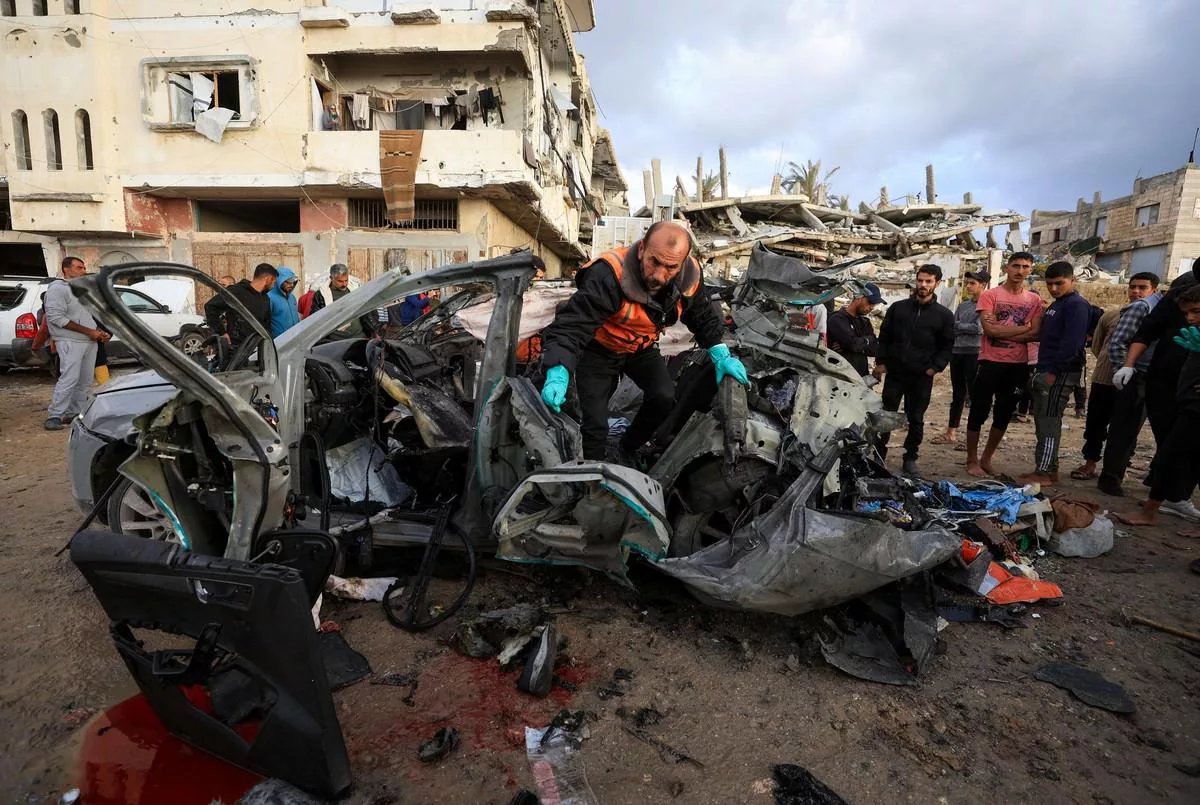
The assassination of Raed Saad a prominent commander in al-Qassam Brigades, head of its military manufacturing division, a member of its military council, and one of the historic faces of the resistance in Gaza has once again drawn attention to Israel’s evolving assassination strategy and its likely priorities moving forward, particularly amid the fragile ceasefire currently in place.
A closer look at the official statement from the Israeli military and the Shin Bet reveals a recurring designation: the target is described as “one of the architects of October 7, 2023.”
This phrasing implies more than just a reaction to the events of that day it suggests a broader operational framework rooted in pre-approved kill lists, moving away from the logic of “hot pursuit” and toward a premeditated “death list” awaiting execution at the appropriate time.
This framing echoes remarks made by former Shin Bet director Ronen Bar in his first public address, where he declared, “This is our Munich. We will hold everyone accountable in Lebanon, Gaza, and around the world. Only two architects remain to close the account.”
Bar’s statement harks back to Mossad’s infamous global assassination campaign following the Munich Olympics in September 1972, signaling a possible attempt to replicate that model under different political and security circumstances.
The Munich Doctrine and Operation Wrath of God: The Historical Blueprint
In the world of targeted assassinations and covert intelligence operations, “the Munich Doctrine” is synonymous with what Israel dubbed “Operation Wrath of God.” This became Tel Aviv’s strategic response to the 1972 Munich Olympics attack and lasted roughly 16 years, resulting in the assassination of fewer than 20 individuals from a kill list approved by then-Prime Minister Golda Meir.
Israeli historian Michael Bar-Zohar recounts how, following the Munich attack, Meir was uncertain about what action to take until she concluded: “We must destroy Black September now.”
Mossad chief Zvi Zamir and counterterrorism advisor Aharon Yariv realized that hunting down every member of Black September was nearly impossible. Instead, they adopted a “decapitation” strategy, targeting leaders rather than operatives.
A special committee, known as the “X Committee,” was established to determine targets based on intelligence provided by Mossad and military intelligence unit Aman. The name reportedly derived from placing an “X” over the photos of approved targets.
Operation Wrath of God codenamed Mivtzah Elohim or “Wrath of God” was conducted by Mossad and various branches of Israel’s security forces. It initially identified around 35 Palestinian figures supposedly connected to Black September.
However, the record shows that most of those assassinated were prominent political and military leaders of the Palestine Liberation Organization (PLO) in exile, undermining Israel’s justification.
Assassinations occurred in European capitals such as Rome, Paris, and Nicosia. Given that many of these operations took place outside Israel and occupied territories, the Mossad formed a special unit dedicated to executing missions abroad.
This unit carried out most of its assignments except the assassination of Atif Bseiso, PLO intelligence chief, who was eventually killed in Paris after nearly two decades of pursuit.
In a chilling tactic, the unit would often place obituary notices in European newspapers featuring the names of soon-to-be-targeted individuals not to warn them, but to instill psychological fear and intimidation.
David Kimche, then deputy Mossad chief, once noted that assassination wasn’t the primary goal of the operation; rather, it was the creation of “terror,” which in Israeli doctrine is considered more impactful than the act of killing itself. Israel sought to make Palestinians involved in the Munich operation experience the same sense of terror that the Munich attack had inflicted on Israel.
The operation worked on two complementary tracks: a psychological-media campaign of fear and a sequential field campaign of assassinations. These operations involved not only intelligence agents but also Israeli commando units, blurring the line between intelligence and military action.
Despite efforts at secrecy, Israel deliberately left evidence pointing to its involvement, in line with a doctrine of “shock and awe” meant to amplify fear through unmistakable fingerprints.
Between 1972 and 1973, Mossad assassinated several PLO representatives abroad, including Wael Zwaiter in Italy, Mahmoud Hamshari in France, and Hussein Abul Khair in Cyprus.
As the PLO strengthened its base in Lebanon, particularly in Beirut, Mossad faced growing operational challenges. In response, Israel launched a military operation within “Wrath of God” called “Spring of Youth,” targeting senior Palestinian leaders Abu Youssef al-Najjar, Kamal Adwan, and Kamal Nasser an action that led Lebanese Prime Minister Saeb Salam to resign in protest.
The most elusive and high-profile target was Abu Hassan Salameh, allegedly the mastermind of Black September. Mossad infiltrated his security circles, and when warned that his name was “out of the drawer,” he replied calmly: “Let them do as they wish.” On January 22, 1979, Salameh was assassinated in a car bombing in Beirut.
Other prominent victims included Wadie Haddad, co-founder of the Arab Nationalist Movement and the Popular Front for the Liberation of Palestine; writer and political figure Ghassan Kanafani; PLO representative Naeem Khader; and others.
Golda Meir encapsulated this doctrine succinctly: “Our war against Arab terrorists cannot be only defensive. It must be proactive: to expose the killers and their leaders, foil their plans, and destroy their organizations.”
Since then, targeted assassination has become a cornerstone of Israeli security doctrine, based on the belief that allowing adversaries to live poses a “moving threat.”
While the practice neither began nor ended with Munich, Operation Wrath of God remains the most emblematic example of a policy driven by borderless and timeless kill lists.
From Munich to October 7: “Nili” Returns
In an interview with AFP, Ronen Bergman author of Rise and Kill First: The Secret History of Israel’s Targeted Assassinations argued that the Munich attacks created an Israeli mindset that “no one else would protect its interests.” He sees a direct line from that moment to present-day policy, stating that targeted killings remain one of Israel’s principal tools in safeguarding national security.
From day one of the war on Gaza, Israeli leaders have relentlessly emphasized the goal of “total eradication of Hamas.” While the military campaign has focused on Gaza, the scope of Israel’s operations has extended far beyond.
Defense Minister Yoav Gallant declared that the army would “pursue Hamas operatives for years,” from senior commanders to field members. Prime Minister Benjamin Netanyahu echoed the sentiment, calling Hamas’s destruction the war’s primary objective.
References to the Munich model were neither new nor incidental. In December 2023, while still in office, Shin Bet chief Ronen Bar stated in a televised address: “The cabinet gave us a goal to eliminate Hamas. This is our Munich. We will carry this out in Gaza, the West Bank, Lebanon, Turkey, and Qatar. It may take years, but we are determined.”
In her book Operation Wrath of God: The Secret History of European Intelligence and Mossad’s Assassination Campaign, strategy professor Aviva Guttmann traces this policy’s roots and explicitly connects it to the present.
She writes that the 1972 Munich attacks led to Operation Wrath of God, just as the October 7 attacks led to the creation of a new Israeli assassination unit named “Nili.” The unit’s task: to pursue and eliminate all those involved in the October 7 operation.
Established in late October 2023, the new “Nili” unit operates under Mossad and Shin Bet oversight. Its targets include Hamas leaders not only in Gaza but also in Qatar, Egypt, Lebanon, Turkey, and even Europe.
The name “Nili” is steeped in Zionist symbolism. It refers to a Jewish spy ring in Ottoman Palestine that collaborated with British forces during World War I to advance the Zionist project. The acronym stands for a Hebrew biblical phrase from the Book of Samuel, often translated as “The Eternal One of Israel will not lie.”
Though mythologized in Israeli lore, intelligence archives acknowledge that Nili’s operational efficiency was poor. The network suffered from delays, logistical issues, and outdated information casting doubt on its actual wartime value.
Expanding the Kill List: From Commanders to the “Shadow Circle”
Israel’s assassination campaign during the current war has become one of the largest in modern history, employing advanced technologies especially artificial intelligence to streamline and escalate targeted killings.
Key among these technologies is “Lavender,” an AI-driven system capable of processing massive data in real time to generate thousands of potential targets. According to six Israeli intelligence officers cited by +972 Magazine, Lavender played a central role in the early phases of the bombardment campaign, drastically accelerating the kill chain.
One officer described the process: “I spent 20 seconds per target, approving dozens a day. My only role was to stamp approval.” The automation of the kill process, devoid of human scrutiny, turned assassination into a routine devoid of ethical restraint.
Another system, known as “Where is Daddy?”, was used to track individuals returning home at night, where they were assassinated alongside their families. According to reports from +972 and Local Call, this system was responsible for wiping out entire Palestinian families in their homes, explaining the extraordinarily high civilian death toll particularly among women, children, and the elderly.
In November 2023, the Israeli military announced its use of a third AI system known as “Gospel,” which identifies buildings supposedly linked to Hamas operatives and directs immediate strikes on them regardless of the civilians inside.
“Gospel” reportedly enabled the targeting of over 12,000 sites by feeding real-time intelligence to air, ground, and naval forces, accelerating coordinated attacks to an industrial scale. One report claimed it could generate up to 100 new targets per day, compared to an annual average of 50 before the war.
These systems tracked anyone who crossed the border on October 7 combatants, civilians, even journalists folding all into a matrix of pre-justified lethal targeting. For instance, the Israeli military justified the killing of journalist Hassan Salih by alleging his involvement in documenting the October 7 incursion.
But the kill list has expanded beyond participants to include those Israel claims played any role in planning or facilitating the attack from surveillance and training to documentation and command.
This approach has encompassed Hamas’s political leadership as well. The now-iconic photo of former Hamas political chief Ismail Haniyeh leading a group prayer of gratitude on October 7 became, in Israel’s eyes, proof that all pictured were fair game.
Subsequent assassinations outside Gaza included Saleh al-Arouri, Hamas deputy political leader, killed in Beirut on January 2, 2024, and Haniyeh himself, assassinated in Tehran on July 31, 2024. A failed but bold attempt was also made on the Hamas negotiation team in Doha in September 2024.
All of these operations, including those carried out during ceasefire periods, reflect Israel’s commitment to hunting down anyone linked to October 7 whether directly involved or part of a wider “shadow circle.”
This mission appears detached from shifting political contexts or geographic boundaries and is poised to continue for years mirroring the original Operation Wrath of God, which took nearly two decades to complete.
Ultimately, Israel sees this campaign as essential to restoring the deterrence shattered on October 7, when a full Israeli military unit collapsed in the face of an unprecedented security breach.
The state has responded with what may be the most extensive targeted killing campaign of the modern era one still unfolding and unlikely to abate anytime soon, regardless of political developments within or beyond its borders.