













On trading screens, the dollar’s drop was more than just a passing number. The US currency slid to its lowest level in four years a descent deepened by a statement from President Donald Trump that raised fresh questions about its future.
On January 27, 2026, Trump declared that the dollar was “great,” a remark interpreted by markets as political tolerance for further weakening. Investors responded by flocking to safe-haven assets.
Dollar Declines as Safe Havens Surge
The US dollar has recently experienced a sharp decline against a basket of global currencies, hitting its lowest level since 2022.
The Dollar Index which measures the greenback against six major currencies — fell to around 95.5 points following Trump’s remarks, continuing a downtrend that saw the dollar lose roughly 10% of its value in 2025 alone.
Conversely, safe-haven assets such as gold soared to record highs. By late January 2026, gold prices exceeded $5,550 per ounce for the first time in history.
This surge was driven by global economic and geopolitical uncertainty, with investors seeking more secure assets. Central banks have also been diversifying their reserves away from the dollar.
Gold has risen by about 18% since the start of 2026, following a staggering 64% gain in 2025 a clear indication of the shift toward alternative assets amid waning confidence in the dollar.
Why Is the Dollar Weakening?
Economists attribute the dollar’s weakness to a confluence of factors that have intensified in recent months:
1. Shifting Expectations for US Monetary Policy
With the economy slowing and inflation retreating, markets are increasingly betting that the Federal Reserve will resume interest rate cuts a move that reduces the dollar’s appeal to yield-seeking investors.
2. Uncertainty Around Trade Policy
Trump’s unpredictable approach to tariffs oscillating between imposing and lifting them — has created uncertainty that’s discouraged investment in US assets. Meanwhile, concerns have grown over the Fed’s independence.
Trump has not hesitated to publicly criticize the Fed and pressure it to lower rates. His administration even launched a criminal investigation into Fed Chair Jerome Powell, coinciding with the central bank’s latest meeting.
Such political interference undermines confidence and suggests to markets that monetary policy could be swayed by political motives.
3. Ballooning Fiscal Deficit and Tax Gap
Rising government spending and mounting deficits have raised alarms over the sustainability of US federal debt, which in turn dents global confidence in the dollar’s long-term stability.
Together, these pressures have chipped away at the dollar’s traditional prestige as a global reserve currency, prompting investors to demand higher risk premiums to hold it.
Why Does Trump Want a Weaker Dollar?
1. Boosting Exports and Domestic Industry
Trump has long focused on shrinking the trade deficit and promoting American manufacturing. From his perspective, a weaker dollar makes US exports cheaper and more competitive abroad.
US multinationals also benefit, as profits earned in foreign currencies translate into higher dollar revenues when the greenback is weaker.
Unsurprisingly, Trump called the dollar’s decline “great” for exports, aligning with his “America First” policy aimed at reviving domestic production.
A weaker dollar also reduces the relative cost of imports, encouraging consumers to favor local goods and potentially narrowing the trade deficit a long-standing Trump grievance.
Reuters has reported that Trump’s administration now explicitly supports a weaker dollar as part of its trade strategy.
2. Monetary and Political Pressure on the Fed
Beyond trade, Trump’s preference for a weaker dollar is partly strategic. With midterm elections looming in November 2026, he’s aiming for a robust, overheated economy even if that means tolerating higher inflation.
Some analysts interpret Trump’s strategy as an attempt to stimulate growth via a devalued dollar, compensating for the Fed’s reluctance to cut rates.
In effect, a weaker dollar serves as a form of implicit monetary easing stimulating lending and investment much like a rate cut would.
By allowing the dollar to fall, Trump exerts indirect pressure on the Fed to maintain loose monetary policy and avoid rate hikes. The dollar’s previous strength, after all, had been one rationale for Fed tightening.
In this light, Trump is betting that a softer dollar can both restrain the Fed and energize the economy without waiting for central bank action.
3. Reducing the Relative Burden of Debt
Reuters also notes that a weaker dollar helps shrink the real value of the national debt. With total US public debt surpassing $38 trillion, a declining dollar erodes the real burden over time essentially “repaying debt with cheaper money.”
This offers some relief to the US Treasury, especially as much of the debt is held by foreign investors in dollars.
Perhaps for these reasons, Trump told reporters he wasn’t necessarily seeking further dollar declines but rather wanted the market to “decide its level,” a statement widely seen as coded approval of the current weakened dollar.
The Hidden Cost
But a weaker dollar comes with hidden economic costs, especially over the medium term:
1. Rising Domestic Inflation
A cheaper dollar automatically makes imports more expensive for US consumers and companies.
In 2025, the US already saw price hikes for key goods from electronics to pharmaceuticals imported from Europe and Asia due to the dollar’s slide against the euro and yen.
This increase in import costs feeds into domestic inflation and acts as an indirect tax on American consumers’ purchasing power.
Analysts note that while some export sectors benefit, industries reliant on imported inputs and households facing pricier goods may suffer, offsetting any broader economic gains.
2. Shaken Global Investor Confidence
The dollar is not just a national currency it’s the world’s primary reserve currency and the backbone of global trade and finance. When international investors sense that Washington is implicitly embracing a weaker dollar, they may reconsider their holdings of US Treasury bonds.
Indeed, some foreign bondholders have begun hedging against dollar depreciation by selling US assets or diversifying into gold and non-dollar assets.
One market analyst summed it up: “There’s no point holding Treasuries yielding 4% if the dollar loses 10% in value.” This dynamic could push Treasury yields higher to compensate, raising US borrowing costs and debt servicing burdens.
3. Fed Intervention Risks
Persistent dollar weakness may eventually prompt a policy response from the Fed.
If a soft dollar leads to runaway inflation or capital flight, the central bank could be forced to raise rates the opposite of Trump’s aim which would cool the economy and hurt equity markets.
This scenario alarms analysts, who warn that a rapid dollar collapse could corner monetary policymakers into drastic action.
4. Declining Global Dependence on the Dollar
America’s economic credibility is at stake. If allies like Europe or Japan believe Washington is deliberately weakening the dollar for selfish gain, they may gradually reduce their reliance on it.
That trend has already begun, with several central banks increasing reserves of gold and alternative currencies over the past two years.
Any further erosion of trust in the dollar could accelerate the long-term decline of US financial dominance a transformation still distant, but now less far-fetched.
Impact on Arab Economies
The effects of a weaker dollar extend to Arab economies, particularly those whose currencies are pegged to the greenback. Many Gulf states including Saudi Arabia, the UAE, and Qatar maintain official pegs to the dollar.
While this peg provides monetary stability when the dollar is strong, it also means that global dollar weakness directly affects Gulf currencies.
1. Higher Import Costs
When the dollar weakens against currencies like the euro, the cost of European imports such as cars, electronics, and medical equipment rises in dollar-pegged currencies like the Saudi riyal or Emirati dirham.
Data already show rising import bills for Gulf countries in 2025 as the dollar weakened particularly for goods priced in euros, pounds, or yen fueling inflation.
Experts explain that many essential imports in the Gulf originate from Europe and Japan. A weaker dollar, therefore, means imported inflation, eroding local purchasing power.
Prices are expected to gradually climb, even if nominal exchange rates remain fixed, as global supply chains are increasingly priced in stronger currencies.
2. Lower Value of Remittances
In the Gulf, expatriate workers make up a significant share of the labor force and regularly send remittances paid in riyals or dirhams to their home countries in Indian rupees, Egyptian pounds, or Philippine pesos.
When the dollar weakens, these remittances lose value. As the head of trading at Saxo Bank Middle East explains: “A weak dollar typically reduces the value of remittances sent home, since converting to currencies like the rupee or peso yields less than before.”
This may prompt some workers to delay transfers or seek better exchange rates, but the overall result is a decline in foreign currency inflows to Arab countries reliant on remittances straining households that depend on them.
Bright Spots for Some Arab States
1. Oil Exporters Could Benefit Indirectly
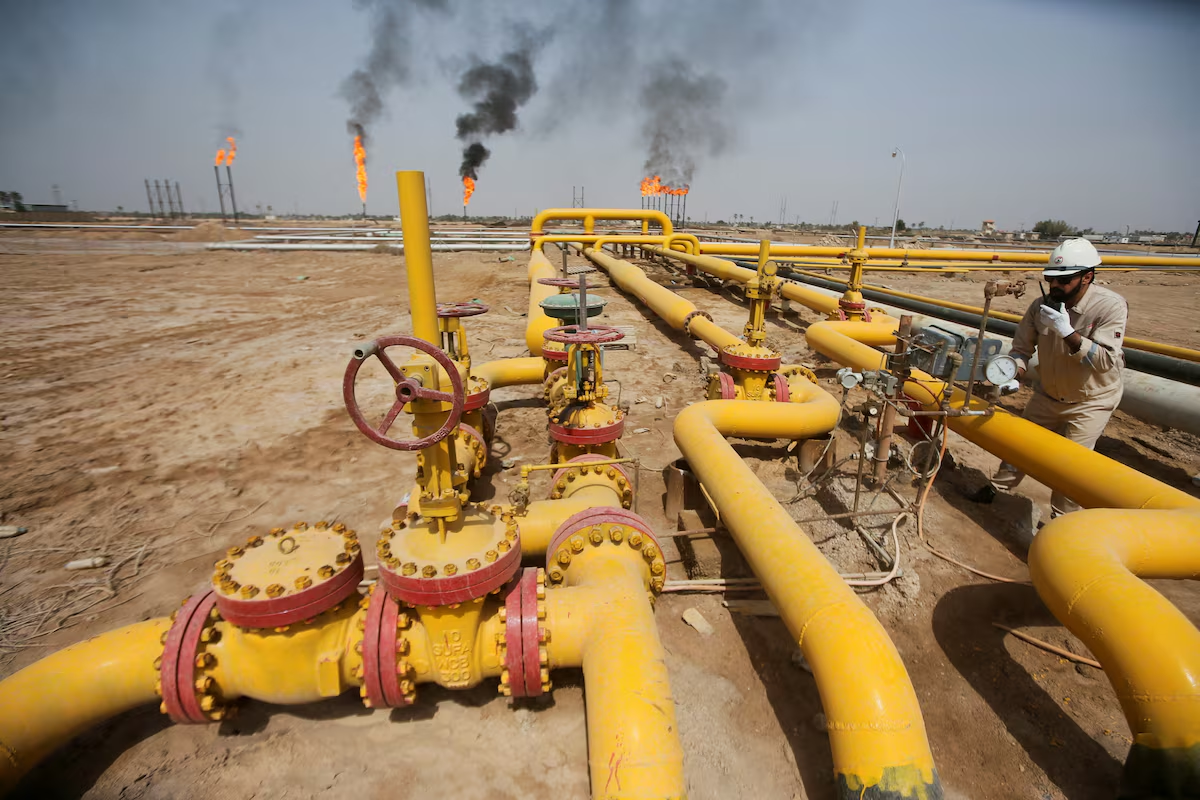
Because oil is priced in dollars, a weaker dollar can push nominal oil prices higher or at least make them more affordable for non-dollar buyers, potentially boosting demand.
Indeed, oil prices have held steady in the $60–65 per barrel range in early 2026 despite ample supply, supported in part by the dollar’s decline enhancing global purchasing power.
2. A Boost for Tourism
A weaker dollar makes dollar-linked tourist destinations more affordable for European and Asian travelers.
Economic reports indicate a rise in tourism flows to the region in 2025 as travelers capitalized on the favorable exchange rate.
In the end, a weaker dollar is a double-edged sword. On one hand, it supports US exports and serves Trump’s short-term political and economic goals. On the other, it poses long-term risks to global confidence in the dollar risks that could ultimately backfire if mismanaged.


