







هذا التقرير متاح أيضًا بـ العربية
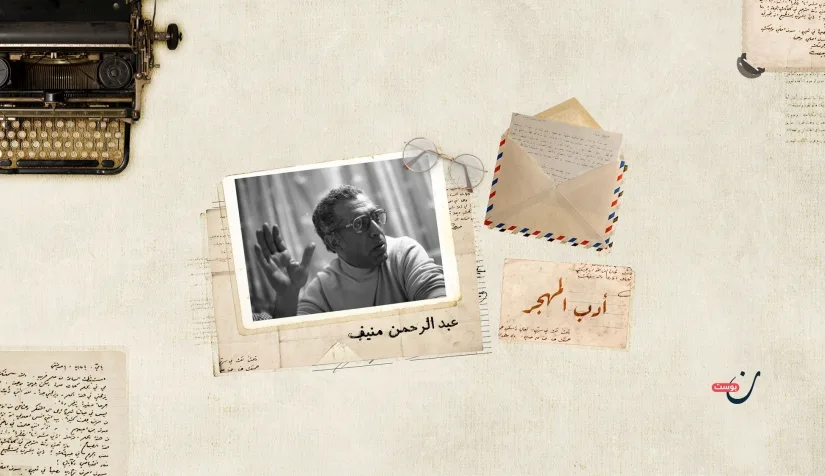
Of the many interviews, articles and books about Abdulrahman Munif, one of the most revealing accounts of his life may be that of his friend, the critic Dr Faisal Darraj. In an interview, Darraj described Munif as an ascetic whose moral commitment and integrity in politics and literature were without equal. Perhaps no one in the Arab cultural world, he suggested, had been as determined to preserve his intellectual integrity and dignity.
Darraj’s account reflects the distinctive course of Munif’s life: his political activism, his restless movement between Arab cities and cities further afield, and his eventual decision to devote himself to literature after becoming disillusioned with politics.
Literature became Munif’s last means of resistance. He did not write for a homeland defined by a particular place. Instead, he addressed the Arab world from afar, exposing its political problems and examining how its emerging societies had taken shape. These societies had produced stunted urban sprawl rather than fully developed city life, lacking the cultural foundations and accumulated experience needed to sustain it. His writing scrutinised successive phases of Arab political life, particularly the pivotal period of political ascendancy in the 1960s, the dashed hopes of change that followed, and the mounting excesses of repressive regimes and political blocs.
Munif was born in Amman in 1933 to a father from the tribes of Najd and an Iraqi mother. A Saudi national, he moved to Baghdad to study law and became politically active as the Baath Party gained ground in Iraq. He was expelled for political reasons, then lived in Cairo and Beirut before moving to Damascus, Syria. His movements coincided with a wave of political upheaval across the Arab world.
Exhausted by political work and years of moving between Arab cities, Munif earned a doctorate in oil economics in Bulgaria. He then returned to Syria, where he worked for an oil company.
In 1973, the author of Cities of Salt moved to Lebanon to work for Al-Balagh magazine. He later became editor of Oil and Development in Iraq, a post he held until 1981. That year, he left the Arab world for Paris, where he began writing for the press and devoted himself to literature. He never returned to the Arab world.
Munif’s repeated moves between Arab cities, and eventually beyond them, as he fled political repression made him one of the leading figures of the second generation of émigré literature. His travels and political activism provided material for his fiction, which he developed after moving to France.
Resistance from afar
In The Travels of the Noble Bird, Mohammed Al-Qashami recounts Munif’s turn from politics to literature:
“After a short period in political work, I discovered that I was deceiving myself and deceiving others — not because politics is inherently a vile profession in absolute terms, but because this kind of politics was closer to absurdity, since it was not grounded in reason, knowledge of reality, or service to the poor and the oppressed. That is why the political institution I was part of carried on without regret, while I turned to what had been a passion.”
Munif did not break completely with politics, nor did he leave the Arab world behind. He may have left it physically, but his move to Paris and the development of a remarkably rich literary project expressed his belief in another approach: writing in exile could offer an alternative history of the stages through which Arab states had passed. It also allowed him to explore whether literature could remain his only means of reaching distant places.
Munif wrote many novels, using a range of narrative styles and techniques. He co-wrote A World Without Maps with Jabra Ibrahim Jabra and worked on an epic scale in his celebrated five-volume Cities of Salt and the trilogy Land of Darkness. Yet one novel has remained somewhat overshadowed by these works: East of the Mediterranean.
In it, Munif set aside the distance from which he had examined the formation of political structures and the workings of Arab regimes. He replaced it with a narrative as raw as an open wound, establishing a new strand of Arab writing: prison literature.
Reading Arab societies through fiction
Munif’s novels combined close critical scrutiny with political and social insight, both in their details and in their broader concerns. Even their titles offered a pointed examination of Arab societies. Across the five volumes of Cities of Salt, he tells the story of oil cities that appeared almost overnight. Their sudden, exceptional growth lacked the long historical process through which cities take shape, develop and expand.
Whether or not Munif made the connection explicit, an explosion of wealth had created these cities. They were swollen like balloons, ready to burst at the touch of something sharp. Salt in the title mirrors the properties of oil in the countries Munif wrote about. Like wealth, salt is essential to life, but in excess it spoils land and water and becomes more than the human body can tolerate.
In Land of Darkness, Munif returns to his mother’s homeland to recount the history of 19th-century Iraq. He begins with the politics of Dawud Pasha’s rule and the fraught relationship between the ruler and the British consul. The trilogy then examines different layers of Iraqi society: first the inner workings of politics and the methods used to govern Mesopotamia, then life on the streets, conveyed through Iraqi vernacular appropriate to the period, and finally the repressive presence of the British mandate.
The title Land of Darkness evokes Iraq’s palm trees, whose canopy blocks the light from reaching the ground, making the land appear shrouded in black. It foreshadows the catastrophe and the depths into which Iraq would descend only a few years after the trilogy’s publication.
East of the Mediterranean is unusually short beside Munif’s expansive works, which nevertheless consistently maintained a high standard. Into this brief novel, he poured all his pain.
A muffled scream
Munif began writing novels in 1970. He wrote East of the Mediterranean in the early 1970s, before any of his novels had been published. He was not yet fully convinced that fiction was his last hope of communicating with others. Politics still drew him, and the wounds left by the political failures of the 1960s, particularly in Egypt and Syria, remained raw. The novel emerged from that anguish: a scream without a sound.
From the outset, the novel examines how a jailer can take possession of a prisoner’s body, through physical assault and by destroying his will. Munif sought to assert that, however dark their lands or salt-ravaged their soil, people retain the capacity for freedom. Freedom, he argued, is the only way for rulers and ruled alike to sleep in peace.
The novel opens with an article from the Universal Declaration of Human Rights stating that no one shall be subjected to torture or to cruel, brutal or degrading punishment or treatment.
The fictional world that follows draws the reader into the cities of the eastern Mediterranean, broadly encompassing Arab countries including Lebanon, Egypt, Palestine, Syria and Libya. We encounter “Ismail” as he leaves prison after five years of brutal torture and travels to Europe for treatment. He has informed on his companions against his will, simply because he could endure no more.
On the ship to France, Ismail asks himself what it means to leave prison. Another form of torment awaits him: psychological suffering, self-contempt and a sense of betrayal that consumes him. It is as though the torturer has taken possession of his conscience, leaving it to continue the torture.
Surrounded by the expanse of land and sea, Ismail feels trapped in the eye of a needle. Where can he escape? He recalls his abilities and strength before prison and wonders how he became an informer who betrayed his companions.
Writing in France, where Ismail has sought refuge, Munif moves between memories of prison and torture and efforts to recover from that past. Another character, Rajab, meets Dr “Vali,” a former resistance fighter against the Nazi occupation of France during the Second World War. Vali helps him recover and advises him to turn his sorrow into hatred of the torturer. That, he says, is the way to prevail. Giving in to sorrow will destroy both him and his cause.
Unlike Munif’s other novels, East of the Mediterranean does not use a slowly unfolding narrative to construct a fictional world that parallels reality. Its language moves at a feverish pace, reflecting Ismail’s inner crisis: he has left prison, but prison remains within him. Munif describes the methods of torture in detail, yet his purpose extends beyond that description. He presents torture as an act that destroys its victim even when he survives, because memory continually recreates the experience, inside prison and outside it.
This “mental” approach, which quietly draws the reader into the heart of the story, differs from that of later works of prison literature, such as Ayman Al-Atoum’s They Hear Its Hissing and Mustafa Khalifa’s The Shell.
For Munif, depicting the horror of torture means more than eliciting emotion or lamenting the plight of detainees. Such lament usually arises from sympathy and is soon forgotten. He instead seeks to connect the mechanisms of torture with the struggle for civil rights: the freedom to oppose, criticise and help shape a political project. Rajab’s conflict therefore extends beyond the memories of prison that are destroying him from within. It also concerns the possibility of resistance.
When Rajab’s family is harassed to force him to return, he agrees to go back and accepts the consequences, having considered the possibility of resisting again. He returns, is arrested and dies in his bed. One of his sisters has sent his documents and diaries recording prison and torture to the United Nations in Geneva, and his testimonies are published in the foreign press.
The novel gives few details of its setting. It refers to spaces inside and outside: a room, a street, a garden. These could be found in any country. Perhaps Munif avoided naming a particular Arab country because he wanted to sketch a setting that could apply anywhere. The novel could then serve as both a satire and an exploration of resistance and the political struggle for human dignity under any regime that tortures its opponents.
The value of East of the Mediterranean lies in these multiple layers. It offers a confessional account and a record of prison life in the Arab world. It also tells a universal story that defends humanity and its dignity against repressive regimes. The novel also explores the tension between the prospect of freedom beyond the Arab world and the constraints on freedom within it.
Would Munif have written such a novel without the bitterness of moving from one country to another? Any answer would be speculative, but the bitterness in East of the Mediterranean reflects his profound disappointment with his political experience in the Arab world. He was rejected more than once: cast out by Saudi Arabia, stripped of his citizenship and expelled from Iraq. He passed through cities to which he belonged but which did not belong to him. He found no alternative but to seek hope in writing, at a time when hope itself was a form of absurdity and madness across the Arab world.