


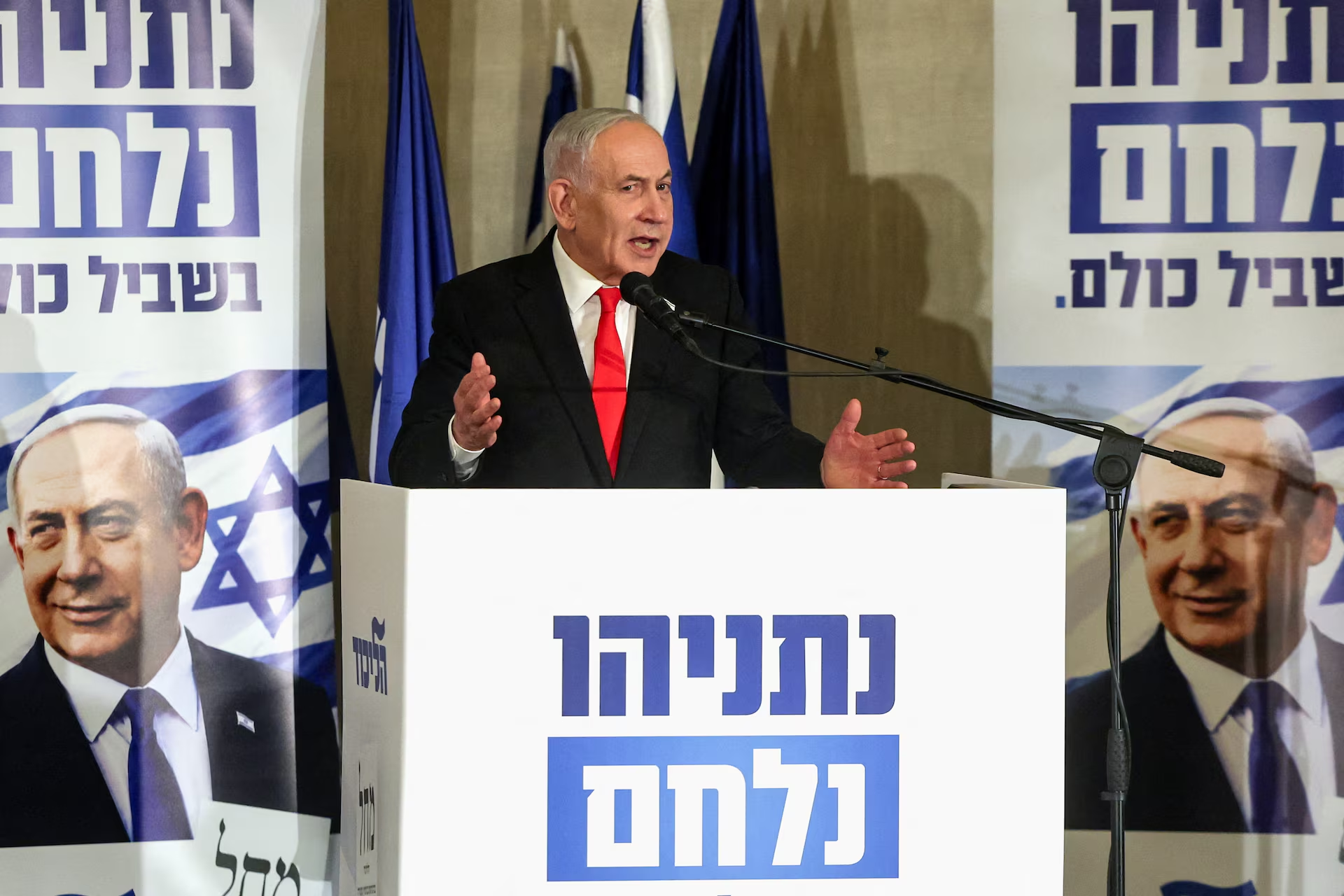



Just hours after the U.S. strike on Venezuela and the arrest of President Nicolás Maduro, Israeli opposition leader Yair Lapid declared, “The Iranian regime should take careful note of what’s happening in Venezuela.” His pointed remark reflected the lens through which the operation was interpreted in Tel Aviv.
This statement wasn’t a passing comment. Rather, it underscored a sense of political and security satisfaction in Israel with Washington’s use of force absent any international mandate an approach Israel believes should be replicated in other contexts.
Foremost among these is the Iranian regime and its regional and international affiliations, which Israel views as the central threat to its national security doctrine. But the implications go beyond Iran.
They include a renewed legitimacy for Israel’s own military actions, a reduced cost for deploying force outside legal frameworks, and a weakening of transcontinental international solidarity with the Palestinian cause solidarity that has placed mounting political and moral pressure on Israel in global forums.
From this perspective, the U.S. strike on Venezuela is not viewed in Tel Aviv as an isolated event in Latin America, but rather as part of a broader reshaping of priorities and norms within the international order an order increasingly aligned with Israel’s security worldview.
It restores the primacy of force over law, weakens the centrality of international legal norms, and gives Israel broader leeway to justify its military policies. In effect, the operation resembles a penalty kick taken by Washington but its strategic outcome lands squarely in Israel’s favor.
Whitewashing Israeli Crimes
In the final months of 2025, President Donald Trump repeatedly threatened Venezuela and its president, urging Maduro to step down and leave the country. These threats were backed by a large military buildup off the Venezuelan coast, including more than 10,000 U.S. troops, the aircraft carrier USS Gerald R. Ford, and several heavy bombers, including B-52s and B-1s. Since October 2025, several attacks were carried out on speedboats in the Caribbean, killing more than 60 Venezuelans.
To many observers, Trump’s talk of regime change in Venezuela seemed fanciful divorced from the post-WWII norms of international legitimacy and grounded only in flimsy pretexts like drug trafficking or Maduro’s alleged illegitimacy, charges that could easily apply to other Latin American governments.
Yet in a sudden turn, Trump followed through: he attacked Venezuela, bombed its ports, and abducted its president and first lady.
This shift from threat to execution without legal authorization or international consensus and despite explicit European (British and French) declarations of non-participation mirrored the Israeli military model in the Middle East over the past two years.
In Israel’s case, the combination of preemptive threats and rapid execution has become a cornerstone of what is marketed as “preventive deterrence” whether in operations against the Houthis, Hezbollah, or repeated strikes in Syria. What the Venezuelan case adds is the application of this model to direct U.S. military action, lending it a de facto legitimacy and normalizing what had previously been seen as an Israeli exception.
As a result, the overlap between American and Israeli methods of military engagement yields several consequences: conditioning international and regional audiences to expect strikes as foregone conclusions, diminishing the value of national sovereignty by violating territorial integrity, and bypassing the usual criteria for launching wars, such as UN resolutions or multilateral consensus.
In this light, the U.S. strike on Venezuela sets a precedent that legitimizes future attacks on countries like Qatar, Iran, Lebanon, or Yemen their infrastructure, leadership, or critical assets. The implicit message: if Israel can do it, so can the U.S. so why should Israel be held accountable while America is not?
This dynamic erodes any legal argument against Israeli actions, including assassinations, preemptive strikes, and the violation of sovereign airspace. It constitutes a retroactive political and moral whitewashing of Israel’s conduct two years of mass violence, and seven decades of colonialism and breaches of sovereignty and human rights within the Western narrative.
The High Cost of Solidarity
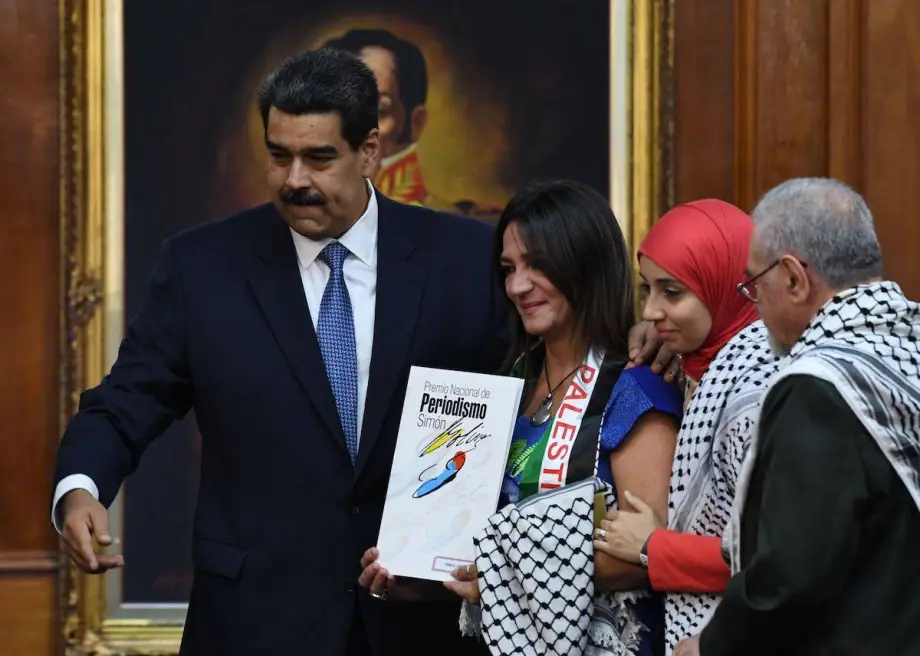
The impact of the U.S. strike extends beyond the legal fabric of the international system. It also raises the cost of official solidarity with anti-imperialist causes, foremost among them the Palestinian struggle. Venezuela has not been a neutral actor in the Arab-Israeli conflict. In recent years, it emerged as one of the most prominent non-regional champions of the Palestinian cause.
This was reflected in severing diplomatic ties with Israel in 2009, hosting Palestinian delegations, supporting international legal actions against Israel, and backing countries pushing for an oil embargo to pressure Tel Aviv to halt its crimes against Palestinians.
Seen through this lens, the targeting of Venezuela sends an implicit warning to states and organizations that have translated pro-Palestinian stances into measurable policy. Although Washington did not explicitly cite Caracas’s position on Israel as a motive, broader U.S. foreign policy trends over the past two years reveal growing intolerance toward any international solidarity that transcends humanitarian concern and moves into direct criticism of U.S. policy or its backing of Israel.
This development increases the cost of official solidarity, pushing many countries to recalibrate not by abandoning support for Palestinians outright, but by limiting that support to rhetorical or popular channels.
In such a climate, official silence or vague, noncommittal statements becomes less risky than adopting practical policies like boycotts or legal action. Consequently, institutional solidarity is hollowed out, reduced to a political liability instead of an effective tool for international pressure.
This shift drives official solidarity inward confined to public sentiment rather than state action and drains it of efficacy, as states adopt more cautious, centrist positions both domestically and internationally, including in forums like the UN Security Council and General Assembly, to avoid potential political, economic, or military reprisals from Washington.
It is within this context that Palestinian factions swiftly condemned the U.S. assault on Venezuela, describing it as an extension of imperial dominance and a punishment for supporting Palestine. Meanwhile, Arab states and Middle Eastern regimes largely chose silence, watching events unfold from the sidelines.
The Power of Implicit Threats
From an Israeli standpoint, the most significant benefit of the U.S. strike lies not in its direct outcomes but in its broader implications. Though Israel played no role in the operation, it stands as the primary beneficiary of the messages the strike conveyed particularly in the context of Iran and the Middle East.
The operation thus serves as a political and security signal: that the use of force outside international legal frameworks remains a viable—and repeatable—option. On one level, the strike is interpreted as an escalation against Iranian-linked networks beyond the Middle East, curbing their operational space in Latin America.
This region has long been considered a core sphere of American influence, and the strike aligns with past U.S. efforts to sanction entities involved in Venezuelan-Iranian military and technological cooperation. It reinforces the perception that targeting Venezuela is part of a broader strategy to pressure Iran’s global enablers, if not the regime itself—for now.
This began in late December, when the U.S. Treasury Department imposed sanctions on Venezuelan individuals and entities assembling Iranian-designed combat drones, labeling them a threat to U.S. interests in the Western Hemisphere.
Simultaneously, Israeli intelligence-linked think tanks issued a series of reports highlighting close ties between Caracas and Tehran, including direct flights allegedly used for transferring personnel and equipment, the Venezuelan regime’s reliance on Iran’s Revolutionary Guard to rehabilitate its oil sector, and safe havens granted to Hezbollah operatives.
In this context, the U.S. operation functions as an indirect deterrent a message to Tehran without triggering full-scale confrontation. Rather than a direct blow that risks regional escalation, pressure is being strategically applied to Iran’s far-flung allies.
This approach offers Israel a dual strategic gain: tightening the noose around Iran beyond the Middle East, while expanding its own freedom of action within it. It reinforces the idea that unilateral strikes are no longer Israel’s domain alone but a shared tactic with the world’s dominant power.
Accordingly, the U.S. strike may be viewed as Israel’s final warning to Iran pushing Tehran to take Israeli-American threats more seriously, reduce its regional involvement, and pull back from rebuilding its ballistic and nuclear capabilities.
This comes amid growing anti-government protests across Iran and following a Trump warning that “using live ammunition against protesters is not a domestic matter and continued repression will be met with consequences.”
The warning narrows the Iranian regime’s options in dealing with protesters, even as it suspects foreign orchestration behind the unrest aimed at toppling the government.
Israeli sources, along with former U.S. Secretary of State Mike Pompeo, reinforced this narrative. In a post, Pompeo wrote: “Happy New Year to every Iranian taking to the streets and to every Mossad agent marching beside them,” an unambiguous reference to foreign intelligence operatives among the demonstrators.
Redrawing the Map of Legitimacy
The U.S. assault on Venezuela at the dawn of 2026 reveals stark discrepancies in how Western powers approach foreign intervention depending on geography. A comparison with Syria, Ukraine, South Sudan, or the plight of minorities in China shows that legitimacy is no longer grounded in popular will or the severity of abuses, but in the calculus of Western interests and influence.
In Syria, mass protests erupted in 2011 demanding political change amid well-documented rights abuses, drug trafficking, and the regime’s reliance on foreign forces for survival. Yet the U.S. and Western powers refrained from direct intervention to remove Assad highlighting a clear selectivity in applying principles of intervention and civilian protection, based not on legality or morality, but on strategic interest.
This is not unique to the Trump administration. It extends to the European Union and the broader Western order. Despite the American operation’s flagrant breach of international law, the European Commission issued a statement treating it as an internal Venezuelan uprising.
Commission President Ursula von der Leyen declared, “We support a peaceful transition in Venezuela… We stand by the Venezuelan people and back a peaceful, democratic transition. We’ve repeatedly stated that Maduro lacks legitimacy.”
Other governments limited themselves to platitudes about respecting international law, urging restraint, and expressing “shock and concern.” Only close U.S. allies like Israel and Argentina rushed to applaud and endorse the operation.
In his most recent statement, Trump laid out his vision for Venezuela’s future, affirming that the U.S. would manage the country directly if necessary. He laid down the terms of what he sees as just governance modeled after his preferred opposition figure and driven by access to Venezuela’s vast oil reserves.
Once again, Trump writes the Middle East’s story from afar justifying Israeli wars through his own, serving up nations on silver platters to their tormentors and colonizers, dismantling the principle of state sovereignty to his and his allies’ advantage, promoting piracy and violence, and redefining international relations through the lens of brute force.


