






Amid the rubble of Rafah in southern Gaza, the United Arab Emirates is planning to fund what has been described as the “first master-planned residential community” for Palestinians offering supposed access to basic services such as education, healthcare, and clean water, contingent upon residents submitting biometric data and passing a “security screening.”
This scheme revealed in detail by The Guardian marks the first Emirati investment of its kind in a so-called Gaza reconstruction initiative following Israel’s offensive on the territory.
Despite being marketed as a “planned community” or “humanitarian city,” both Palestinian and Israeli observers have warned that the project resembles a ghetto or sprawling detention zone under Israeli control, where entry and exit are governed by biometric checkpoints and strict security protocols.
Background and Objectives
According to The Guardian, the plan has already received the green light from Israeli military planners. It stems from a broader vision put forth by the administration of former US President Donald Trump in the aftermath of the 2023–2025 Gaza war.
Under a fragile ceasefire agreement brokered by Trump, Gaza was effectively divided into two zones: a “green” zone controlled by Israeli forces, and a “red” zone under what Washington labeled as “Hamas governance.”
Although the reconstruction plan ostensibly applies to the entire territory, both Israel and the US have been promoting initiatives restricted to the so-called “yellow zone” an area comprising approximately 58% of Gaza and under direct Israeli oversight.
At the World Economic Forum in Davos in January 2026, Jared Kushner Trump’s son-in-law unveiled a comprehensive blueprint to “redevelop the entire Gaza coastline,” including eight new residential clusters. Among them are two development zones named “Rafah 1” and “Rafah 2,” intended to form a new city: “New Rafah.”
The newly formed “Peace Council,” the overseeing body for Gaza’s reconstruction, pledged that “New Rafah” would eventually offer 100,000 permanent housing units, 200 educational centers, and 75 healthcare facilities.
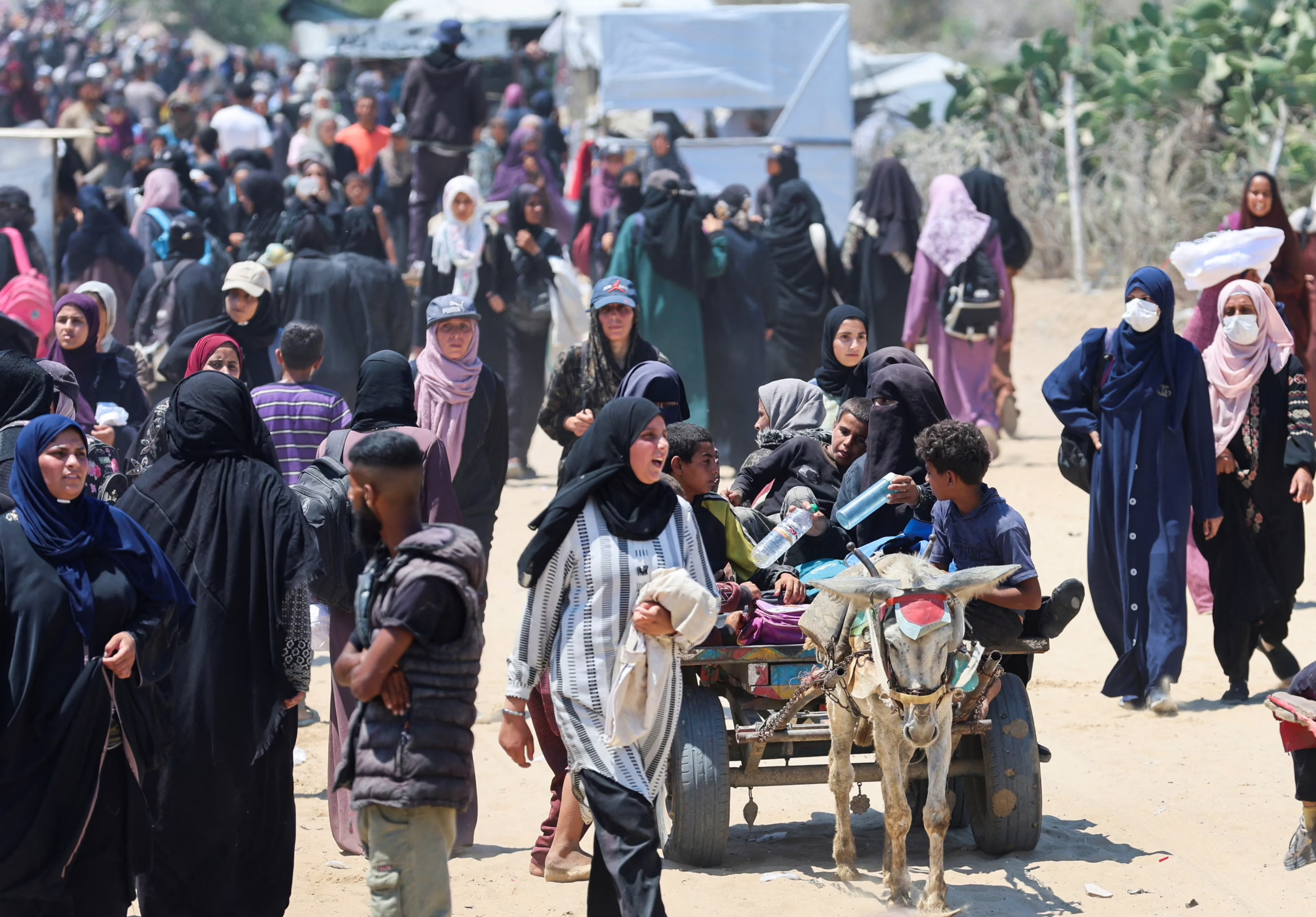
Israel’s most recent assault on Gaza left the territory in ruins around 75% of its buildings and infrastructure were destroyed or damaged. UN experts estimate that full reconstruction will require at least $70 billion and could take up to 80 years, especially given the ongoing blockade.
Established under Trump’s initiative, the Peace Council included the UAE among its first member states, signaling not only Abu Dhabi’s financial commitment but also its political endorsement of the project.
By late 2025, reports indicated that the US-led reconstruction team was preparing to begin building the first residential compound in Rafah within weeks, with an estimated cost in the tens of millions of dollars and a projected construction timeline of several months.
The Israeli army has already begun clearing land in the designated Rafah area, including removing tunnels, booby-trapped buildings, and rubble east of the “yellow zones” demarcation line.
Israel claims it will not be directly involved in the construction or management of the Emirati-funded compound, delegating this responsibility to an international force expected to oversee the ceasefire.
Project Features and Residency Criteria
The Rafah compound is presented as a pilot project (a case study) under a strict framework:
-
It will accommodate approximately 25,000 Palestinians.
-
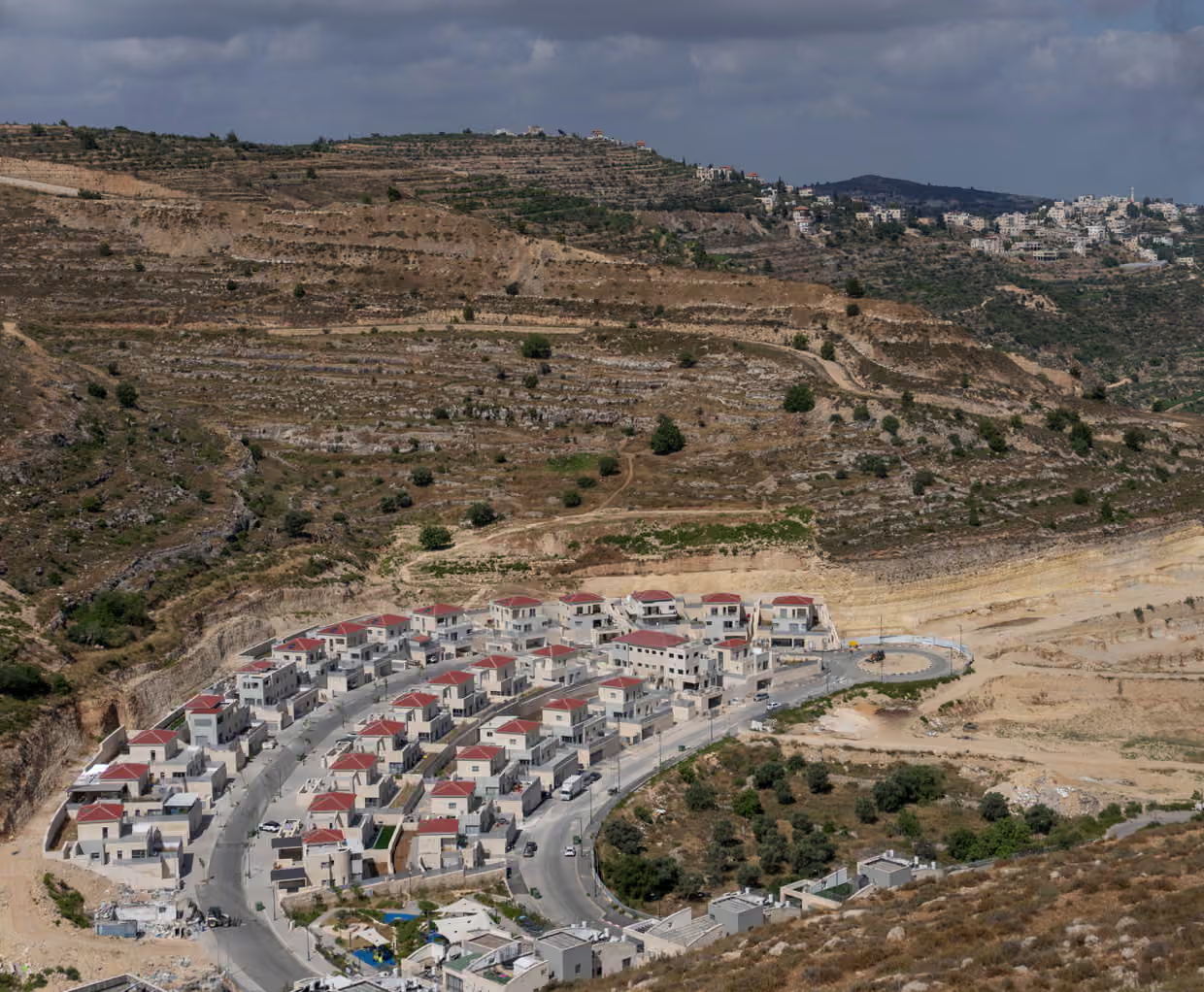
It will be built in an area entirely under Israeli control in southern Rafah, spanning 1 square kilometer at the intersection of two military corridors.
-
Entry will be limited to Palestinians “invited” based on Israeli-determined criteria.
-
Priority will be given to former Rafah residents, especially those from the Shaboura camp.
-
Preference will be shown to extended, multi-generational families to ensure “solidarity networks.”
-
Residents must include individuals with essential professions: teachers, medical staff, rescue workers, merchants, civil servants, and bankers.
-
All potential residents must undergo intensive security screening to prevent the infiltration of militants or weapons.
-
Those coming from the “red zone” must cross an Israeli checkpoint at the demarcation line.
-
Residency is conditional on submitting biometric data and passing security clearance.
-
Entry and exit will be tightly regulated through inspection points to prevent the movement of weapons or “hostile actors.”
-
Biometric data will be logged in a private database linked to residents’ Palestinian ID numbers.
-
Administratively, the project will establish a local civilian authority, initially led by a provisional committee from within the community, with future elections planned to form a local council.
-
This local administration will manage basic municipal services water, electricity, and sanitation in coordination with donor agencies, bypassing traditional Palestinian Authority channels.
-
The land will be designated as “public property,” with ownership documents reviewed in late 2025 to confirm no private claims.
-
For internal security, a civilian police force is proposed to operate under the oversight of the international stabilization mission.
Economic and Educational Systems
The compound’s blueprint outlines distinct economic and educational systems.
Economically, residents will be required to use digital payment systems primarily electronic wallets in Israeli shekels purportedly to “secure” transactions and prevent the diversion of funds or goods to “Hamas financing channels.”
This means all economic activity within the compound will be closely monitored within a financial framework dominated by Israeli oversight. A branch of Bank of Palestine will be established inside the compound to facilitate transactions.
Imports will be permitted to “encourage economic growth,” though they will remain subject to strict Israeli security controls. For nearly two decades, Israel has maintained a blockade and rigorous monitoring of goods entering Gaza.
On the educational front, the compound will adopt an alternative curriculum aligned with Emirati standards, replacing the traditional Palestinian syllabus.
The curriculum is said to promote a “culture of peace,” following the UAE’s model, instead of the usual nationalist content.
The objective, critics argue, is to reengineer consciousness dismantling the Palestinian narrative and replacing it with a depoliticized identity detached from the national cause.
This approach mirrors the UAE–Israel normalization agreement (Abraham Accords, 2020), which committed both parties to fostering “mutual understanding, respect, coexistence, and a culture of peace.”
Criticism and Concerns
The proposed “residential compound” has triggered a wave of criticism, with skeptics questioning its motives and warning of dire consequences.
Former Israeli negotiator Daniel Levy argued that the plan gives Israel “another layer of permission” to continue “cleansing” Rafah of its Palestinian population through killing and displacement without even laying a brick.
He added that Emirati involvement allows Israel to claim the initiative is backed by an Arab state, obscuring the reality that Israel effectively controls 58% of Gaza, while presenting the zones under its authority as a prosperous “Happy Gaza” filled with schools, hospitals, and courthouses.
Humanitarian experts warned that the plan marks a new phase in “weaponizing humanitarian aid” by dominant powers.
Former UN official Jonathan Whittall noted that after Gaza was “flattened, starved, and deliberately besieged,” these new communities built on the ruins of people’s homes function as laboratories for governance testing absolute control and the subjugation of Palestinians. He likened them to a revival of refugee camps in a new form.
Designed to confine a new generation of displaced Palestinians to ever-shrinking zones under Israeli control, the compound offers the bare minimum for survival while the remaining “red zones” remain vulnerable to bombing, siege, and humanitarian neglect.
Analysts believe that dangling food and shelter may not achieve Israel’s goal of depopulating Hamas-controlled zones.
Palestinian analyst Mohammed Shehada observed that such tactics “ignore politics” and are unlikely to push red-zone residents to relocate merely for access to food.
Many believe the real outcome will be further demographic fragmentation and ethnic cleansing. Some fear that the US and Israel will establish a handful of limited-capacity compounds (each holding 20,000–25,000 people), selectively populated through stringent security vetting, while the rest of Gaza is left a desolate wasteland driving mass displacement through unbearable living conditions.
European observers have also flagged the disconnect between these blueprints and Gaza’s chaotic on-the-ground reality. According to Reuters, several European countries are considering reducing or entirely withdrawing their involvement in the US-Israeli Coordination Center (CMCC) after concluding that it has failed to improve humanitarian access.
Meanwhile, Israel uses such projects to burnish its global image an accusation now echoed within Israel itself.
Former Israeli Prime Minister Ehud Olmert called the planned “humanitarian city” in Rafah a blatant attempt to confine Palestinians in sealed camps as part of a broader campaign of ethnic cleansing. He described the initiative as a modern-day internment camp designed to lock in hundreds of thousands of people with no political horizon.


