











In a dangerous development the first of its kind since the fragile ceasefire began in Gaza on January 19, 2026, the Israeli military dropped leaflets east of Khan Younis giving dozens of Palestinian families only moments to leave their homes.
The evacuation orders in the southern town of Bani Suheila marked a de facto expansion of Israeli control inside the enclave, sparking fears of a continued incremental advance of Israeli lines despite the ceasefire agreement.
This move coincided with ongoing reports of repeated expansions of the so-called withdrawal boundary, or “yellow line,” since the truce began intensifying internal displacement and exacerbating the suffering of Palestinians trapped in an ever-shrinking geographic space.
Evacuation Orders
The leaflets, printed in Arabic, Hebrew, and English, carried a terse message: “Urgent Message: This area is under the control of the Israeli army. You must evacuate immediately.”
Local residents reported that the warning targeted at least 70 families living in tents and homes already partially damaged in earlier attacks. These families were forced to hastily gather their belongings and flee westward, away from the danger zone.
The Israeli military later claimed there was no intent to forcibly displace civilians, contradicting media reports. According to its spokesperson, the leaflets were meant to warn civilians not to cross the yellow demarcation line.
A military spokesperson confirmed the leaflets were dropped east of Khan Younis, stating they followed the observation of several Palestinians allegedly attempting to cross into the “Israeli” side of the line.
However, the explicit wording of the leaflets which contained a direct order to evacuate left residents feeling it was a serious warning of forced displacement, particularly given the precedent during previous stages of the war when such leaflets often preceded attacks and invasions, followed by mass displacement.
The Bani Suheila incident was just the latest in a series of on-the-ground expansions carried out by Israeli forces since the ceasefire took effect.
Mahmoud, a father of three from the area, said they were once again forced to flee west following the recent warning. “This is probably the fourth or fifth time the Israelis have pushed their yellow line forward since last month,” he said.
He confirmed that the army has, each time, carved out a strip between 120 to 150 meters into previously Palestinian-held territory, “swallowing more land.”
Fortifications and Concrete Blocks
The historic al-Tuffah neighborhood in eastern Gaza City offered another stark example of Israel’s attempts to entrench a new on-the-ground reality during the ceasefire period.
The Israeli army used yellow concrete blocks to adjust its withdrawal line, as shown by satellite images that reveal the initial placement of the blocks along the original boundary, followed by a push some 200 meters deeper into the neighborhood in December 2025.
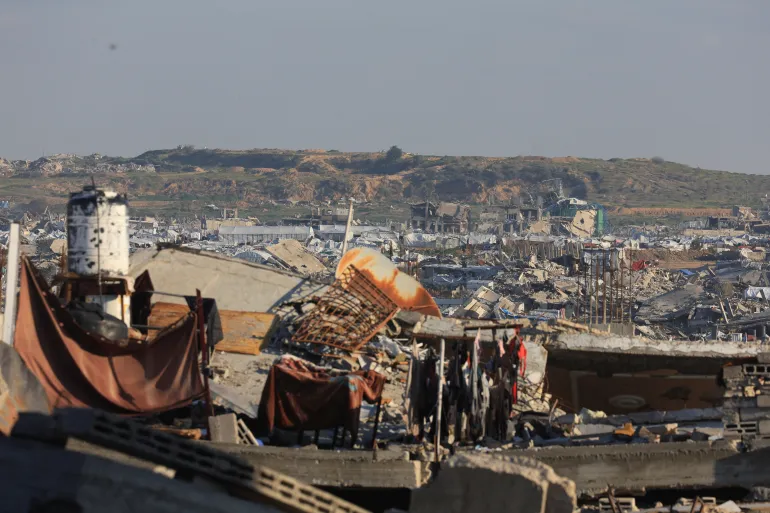
Following this, the military leveled the area and demolished no fewer than 40 residential buildings within the newly expanded zone, turning large portions of the neighborhood into scattered rubble.
Only a few buildings remain standing between the newly placed blocks and the original yellow ceasefire line, offering a visual measure of the destruction caused by the expanding buffer zone at the expense of civilian housing.
In the south, Khan Younis was not spared from similar actions to solidify these new lines. Recent imagery shows Israeli forces installed forward-positioned concrete blocks extending roughly 390 meters and another set 220 meters beyond the agreed-upon line east of Khan Younis in December.
This was accompanied by the destruction of multiple buildings in the area and the dismantling of two displaced persons camps that had sheltered hundreds of families fleeing earlier fighting.
Along the length of the yellow line, the Israeli army has constructed at least six large military fortifications near its control boundaries some as close as 264 meters from the demarcation line in Beit Hanoun in the north to house troops and secure the newly expanded zones.
Despite these actions, the Israeli military insists it has not unilaterally altered the lines, claiming that the placement of blocks falls under “temporary field arrangements” to ensure troop safety, and that the shifting locations are due to terrain and logistical challenges on the ground.
Mounting Humanitarian Fallout
These repeated expansions have deepened Gaza’s humanitarian crisis, already dire after more than two years of war.
Over two million Palestinians are now confined to just one-third of Gaza’s original area, most of them living in tents or partially destroyed buildings with minimal access to shelter or basic services.
According to the Gaza Government Media Office, the Israeli army has extended its control east of Khan Younis five times since the ceasefire began, displacing at least 9,000 Palestinians from that area alone.
The most recent incursion, following the leaflet drop in Bani Suheila, forced around 3,000 people to flee. The media office described this as part of a systematic campaign of intimidation and pressure aimed at pushing civilians away from their communities.
The ongoing push of the yellow line westward has displaced thousands, compressing Gaza’s entire population into a narrow coastal strip that now comprises just 30% of the territory’s original landmass, according to an official Hamas statement.
Local officials warn that recent waves of displacement have further deteriorated the already overwhelmed shelter infrastructure.
The makeshift shelters and crumbling infrastructure in the crowded coastal zone are under immense pressure, with few options for relocation or return, as many of the original hometowns now lie behind newly imposed Israeli lines.
Toward Permanent Occupation
These developments have sparked local and international warnings that Gaza may be heading toward de facto partition and the entrenchment of a long-term Israeli occupation under the guise of security.
Palestinian officials say the new reality effectively enforces a forced separation of areas now under Israeli control. They caution that future reconstruction efforts may be limited to these Israeli-controlled zones, while the rest of Gaza remains devastated and overcrowded, with no clear horizon.
Meanwhile, official statements in Tel Aviv have revealed clear intentions to maintain a permanent military presence inside Gaza.
Israeli Defense Minister Israel Katz has repeatedly declared that Tel Aviv will not fully withdraw from Gaza, stating that even in the second phase of the ceasefire agreement, Israel will retain a broad security corridor within the enclave “to protect nearby settlements.”
This stance blatantly violates the war-ending roadmap, which stipulates freezing combat lines, prohibiting expansion, and banning any reoccupation or construction of new settlements in Gaza.
As implementation of the ceasefire’s next phase begins, skepticism is growing over Gaza’s future due to Israel’s delays in withdrawal and its claim that pullback depends on disarmament.
Amid the reality imposed by Israel’s military power on the ground, Palestinians fear that temporary arrangements could harden into permanent borders, leaving the vast majority of Gaza’s population trapped in a barren, resource-starved enclave while Israel tightens its grip on what remains of the territory.


