



هذا التقرير متاح أيضًا بـ العربية
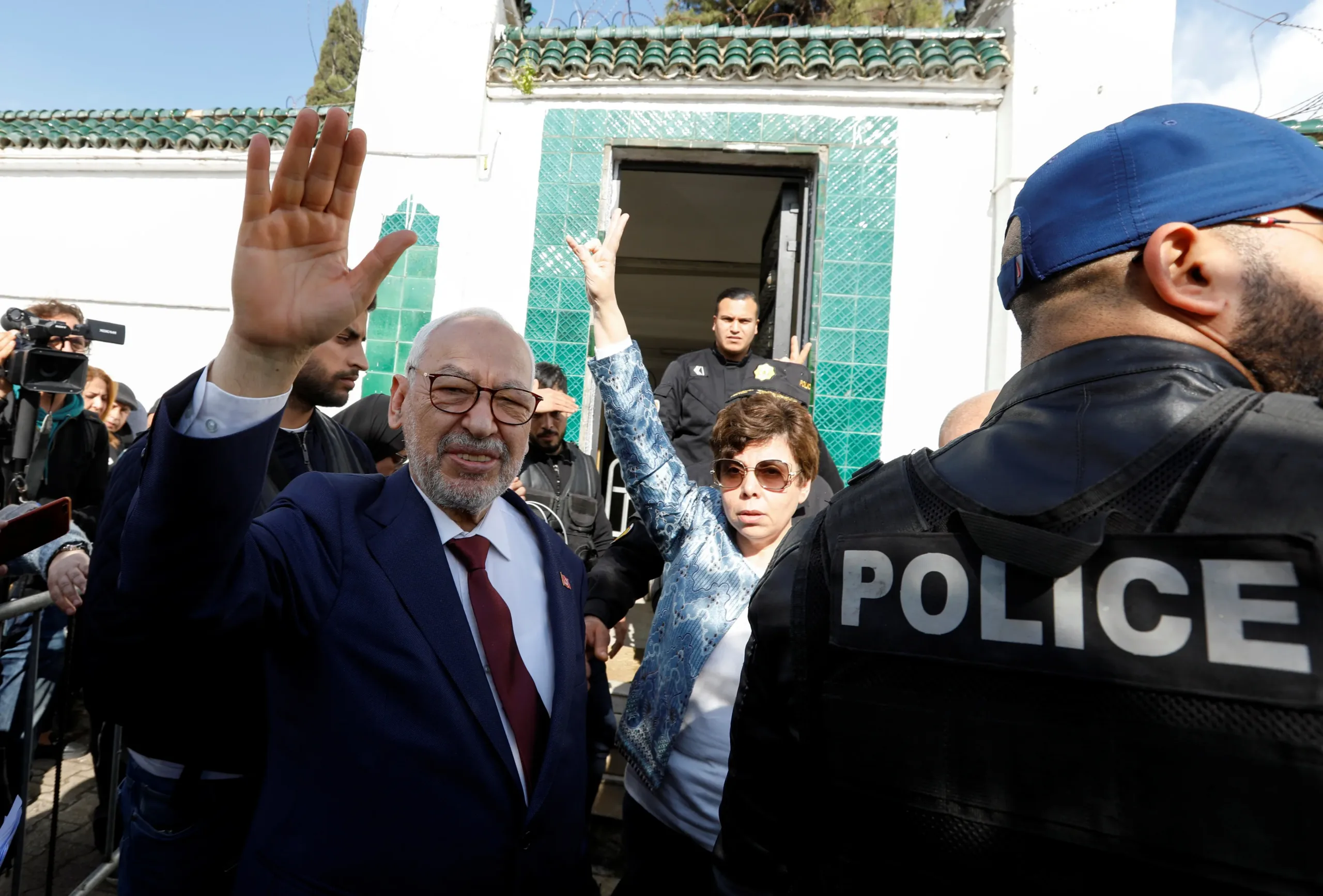
The fallout from the harsh rulings issued in the case known in the media as Ennahda’s “secret apparatus” continues to cast a heavy shadow over the Tunisian scene, especially after life imprisonment plus 30 years was handed down to the movement’s leader and former parliament speaker Rached Ghannouchi, and 42 years to former Prime Minister Ali Larayedh.
The rulings sparked a broad wave of criticism in political and rights circles, whose members said they cannot be separated from a broader pattern of restricting political freedoms and rights in the country.
In their severe form, the rulings have triggered a sharp divide in the Tunisian street, between those who see them as judicial justice and those who describe them as political liquidation, once again thrusting the issue of judicial independence to the forefront of public debate. While Ennahda said what had been issued amounted to “political rulings” and a serious, unprecedented deviation in the course of justice, the opposition National Salvation Front called for an end to what it described as the use of judicial cases to settle scores with rivals and exclude opponents from public life.
These developments cannot be read apart from the political climate Tunisia has been experiencing for nearly five years, specifically since President Kais Saied announced his exceptional measures, which included freezing and then dissolving parliament, dismissing the government, and reshaping the rules of the political and constitutional game.
Those measures pushed the country into a sharp turning point that changed the features of the broader landscape, amid growing criticism that Tunisia is heading toward a concentration of power and a retreat in democratic safeguards, in what opponents describe as a slide toward a “new dictatorship.”
What is the story of the secret apparatus?
The roots of this case go back to 2013, following the assassinations of Tunisian politicians Chokri Belaid, secretary-general of the leftist Unified Democratic Patriots’ Party, and Mohamed Brahmi, secretary-general of the Arab nationalist People’s Movement. At the time, the two killings sent a major political shock through the Tunisian street and opened the door to a deep crisis that affected the course of the post-revolution democratic transition.
Although the Islamic State group, ISIS, claimed responsibility for the two killings, the defense team for Belaid and Brahmi cast doubt on that account and went on to accuse what it described as a parallel apparatus attributed to Ennahda. It said the apparatus was linked to political assassination files, espionage, and the infiltration of state institutions.
From there emerged the label Ennahda’s “secret apparatus,” a term that has remained the subject of intense political and judicial controversy between those who see it as a serious security file that requires exposure and accountability and those who regard it as a political accusation targeting the movement and its leaders.
For years, the case remained captive to political wrangling, until it forcefully returned to the forefront in early 2022 after a complaint was filed by the public prosecutor and the defense team for Belaid and Brahmi. They accused what they called Ennahda’s “secret apparatus” of involvement in the politicians’ assassinations, espionage, and the infiltration of state institutions. Accusations were also directed at a number of the movement’s leaders, foremost among them Rached Ghannouchi, of running and supervising the apparatus.
Ennahda denied the accusations and said they were political in nature, stressing that no secret apparatus affiliated with it exists.
In April 2023, the file entered a more sensitive phase when security forces raided Ghannouchi’s home and arrested him, before a court of first instance ordered his imprisonment on accusations that he had made statements the authorities said incited chaos and disobedience. That came in a tense political context marked by an expansion of judicial prosecutions against a number of opponents and prominent political figures.
In the same year, the Belaid and Brahmi assassination file was referred to the judicial anti-terrorism pole after having been under review by the public prosecutor. Opponents and observers interpreted the move as an attempt to reintroduce the “secret apparatus” file at a moment of intense political polarization and to capitalize on Tunisia’s broader climate to reopen the case before public opinion.
Since then, the file has become one of the country’s most controversial cases, before Tunisians awoke to harsh rulings against Ghannouchi, Larayedh, and others, once again bringing debate over the judiciary, politics, and the future of the opposition in Tunisia to the forefront.
Score-settling first and foremost
Most of the rights-based condemnations that accompanied these rulings have treated them as part of a broader path of political score-settling with Ennahda and its leaders, not merely rulings of a purely criminal nature. From this perspective, critics argue that reading the case solely through a legal lens remains inadequate unless it is placed in its broader political context, and in light of the tension Tunisia has experienced for years between the authorities and the opposition, as well as declining confidence in judicial independence and the guarantees of a fair trial.
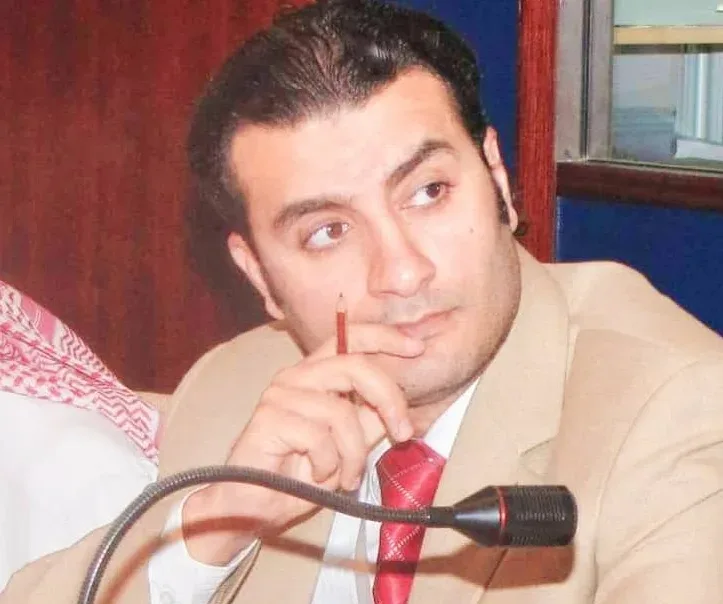
In this context, Tunisian journalist and political analyst Noureddine Ouididi believes that the “secret apparatus” file, which has remained present in Tunisian debate for years, has shifted from a case with legal dimensions into a tool within the political struggle. He argues that the severe rulings issued against prominent leaders, especially first-rank figures in Ennahda, reflect — in his view — a tendency toward political exclusion more than they reflect an independent and reassuring judicial process, especially in light of what he describes as a decline in guarantees associated with fair trials and an expanding circle of targeting political rivals.
Ouididi warns that the danger of this type of case lies in the possibility of using it to reshape the Tunisian political landscape by pushing influential actors out of the public sphere and weakening opposition forces under the cover of highly sensitive security and judicial files.
This view overlaps with that of political analyst Ahmed Ghiloufi, who argues that the “secret apparatus” has no criminal existence, describing it as a political “myth” and citing influential statements that, he says, denied any criminal link between Ennahda and the assassination file, while acknowledging that the movement’s responsibility, if any, remains political rather than criminal.
In a television appearance, Ghiloufi said the file had circulated among more than one judicial body until it landed with the judicial pole in Ariana, in a context he said was aimed at silencing rivals through a “cheap and cowardly conflict,” as he put it. He linked the matter to what he described as a deeper constitutional dilemma related to the structure of the Tunisian judiciary under the current constitution, noting that the constitutional text replaced the concept of “judicial authority” with “judicial function,” which he believes weakened judicial independence and made judges more vulnerable to pressure from the executive branch.
Ghiloufi cited what he considered a climate of intimidation within the judiciary, pointing to the dismissal of dozens of judges and the authorities’ refusal to implement Administrative Court rulings ordering a number of them reinstated to their posts. Under that reading, the case, for these critics, goes beyond the “secret apparatus” file itself to become a broader title for the crisis in the relationship between the judiciary and politics in Tunisia, and the limits of using judicial files to manage the conflict with the opposition.
Cover for failure and entrenching a climate of fear
One current within the Tunisian street believes that the wave of prosecutions and rulings targeting opponents and politicians in the country cannot be separated from the authorities’ desire to divert attention from their internal crises, especially on the economic and living standards fronts. Over the past five years in particular, Tunisian citizens have faced rising prices, inflation, and unprecedented daily pressures, alongside a clear political deadlock and an opposition that appears fragmented and weak, lacking the ability to formulate alternatives and programs capable of reaching the street.
From this perspective, the revival of such files is read as an attempt to distract from failures in crisis management and steer public debate toward highly polarizing judicial and security issues.
By contrast, other voices argue that the danger of these rulings does not stop at targeting specific individuals, but extends to entrenching a broader climate of fear and withdrawal from political participation. This is what the opposition National Salvation Front expressed when it said that these rulings, even if they appear directed at specific individuals, have political effects that extend beyond them to the entire public sphere, deepening the sense that the horizon for political and opposition activity is closing.
In its statement commenting on the rulings, the front added that the country today, more than ever, needs an inclusive national dialogue that restores confidence in institutions, rather than deepening division and privileging the security and judicial approach in managing public affairs. It called for absolute respect for judicial independence, ensuring its full neutrality from political wrangling, and providing all the conditions for a fair and public trial, including fully guaranteeing defense rights.
By these indicators, the rulings are transformed from merely a judicial file that goes beyond the limits of paper and collected evidence into a broader, more comprehensive sign and a revealing mirror of the nature of the political phase Tunisia is going through, the limits of the relationship between the authorities, the opposition, and the judiciary, and a precise and sensitive test of the concept of independence and sovereignty.
These rulings reveal a deep aspect of the crisis in Tunisia’s political landscape and put the alleged official discourse on democracy and institutional independence to a difficult test. At a moment when some had hoped the country would turn the page on years of turmoil and open a path toward reconciliation and dialogue, these rulings add a thick new layer of division and doubt over the future of political life.
The picture grows darker when these developments are read in a country that, just years ago, was the first spark of the Arab Spring and one of its most promising models. But the current trajectory places Tunisia before a critical impasse, where political space is shrinking, the gap between the authorities and their opponents is widening, and the judiciary is becoming central to the battle over public trust.
Here, the Tunisian state finds itself facing an open question: Is it still possible to save the political experiment through a national dialogue and genuine guarantees for justice, or is the country moving deeper into a dark tunnel from which it will be difficult to emerge if the current situation continues?